

A case review in this category is usually a story with a name attached, and we are not going to write one. Our documentation does not publish customer names, project details, volumes or programme outcomes, and a composite account written to look like a real one would be worse than nothing, because it would give you false precision about a factory you have never worked with. So this article does something different. It sets out how to read a smart glasses case review, what a decision-grade one has to contain, where the ones you are shown will stop short of the answer, and how to run the same review on a programme of your own that is live right now.
The reason this matters more than a typical methodology article is that a case review is the only document a factory produces that describes its own failures. Sales material describes the product. A proposal describes the intent. A case review describes what actually went wrong, which is the only material a buyer can use to predict what will go wrong for them. That is why the quality bar for one is so high, and why so few of them clear it.
The second reason is uncomfortable but useful: in this category the failures cluster at handovers rather than at stages of work. Nobody fails while building the thing. They fail between two parties who each believed the other had it under control. A review that does not identify the handover is not a review, and a pattern that does not name the handover is not usable.
The buying moment is the other reason this deserves attention. A case review is most valuable before a programme starts and least valuable after a factory has already failed you, which is the moment most buyers end up reading one. Read earlier, it tells you which questions to put in the requirement brief and which clauses to put in the agreement. Read later, it is an explanation, and explanations do not recover a tooling cost or a missed launch window. The material is not hard to obtain; it is simply usually read at the wrong point in the sequence, which is a habit worth breaking deliberately.
Smart glasses case reviews: what a decision-grade account has to contain
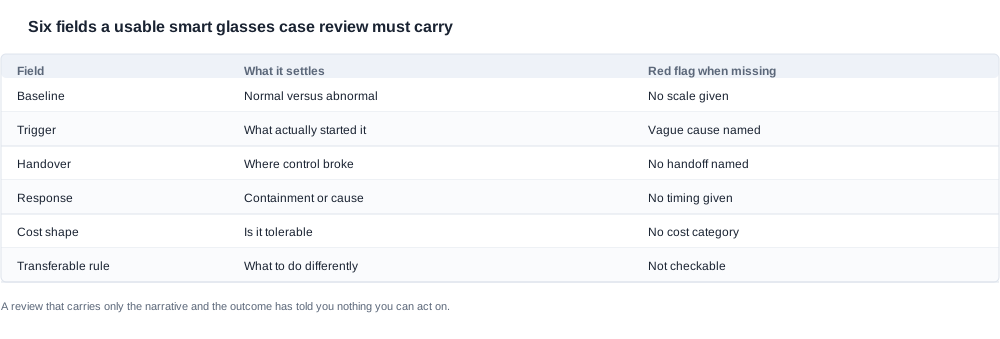
A case review earns its place in a procurement file when it carries six fields. Most of what circulates as a case review carries two, and the two it carries are the two that tell you nothing.
The baseline. What the programme looked like before the problem: the product type, the order shape, the stage the project had reached, and what had already been signed off. Without a baseline there is no way to judge whether the outcome was normal. A missed date on a first three hundred units is a different event from a missed date on a mature line.
The trigger. The specific, observable event that started the problem. Not "communication difficulties" and not "quality concerns" but "the sample shipped with a different firmware revision than the one that had been approved" or "the first production lot failed the burn-in check on units four and five of a hundred". A trigger that cannot be observed cannot be prevented, and a review that cannot name one has told you nothing actionable.
The handover. The point in the sequence where responsibility passed from one party or one function to another, and where the information needed to carry it did not pass with it. This is the field most often missing, and it is the one that makes a review transferable.
The response. What was done, in what order, and how long it took to stabilise. The response tells a buyer whether the factory treats a problem as a containment exercise or as a cause, and it tells them how much of their own schedule to reserve.
The cost shape. Not a number, which is rarely publishable, but a shape: was it a schedule cost, a scrap cost, a rework cost, a re-tooling cost, a certification cost, or a commercial cost in the form of a credit or a cancelled order. Shape is enough to decide whether a failure is tolerable at your order size.
The transferable rule. The sentence that says what the reader should do differently. A review that stops at the narrative has told you about the past. A review that ends with a rule has told you about the future, and that is the only part worth the reader's time.
Two quality signals tell you quickly whether a review clears the bar. The first is specificity: does it contain a model, a stage, a quantity or a date? Reviews that say "a recent project" are marketing. The second is falsifiability: could a reader check whether the rule was followed? If a supplier's transferable rule is "we now communicate more closely with the customer", it cannot be checked and it cannot be acted on.
There is a third signal, and it is the one that distinguishes a real review from a rehearsed one. A genuine review usually names a party who was at fault, including itself. If every case ends with the other party's error, you are reading a defence document rather than a review. That is not a reason to reject the document, but it is a reason to weight it accordingly.
The practical test of a weak review is whether you can normalise it onto the six fields. Take a paragraph that says a project had problems with quality and was ultimately resolved through close cooperation with the customer. Against the baseline, it gives you nothing: you do not know the product type or the order shape. Against the trigger, it gives you a category rather than an event. Against the handover, it gives you nothing at all. Against the response, "close cooperation" is the absence of information rather than information. Against the cost shape, nothing. Against the transferable rule, "we now communicate more closely" is not checkable. A weak review is not a review with gaps; it is a paragraph that has been placed where a review would normally sit, and the six fields are the fastest way to see the difference.
This is also where a buyer can add value in a way that most people do not think to. A factory that has never written its own reviews in this format will be unable to produce the six fields on request, because the information exists in people's heads rather than in a file. Offering to structure the answers — by asking the six questions in order and writing down what comes back — is a low-cost way to get a usable document out of a supplier who has never been asked for one, and it produces a record of the discussion rather than a marketing document. It also has a useful side effect: a factory that has to think in terms of a specific trigger and a named handover will tend to change how it works, not merely how it describes how it works.

The questions a smart glasses case review cannot answer
It is worth being blunt about the limits, because the failure pattern is that a buyer treats a well-written case review as a substitute for the specification sheet it should be sitting next to. There are several questions that no case review, however well constructed, will settle for you.
The first group is commercial. A case review may describe a project that involved several thousand units; it will not tell you your MOQ, your unit price, your tooling cost, your NRE, your lead time or your payment terms, because those depend on your configuration rather than on the reviewed project. It also will not tell you the factory's current capacity, its current order book, or its delivery performance over the last two quarters. A review describes a past state; a quotation describes a present one, and only the second one can be relied on to price anything.
The second group is technical and specific to this catalogue. A review might mention that a battery problem was solved, and that tells you nothing about the cells in the model you are quoting, because we publish no cell chemistry, no cycle life, no replaceability and no sensor models. It might mention that a lens issue was corrected, and the catalogue will still not tell you the coating specification. Only two models carry an ingress marking, only one publishes a weight, and the export-certification page is a picture page of patent certificates with no per-model certification row. The honest position on every one of these is the same: ask the supplier, in writing, for the specific model, and treat the answer as configuration-specific rather than as a catalogue fact.
The third group is the one that catches people out: the factory's own failure rate. A factory cannot publish its delivery outcomes to you without publishing them to everyone else in the negotiation, so this figure is almost always unavailable. The substitute is the audit route, which is the one a serious buyer runs anyway: an independent check of the facility, the process, the traceability and the documentation. The audit answer is not as convenient as a case review, and it is worth considerably more.
A fourth limitation is subtler. A review from one factory about "the industry" is a review of what that factory has seen, and it is biased in a predictable direction, towards the failures that reached them, which are by definition the failures the previous supplier did not resolve. Read it as a map of incoming problems, not as an assessment of anyone else's capability.
A fifth limitation is the one that catches the most experienced buyers, because it feels like a strength. A review that is clearly composite, assembled from several programmes, is often more interesting than a single case, because it shows a pattern rather than an anecdote. It is also the document that is easiest to construct without any underlying fact, and the tell is a uniformity of tone. If every case in the document has the same structure, the same length and the same moral, treat it as a hypothesis to test rather than as evidence to accept. A composite can still be used, but only by asking the supplier to unpack one of its cases into the six fields, which converts the claim from "this happens to us" into a specific, checkable account. If the supplier will not unpack even one, you have learned something about the document.

Using a smart glasses case review inside a shortlist
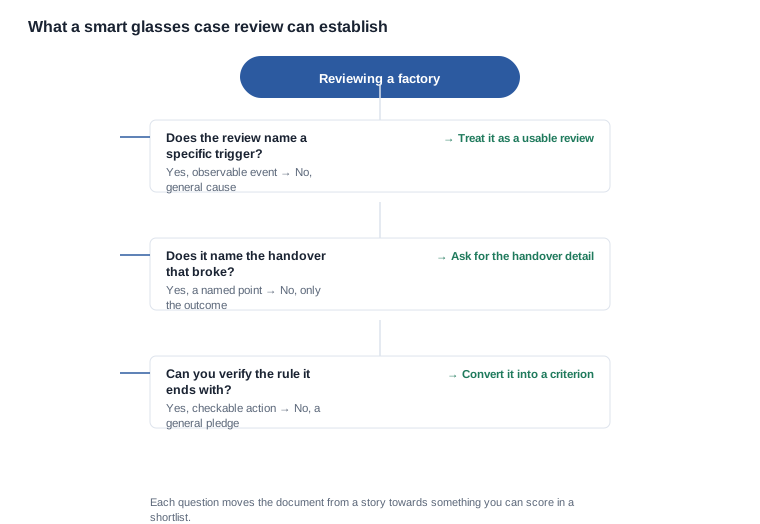
A shortlist is a comparison, and a case review is only useful in a comparison when you are comparing like with like. Two programmes of different scale, different maturity and different stage produce reviews that look completely different while saying nothing about the factory's competence. The first move, therefore, is to normalise: force every review onto the same six fields, and mark any field the source cannot populate as unpopulated rather than leaving it blank or letting a paragraph stand in for it.
The second move is to grade the evidence, because a review's usefulness depends on its source and not on its tone. A review written by the engineering team that handled the failure, with a specific trigger, a stated response time and a transferable rule, is worth more than a review written by the sales team from a customer request. A composite assembled from several projects is worth less than one honest account of a single project. A review that has been through a legal review is evidence of a defensible process, and that is a signal in its own right even where the content is sanitised.
The third move is to convert reviews into shortlist criteria rather than into conclusions. A review about a non-representative sample becomes a criterion: does the supplier define, in writing, the build revision and component list that a sample represents, and does the production unit match it. A review about verbal tooling ownership becomes a criterion: is tooling ownership, modification cost and end-of-programme disposition written into the agreement. Converting the story into the criterion is the step that makes the review survive contact with a negotiation, because criteria are what you can ask, score and refuse.
The fourth move is to weight by relevance to your own programme, and to be honest that this is a judgement rather than a measurement. A review of a camera-equipped product line is directly relevant to a camera-equipped programme. A review of a pure audio product line tells you about the factory's audio discipline and rather less about its camera or firmware discipline. A review of a mature, high-volume programme tells you about stability and rather less about the early-stage behaviour that a new launch will actually experience.
The fifth move is to make the scoring explicit, because an unweighted comparison of three reviews is just a comparison of three writing styles. A workable approach is to score each factory on the same five axes, each scored against the same evidence requirement, and to require a written reason for every score below the top band. The axes that matter most in this category are the handover discipline, the sample definition, the change-control process, the traceability record, and the willingness to be audited. Then carry the low scores into the negotiation as specific requests rather than as general dissatisfaction. "Your review shows tooling ownership was left verbal, so we have put tooling ownership, modification cost and end-of-programme disposition into clause seven" is a strong negotiating position, because it is specific, it is evidenced, and it is already the factory's own lesson rather than an outsider's opinion.


Running a smart glasses case review on your own live programme
Everything above assumes the reader has a factory willing to share a review. Most buyers do not, and the alternative is to run the review yourself, on your own project, at each handover. This is a small amount of work and it is the highest-leverage thing available to a buyer who is mid-programme.
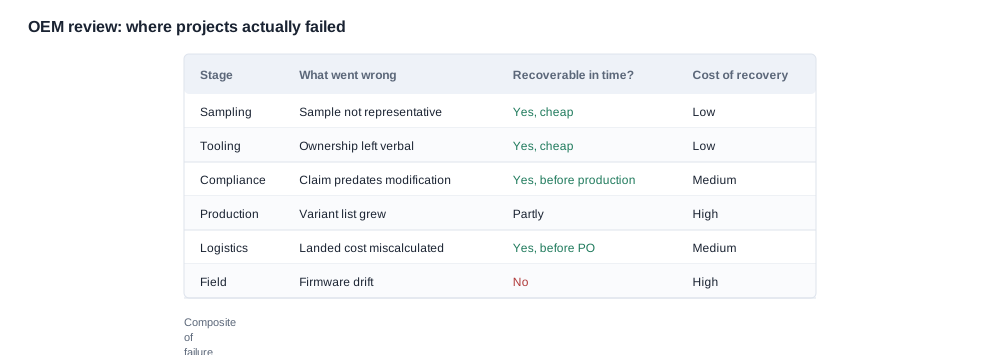
The handover that fails most often is the sample approval. The sample was built from a different component lot, a different firmware revision, or hand-finished work the production line cannot repeat. It gets approved by your customer, and the first production unit then misses it. The cheapest prevention in the whole category is a single document that names the build revision, the component list and the firmware build the sample represents, and requires the production unit to match it. That one document closes the most common failure and prevents the second-order version of several others.
The handover that surfaces in disputes rather than on the floor is tooling ownership. Who owns the mould, who pays to modify it, what happens to it at the end of the relationship, and what happens if the programme ends early. This is free as a paragraph and expensive as a negotiation, and it is the failure most likely to be nobody's fault at the moment it happens. Note the constraint: our catalogue publishes nothing about who owns any design or any tooling, so this must be settled as contractual practice with the specific factory, not assumed from a general policy.
The handover that survives longest before it surfaces is the compliance file. Someone changes a colourway, a temple shape or a Bluetooth device name after the claim was made, and the technical file behind the claim no longer describes the product. Nobody notices until an audit or a customs query. Since our catalogue publishes no per-model certification row at all, the file is yours to maintain, and the maintenance rule is simple: any change that alters the described product invalidates the file until it is reissued.
The handover that quietly moves a date is the variant list. Ten colourways and ten firmware builds are twenty build combinations, not two, and the freeze date is the control that holds it. A programme that keeps adding variants after the freeze date is not being difficult, it is being unscheduled.
The handover that is invisible at pilot volume is the landed cost. Battery products carry transport obligations, packaging and labelling requirements that non-battery electronics do not. Calculating on factory price alone means the margin disappears somewhere between the quotation and the invoice, and the discovery usually happens when it is too late to do anything about it.
The handover that is small on the first order and expensive by the fifth is firmware drift. The approved sample and the shipping product slowly stop being the same thing, and by the time it matters, the customer has already noticed.
Six failure points, one pattern. Write the review yourself at each of them, in the six fields above, and you will have a document that is worth more than any published case study, because it is about your programme, your configuration and your factory — and it is available to you at the moment when it can still change something.
Due diligence when a smart glasses factory offers no cases at all
Not every factory will share a review, and refusing is not automatically a bad sign. A supplier with a strong process may have legitimate confidentiality obligations to the customer, particularly where the review names the customer, the product or a defect. A refusal to write a story about someone else is different from a refusal to talk about capability, and the distinction is worth keeping in mind before you treat silence as evidence.
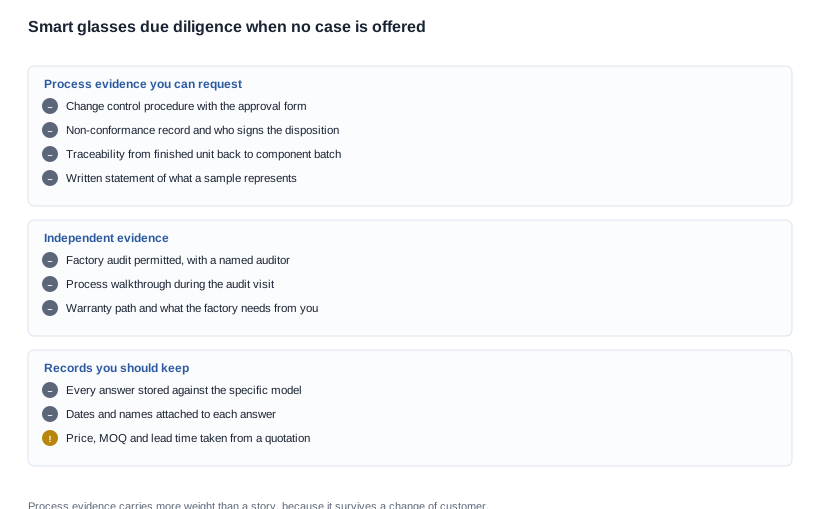
What you can ask for instead is process evidence, which is more useful than a story anyway:
- The change-control procedure. How a change to a material, a component, a firmware build or a packaging component is proposed, assessed, approved and recorded. Ask for the form, not for the story.
- The non-conformance record. What happens when a unit fails inspection, who signs the disposition, and what the containment is. The existence and shape of this record tells you more than any anecdote.
- The traceability answer. How a finished unit is traced back to the batch and the components that went into it, and how long that record is kept. This is the question behind every compliance file in the category.
- The sample definition. Whether the supplier will state, in writing, what a sample represents, and what a production unit must match. This is the single most valuable answer available in a category where samples are routinely unrepresentative.
- The factory audit route. Whether an independent inspection of the facility is permitted, and who the factory is comfortable being inspected by. Refusing an audit is a more serious signal than refusing to share a review.
- The warranty path. What the factory's own process is for a defective unit, and what it needs from you. The warranty coverage and after-sales pages set out what is published, and the rest is a question.
If you want an independent view rather than the supplier's own account, the factory-audit route is set out in smart glasses factory audit and supplier verification, and the wider risk landscape is covered in smart glasses oem risk factors. Modification-driven cost is treated in customization options and the sample-stage controls in sample evaluation.
Related reading
- The six handovers in detail — smart glasses oem risk factors
- Cost changes caused by customisation — customization options
- Confirming the supplier independently — supplier verification
Send us the stage your project is at and we will tell you which of these six handovers is live for it.


