
Two things get called an OEM case study in this category, and they are not close to the same thing. The first is a supplier's marketing story about a happy customer: a logo, a flattering sentence, and a set of numbers chosen for their roundness. It proves nothing and it transfers nothing. The second is a structured record of one programme — the scope it ran at, the decisions that were taken, the conditions it ran under, what those conditions cost, and what the brand would do differently. A case study in that second sense is worth a substantial amount of money to a buyer, because it is the only document that describes a factory's behaviour in detail rather than its claims.
This article is about running the second kind. The approach it describes is collection, not construction: you assemble the record while the programme is live, you fix what the record must contain before you start, and you treat the document as a working artefact with an owner rather than a piece of marketing that gets written at the end. The single most common reason a case study in this category is worthless is not that the programme failed. It is that the record was not kept, and what was published years later was reconstructed from memory by people who had moved on.
A buyer reading a case study is asking one question: would this have happened for me? That question is only answerable if the case study carries the volume, the configuration, the market, the season and the channel it ran in, because every one of those changes the outcome. Everything below is organised around making that question answerable, or making it plainly unanswerable so that nobody builds a decision on it.
Smart glasses case studies are collected, not written
The distinction that matters most is between a record and a narrative. A record is captured at the time, by the person who was there, and it can be audited against other documents the programme produced. A narrative is assembled afterwards, from recollection and from internal chat, and it is shaped by whatever the writer wants the reader to conclude. The two look identical on the page and behave completely differently under scrutiny.
Reconstruction is not merely less accurate. It is systematically biased in a predictable direction: the parts of a programme that were argued about are the parts that get remembered, and the parts that were routine disappear. A reconstructed case study therefore over-represents conflict and under-represents the ordinary execution decisions that actually determined the outcome. If you are trying to learn how a factory works, that is exactly the wrong bias.
The practical consequence is that a case study should have an owner and a collection calendar rather than an author and a deadline. The owner is usually the programme manager on the buyer's side, because the supplier's view of the programme is the view from inside the box. The collection calendar is the set of moments at which specific fields can still be captured accurately: the moment the specification is frozen, the moment the sample is approved, the moment the first production unit passes inspection, the moment the first shipment leaves. Miss those windows and the corresponding fields become reconstruction, and the document's value drops accordingly.
There is a second reason to collect rather than write, and it is commercial. A programme with a properly kept record is a programme that can be handed over. If a brand exits a market, changes supplier or simply outgrows the first design, the record is the only thing that lets the next programme start from what the last one learned instead of from nothing. For the brand that owns the record this is worth real money, because it shortens the requirement phase of every subsequent launch. For the supplier, a well-documented programme is worth more commercially than a testimonial, since it answers the question a prospective customer's technical team will actually ask.
The practical test of a collected record is simple and unforgiving: can every claim in the document be traced to a document that existed at the time? Dates to the project plan, volumes to the purchase order, decisions to the meeting minute or the change notice, test results to the test record. Where a claim cannot be traced, either the claim comes out or it is labelled as recollection, and the label is not a small thing, because a reader who knows which claims are soft can still use the document.
That test is worth applying to the case study you are being shown right now, before you ask any other question about it. Ask for the underlying documents for three or four claims and see what comes back. A supplier with a live record can produce them in an hour, and the fact that it can do so is a stronger due diligence signal than any number the document contains. A supplier who cannot is telling you that what you are reading is a story, and you should price that story accordingly rather than treat it as evidence.
There is also a distinction between the case study and the file it sits in. The case study is the readable summary that helps a stranger understand a programme. The file is the collection of dated records that lets anyone verify the summary. Programmes often keep the second and lose the first, and then publish the first as though it were the second. A short, accurate summary with the file behind it is worth more than a long one without, and it is worth more specifically because a reader can spot the difference between a conclusion and a measurement.
The evidence standard a smart glasses case study has to meet
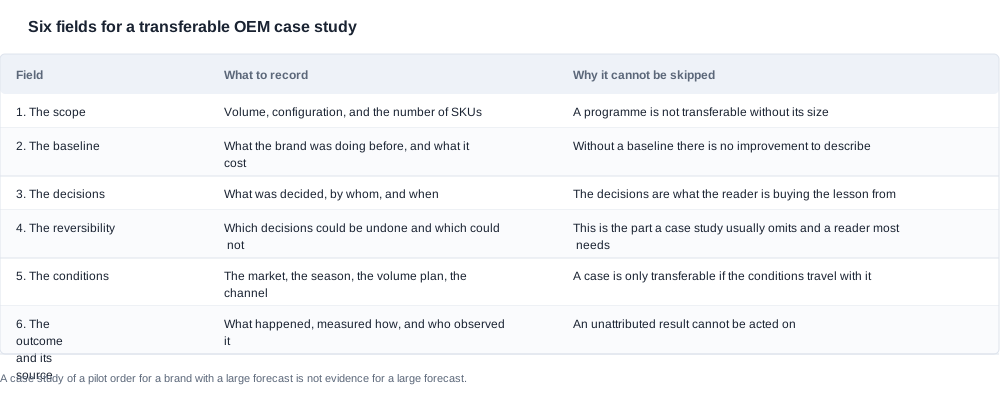
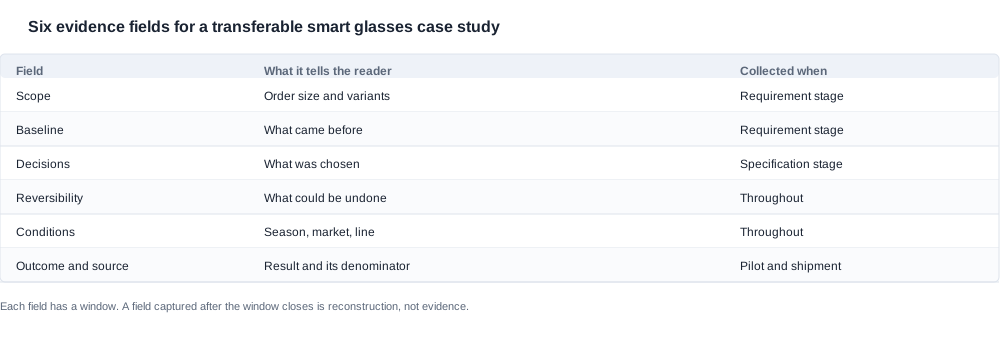
Six fields carry a transferable record. Most case studies in this category carry two, and the two they carry are the two that tell you nothing about conditions.
The scope. Volume, configuration, and the number of distinct SKUs. A programme of five hundred units across one model and a programme of five thousand units across six models are different programmes, and the second one carries per-colour and per-configuration minimums that the first one does not. A case study that does not state the scope is describing an average of nothing in particular.
The baseline. What the brand was doing before, and what it cost. Without a baseline there is no improvement to describe, and a case study that opens with a result — a unit price, a lead time, a defect rate — has skipped the only part that makes the result meaningful. The baseline is also where the honest numbers live, and it is usually the part a supplier is least keen to supply.
The decisions. What was decided, by whom, and when. This is the part a reader most wants and a supplier most often omits, because the decisions are the thing being sold. The name of the logo method, the packaging decision, the split between standard and customised, the date the specification was frozen — these are the content.
The reversibility. Which decisions could be undone and which could not. This is the field that separates a useful case study from a promotional one, and it is the one almost never written down. A brand that changed the temple shape and then changed it back, at a cost in tooling and in schedule, has learned something worth publishing. A brand that got it right first time has had a lucky first time, which is not a lesson.
The conditions. The market, the season, the volume plan, the channel, and the state of the supplier's line. Every one of these moves an outcome, and a case study without them is a story rather than evidence. The two that are most often missing are the season and the state of the line, and they are the two that most often explain an otherwise inexplicable difference between two programmes.
The outcome and its source. What happened, how it was measured, and who observed it. A defect rate measured over two hundred units and a defect rate reported by a customer in a single message are different quantities with the same name. Say which one it is, and say the sample size, because a rate without a denominator is a feeling.
Two quality tests sit above the six fields. The first is transferability: does the reader have enough of the scope and the conditions to decide whether the outcome would have happened for them? If not, the document describes rather than informs, and it should be labelled as a description. The second is falsifiability: could somebody check whether the rule at the end was followed? A case study whose conclusion is "we now work more closely with the factory" has not produced a finding, and publishing it does harm, because it teaches readers that case studies in this category are promotional.
Where a smart glasses case study is the wrong instrument
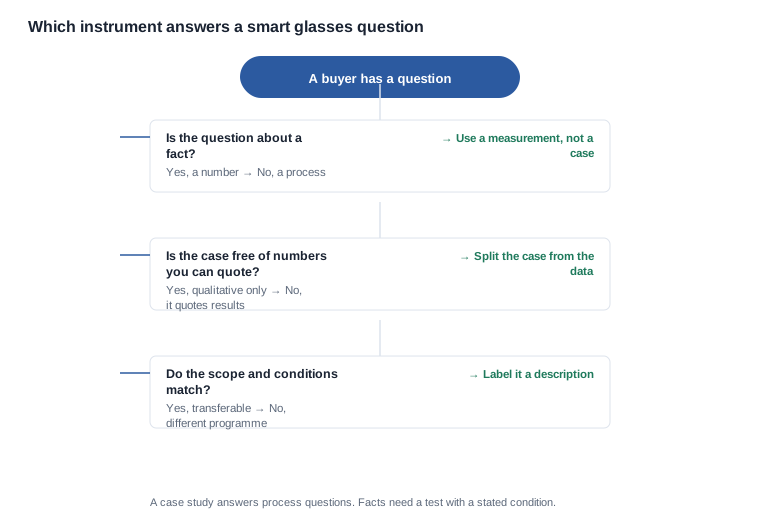
Case studies are used too readily, and the misuse is nearly always the same one: they are asked to carry a factual question. A case study is the right instrument when the question is about process — how a programme ran, what a decision cost, how a specification was handled, where a handover failed. It is the wrong instrument when the question is about a fact — what a battery lasts, whether an ingress rating holds, what a lens does in a car, how much a unit weighs. Those need a measurement, and the structure for one is in the relevant technical page rather than in a case study.
The distinction is sharp in this category because the catalogue is explicit about what it does and does not publish, and the published surface is a good illustration of where a case study can help and where it cannot. The catalogue states a rated runtime of roughly five to eight hours for the camera models on cells in the 220 to 290 mAh band, and it publishes no test condition for any of them. A case study might tell you that a brand's customers were satisfied with the battery over a season. That is a genuine and useful signal, and it is a signal about one programme in one season, not a specification. The only thing that converts it into a specification is a test with a stated condition, which is a different piece of work with a different owner.
The same logic applies to the other two facts buyers lean on hardest. An ingress rating is a property of a specific model against a specific standard, and only two models in the range carry a published IP marking at all; a case study cannot add a third. A weight is a property of one specific product, and the catalogue publishes a weight for one model only, excluding its case. Where the published surface is deliberately narrow, a case study is the right place to record what a programme experienced, and the wrong place to look for a number.
The second wrong use is treating a case study as transferable when it is not. A pilot of a few hundred units, run for a brand with a large forecast, on a supplier with a quiet line, in a month when the materials were available, is not evidence for a large forecast on a busy line in a peak season. It is a description. The distinction is worth keeping because case studies are often quoted precisely where they stop being transferable, and a due-diligence file that quotes a pilot as evidence of scale is worse than an empty file, because it looks rigorous.
The third wrong use is treating a case study as a substitute for a contract. A programme that worked because a particular person made a particular judgement call is not a programme that will work again because the story was told well. What travels is the mechanism — a written change process, a defined sample, a documented handover — and the case study is the evidence that the mechanism existed and what it cost.

Recording a smart glasses programme while it is still running
If the record is collected rather than reconstructed, the collection has to be designed. The following is a workable arrangement for a buyer-side owner, and it is deliberately lightweight, because a case study scheme that needs a full-time project manager to maintain will not be maintained.
At the requirement stage. Capture the baseline, the scope as first understood, and the list of assumptions made before any quotation was requested. Assumptions are the most valuable thing in the record, because they are the things most likely to have been wrong, and a case study that lists them shows what a good requirement brief should have contained. At the same moment, record which of the requirements were fixed by the brand and which were open to the factory's recommendation, since that split predicts almost every later argument.
At the specification stage. Capture the decisions: what was specified, what was proposed by the factory, what was rejected and why, and what was deferred. The rejections are the interesting part. A rejected suggestion with a recorded reason is one of the most useful lines in the whole document for the next programme.
At the sample stage. Capture what the sample represented: the build revision, the component list, the firmware build, the finish and the accessories. This is the same detail that closes the most common programme failure, and capturing it for the case study costs nothing extra because it should be written down for the sample approval itself. Record the sample outcome against the agreed criteria, and record who signed.
At the tooling stage. Capture the cost, the time and the ownership of everything that was created. This is the field that becomes the most valuable asset in the file, because it is exactly what a buyer needs when a second brand asks the same question two years later.
At the pilot and first production stages. Capture the defect rate with its denominator, the non-conformances raised, the containment applied, and the dates. Capture the first shipment and what happened after it. A programme that had a bad pilot and recovered is more instructive than one that ran cleanly, and the recovery is the part that is never written down.
Throughout. Capture the reversibility record: what was changed after the freeze, what each change cost in money and in days, and whether the change could have been made earlier. This is the field that separates a genuine case study from a promotional one, and it is also the one that most improves the next programme, because it converts a vague lesson into a dated, priced decision.

The failure mode to guard against is drift. A record that is captured on the right day beats a record captured on a good day a month later, and a record captured on the right day is cheap, because the person who made the decision is still in the room. A monthly fifteen-minute slot with the programme owner, during which the fields above are updated, is enough for a typical launch. The cost of a record is usually not the effort of collecting it. It is the fact that nobody was ever given the job, which is a management decision rather than a methodology failure.
Two situations break the rhythm and need their own rule. The first is a programme going off plan, which is exactly when the record is most valuable and least likely to be kept. When a schedule slips or a quality problem appears, the reactive response is to spend every available hour on containment, and the record falls to the bottom of the list. The countermeasure is small: when a containment meeting ends, one person writes three lines — what the trigger was, what was changed, what it cost. Those three lines are the difference between a record and a memory, and they take minutes.
The second is a programme that ends badly, which is the case a buyer is most likely to want to publish and least likely to have documented. A launch that was abandoned has a short, sharp and commercially sensitive record: which assumption failed, how long before it was visible, and what the early warning signs were that nobody acted on. That record is the most valuable artefact a failed programme produces, and it is worth a supplier's willingness to share it, because it is the one thing that protects the next buyer from repeating the same loss. A supplier that shares it is demonstrating a culture, and that is a far better basis for a long relationship than a successful launch that nobody can account for.
Using a smart glasses case study as a handover document
The most valuable consumer of a case study is not a marketing department and not a competitor. It is the next programme, and specifically the requirement brief that precedes it. A programme that ends with a good record has produced two things: a referenceable case study, and a shorter specification phase for whatever comes next.
That works because the record replaces a specific kind of guesswork. The next programme does not need to rediscover which decisions were expensive, which requirements were not really requirements, which suppliers' suggestions were worth taking, and which parts of the scope were irrelevant. In a category where a first programme routinely costs several months, a brief that removes a month of clarification is worth more than the case study itself.
The same document functions as due diligence material for a new buy-side team, and as the starting point for a negotiation with a new factory. A factory that receives a structured record rather than a list of complaints will engage with it differently, because the record separates the decisions it made from the decisions the buyer made, and that separation is exactly what a negotiation needs in order to be fair. Where a case study shows that the brand changed the specification three times after the freeze date, no factory should be held responsible for the cost of those changes, and a well-built record makes that visible without either party having to argue about it.
The last consumer worth naming is the supplier themselves, because it changes the commercial relationship. In this category the recurring failure is a handover between parties who each believed the other held the information. A structured record is the only mechanism that reliably closes that gap across a programme, and it is the reason a well-run programme can be repeated rather than merely survived.
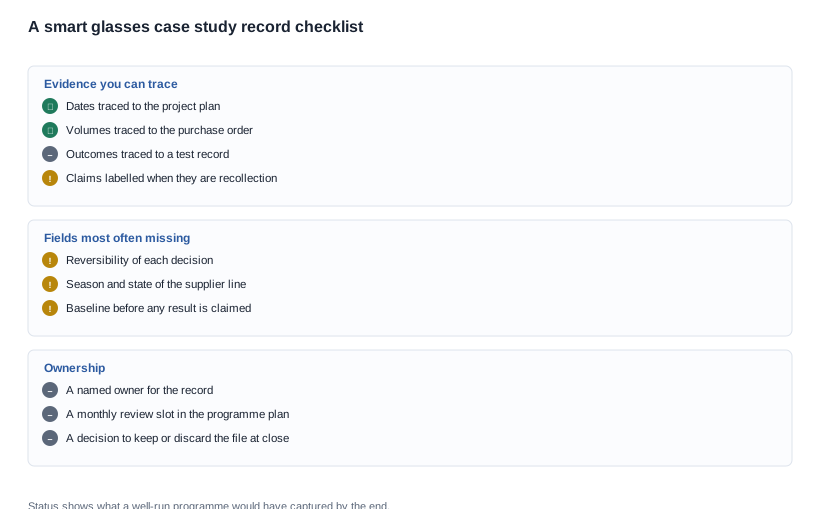
Two boundaries are worth stating plainly. First, a case study is not evidence of a fact: the moment a reader needs a number they can quote, the case study is the wrong document, and the trade-off between a rich narrative and a verifiable specification should be resolved in favour of the specification. Second, a case study is only as good as its ownership, and ownership needs a name against it, because a document with no owner is a document that will be reconstructed by somebody else later, and reconstruction is the failure mode this whole approach exists to prevent.
The programme structure is described under smart glasses OEM, the risk side of the same programme is in odm development risk factors, and the development sequence is in odm development stages. The requirement brief that the record ultimately feeds is covered in smart glasses oem requirements checklist.
Related reading
- The risk side of a programme — odm development risk factors
- The development sequence — odm development stages
- The requirement brief the record feeds — smart glasses oem requirements checklist
Tell us the programme you are running and we will tell you which of the six fields to collect now, while the evidence still exists.


