

Every ODM programme has the same eight stages, and the reason programmes fail is rarely a stage that was done badly. It is a stage that was skipped under schedule pressure because its output looked like documentation rather than something load-bearing. Odm development stages matter as a sequence because each stage produces something the next stage cannot produce for itself, and a stage that is compressed does not produce a weaker artefact — it produces none.
That distinction is worth stating plainly at the outset, because the usual reaction to a slipping programme is to work harder on the stages that are visibly behind, which are assembly and testing. The stages that are actually behind are the ones whose output is a document, and those are the ones nobody can see slipping until it is too late to recover.

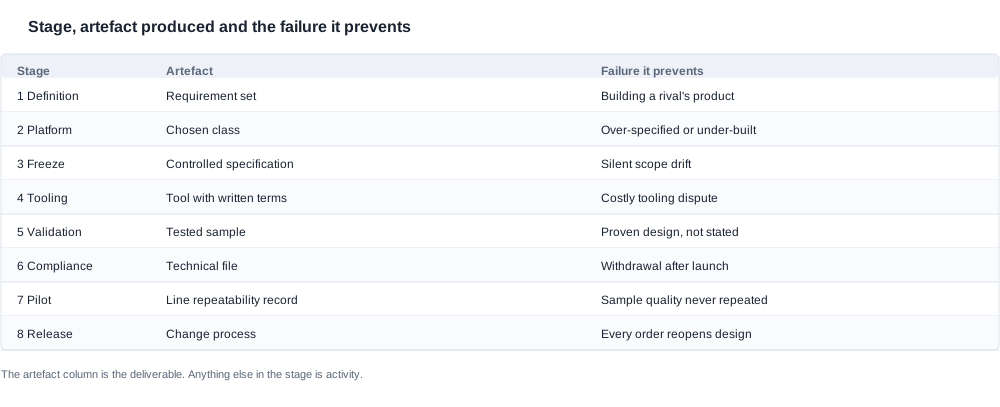
odm development stages: the eight outputs and what each one prevents
1. Requirement definition. Output: what the product must do, for whom, in what environment — not how it will be built. Most downstream disputes trace back to a requirement that described a solution rather than a need, because two solutions were then compared against each other instead of against the need they were both supposed to serve.
2. Platform selection. Output: a chosen class, justified by workload. This is the stage where workload beats specification, and our own catalogue illustrates the trap well: capacity ranking inverts the answer, because the 40 mAh children's platforms claim roughly twenty hours while the 290 mAh camera platforms claim roughly seven. A buyer selecting on the published capacity number would choose the platform that does the least work.
3. Specification freeze. Output: a document naming the model, the build revision, the variant list and the agreed published figures. This is the control document for everything after it, and a programme without one manages all of its risks by default rather than by decision.
4. Design and tooling. Output: tooling produced, with ownership, modification cost and end-of-programme terms in writing. Verbal tooling terms are the most common single cause of an expensive dispute in this category, because both parties remember the conversation and neither remembers the terms.
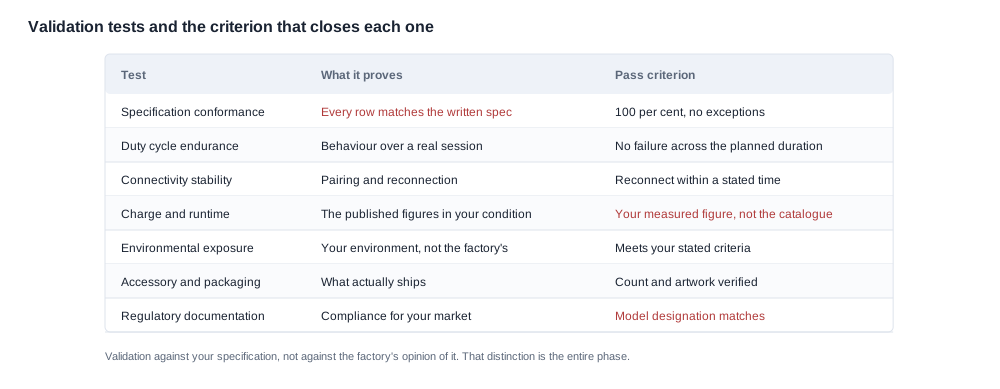
5. Validation sample. Output: a unit that matches the frozen specification, and a record of what was tested against it. The sample is the first point at which the specification is proven rather than stated.
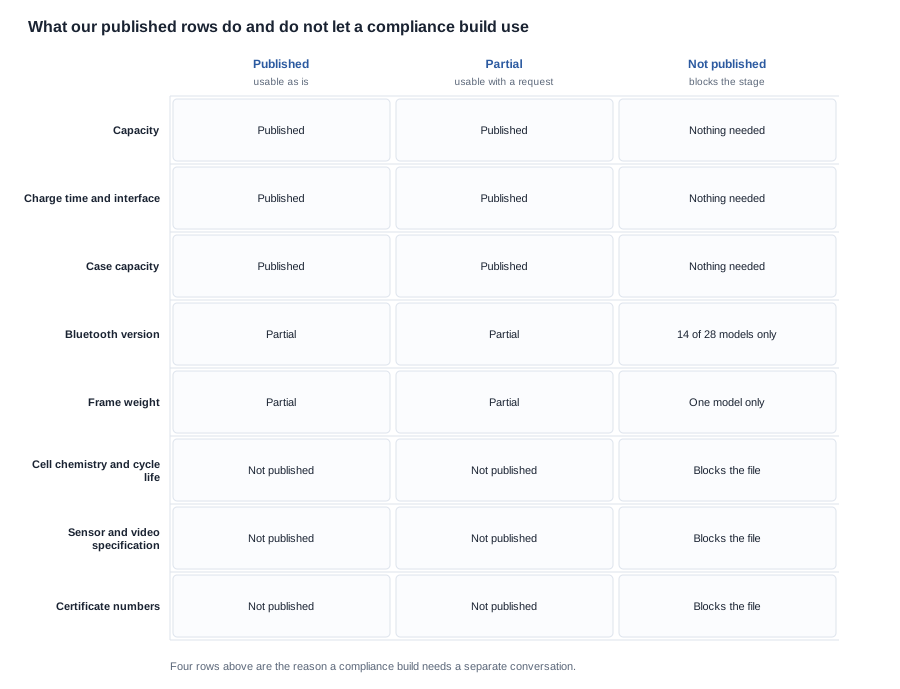
6. Compliance build. Output: a technical file describing the configuration that will actually ship. This is the stage where a supplier's documentation gaps become expensive, and it is the stage most often deferred — because in a range where there is no cell chemistry, no cycle life, no certificate number and no sensor specification published, there is nothing to build the file from.
7. Pilot run. Output: evidence that the line reproduces the validated sample. This is a different question from whether the sample was good. A factory can produce an excellent hand-built sample that the line cannot repeat, and discovering that difference at volume is the most expensive way to find it.
8. Production release. Output: a shipped product plus an agreed change process for everything after it. The change process is the deliverable most often forgotten, and it is what prevents stage four from repeating on every subsequent order.

The stage where programmes actually fail, and why it looks harmless
Four failure patterns account for most of the programmes that go wrong, and none of them looks like a failure at the time it happens.
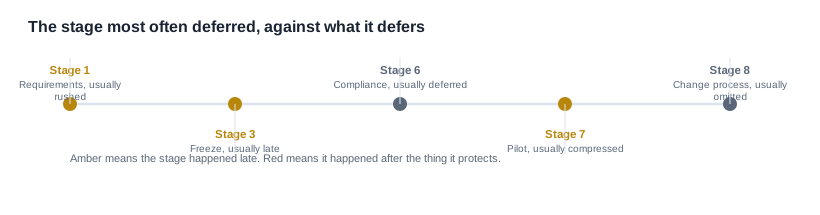
Skipping stage one under pressure produces a specification that describes a competitor's product rather than your own. The tell is a requirement list written in the vocabulary of another company's listing — features rather than outcomes, with no statement of the environment or the user. It is hard to detect because the document is detailed and the meetings about it are substantive.
Freezing stage three too early produces a specification that cannot absorb a change you needed at stage five. The tell is a freeze date earlier than the date at which the last requirement was settled. A freeze that is genuinely a freeze is a good thing; a freeze applied to an incomplete list simply converts later work into change requests.
Running stage six late is the most expensive deferral in the list, because a compliance build after production has started cannot be done quickly, and a published claim that predates a product change is a withdrawal rather than a correction. The distinction between correction and withdrawal matters commercially: a corrected specification is an administrative event, and a withdrawn claim is a product recall conversation with a retailer.
Omitting stage eight means every repeat order reopens the decisions from stages four and six. The tell is that the second order takes as long to specify as the first, which is always explained as an anomaly and is never an anomaly.
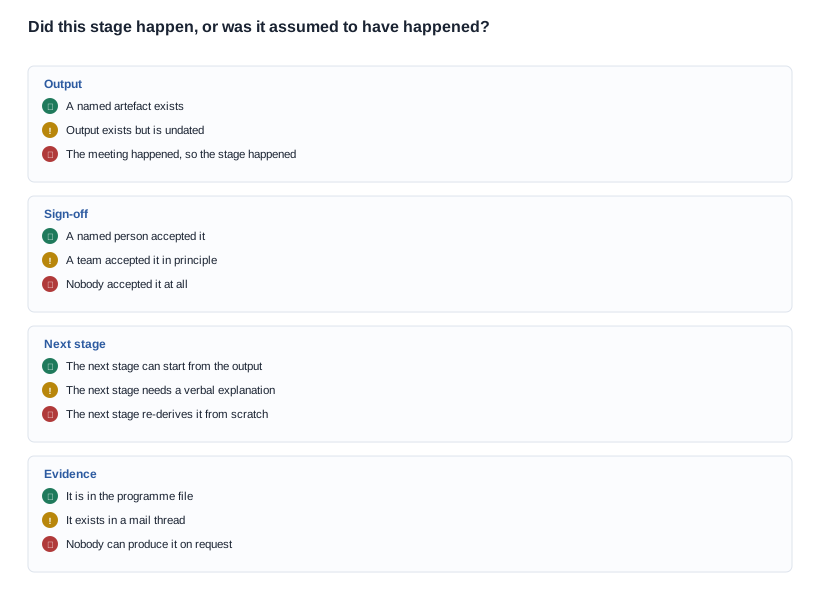
What makes these failures hard to catch is that each one substitutes an activity for an artefact. A meeting was held, so a stage happened. A spreadsheet was updated, so the specification was frozen. The pilot ran, so the line is validated. Each substitution is reasonable in the moment and indefensible in a review, which is why the test that catches them is simple: can the next stage start from the artefact alone, or does it need somebody to explain it?
There is a fifth pattern that sits underneath the other four, and it is worth naming because it explains why all of them are permitted. It is the assumption that stages are serial. In a programme that is genuinely serial, the second stage cannot start until the first finishes, which is exactly why the first stage gets compressed when a date moves. In a programme that is not genuinely serial — and in this category most are not — the stages have dependencies that are narrower than the sequence suggests. Requirement definition, platform selection and the commercial work can proceed in parallel with early design work. What cannot proceed in parallel is anything that depends on a frozen specification, which is why the freeze is the real critical path rather than the first stage.
The consequence for a buyer planning a schedule is that the deadline that matters is the freeze, and everything before it should be measured against the freeze date rather than against the launch date. A buyer who measures stage one against the launch date will accept a stage one that cannot produce a usable specification in the time remaining, because on that measure it appears to have plenty of margin.
Stage eight is the one everybody forgets
The change process is stage eight's real content, and it is worth agreeing four things before release rather than after the first request arrives.
Who may request a change, and at what level. If the answer is anybody in the buyer's organisation, then the change process is not a process. A named requester with a named approver on each side costs nothing to agree and prevents most of the ambiguity.
What a change costs, and how long it takes. The cost is not always money — for several categories of change it is a schedule effect, a compliance effect, or a documentation effect, and a requester who is told only the schedule effect will route around it.
What happens to the compliance position when the configuration changes. This is the item buyers omit, and it is the one that converts a small modification into a regulatory problem. If a component is substituted for availability, the question is not whether the product still works; it is whether the evidence on file still describes the product. Agreeing the rule in advance means the answer is a process rather than an investigation.
There is a fourth item worth adding, and it is the one that distinguishes a programme from an order. What happens to the price when the volume changes, and what happens to the configuration when the market changes. A programme that has agreed a change process will handle a second model in the same family; an order will treat it as a new programme and re-quote from scratch. Buyers who intend to build a range rather than a product should establish this at stage eight rather than discovering it at the second launch.
It is worth being concrete about what the change process looks like in practice, because the phrase covers several different documents. The most useful is a single page that states: the classes of change that are free to the buyer and require only a notification; the classes that require a quotation and a lead time; the classes that require a specification revision and a build revision; and the classes that require a compliance review. Buyers who establish those four classes at stage eight discover that most of the changes they were worried about fall into the first or the second, and that the expensive conversation applies only to a small minority.
The same page should state what happens to work in progress. If a change arrives while units are in assembly, the cost is not only the rework; it is the scrapped material and the re-inspection. Agreeing that the supplier absorbs the scrap when the change was requested late, and charges for it when it was requested early, is a rule that prevents a recurring argument and costs nothing to agree in advance.
There is a fifth element, which is the least technical and among the most valuable: a named person on each side who may say no without escalating. Without one, every change request turns into an organisational negotiation instead of a decision taken by engineers, and the ones best placed to judge that impact are the ones who cannot commit to it.

Checking each stage instead of assuming it happened
The verification question for each stage is the same in form: what would I need to see to know this was done, and can I get it today. Applied stage by stage, the answers are short and unglamorous.
For stage one, the requirement set with an owner against every line. For stage two, the reasoning linking workload to class, in two paragraphs rather than a slide. For stage three, the frozen specification itself, with a build revision and a date. For stage four, the written tooling terms, which are the hardest document to obtain and the most valuable. For stage five, the test record against the freeze. For stage six, the technical file, or an honest statement of which rows are missing and who is obtaining them. For stage seven, the pilot evidence, including what was not tested. For stage eight, the written change process.
Two of those are routinely harder than expected, and both point at the same underlying issue. The tooling terms are harder because nobody wants to raise ownership at the moment the relationship is good. The technical file is harder because it may not exist, and asking whether it exists reveals the answer before there is a programme to receive it.
How to evaluate a supplier on stage discipline, rather than on the programme they are currently running, comes down to asking for a stage artefact from a finished programme rather than from this one. A supplier with an orderly file for a shipped product is telling you something they cannot fake about how they run the next one. A supplier who offers to produce it after the order is placed is telling you something different.
What changes on the second order
The eight stages are designed for a first product. What a buyer actually wants, in most cases, is a range, and the second order is where a programme either becomes a range or stays a one-off with a supplier who was pleasant about the first one.
The criteria that separate the two are simple and worth testing early. Is there a variant list agreed at stage three, or was the first product specified as a single configuration? Is there a price structure by volume, or was the first price a single negotiated figure? Is there a model designation scheme with room in it, or was the first model given a name that does not extend? Is there a compliance scope per market that anticipates the second market? Each of these four, if answered for the first order, removes most of the friction from the second.
Where they are not answered, the second order reopens stages one, two, three and four in sequence, and it reopens them as negotiations rather than as executions. That is the mechanism behind the earlier observation that a repeated order takes as long to specify as the first. It is not an anomaly in the supplier's process; it is what happens when the first order was treated as a one-off.
There is also a compliance dimension that catches buyers who planned the range carefully. A second model in the same family usually means a second model list on the technical file, and in some categories a second assessment. Buyers who assumed that a second colourway or a second case capacity was a packaging change are frequently surprised, because a change to the model list is a change to the evidence.
How to evaluate a supplier on whether they can run a range, rather than a single programme, comes down to asking for the variant logic before asking for the price. A supplier who has a variant structure will explain it in one sentence and show which parts of it are fixed and which are selected. A supplier without one will quote the first configuration again and treat the second as a new enquiry. The distinction is visible in the first conversation, and it is much cheaper to establish than to discover after two launches.
Before you commit to a supplier for a range rather than a product, the checklist is the four criteria above plus one commercial question: what does the second model cost in engineering time, and is that included in the quotation or charged separately. The answer determines whether the range grows cheaply or whether every addition is a negotiation.
The trade-off is worth naming, because range discipline has a cost. Agreeing a variant structure at stage three means accepting constraints now — a fixed platform, a fixed cell family, a fixed set of colours — in exchange for lower friction later. Buyers who want total freedom in year one frequently pay for it in year two, and buyers who over-constrain in year one discover in year three that the constraint they imposed to save money has become the thing their customer compares. Neither error is visible at the start, which is why it is worth deciding deliberately rather than by default.
Where our documentation constrains stage six
We will supply stages two to five and eight, and we will be explicit that stage six is currently constrained by our own documentation rather than by anything in the programme.
Specifically: our catalogue publishes capacity, rated runtime, charging interface, charge time, case capacity, Bluetooth version for 14 of 28 models, and customisation scope by product class. It does not publish cell chemistry, cycle life, replaceability, acoustic measurements, sensor and video specifications, frame weights beyond one model, ingress test basis, or any certificate number.
A programme whose compliance burden depends on those rows will need to obtain them separately, and that is a stage six conversation rather than a stage seven one — which is a distinction worth making early, because stage six has external lead times attached and stage seven does not.
The practical implication is a rule we would apply to our own programmes if we ran them with this documentation. Do not begin stage six as a single block at the end. Begin it as soon as the configuration is fixed, and treat each missing row as a separate item with its own owner and its own lead time, because a cell chemistry request and a certificate number request are different conversations with different third parties and they do not resolve together. Programmes that batch stage six into one phase discover that the slowest item in it defines the phase, and the other six items finish early and are not useful.
There is a sequencing detail inside stage six that matters more than it appears. The technical file describes a configuration, not a product, so every change to the configuration invalidates part of it — and the parts most likely to change are exactly the parts that took longest to assemble. A programme that freezes stage six before the specification freeze will build a file twice; a programme that freezes it after production has started will build it while the thing it describes is moving. The correct position is immediately after the specification freeze and before the pilot, which is later than most buyers expect and earlier than most suppliers propose.
It is also worth being honest about which rows are likely to be obtainable and which are likely to require commissioning. Capacity, charge time, charging interface and case capacity are catalogue rows and are obtainable immediately. Bluetooth version is published for 14 of 28 models and is obtainable for the rest by asking which platform a model uses. Frame weight is published for one model and would need to be measured for the others. Cell chemistry, cycle life, ingress test basis, sensor and video specification and any certificate number are the hard four: they need either a request to a component supplier with a lead time, or a commissioned measurement, or both.
When a buyer asks us which of these we can supply for a named programme, the honest answer has three parts and the third is usually the most valuable. We can supply some rows today. We can obtain others with a stated lead time. And for the remainder, we can define the measurement method and the cost of commissioning it, so that the programme is not blocked while the question is negotiated. The certification pathway covers how that sequence is normally arranged.
We would rather a buyer spend longer on stages one and three than on stages five and seven. The specification is the only document that prevents every downstream stage from failing quietly, and it is the one most often written in an afternoon. The stage sequence sits under ODM development, the risk items each stage manages are in risk factors, and what a modification changes is set out in customisation cost factors.
Related reading
- The four risk items a specification prevents — ODM risk factors
- What a modification changes — customisation cost factors
- The quality gates between stage five and release — development quality gates
- The same sequence for a standard OEM engagement — development process stage by stage
Send us your stage one requirement and we will tell you which platform our documentation supports.


