
A first enquiry to a smart glasses supplier usually contains the same eight or nine questions, asked in roughly the same order, and the answers to them tell you more about the supplier than the questions themselves suggest. A supplier who answers with a number and a condition has done something a supplier who answers with a number alone has not: they have told you what the number depends on, which means you know whether it applies to you.
That distinction is the subject of this article. It is also, honestly, the reason we publish the empty rows next to the filled ones. Our catalogue states a lot about hardware — twenty-eight models across an eight-model audio range, an eleven-model camera range, a three-model sport range, a three-model kids range, plus AR, electrochromic and bone-conduction products without a model string. It states very little about commercial terms, because price, minimum order quantity, lead time, sample fee, warranty duration and production capacity are not published anywhere in our documentation, and a number that appears on a marketing page without its conditions is worse than no number at all.
So here is the question set, reorganised by what each question is actually for, with a plain account of what we can answer, what we cannot, and what the answer tells you either way. The questions are grouped into four: the ones that screen a supplier out, the ones that establish a configuration, the ones that require evidence rather than an assurance, and the ones that let you compare suppliers on the same basis.
One thing this article deliberately does not do is present a list of questions to send. A list that is sent becomes a form, and a form produces form answers. The set below is written to be asked, in conversation, in the order given, and the most valuable of them are the ones where the answer is inconvenient. A first call that produces comfortable answers across the board has usually been a first call that did not go deep enough, and the depth is what the follow-up is for.
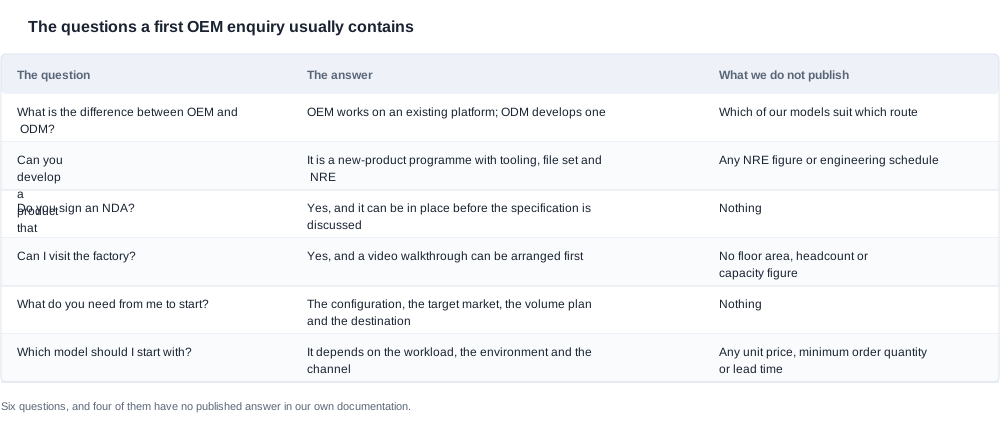
Smart glasses OEM questions that separate a supplier from a quotation
The reason to work from a fixed question set rather than an improvised conversation is that improvised conversations produce answers that cannot be compared. A supplier who says "the tooling is around eight thousand" and a supplier who says "tooling is quoted per configuration, and here is what drives it" are both being helpful, but only one of them has told you anything you can carry to a negotiation with the other.
Three tests separate a usable answer from a filler answer. The first is whether the answer is tied to a specific configuration. A price without a model, a colour count, a quantity and a destination is not a price; it is a way of starting a conversation. The second is whether the answer names a source — a published specification row, a document you can be shown, a measurement with a stated test condition. The third is whether the answer identifies what would change it. A response that says "it depends" without saying on what is a refusal dressed as a nuance.
Applying those three tests to our own published position is a useful exercise, because it shows what an honest answer looks like. We publish charge time for twenty-six models as "two hours or less", and only the D17 and the ZH12 publish about one hour; that is a published ceiling with a named exception, which is exactly the right shape. We publish charging interface for twenty-four of the twenty-eight models — magnetic on seventeen, Type-C on seven — and for four models, the L1 Pro and the MT6, and the CY05 and the CY03, we publish nothing, which is a gap rather than a claim. We publish runtime for all eleven camera models, roughly five to eight hours, on cells between 220 and 290 mAh, and we publish no test condition for any of them, which is precisely the caveat a buyer needs to hear.
The reason to care about that shape is that it tells you how to ask the next question. Where the catalogue has a row, you can ask for the document behind it. Where it does not, you are asking the supplier to create an answer, and you should budget for that in the schedule rather than assuming the answer will be immediate.
It is worth being explicit about the things a published catalogue can answer completely, because a buyer arriving with a shortlist should not spend a call on them. The model families and what they are for: an eight-model audio range, an eleven-model camera range, a three-model sport range, a three-model kids range, and AR, electrochromic and bone-conduction products listed without a model string. Which models publish a Bluetooth version — fourteen of the twenty-eight do, and the eleven camera models, the A05, the A06 and the bone-conduction products do not. Which models publish a charging interface, and which four do not. Which models publish a case capacity, which publish a case without a capacity, and which have no case row at all — the S7, the V06 and the V03, and the V03 Pro. Which camera models publish a 13-megapixel sensor rather than an 8-megapixel one. Which one model in the entire catalogue publishes a weight.
None of that is a commercial term, and all of it is the raw material of a configuration. A supplier who can answer those quickly has a real catalogue, and a supplier who answers them vaguely while answering commercial questions fluently is doing the reverse of what you want.
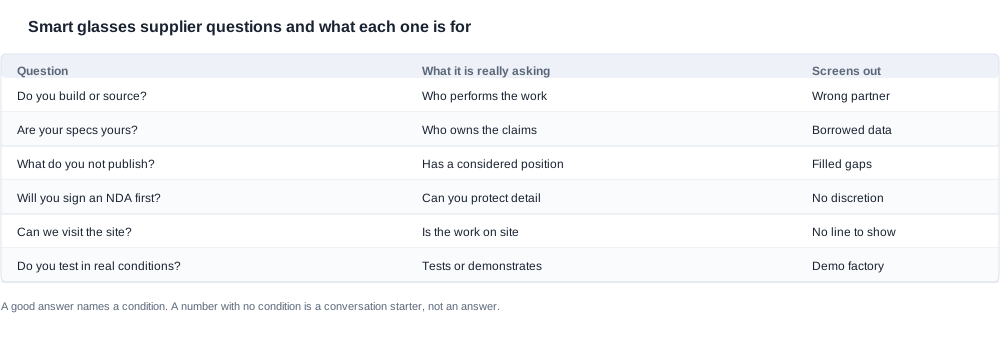
The screening questions a smart glasses buyer should ask first
These are the questions worth asking before any configuration discussion, because their answers disqualify faster than any quotation will.
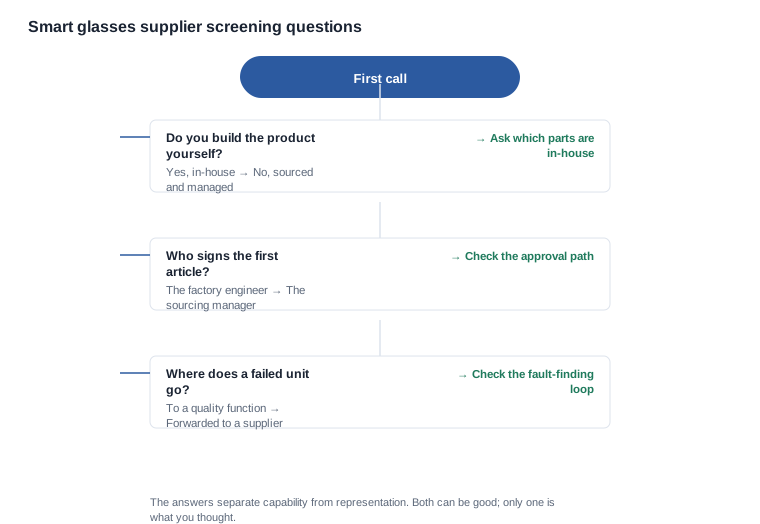
Do you manufacture, or do you source and manage? The honest answer names a distinction rather than blurring it. A manufacturer will talk about lines, tooling and process control. A sourcing and management operation will talk about supplier networks and lead times, and it will be perfectly capable of running a good programme. The point of asking is not to disqualify the second kind, it is to know which one you are dealing with before you write a specification that assumes the first. The detailed version of this is in factory audit questions.
Are the specifications on your own product pages yours? A supplier publishing a camera resolution, a runtime, a charging interface and a case capacity for twenty-eight models is making a large number of technical claims. Ask whether those are the specifications of the products they build, or the specifications of a product they buy. The question is not adversarial; a direct answer is a good sign in either case.
What do you not publish, and why? This is the most diagnostic question on the list, and it is worth putting to every supplier on a shortlist. A supplier who can say "we do not publish our minimum order quantity because it moves with the configuration, but here is how it is calculated" has shown that they have a considered position. A supplier who says "everything is on the website" has told you that every number in the documentation is a general figure, which may or may not match your configuration.
Will you sign a confidentiality agreement before we discuss the specification? A mutual NDA is straightforward and it should be in place before drawings, firmware behaviour or market plans are discussed, because the commercially sensitive part of a smart glasses programme is rarely the hardware — it is the app behaviour, the firmware, the acoustic tuning and the launch plan.
Can we visit the site, and what would we see? A video walkthrough first is a reasonable sequence for a first contact, and a refusal of a physical visit later is a different matter from a refusal now. We publish no floor area, no headcount, no production capacity and no daily output, and we would not present a tour as evidence of any of them. What a visit does establish is the thing a specification cannot: whether the work happens on the site you are standing on.
Do you run samples under conditions the customer will actually meet? This is the question that separates a supplier who tests from one who demonstrates. In this category the published evidence is thin on exactly the points that matter outdoors: no operating temperature range is published for any model, and no test report number sits behind the IP54 marking that only the V06 and the S7 carry.
What happens to a question you cannot answer immediately? The way a supplier handles the question it cannot answer is more diagnostic than the answer itself, because in a first call the honest response is usually "I will come back to you on that". The useful variant is "I will come back to you on that, and here is who will answer it". A supplier that names the person has an organisation behind the question. A supplier that says the answer is confidential, or that it depends on the configuration in a way that cannot be stated, has told you something else entirely.
Are you able to say no? A supplier that agrees to every variant request in the first call is not being accommodating, it is describing a service model that will not survive a programme. The version of this worth asking is practical: if the requirement brief asks for something the platform cannot do, what happens? The right answer involves a conversation about alternatives. The wrong answer is a yes that the engineering team will quietly reverse later, after tooling.
How long has the person answering these questions been doing this work? Not a CV request, a continuity question. A programme that is handed over twice loses the reasoning that made it work, and in this category the reasoning is mostly held by one or two people. If the person answering the first call will not be the person running the programme, that is worth knowing in the first call and considerably easier to raise then than at the first tooling review.

Smart glasses questions about configuration, tooling and samples
Once a supplier has survived the screening questions, the work becomes concrete, and the questions become specific.
What do you need from me to start? Four things, and none of them is a purchase order. The configuration — which model, which colour, which case, which packaging. The target market, because the radio and the battery positions differ by market and the document set follows. The volume plan, because it sets the per-colour and per-configuration floors and the one-time costs. And the destination, because the freight and the battery rules are part of the landed cost. With those four, a quotation and a schedule are meaningful; without them they are guesses, and we would rather ask than guess.
Which model should I start with? It depends on three things, and the answer changes with each. The workload decides the platform: a continuous capture product needs the camera class, and an intermittent audio product needs the audio class. The environment decides the durability expectation: only the V06 and the S7 publish an ingress marking, and both sit in the camera range rather than the sport range, while the sport models — the YKC02, the D17 and the ZH12 — publish no ingress marking at all. And the channel decides the compliance work, because retail, education and a B2B tender each need a different document set. The selection method for the audio class is set out under how to choose open ear audio glasses, and the camera class is on the ai camera glasses page. The shortlist is not where we start; the scenario is.
What does the tooling cover, and who owns it? Not the price first — the scope. A tooling quotation that lists the number of tool sets, the number of cavity impressions, what happens to the second colour, and whether a new tool is needed when a colour is added, is a document you can negotiate. A tooling quotation that gives a single total is not. The ownership question is separate from the cost question and it is the one that decides the end of the relationship.
What does a sample fee cover, and what happens to the sample afterwards? Specifically: what is included, what is credited against a first order, whether the sample is hand-finished, and whether the sample unit is the production revision. That last point is the most common programme failure in this category and the cheapest to prevent: a sample built from a different component lot or a different firmware revision gets approved by your customer, and the first production unit then misses it.
Which documents will you issue for this model, and for which markets? Ask for the list rather than for the documents, and ask which are per-model and which are per-market. The honest starting position in our own documentation is that the catalogue body mentions no certification scheme at all, and the export-certification page carries ten patent certificate images — eight design patents and two utility models — rather than a certification record. That means a certification question is answered per configuration, by document, and it should be treated as due diligence rather than as a catalogue lookup.
The programme structure itself is described under odm development, the standard route is in standard oem, and the platform range is on the oem ready products page.


The smart glasses questions that separate a factory from a trading company
This is the part of the first call that most buyers treat as a formality and that most suppliers treat as a commercial conversation. It is worth handling carefully, because the answer is not binary and a good supplier may well be doing both.
The question to ask is not "are you a factory" but "which parts of this programme do you perform yourself". On a standard OEM route — an existing platform with a logo, a colour and a packaging change — the answer may be that the engineering and the assembly are in-house and the logistics are not. On an ODM route with new tooling, the question becomes specific: who designs the tooling, who makes it, who owns it, and who inspects the first article.
There are four questions that get closer to the truth than the first one does.
Who signs off the first article? A first-article approval signed by the organisation that built the product means the factory owns the approval. One signed by a sourcing manager means the factory is representing a supplier. Both are workable, and they are priced differently.
Where does a returned defective unit go, and who analyses it? This is a process question with an observable answer, and it separates an organisation with a service and quality function from one without. A factory will receive returns, quarantine them, and analyse them. A sourcing office receives returns and forwards them. The capability is not the same, and the fault-finding loop that the analysis supports is the mechanism by which a recurring defect gets fixed rather than absorbed.
Can a customer visit the assembly line, unannounced, during a working day? A factory can usually accommodate this and a sourcing office cannot, because there is no line to stand on. It is also the check that most reliably distinguishes a busy facility from a quiet one.
Will you show us the process for a change to an approved component? Not the change, the process: who raises it, who assesses it, how the customer is notified, and what happens to the compliance file when a change alters the described product. A factory that has this process will describe it in sequence. An organisation without one will describe it in terms of individual decisions.
A fifth question is worth adding because it tests something almost nothing else does: can you show us a non-conformance record from a previous programme, with the customer name removed? A record is a different kind of evidence from a description. A supplier with a process can produce one, because the record exists. A supplier describing a process can describe it in the abstract and still have nothing to show, because the description was written for the question. The redaction is not an obstacle; almost any record can be anonymised, and the refusal to anonymise a record is more unusual than the request itself.
Scoring a smart glasses supplier shortlist on the answers
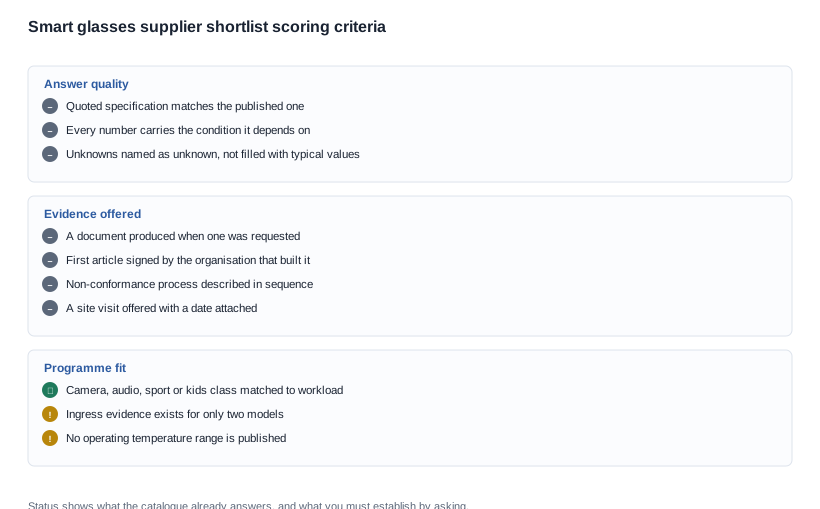
The point of a fixed question set is that the answers can be compared, and a shortlist is only as good as the comparison behind it. A workable method is to ask every supplier the same questions in the same order, to record the answers in a table with a column for the source, and to score the shortlist on criteria that are about behaviour rather than about capability claims.
Five criteria earn their place in a smart glasses shortlist, and each of them is observable rather than asserted.
- Answer consistency. Does the specification the supplier quotes match the specification the supplier publishes? A mismatch here is not a small thing, because it means one of the two is a marketing artefact.
- Document willingness. When asked for a document — a test report, a material declaration, a first-article record — does the supplier produce it, and does it arrive in a usable form?
- Process transparency. Can the supplier describe, in sequence, how a change, a non-conformance or a substitution is handled?
- Boundary honesty. Does the supplier say plainly what it does not publish and why, rather than filling the gap with a typical value?
- Site access. Is a visit offered, and does the offer survive contact with a date?
The trade-off across these is that criteria 2, 3 and 5 all cost the supplier time, and a supplier early in a relationship will sometimes decline. The judgement to make is whether the decline is about the request or about the capability. A supplier who will not show a line in the first month may still show it once there is a programme on that line, and a supplier who will not explain its non-conformance process at all is telling you something about the process.
The best single diagnostic in the whole set is the boundary question, and it is worth asking it last, after the supplier has relaxed. "Which of these do you not publish, and why?" produces one of three answers: a considered reason, which is a good sign; a deflection, which is a warning; or a flat no, which is a warning and a question about the documentation behind the published figures. Very few suppliers give the third answer, and the ones that do are usually the ones with the most to hide.
There is a commercial reason to keep the question set fixed as well as a diligence one. A supplier that has answered the same six questions for three buyers knows the shape of the requirement, and that reduces the number of clarification rounds on your programme, which is where the calendar quietly disappears. A programme that takes two extra rounds before the first quotation is a programme whose lead time nobody can state accurately, and an unstateable lead time is a cost that shows up as a stock-out rather than as a line on an invoice. Ask the questions in the same order every time, keep the answers, and the second and third programmes start from a position the first one had to build.
A shortlist built this way is slower to assemble and considerably more useful, because it is built on evidence rather than on the confidence with which a specification was delivered. The risk side of the same exercise is in odm development risk factors, and the programme structure is under smart glasses OEM.
Related reading
- The programme structure — odm development
- The standard route — standard oem
- Verifying before you commit — factory audit questions
Send us the four things above and we will answer all of these against a defined configuration.


