

An audit is the only verification method in this category that produces evidence rather than statements. Everything else — the capability deck, the quotation, the sample, the specification sheet, the video walkthrough — is a claim, and claims from two different kinds of supplier look nearly identical. A walk through a production floor does not. What you can see with your own eyes, on a date you chose, in a building you can find again, is not something a capable intermediary can manufacture.
The difficulty is that most audits are badly designed. They are scheduled by the sales contact, they follow the route the supplier prepared, and they end with a set of impressions that nobody converts into a decision. The questions below are ordered so that each one narrows the field, and each one is paired with the observation that would actually answer it. They are written to be asked out loud, on the floor, pointing at things.
One thing to establish before travelling: what the audit is for. If the purpose is to satisfy a compliance auditor rather than to decide whether you can work with this supplier, the questions are different and the cost is lower. If the purpose is the second, you should be on site for a day, not an hour, and you should not go alone.
That distinction matters because the two purposes fail differently. A compliance-driven audit is a checklist against a standard and a moderate cost. A supplier-selection audit is an investigation, and it fails most often through preparation: the wrong site visited, the wrong people answering, the wrong questions asked, and a day spent confirming what the proposal already said.
Factory vs trading company: preparing an audit that returns answers
Preparation decides the outcome more than the questions do. Three things have to be settled before a date is booked.
Name the build site first, in writing, and audit the site, not the relationship. If the supplier answers "we work with several partner factories", then the question to ask before you book anything is which one will build your specific model, at your specific volume. An audit of the wrong site is a wasted trip and a wasted relationship. This is the step most audits skip, and skipping it produces a pleasant visit to a building that will never touch your order.
Decide what the audit has to establish. Write it down as three to five statements before you travel. For most smart glasses programmes they are of this shape: the named site assembles units of our model; the site controls the assembly and final test steps rather than receiving them finished; the site holds the tooling for our parts or can name who does and will introduce them; incoming materials are inspected against a specification; a documented route exists for a non-conforming unit. An audit with no written purpose becomes a tour.
Book the time with the site, not with the contact. Ask for the production or quality manager to be present for the whole visit, and ask for a translator if the language is not shared. Ask the contact to be present too, but do not let the contact answer the operational questions. An audit conducted entirely through one person gives you that person's account of a site, not the site.
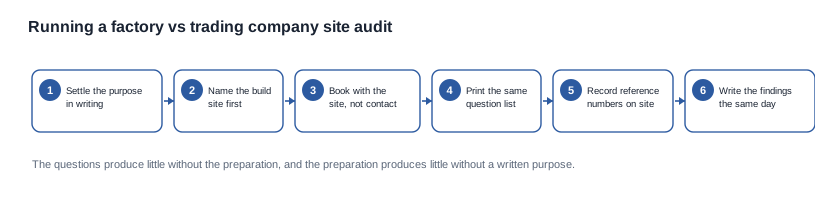
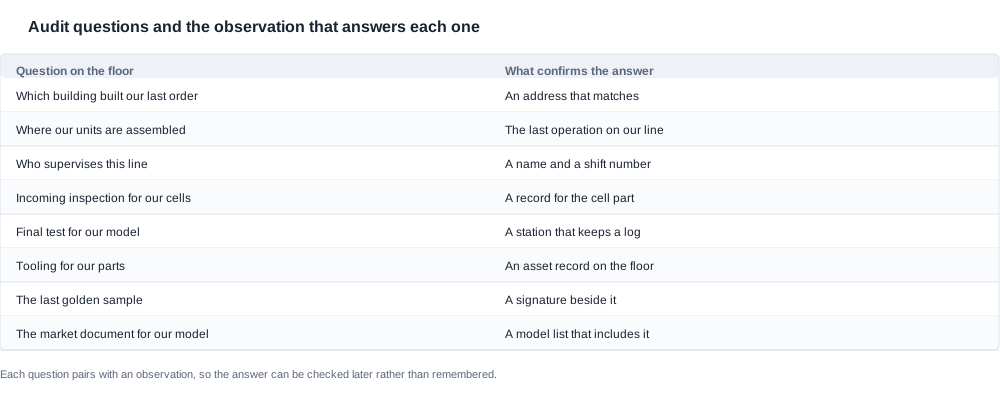
Then prepare the list itself. Print it. Do not rely on a phone. Ask each question in the same words on every site, so that two suppliers receive the same treatment and the comparison is real. Take photographs of the things you asked about rather than of the building, and note down the reference numbers you see on documents while you are looking at them — a report number, an asset number, a record identifier — because those are what make the evidence checkable later.
The other preparation is deciding what you will not check. Production capacity is the usual casualty, because it is the number everyone wants and nobody can verify on the day. If you want an answer on capacity, the productive route is a written request: monthly units by line, the shift pattern behind them, and the planning horizon. Our own capacity is not published, and we would rather say so than let a visit substitute a guess for a number.

The factory vs trading company audit questions that expose the build site
These are the questions worth the trip, in the order that produces the most information per minute on the floor.
- "Which building are we standing in, and which building did the units we ordered last come from?" If the answer is a different address, you have learned the single most important fact of the visit.
- "Show me where our units are assembled." Not the showroom, not the finished-goods shelf. The line where the last operation happens.
- "Who supervises this line, and how many people are on it during a full shift?" Answers come in two forms: a name and a number, or a vague description of capacity. Only the first is useful.
- "Where is the last operation on our units, and who signs it off?" The signature tells you whether the site is making decisions or relaying them.
- "Show me incoming inspection for the components in our units." For a smart glasses product this means the cells, the PCBs and the frames. If incoming inspection is not documented, the factory is not controlling the thing that most often causes a field failure.
- "Show me the final test station for our model." Then ask what it tests. A burn-in rack with no log is a rack.
- "Show me the tooling for our parts, or tell me who holds it and take us there." Tooling is the cleanest asset test. A site that cannot produce the asset record on the spot has not been managing it.
- "Show me the last golden sample for our configuration and the approval record." A physical sample in a box with a signature is stronger evidence than a photograph of one.
- "Show me the non-conformance records from the last three months and one that was closed." The closed one is the valuable one, because it shows the corrective action loop.
- "Show me the calibration certificates for the test equipment on this line." Test equipment drifts, and the certificate is how you know it was checked.
- "Show me the transport test summary for the exact cell fitted in our product." A lithium cell ships under its own documentation regime, and a summary for a different cell does not cover yours. Ask for the cell part number first and read it off the summary.
- "Show me the document that covers our model in the market we are shipping to." Then read the model list on the document. Family-level coverage that names a different variant leaves your model uncovered.
Two notes on how to ask. Question 12 deserves particular attention in this category, because a supplier who holds a family-level document has, in good faith, described it as covering your product. Ask for the model list. It takes thirty seconds and it is the difference between a compliant shipment and a shipment that stalls at the border. Our own catalogue publishes no per-model certification row at all, and mentions CE, FCC, RoHS, RED and EN 18031 nowhere in its body; the export-certification page is a picture page carrying ten patent certificate images, eight design patents and two utility models. So for us the honest answer to question 12 is that no such document is published, and that a buyer who requires one has to request it for the specific model.
Question 5 is the one that most often gets skipped and most often matters. Incoming inspection is where the cell, the PCB and the frame are judged before they become your product, and it is also where a sub-supplied component enters the build with no one downstream checking it.
Auditing a factory vs trading company intermediary: three adjustments
When the party you contract with is an intermediary, the standard audit still applies, but three adjustments turn what is usually a wasted day into a useful one.
1. Look at the site and the intermediary separately, and on different days. The intermediary's own operation may be an office, a small warehouse, a certification consultancy or a project manager. That operation deserves its own attention, because it is the part of the relationship you are contracting with: how an order is tracked, who owns the escalation path, what happens to a document you send, and how long it sits before anyone opens it. If the office is two people in a shared room with a shared mailbox, that is a fact you can work with — provided you know it before the first shipment rather than during the first escalation.
2. Ask the intermediary what they will do when the site says no. This is the question that defines the value of the middle layer. A partner who can absorb a site that pushes back on a date, on a specification change or on a corrective action is worth paying for, because that is the volatility they exist to hold. An intermediary who cannot answer this question is adding a routing step to a relationship that would otherwise be direct.
3. Ask what they have never been able to fix. Every supplier has a standing constraint they cannot remove, and an intermediary's constraints are usually about the site rather than about their own operation. A supplier who says plainly that they have never been able to get the site to hold buffer stock of one component, or that they cannot get a certificate issued for a variant, has given you something more useful than a reassurance. Their constraints are the correct basis for your contingency plan.
In practice, budget two days rather than one when you are auditing an intermediary — one for the site and one for the party you actually contract with — and write the two findings up separately. They are different subjects and they fail differently.
Documents to request during a factory vs trading company audit
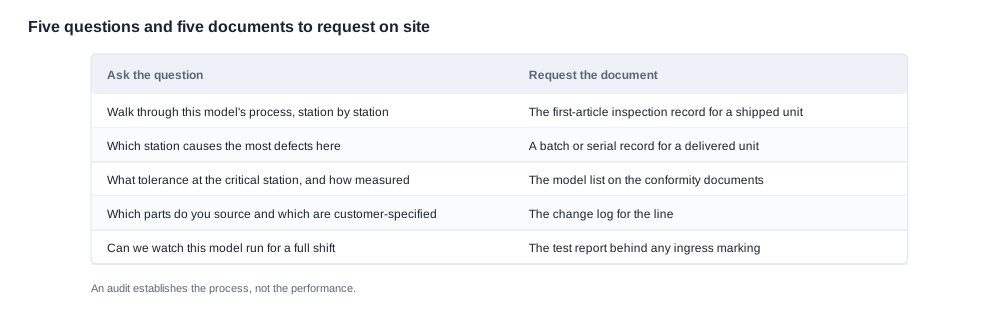
Some evidence can only be seen on site, and some should leave with you. Ask for the second category by name, and ask for copies rather than photographs, because a photograph of a document proves you visited.
- The golden sample approval record, with the date, the approver and the configuration it covers.
- The most recent outgoing test or release report for a shipment of your model, with the report number and the model list printed on it.
- Incoming inspection records for the cells and PCBs used in your units, covering a recent period.
- The cell transport test summary for the exact cell part number fitted.
- Calibration certificates for the measurement equipment used at final test.
- The tooling asset record for your moulds and jigs, with cavity count and any recorded maintenance.
- The non-conformance log for the last quarter, and one closed case with its corrective action.
- Training records for the operators on the line that touches your model.
- The quality management certificate the site holds, with its number and issuing body, if it holds one. Read the scope and the expiry, and read the name on the certificate against the name on the building.
- The document for your model in your target market, if one exists.
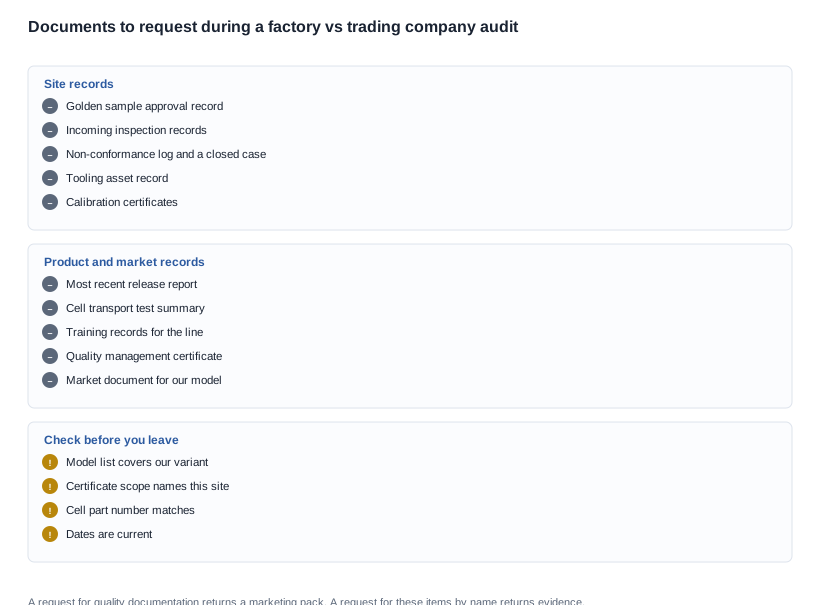
What to check in each, rather than merely collecting them:
| Document | The check that matters |
|---|---|
| Golden sample approval | Does the configuration named match the one you are buying? |
| Release report | Does the model list printed on the report include your model? |
| Incoming inspection records | Is the cell part number the same as the one fitted? |
| Cell transport summary | Does the summary name the cell, not the battery pack? |
| Calibration certificates | Are they current, and do they cover the stations in use? |
| Tooling asset record | Does the asset number match the tooling on the floor? |
| Non-conformance log | Is there a closed case, or only open ones? |
| Training records | Is the operator on the line the one named? |
| Quality certificate | Does the scope cover the site you are standing in? |
| Market document | Does the model list cover the shipping variant? |
This list is deliberately short and deliberately specific. A request for "quality documentation" returns a marketing pack. A request for these ten items, by name, returns evidence.

What a factory vs trading company audit cannot establish
An audit is strong evidence about the site in front of you and weak evidence about everything else. Being clear about the boundary is what stops a good day on site from producing an over-confident decision.
It cannot certify compliance. An auditor can show you a document; only the issuing body and the market determine whether that document covers your product and your destination. The reading of the model list is the part that matters.
It cannot establish financial health. A site can be busy on the day you visit and unprofitable six months later. Order size, payment behaviour and the stability of the sub-supply base are separate enquiries, and they are answered by documents and by trading history rather than by a walk.
It cannot reach below your sub-suppliers. A factory that buys cells from a cell maker and frames from a frame maker controls the assembly and not the sub-supply chain. A factory that owns its moulding controls a great deal more. The audit tells you which of these you are looking at.
It cannot verify quoted capacity. This is the one buyers most want and most reliably misread. A well-run site on the day you visit can be running one line at one volume while quoting a figure across the whole plant. Treat capacity as a written request, with a number, a shift pattern and a planning horizon, and treat an unquantified answer as no answer.
It cannot substitute for a sample. A production site and a golden sample are different evidence about different things. The audit tells you the process is what it was described as; the sample tells you whether the output meets your acceptance criteria.
It cannot tell you what will happen at three in the morning. The behaviour of a site under pressure — when a cell delivery is late, when a machine fails, when a buyer is angry — is a cultural fact, and the best proxy remains the non-conformance log and a reference customer willing to talk.
It cannot tell you how the site treats your order relative to others. A factory running several customers may prioritise in ways you cannot observe from a one-day visit, and the only honest way to test it is the reorder: whether the second delivery arrives when it was promised, and whether someone chased it before you did.
It cannot substitute for a reference call. The single most useful hour of due diligence is usually a phone call to a customer who bought from this site in the last year and can describe what happened when something went wrong. Ask about the failure, not about the relationship.
On our own site, we would add a seventh limitation and state it plainly: we do not publish a line count, a headcount, a plant size, a production capacity, an audit outcome or a certification row per model, because those figures have not been given to us in a form we are willing to print. A buyer who needs them should ask for them in writing and judge our answer on whether it is specific.
Scoring a factory vs trading company audit and acting on the result
An audit that produces notes rather than decisions has cost you a trip and a day of programme time. The output has to be structured, and it has to be written within a day, while the observations are still sharp.
Use three columns for every observation, and one extra column for the gaps.
| Observation | Evidence held | Gap | Owner and date |
|---|---|---|---|
| Site builds our model | Line walk, name of the line | None | — |
| Final test exists but has no log | Test station seen | No release record | Supplier, two weeks |
| Tooling held by a partner | Asset record named the partner | Partner not audited | Buyer, before tooling order |
| Cell incoming check documented | Records for a recent period | Older periods missing | Supplier, one month |
Then score the visit on four questions, and only these four:1. Did the named site build our units? If the answer is no, the relationship is intermediary in nature, whatever the paperwork says, and the audit's purpose shifts from assurance to mapping. 2. Can we audit the site again, on our own schedule? A site that accepts an unscheduled second visit is a site you control. 3. Which gaps did they raise themselves? A supplier who volunteers that the calibration certificate is out of date is telling you something useful about how they run. 4. What did we see that we did not expect? The surprises are the findings, and they are the part that never appears in a capability presentation.
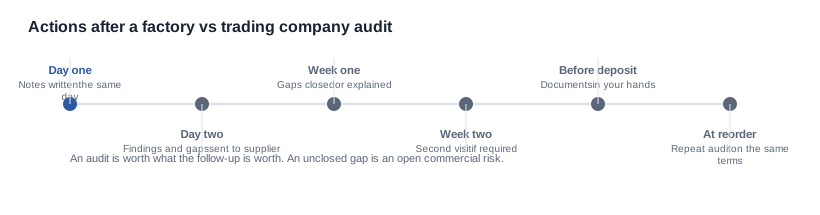
Finally, the decision. Most audits end in one of three states, and each has a different consequence for the shortlist: proceed and close the gaps before the deposit; proceed with a second visit scheduled after the gaps close; or do not proceed, and ask the question you now know how to ask — which site, and which document covers our model.
The three states are not equally comfortable, and buyers often drift into the first one because the site was pleasant. Resist that. A site that was pleasant and could not produce a release record for our model has told you something important, and the right response is to make the release record a condition of the deposit rather than to proceed and raise it later, when you have less leverage and a launch date you cannot move.
Whichever state you reach, the negotiation position afterwards is stronger, because you are no longer negotiating against a description. You are negotiating against a set of observations with reference numbers in them, and that is the difference between a request and a requirement.
The related work on this site covers the same ground from three directions: the production line questions look at the build site from the outside, the quality documentation comparison covers what each kind of document can actually prove, and OEM service levels sets out what response commitments are worth putting in the agreement once you know who answers. The Factory vs Trading Company pillar carries the full model comparison, and the factory audit page covers the commercial arrangement for running one.
Related reading
- Factory vs Trading Company — the pillar behind this audit method
- Common questions — the eight questions to ask before you travel
- Worker and facility checks — what a visit settles and what it does not
- How trading companies operate — the middle layer described from the inside
Tell us the model, the volume and the market, and we will tell you which questions on this list have answers we can put in writing.


