

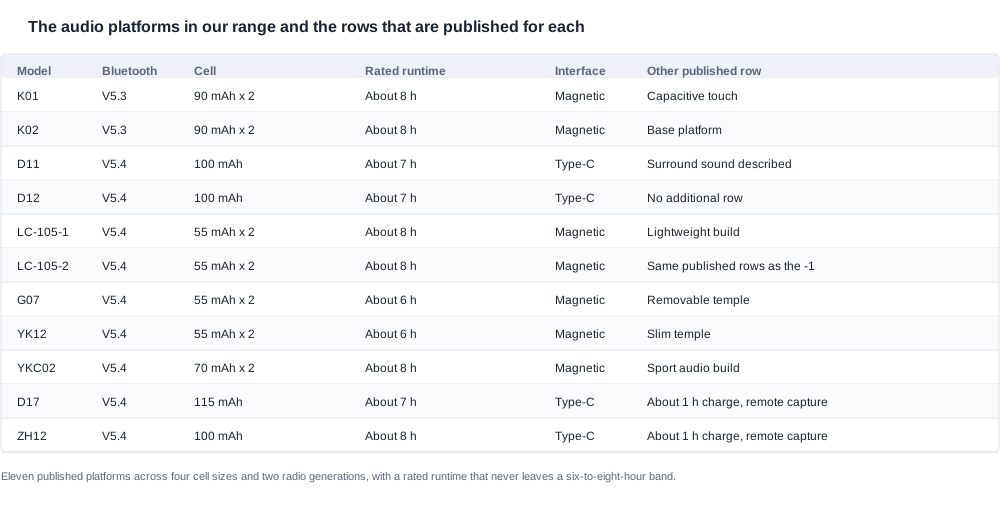
Open-ear audio platforms are the easiest category to buy badly, because the catalogue rows are so similar that the comparison feels finished before it starts. Eleven platforms in our range, four cell configurations, two radio generations, and a rated runtime that never leaves a six-to-eight-hour band. On paper they are interchangeable. On a call in moving air they are not, and the reason they are not is in rows nobody publishes.
So the conclusion first.
Shortlist on the published electrical rows, because they are the only rows that are comparable across suppliers, and then choose on a test you design yourself. The published rows will remove the majority of candidates for you — the charging interface alone removes seven of the eleven from consideration if your customer owns Type-C cables — but they cannot choose between the ones that remain.
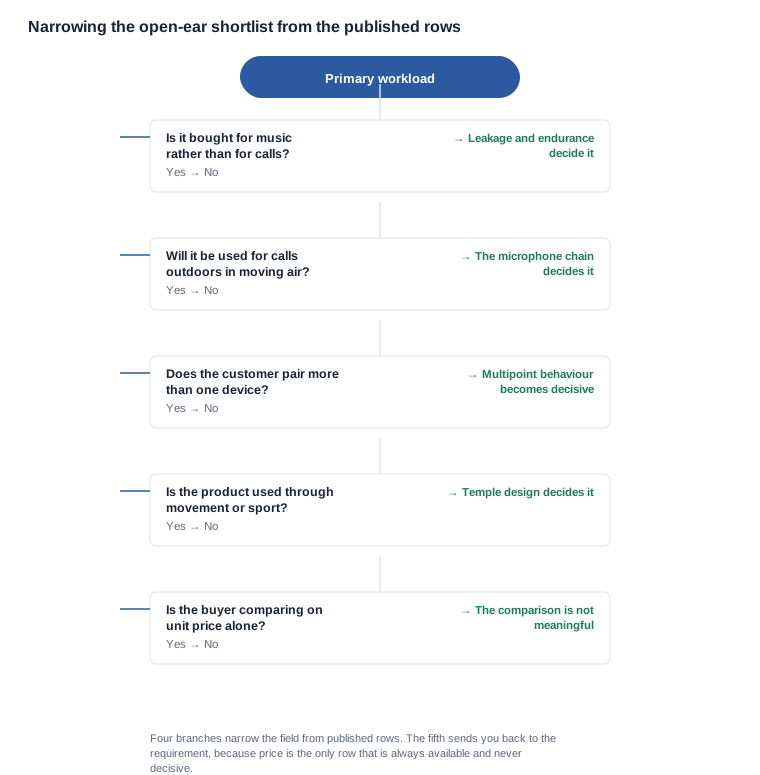
If the product is bought for music rather than for calls, the deciding row is leakage and endurance. If it is bought for calls, the deciding row is the microphone chain, and no microphone row is published for any platform in our range.
If the buyer compares on unit price, the comparison has not happened. Price is the only figure that is always available and it is the only one that never distinguishes two open-ear platforms.
Do not expect our documentation to answer the acoustic question. We publish no driver size, no frequency response, no leakage figure, no microphone specification, no pickup distance and no noise-cancellation implementation detail for any of the eleven platforms. We would rather tell you that than present a "surround sound" description as though it were a comparison result.
Open ear audio glasses: limits of published rows
The table above is the whole of what our catalogue publishes for the open-ear class, and it is worth reading as a structure rather than as a list. Four things fall out of it immediately.
The charging interface splits the class almost in half. Four platforms publish Type-C — the D11, the D12, the D17 and the ZH12. The remaining seven publish magnetic charging. That single row decides the accessory chain, the customer's cable habit, the packaging contents and the freight profile of every unit you ship. It also decides the contact-wear question, because a magnetic contact is a wear item and a Type-C port is an ingress opening, and those two facts have consequences that belong in the same decision rather than in two separate ones.
The cell configuration does not map onto the runtime. The LC-105 pair and the G07 and the YK12 all publish 55 mAh on each side, and the LC-105 pair rates about eight hours while the G07 and the YK12 rate about six. The K01 and the K02 publish 90 mAh on each side and also rate about eight hours. Two different totals, two very different ratings, the same headline number. The only conclusion a buyer can draw is that the rated runtime is a workload rating rather than a capacity rating, and that the workload behind it is not published.
Only two platforms publish a fast charge. The D17 and the ZH12 publish approximately one hour against two hours or less for the rest of the class. If your channel sells on speed — a gift buyer, a same-day fulfilment model, a retail assistant who needs the unit live before the customer leaves — those two platforms are the shortlist and the other nine are not.
Two pairs are published with identical rows. The D11 and the D12, and the LC-105-1 and the LC-105-2. In each pair the difference has not been confirmed to us. A buyer building two product pages on a pair with identical published rows has a content problem that a supplier should resolve, and the resolution is one email.
The interface row is also a consumable row, and it is the one most often left out of the commercial model. A magnetic platform ships a proprietary charging cable in every unit, which means three things that a Type-C platform does not have: a consumable SKU that has to be stocked and priced, a wear item whose replacement cycle you will be asked about, and a customer who owns a cable that works with nothing else they own. A Type-C platform ships a standard cable that costs almost nothing and that the customer may already have. The difference between those two propositions is invisible in a unit price comparison and visible in your accessory cost per hundred units and in your support contact rate in year two. When you price the platform, price the cable with it.
There is one more published-versus-unpublished row that matters more than the acoustic ones and is easy to overlook: the temple. Two platforms publish a distinctive temple — the G07 with an ultra-thin removable temple, the YK12 with a slim temple — and no platform publishes a frame weight. For a product bought for sport or for all-day use, the temple is the row that decides whether the unit is still being worn at hour five, and it is exactly the row that cannot be compared across suppliers from documentation. If your channel is movement-led, treat the temple as a sample-selection criterion with a written pass condition rather than a preference.
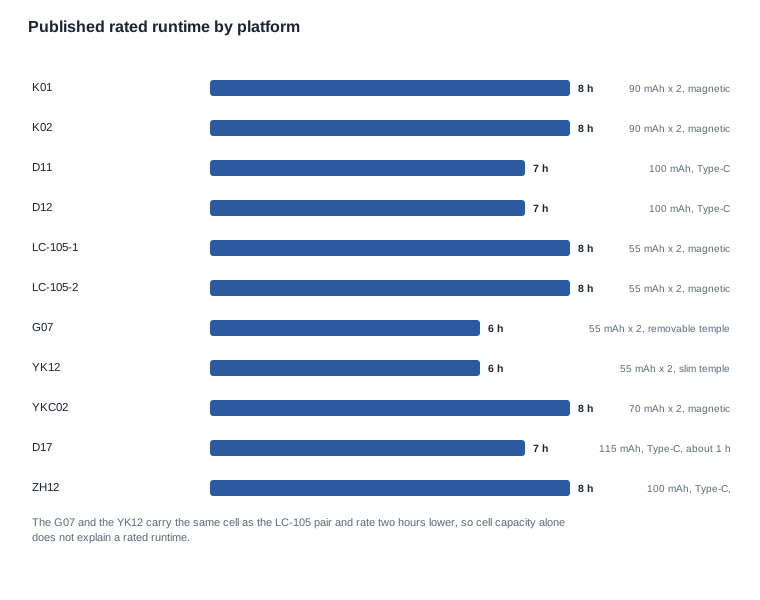
Those are the four things the published rows settle. Here are the two comparisons they cannot support, and they are the two a buyer is most likely to build anyway.
The runtime comparison across different workloads. A platform that plays music continuously for six hours and a platform that carries calls in bursts for eight hours are not competing on endurance; they are doing different jobs. Putting them in one column of a comparison table produces a table that cannot support a decision, and worse, a table that a customer can read.
The acoustic comparison. Every platform in this class is described in our catalogue with marketing language, and only some of them are described with it. The D11 carries a surround sound description, the YK12 and the D17 and the ZH12 carry a similar one, and the remaining platforms carry no acoustic descriptor at all. None of those descriptions is a measurement, and a description is not comparable with a description from a competitor's brochure. This is why the sample test is not a fallback for a comparison the paperwork could have made. It is the only comparison available.
There is also a sourcing truth worth naming. The acoustic performance of an open-ear platform is largely a property of the transducer and the enclosure, and the assembly factory often buys that as a module rather than designing it. That means the part of the product you most want to control may be the part you control least, and the practical consequence is a request: ask for the module part number rather than a performance claim, and treat a supplier who cannot name the module as a supplier who does not control the part that matters.
Writing the acoustic acceptance criteria before you meet a single supplier
The highest-value hour in an open-ear programme is the one spent writing the acceptance criteria before the samples arrive. The reason is that the criteria have to be written while you are still a buyer, because once you have a sample and a supplier in the room, the criteria get written to match whatever the sample happens to do.
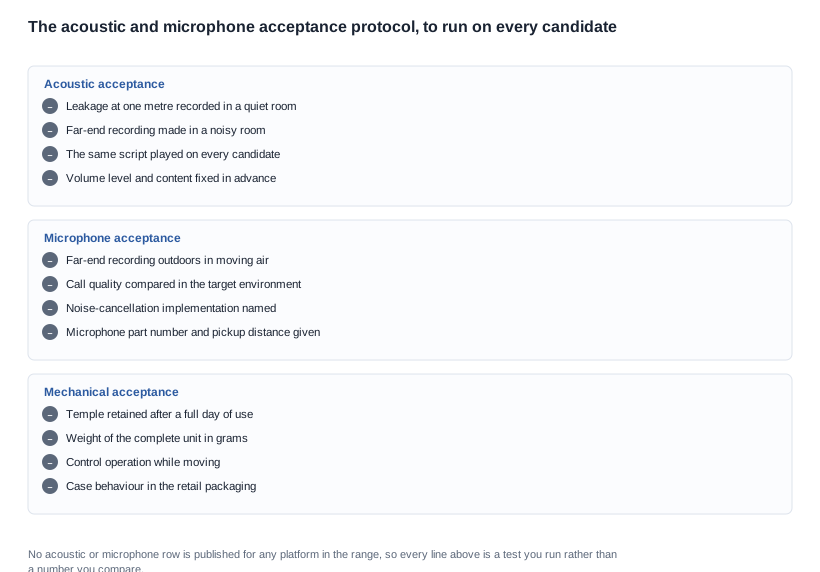
A protocol for this class is short, and it has four parts. Write it down as a single page, dated, and attach it to the purchase order when the sample is approved.
Part one: the playback test. Fix the content — the same track, the same source, the same device — and fix the volume level. Run each candidate in the same room and record what a listener at arm's length can hear, then at two metres, then at four. The pass condition is a number of your choosing, but it has to be a number chosen in advance. A pass condition written after the demonstration is a description of the demonstration.
Part two: the far-end recording test. This is the one that decides call platforms, and it is the one most often skipped. Record the far end of a call rather than judging the near end, because the near end is the part you can hear in person. Fix the call environment — a quiet room, a street, a shop floor — and use the same one for every candidate. The output you want is a recording that somebody else can listen to and judge, not an impression you had while making the call.
Part three: the wind test. Outdoors, in moving air, recording the far end. This is where open-ear platforms are structurally exposed, and it is extremely sensitive to whether the noise-cancellation implementation acts on the microphone signal, on the playback, or on both. No implementation detail is published for any of our platforms, so this test is the only way to find out, and it is also the test that most often separates two platforms that look identical on paper.
Part four: the endurance and comfort test. Run the unit through a full working day in the condition it will actually be used. Glasses that pass a shop-floor demonstration can fail at hour five, and no published figure will tell you that in advance.
The criteria are also what convert the programme from a purchase into a controlled comparison. Without them, a buyer ends up with three opinions. With them, a buyer ends up with three measurements and a decision that can be defended to a colleague who was not in the room.

Running the same protocol on every candidate
The discipline that makes the comparison meaningful is boring and non-negotiable: the same protocol, the same content, the same rooms, the same volume, and the same person recording. Every deviation creates a difference in the result that has to be explained afterwards, and explaining results afterwards is how a procurement process turns into a search for a supplier who agrees with you.
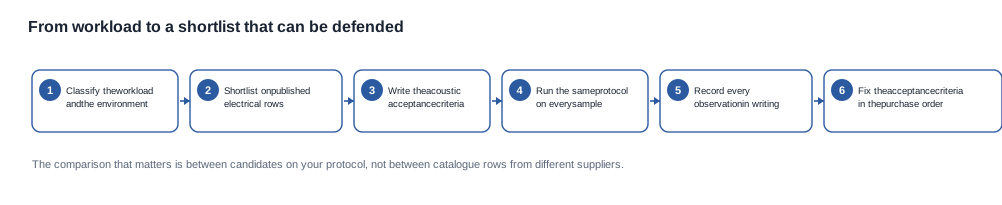
The sequence below is the one we would use.
Step one: classify the primary workload and the environment, in writing. Music or calls, indoor or outdoor, static or in movement. Almost everything downstream is decided by this classification, and it takes five minutes.
Step two: eliminate on the published rows. The interface, the charge time, the cell configuration, the temple design and the case configuration remove more candidates than any other step, and they cost nothing.
Step three: write the protocol and the pass conditions. Four parts, as above. Date the page.
Step four: run the protocol on every candidate, including any competitor sample you buy. A competitor sample on the open market is the cheapest control you can buy, because it is the unit your customer will compare against when they read the listing.
Step five: record every observation before you discuss any of them. A supplier disputing a written observation is arguing with evidence. A supplier who has never seen the test is arguing from theory, and the first conversation is far more productive than the second.
Step six: fix the acceptance criteria inside the purchase order. The measured protocol becomes the acceptance standard for the production lot, so that a lot which behaves differently from the approved sample is a lot you can refuse.
The documents to request before a deposit are these:
- The transducer or speaker module part number, and the driver size if the supplier will state it.
- The frequency response curve, or a written statement that it is not published.
- The microphone part number, the pickup distance and the noise-cancellation implementation.
- The multipoint figure, given as a number of simultaneous connections rather than as a description.
- The frame weight of the complete unit, in grams.
- The case configuration and, where a case is included, the case capacity and the case's own charge time.
- The battery specification sheet with the test condition behind the rated runtime.
- Any approval numbers that name the exact model designation.
Where a comparison made on unit price goes wrong
Five patterns show up in this category, and they are worth naming because each of them is expensive in a way that does not look expensive at the time.
The shortlist is made on price, and the acoustic difference is discovered in the field. The symptom is a review score that drops after launch, or a channel buyer asking for a return credit. The root cause is that the two candidates were never compared on the row that the customer cares about. The prevention is step three in the sequence above, before the samples are ordered.
The unit price gap is a configuration gap. The symptom is that the cheaper quote turns out to be a different cell, a different interface or a different case, and the programme has to restart. The root cause is comparing the price of a configuration against the price of a product. The prevention is to write the configuration on the quotation and compare configurations to configurations.
The interface was chosen from the specification rather than from the customer's habit. The symptom is a customer who owns one cable everywhere being handed a product that needs a proprietary one. The root cause is that nobody asked what the customer already owns. The prevention is to decide the interface from the customer routine, not from the factory's default, and to accept that seven of the eleven platforms in our range will not match a customer who standardised on Type-C.
A comparison is made between two platforms that publish different workloads. The symptom is a table that looks rigorous and supports no conclusion, and a shortlist that changes when the table is rebuilt. The root cause is that the rating conditions were never requested. The prevention is to request the condition behind every runtime figure, and to remove any figure you cannot get a condition for from the table instead of carrying it forward with a question mark.
The acoustic claim in the listing was written from a description rather than from a measurement. The symptom is returns that look like defects and are not, concentrated in one review stream. The root cause is that "surround sound" or a similar phrase was treated as a finding. The prevention is to write the acoustic claim from the recorded protocol, or to write a narrower claim that the recording supports.
On the commercial side, the structure for this class is more ordinary than the acoustic question, and it is worth being clear about which parts of it move. Negotiable: the minimum order quantity tiers, and more so on a repeat order once the setup has been absorbed; the accessory set and the accessory minimum order quantities, which for a magnetic platform include the proprietary cable and therefore a consumable line; packaging specification and the printed regulatory labels per market; the delivery split against a sample-approval milestone, which is often granted more easily than a price concession because it moves the risk onto the schedule where it belongs; the payment structure, with a balance on inspection before shipment and a retention held against the documentation package. Not negotiable: certification cost and certification time, which follow the process and the testing body rather than your order size, and tooling, which is a one-off cost usually amortised across the first order — so the useful question is over what volume it is amortised and what happens to it if the programme is discontinued.
Where our documentation ends and a sample test begins
Stated plainly: we publish the electrical rows we hold and mark the rest as open. For the open-ear class that means the Bluetooth generation, the charging interface, the rated runtime, the cell configuration, the charge time where one is published, the temple design where one is published, the case configuration and the remote capture function are available to you today.
It also means that across all eleven platforms we publish no driver size, no frequency response, no leakage figure, no microphone specification, no pickup distance, no noise-cancellation implementation detail, no frame weight, no frame dimensions and no module part number. We will not estimate any of them from typical values, and we will not present a marketing descriptor as a comparison result. Two frames in the same class can sound completely different and neither of them would be wrong about it.
We will also tell you plainly which model designations we can and cannot talk about. The platforms listed in the table above are the audio platforms we publish rows for. We publish no Bluetooth version for the camera range, for the bone conduction entry or for two of the three children's models, and that is a documentation gap rather than a statement about the radio inside them.
Three things to do this week.
- Write the workload classification and the protocol. One page, one date, four parts, pass conditions chosen before the samples arrive.
- Send the eight document requests as a list. The module part number is the first one, because the answer to it tells you whether the rest of the list will be answered properly.
- Send us the primary activity, the environment, the interface your customers already use and the volume. We will narrow the field from the published rows, tell you which models our documentation supports, and tell you which rows you will have to measure on a sample before the first article.
The technical background is under open-ear audio technology, the comparison method is in comparing open ear audio platforms, the claims our documentation does and does not make are in open ear audio manufacturer claims, and the platforms are on the bluetooth audio glasses range page.
Related reading
- What our audio claims do and do not support — open ear audio manufacturer claims
- The acoustic comparison method — comparing open ear audio platforms
- Testing before committing — sample evaluation
Tell us the primary activity and environment, and we will narrow the field from the published rows.


