

Smart glasses oem what is included is a question with a deceptively simple answer and a commercially expensive one, because the scope of an engagement is not a fixed list of features. It is a set of obligations, and those obligations change as a programme moves from a first sample to a production batch to a repeat order to a shipment into a market. The boundary between what the factory takes responsibility for and what the buyer takes responsibility for is usually left unspoken, and it gets settled by whoever turns out to be holding the missing item when it matters.
This page is written for the buyer who wants that boundary on paper before the first order. It sets out what a standard engagement covers when it is written down properly, the scope items that are easy to leave undefined, the obligations that sit outside the product catalogue altogether, and the structure that lets a scope survive the first production batch rather than expiring with it.
It contains no price, no minimum order quantity, no lead time, no warranty period and no sample fee, because those are commercial terms that belong to a quotation and not to a description of scope.
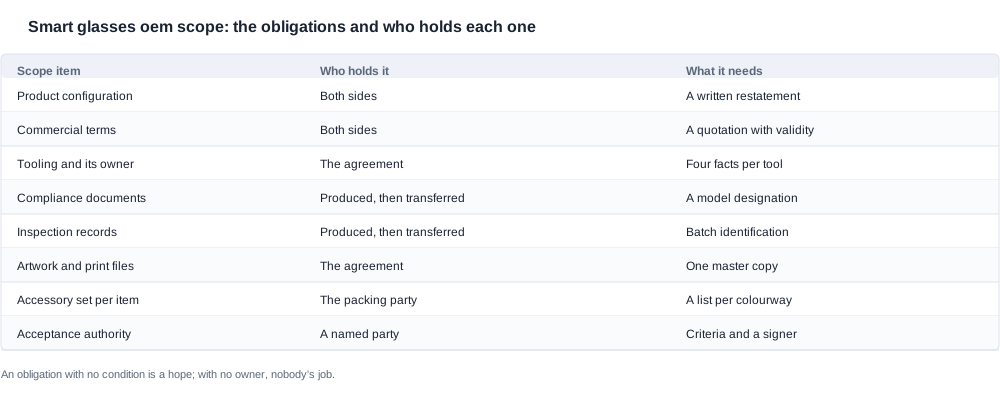
That table is the working structure of this page. Every row is an obligation, every row has a holder, and every row carries a condition — because an obligation without a condition is a hope, and an obligation without a holder is nobody's job.
What a standard engagement covers, in writing
A standard engagement covers ten things. The order below is the order in which they become concrete rather than the order of importance, because the first two settle the terms for everything that follows.
The product configuration comes first: the model, the variant names, the cell configuration, the runtime, the charging method, the case position, the camera resolution class where a camera is involved, the colour, and the removable part arrangement where one is published. Our published catalogue makes most of that configuration checkable — every entry prints its cell, its runtime, its charge time and its charging method, and a resolution class is printed on each of the eleven camera models — and the parts of the configuration that are not published, such as the charging method on four camera entries and the case position on four more, have to be settled in writing rather than inherited by silence.
The commercial terms come second: unit price, price tier, payment, incoterm, freight assumption, the minimum order quantity and its release conditions, the commitment date, and the validity period of the quotation itself. These are not scope in the engineering sense, but they are the terms on which every other obligation is performed, and a scope that does not reference them leaves the other obligations unanchored.
The tooling position comes third: which tools exist against the configuration, who owns each one, who holds it physically, who may modify it, and what happens to it at the end of the programme. A tool is the one item in an engagement that outlives the order, which means the question about it cannot be deferred to the end without cost.
The documentation position comes fourth, and it has two halves that are routinely confused. There is what is produced — test reports, conformity documents for the exact model designation, inspection records, the technical file that supports market access — and there is what is actually handed over. Those are different sets, and the transfer is a decision. A document that is produced and never delivered is not part of the engagement in any sense the buyer can rely on.
The inspection regime comes fifth: which attributes are checked, by whom, against which criteria, with what sample size, and what happens to a batch that fails. The criteria should exist before the production run rather than after the batch arrives, because criteria written in the middle of a disagreement are a negotiation rather than a standard.
The packaging and artwork position comes sixth: the carton structure, the insert, the printed content, the label content, and which copy of the artwork file is the master. The seventh is the accessory set, itemised per sellable item, because the contents of the box are also a printed claim on the carton.
The eighth is the after-sales position: what the factory does with a defective unit, a failed batch and a returned unit, and what it does not do. No warranty period is published in our material, and that is a commercial term to be set in the agreement rather than assumed from the existence of an engagement.
The ninth is change control: who may propose a change, who may approve it, how a change is costed, and what happens to a schedule when one is approved mid-run. The tenth is the acceptance authority: who signs a batch as accepted, against what criteria, and where the signed record is filed.
Two of those ten deserve a note about timing. The tooling position is normally settled before the first order, because a tool that is arranged later usually costs more and takes longer to arrive, and because the ownership question is far easier to settle when neither side has a history to defend. The after-sales position is usually settled last, and it is the one most likely to be regretted: the parts of it that concern defective units and failed batches are needed during the very first production run, not after the first complaint.
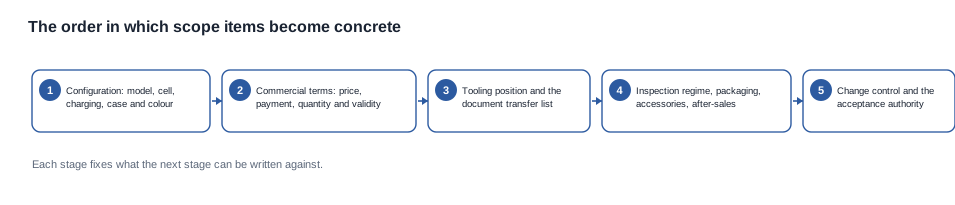
The sequence is the practical content of this section. Configuration fixes what is being built. Commercial terms fix what the performance is worth. Tooling, documentation, inspection, packaging, accessories, after-sales, change control and acceptance then attach to that configuration, one by one, each with its own condition.

The scope items that are easy to leave undefined
Eight items are left undefined more often than the others, and they are left undefined for the same reason: none of them has an obvious owner until the moment somebody needs it.
The artwork master is the first. Two parties can each hold a file called the final artwork, and they can differ in a single line of text that names a specification. Nothing surfaces it until an inspection compares a carton with the file, and by then the print run has been placed.
The tool ownership position is the second, and it is the one with the longest tail. A programme that has agreed a tooling cost and never written down the owner has not settled a question, it has postponed it to the moment the tool is needed and the answer is worth most.
The document transfer list is the third. It is very common for an engagement to produce a conformity document for a model, to file it internally, and never to give it to the buyer — who then discovers at the market-access stage that the document exists and is not in its hands.
The accessory list per sellable item is the fourth. An accessory set specified once for a programme is not specified for a programme with four colourways and two destinations, and the difference between what is in the box and what the carton says is in the box is a printed claim that has quietly become wrong.
The change-control route is the fifth. Without a named approver, a change arrives as a request from a channel, a trade show or a marketing plan, and it is absorbed into the current run by default. Absorbed changes are the mechanism by which a schedule slips without anybody having decided anything.
The failure path is the sixth. Rework, replacement, credit, return or rejection are five different commercial outcomes, and they are decided in advance or they are negotiated afterwards with a delivery date already missed.
The destination's labelling and regulatory text is the seventh, and it is the one that ties a technical scope to a legal one. A scope that says a carton will carry the required text for the destination, without naming the text and who supplies it, has outsourced the item to nobody.
The eighth is the boundary of after-sales. It is easy to write a scope that covers the factory's obligations up to the point of delivery and to leave everything afterwards implicit, and the implicit part is where a buyer's customer-service function ends up carrying a product it cannot describe.
The other side of the boundary deserves the same treatment, because a scope that lists only one side's obligations reads as though that side carries the product's risks. The buyer carries obligations too: the market-access obligation for its own market, the accuracy of its own claims, the instructions and warnings it chooses to give, the after-sales commitment it makes to its own customers, and the records a recall would need. Listing them inside the same scope is unusual and it is the reason it helps, because it makes the division of risk explicit rather than implied.
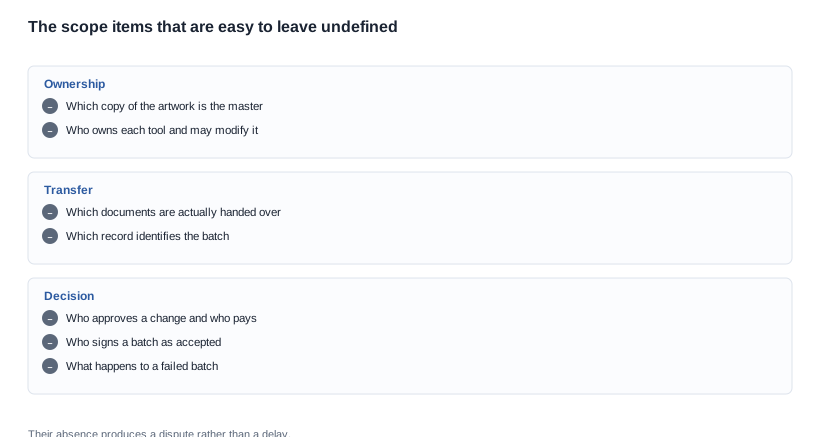
These eight are the items to check when reading a scope that somebody else has drafted, because they are the ones whose absence produces a dispute rather than a delay. A scope that names all eight has told the reader where the boundaries are, even where the boundaries are uncomfortable.

Which obligations sit outside the product catalogue
Some of the obligations in a smart glasses oem engagement do not live in the product documentation at all, and a scope that only describes the product will leave them unallocated.
The largest of them is the market-access obligation itself. In a typical import programme the party that places the product on a market is the party that carries that obligation, which in most structures is the buyer, and the factory's role is to supply what the assessment needs. A file of that kind is normally organised around two instruments — the Radio Equipment Directive (EU) 2014/53/EU, plus the EMC Directive (EU) 2014/32/EU — and they describe how the file is put together rather than what any product achieves.
Our own position on this is narrow and should be stated without hedging. The catalogue carries no certification line for any model anywhere, and its text names none of CE, FCC or RoHS. The export page is artwork rather than a per-model document: ten patent certificates, describing the company rather than any model's conformity. So a scope that says the factory will provide certification documentation is a scope item that has to be written precisely: which model designation, which configuration, which destination, and by when.
The second obligation outside the catalogue is the labelling and packaging compliance work for each destination, including the regulatory text and the market labels. It is not a product attribute and it never appears on a specification row, and it is frequently bundled into packaging work where it is easy to lose.
The third is the claims discipline. Every statement a buyer makes about the product in its own market — on a carton, on a listing, in a campaign — is the buyer's statement to support. That includes the ingress marking, which the V06 and the S7 carry with no third-party report number published anywhere beside it, and which therefore cannot be repeated externally as a claim without a report. It includes the acoustic claims for the audio models, which have no published third-party measurement behind them. And it includes the 35 dB gain published for the bone-conduction entry, which is a catalogue row that supports no statement about hearing, medical use, or about suitability for any population.
The fourth obligation is the after-sales and recall chain: who receives a defective unit, who decides on a root cause, who communicates with the market, and who holds the batch and serial records that would make a recall traceable. Our published material carries no photograph, no video and no test report for any of the twenty-eight entries, so the traceability records are not something a buyer can expect to find in a catalogue.
The fifth is the payment and the risk transfer in between. Which party carries the goods, at what point, and what happens to a batch that is in transit when the documentation does not match the contents.
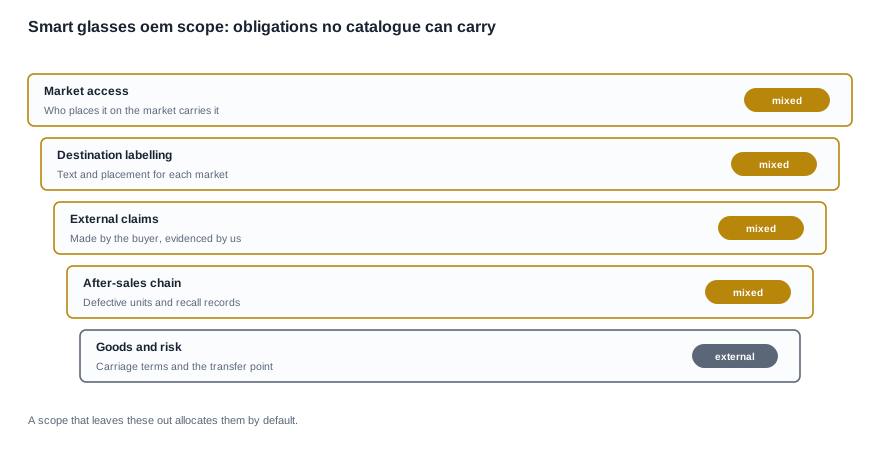
The five groups in that diagram are deliberately outside the product. A scope that allocates the product and leaves these five unallocated has transferred them to the buyer by default, which is a perfectly possible arrangement — but it has to be an arrangement somebody chose.

A scope that survives the first production batch
A scope is a document about a relationship, and it is only useful if it is still accurate after the first batch has been produced. The test is simple: can a reader in six months tell from the scope alone what is different about the second order, and who has to be involved?
Four features make a scope survive that test.
The first is that every item has a named owner rather than a shared description. "The factory" and "the buyer" are not owners; a named function is. Most scopes fail here first, because naming a function feels bureaucratic until the first batch arrives and two functions both believe the item belongs to the other.
The second is that every item carries a condition — the thing that has to be true for the obligation to apply. Without conditions, obligations either apply universally or not at all, and neither is right. A conformity document applies to a model designation and a destination. A tooling position applies to a tool. An artwork master applies to a print run.
The third is that the scope states what changes an item. This is the feature most often missing, and it is the one that decides whether the second order is a repeat or a re-development. A packaging arrangement that binds to a print run has to be revisited when the artwork changes; a technical file that binds to a configuration has to be revisited when the configuration changes; an inspection criterion that binds to a signed reference unit has to be revisited when the reference unit is replaced.
The fourth is an open-items register, kept inside the scope rather than beside it, in which every unresolved question has an owner, a closing condition and a date. The purpose of the register is not optimism. It is to make the weaker assumption explicit wherever an answer has not arrived, so that nobody has to guess which way the risk runs.
These four features also make a scope reviewable. A scope can be checked line by line against them in an afternoon, and the result of that check is a short list of the items that still have gaps — which is a far better position than a scope that reads as complete and is not. Reviewing a scope before you order is inexpensive; reviewing it after the first batch has shipped is a retrospective, and retrospectives do not move a delivery date.
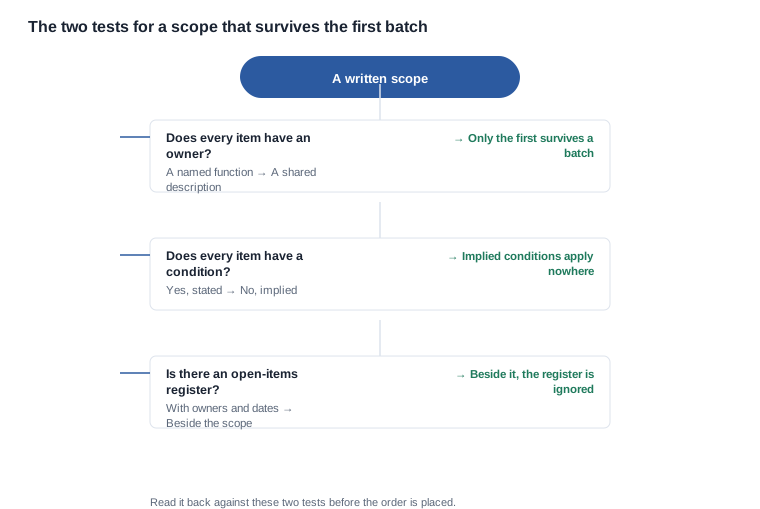
The decision diagram reduces the test to two questions. If every item has an owner and a condition, the scope will survive; if it does not, the survival depends on how well the parties communicate, which is not a property a document can have.
Where CYNRIN stands on smart glasses oem engagement scope
A smart glasses oem engagement is described by a set of obligations with owners and conditions, and we will write our side of that set against a named configuration rather than in general terms. Where our published rows settle a configuration — the cell, the runtime, the charge time, the case position, the charging method, the camera resolution class, the colour, the removable part — we will state them as they are published and check them against the units we build.
Where they do not settle it, we will say so rather than filling the gap. Four camera entries publish no charging method, four camera entries publish no charging-case row at all, two publish a case without a figure, and only two entries in the whole range publish colour names. Our catalogue carries no certification line for any of the twenty-eight entries, no test report, no photograph and no video, and its text names none of CE, FCC or RoHS. Those gaps are stated as gaps, because a scope that quietly assumes them away is a scope that will be wrong later.
We publish no unit price, no price tier, no minimum order quantity, no lead time, no sample fee and no warranty period, and this article contains none of those figures. They are commercial terms, and they belong on the quotation and in the agreement attached to a specific configuration.
What we will do is supply the artefacts our side of the engagement is responsible for, name the evidence behind each of them, and say plainly which obligations sit with the party placing the product on its market. Where a scope item depends on a document that has to be requested, we will name the document and the model designation it has to be requested against.
For a procurement lead, the method is short. Draft the scope as a table of obligations, owners and conditions; add the change rules; add the open-items register; and read it back against the four features above. A scope written that way is the cheapest document in the programme, and it is the one that determines whether the second order is a repeat of the first.
Related reading
- the limits that cannot be settled before a configuration exists
- the customisation routes recorded per product category
- the criteria that let a batch be accepted and by whom
- the nine points that make two quotations comparable
- the printed claims on a carton that need evidence behind them
An engagement is a set of obligations with named owners and stated conditions — write them down in that form and the second order becomes a repeat rather than a re-discovery.


