

Questions about how a smart glasses OEM programme actually runs usually come from buyers who have managed a simpler product category and assumed the same sequence applies. In two specific ways it does not. The specification has far more unpublished rows than most buyers expect, and the compliance step is harder than the tooling step, which is the reverse of what the sequence suggests.
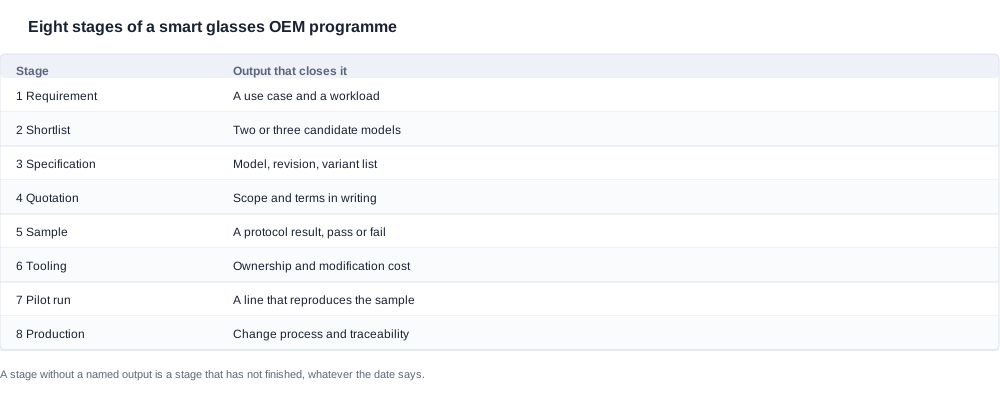
What follows is the process as it actually runs, stage by stage, with the point at each stage where projects typically diverge and the output each stage is supposed to produce. A stage without a named output has not finished, whatever the schedule says.
Unit prices, tooling costs, minimum order quantities, production lead times and capacity are not published on this site and are confirmed per enquiry, and our own source material records the minimum order quantity figures as unresolved. So for us, the stage where those get fixed is the stage where a quotation replaces a page.
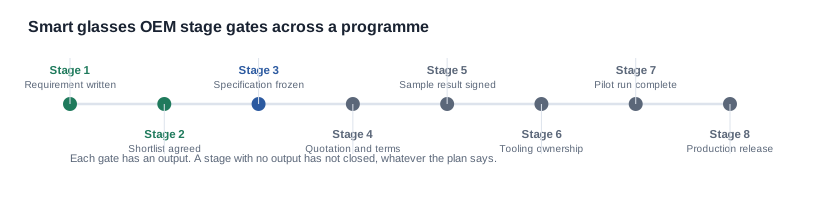
Smart glasses OEM how it works: eight stages from requirement to release
Stage 1: requirement, not model. The process works best when the first conversation is about the use case and the environment, and it works worst when it opens with a model number. A model request gets you a model. A requirement gets you a recommendation you can argue with, which is worth more than the model you asked for.
This matters more in this category than in most. Our catalogue contains a genuine trap for anyone who shortlists on cell capacity: the camera entries publish capacities in the region of 220 mAh to 290 mAh with rated runtimes of roughly five to eight hours, and other entries in the range are built around a different workload entirely. A buyer who reads a capacity figure as a runtime proxy inverts the answer, because the number that matters is the one that fits how the product is actually worn.
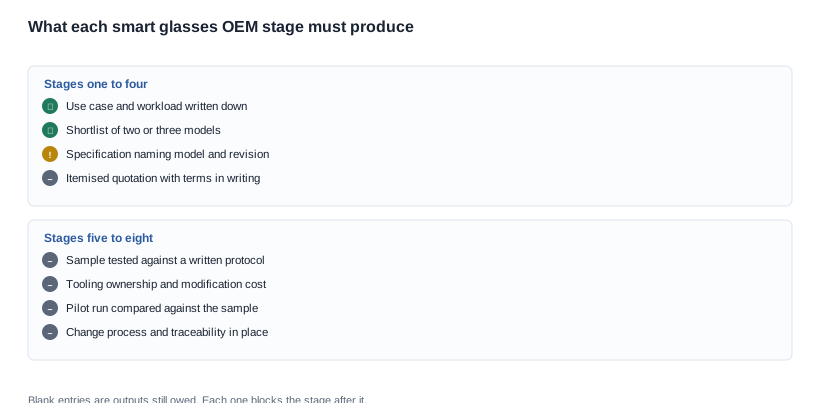
Output: a written brief naming the use case, the environment and the workload.
Stage 2: shortlist. Workload selects the class. Continuous capture points to the camera entries, playback and calls to the audio class, a high-noise environment to the single bone conduction platform, whose Bluetooth version is not published along with the rest of that row set. Two or three models is the right number. Ten is a list to be narrowed later, which wastes the evaluation rather than saving it.
Output: two or three candidate models with the criteria that selected them.
Stage 3: specification freeze. This is the stage that prevents most downstream failures, and it is also the one most often done in an afternoon. Its output is a document naming the model, the build revision, the variant list and the agreed published figures.
The uncomfortable part is writing down what is not known. For our range that list includes cell chemistry, cycle life, replaceability, acoustic measurements, sensor and video specifications, frame weights beyond the single entry that publishes one, the ingress test basis and every certificate number. Writing those gaps into the specification is what stops them being discovered later as surprises rather than as items that were always open.
Output: the specification document, signed by both sides.
Stage 4: quotation. Scope and terms in writing. The items to insist on: tooling ownership and the modification cost, what the compliance scope includes and what it excludes, the definition of a defect, the inspection scope, and the end-of-project terms. Our documentation does not publish unit pricing, tooling cost, minimum order quantities or lead times, so for us this stage is the point at which those get fixed in a quotation rather than read from a page.
Output: an itemised quotation and a set of commercial terms.
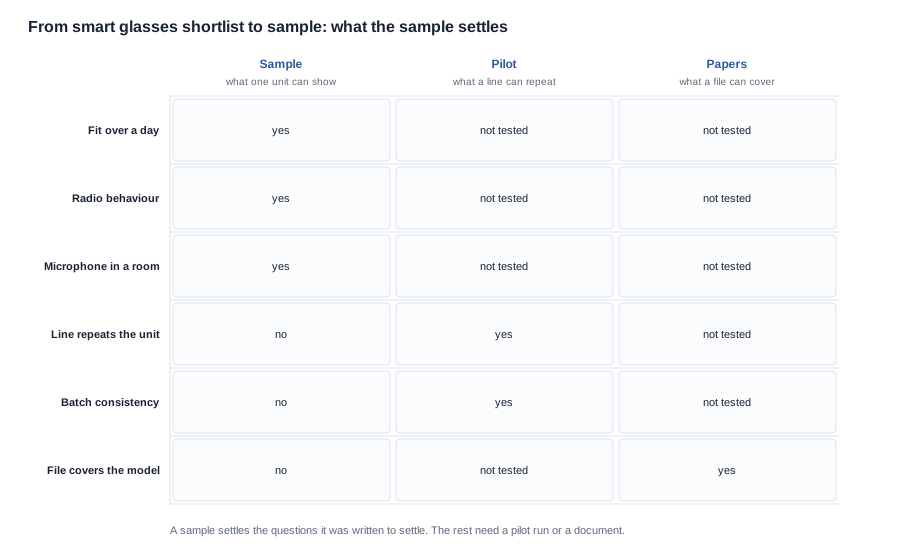
Stage 5: sample. A sample proves more when you decide in advance what it will settle. Fit over a full day, radio behaviour, microphone performance in your environment, battery under your workload. It cannot prove that the production unit will match it, it cannot prove batch consistency, and it cannot prove that the documentation you were shown is genuine. Those three have to be handled by stage 7, stage 8 and a document check respectively.
Output: a signed protocol result, pass or fail, against criteria written before the sample was built.
Stage 6: tooling. Ownership, modification cost and what happens if the project ends. All three in writing. This is the most common single source of expensive disputes in this industry and the cheapest to prevent.
Output: a tooling schedule attached to the purchase order.
Stage 7: pilot run. A different question from stage 5. A factory can produce an excellent hand-built sample that the production line cannot repeat, and the pilot run is the only stage that tests reproduction. A pilot that passes tells you the line can make the product. A pilot that fails tells you something no amount of sample approval would have told you.
Output: a comparison of the pilot run against the approved sample, with the deviations named.
Stage 8: production and the change process. The change process is the deliverable most often forgotten at this stage. Who may request a change, what it costs, how long it takes, and the clause that matters most: what happens to the compliance position when the configuration changes.
Output: a written change process and a traceability record issued with the shipment.
Why the smart glasses specification stage prevents more failures than any other
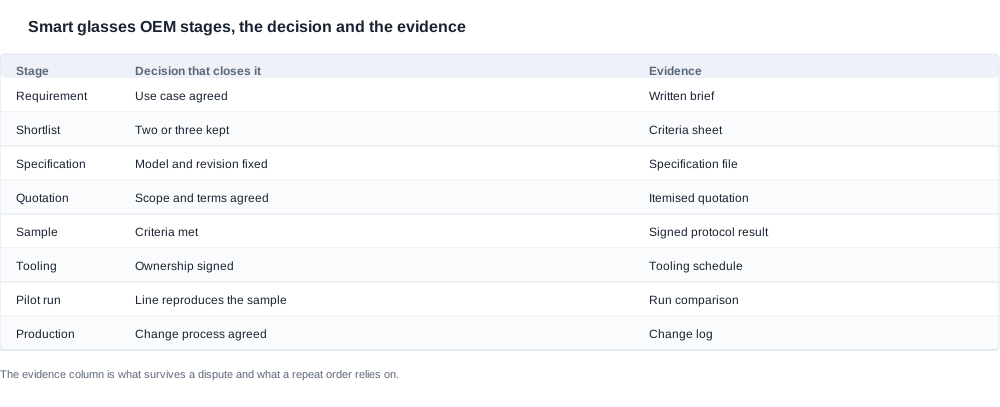
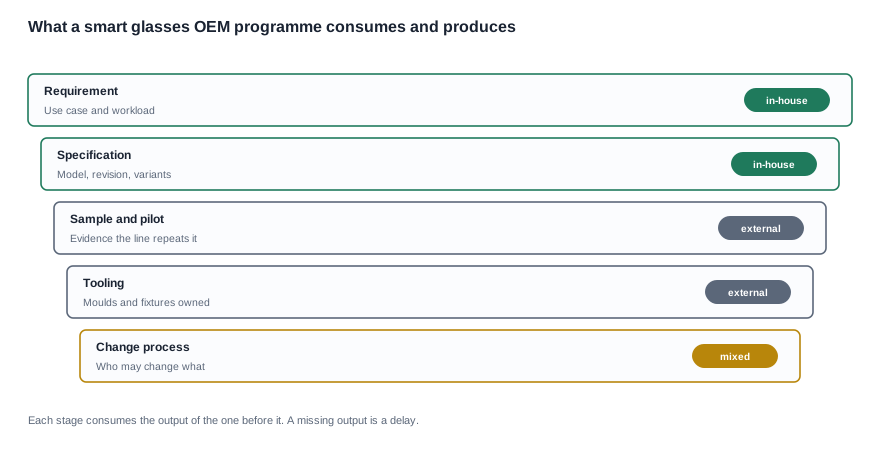
Every other stage in the process consumes something. Stage 4 consumes the specification. Stage 5 consumes the quotation and the criteria. Stage 6 consumes the signed specification and the approved artwork. Stage 7 consumes the sample and the tooling. Stage 8 consumes the pilot result and the change process. The specification is the only document that sits underneath all of them, which is why it is the cheapest place to prevent an expensive outcome and the most commonly skipped.
There is a structural reason the specification gets under-invested. It is the stage that requires both parties to write down what they do not know, and writing down a gap feels like admitting a weakness. It is the opposite. A specification that says "the runtime is published as five to eight hours with no test condition, and we will test it ourselves under the protocol attached" is a stronger document than one that says "runtime about six hours", because the first can be acted on and the second can only be quoted against.
A worked example makes the point. A buyer asks for a camera model that records through a working day. The brief, written as a sentence, produces a quotation. The brief, written as a specification, produces a conversation about the difference between recording continuously and recording in bursts.
Here is what that specification says. Runtime: the published figure for this entry sits in the region of five to eight hours with no test condition published, so the buyer will test to a protocol it has written, with a continuous recording workload, a stated radio condition, a stated temperature and a stated starting state of charge, and the acceptance stated as a number with a tolerance. Charge time: the published ceiling is two hours or less, again with no condition, so the same protocol applies and the acceptance is a stated time from a stated starting state. Case: included or excluded, because the case position differs between entries in this range and its presence changes the bill of materials, the packaging and the freight. Storage: the format, how it behaves at the end of a recording, and whether the unit continues or stops. Colour: the published colour options for this entry, and whether the colour is a part swap or a new setup.
That is a page and a half, and it answers the questions that would otherwise be answered by assumption. It also does something subtle: it moves the runtime discussion from a claim the catalogue makes to a measurement the buyer owns, which is a much better place for the conversation to sit before the order is placed.
The general rule is worth stating plainly. Every requirement in the specification should be one of three things: a number with a condition, a document that will be supplied, or a decision that someone will make and record. A requirement that is none of the three is either a wish or an ambiguity, and in a smart glasses programme most of the cost surprises come from the second kind.
Three things make the specification do its job.
It names the build, not just the model. A model designation in our range can cover a choice of charging interface, a choice of case and a choice of colour, and four camera entries do not publish a charging method at all. A specification that names the model without naming the configuration has not specified the product, and every downstream figure, price and date is conditional.
It lists the variant list explicitly. The variant list is the set of combinations that will exist in the production run, and it is the document that stops the run growing after the freeze date. In our range the variant space is wide because charging interface, case position, colour and camera resolution all vary across the catalogue, and published colour options exist on only two entries, so a colour added later is a development rather than a part swap.
It marks the open rows with an owner and a date. An open row with no owner is an argument waiting to happen; an open row with an owner and a date is work.
The other thing the specification stage does is decide the order of everything else. A specification that is written after the quotation and the sample have already been agreed is a record of what happened rather than a control on what happens next, and the whole sequence downstream of it becomes a negotiation rather than a plan.
The trade-off in spending that time early is real and it is not obvious. Every hour on the specification is an hour not spent on the model, and the model is what a buyer is judged on. The resolution is that the specification is not an alternative to choosing a model, it is the thing that makes the choice safe, and the two work in the same session rather than in sequence. The due diligence question for a buyer deciding how to run that session is simple: which one of the two conversations would you rather have, the one where you discuss the specification in the abstract or the one where you discuss it against a specific candidate and a specific workload. The second is faster, because the specification is written in the vocabulary of the model it is about, and a checklist that names which model it is about answers twice the questions of one that does not. A specification that is written after the quotation and the sample has already been agreed is a record of what happened rather than a control on what happens next, and the whole sequence downstream of it becomes a negotiation rather than a plan.

From smart glasses shortlist to sample: deciding what the sample settles
The shortlist is the stage where buyers most often over-invest, and the sample is the stage where they most often over-claim. Both errors come from the same place, which is not being clear about what each stage is for.
The shortlist is for elimination, not for selection. Two or three models, each with a written reason for being on the list and a written criterion for being removed. The criterion that eliminates most often is completeness of the published rows, because a configuration with several open rows cannot be quoted without a clarification round trip and cannot be reordered without another one. In our range, eleven camera entries publish no Bluetooth version, four publish no charging method, and the case position varies between entries that otherwise look similar. Those entries belong on a shortlist when the product is right, with the understanding that each order will cost you more attention.
The sample is for settling a short list of specific questions, and only those. Write the questions before the sample is built. Does it fit over a full day. Does the radio behave in this environment. Does the microphone capture a usable signal in a real room. Does the battery survive the workload. Four questions, four criteria, four numbers.
What the sample cannot do is worth writing down as clearly, because buyers routinely assume it can. It cannot prove that the production unit will match it. It cannot prove batch consistency. And it cannot prove that the documentation you were shown covers the model you were sent, which is a document question that has to be answered separately. The published charge time for the great majority of entries is a ceiling of two hours or less with no test condition, and the published runtime figures for the camera tier come with no condition either, so a sample evaluation has to establish its own conditions or it produces an opinion.
There is one discipline at this stage that is worth more than the sample itself: record the sample's build revision, photograph the unit against its label, and keep both with the signed approval form. Without that, the approved sample cannot become the golden sample, and the golden sample is the reference that every later batch is compared against. A golden sample that nobody can identify is a memory.

Smart glasses tooling, the pilot run and the change process
These three stages are grouped because they share a single theme, which is reproduction. The tooling is the physical means of reproduction, the pilot run is the first test of it, and the change process is the set of permissions that govern it afterwards.
Tooling. Three items, all in writing: who owns the mould and fixtures, who pays to modify them, and what happens to them if the relationship ends. The modification cost is the one that surprises buyers, because a second colourway or a second market may need a mould change rather than a part change, and a mould change is a setup, not a purchase. Our published colour options exist on only two entries in the whole catalogue, so a range that expects more colourways is buying developments, and the development cost belongs in the same conversation as the tooling ownership.
The pilot run. This is the stage most often compressed into the sample, and compressing them is how a programme discovers that the line cannot repeat the product. The pilot answers one question: can this production line, with these components, in this batch, produce a unit that meets the criteria the sample met. A pilot that fails on colour or finish has told you something valuable and cheaply. A pilot that is skipped tells you nothing until the first production batch, which is at a much greater distance from the point where you can still change something.
What a good pilot looks like in practice is worth spelling out, because it is more than a quantity check. Ask what the line measured while it was running, not only what it inspected at the end. A factory that measures colour, fit and charge performance across the run and can show you the spread is telling you that it knows the pilot is where drift shows up. A factory that inspects only at the end can tell you whether the run passed, and nothing about whether it was drifting toward the edge.
Three practical points. Run the pilot on the same line, and where possible the same shift pattern, as the production run, because a different line is a different pilot. Compare against the approved sample during the run rather than against the specification, since the specification carries tolerances and the sample does not. And put the traceability record in place during the pilot rather than after it, because the pilot is where you find out that the system for issuing it does not work.
And keep one unit. Not several, one: the golden sample from the approved pilot, retained and identified, because it is the reference against which the first production batch, the fifth production batch and every warranty claim in year two will be judged. If the golden sample is lost, the comparison standard becomes a photograph, and a photograph does not settle a dispute about fit.

The change process. Who may request a change, what it costs, how long it takes to implement, and what happens to the compliance position when the configuration changes. That last clause is the one that matters most in this category, because a configuration change can quietly invalidate a technical file, and our catalogue publishes no per-model certification row at all. If there is no published baseline to compare against, the change notification becomes the only mechanism that keeps your documentation aligned with what is in the box.
There is also a discipline at this stage that most programmes skip: the traceability record. The batch or serial reference that links a shipped unit to a production run is what makes a warranty claim work two years later, and it is what lets you answer a question about a field failure without guessing. It is cheap to issue and impossible to reconstruct.
Where a smart glasses OEM process is genuinely constrained
It would be dishonest to describe a process as smooth when parts of it are hard. Two constraints are worth naming early, because they change what a buyer should plan.
The compliance position is the harder step, not the tooling. Tooling is a mechanical cost with a known shape. The compliance position in this category is not published in a form a buyer can read: our catalogue has no per-model certification row, and the export certification page is a picture page carrying ten patent certificate images, eight of them design patents and two utility models, with no model list on any of them. So a programme whose channel requires documentary evidence has to obtain that evidence separately, as a workstream with its own lead time, rather than reading it off a product page. That is a stage 6 and stage 8 conversation, and it is better had before the first purchase order.
The published specification is uneven across the range. Our catalogue publishes a Bluetooth version for fourteen of the twenty-eight entries, a charge time for twenty-six, a charging interface for twenty-four, a charging case capacity for five, an ingress rating for two and a frame weight for one. It publishes no capacitive-touch row and no translation row anywhere. The consequence is that the amount of diligence a configuration needs varies enormously, and a buyer who has budgeted diligence by model rather than by row will under-budget on the sparse configurations and over-budget on the dense ones.
Stages one through five and stage eight we can run properly, because they are process rather than evidence. Stage six carries the structural constraint described above, and the honest answer to it is that it takes longer and depends on documents that have to be requested rather than read.
We would rather a buyer spent more time on stage three than on stage five. The specification is the only document that quietly prevents failures at every later stage, and it is the one most often written quickly. A buyer who arrives with a two-page brief and a considered set of open questions will get a better programme out of this process than a buyer who arrives with a finished specification and nothing to negotiate.
The full stage sequence is set out in odm development stages and in development stages in detail. The handover risks that sit on top of this sequence are covered in the risk factors in an OEM handover, the modification costs that stage eight manages are in how deep a customisation goes, and delivery and support terms at release are in development process delivery and support.
Related reading
- The eight stages in detail — odm development stages
- What a modification changes — customization cost factors
- Delivery and support terms at release — development process delivery and support
- The handovers where projects lose money — OEM risk factors
Tell us your use case and we will tell you which models our published rows support.


