

Smart glasses pricing is only comparable when two quotations are decomposed the same way. The unit price at the top of a quotation is the smallest part of it, and two suppliers quoting identical model codes can sit a long way apart because one has folded the charging case, the setup work and the compliance route into the unit price while the other has priced all three as separate lines. Treat that gap as a pricing disagreement and you will argue about the wrong number; treat it as a decomposition disagreement and you can fix it before a deposit is paid.
This article sets out the four cost lines a quotation has to separate, which parts of each line the 2026 catalogue lets you observe for yourself before you contact anyone, which questions move the price before you even ask for it, and — stated plainly — which parts of a smart glasses price we will not put in writing, and what we will answer instead.
Smart glasses pricing: what a comparable quotation has to contain
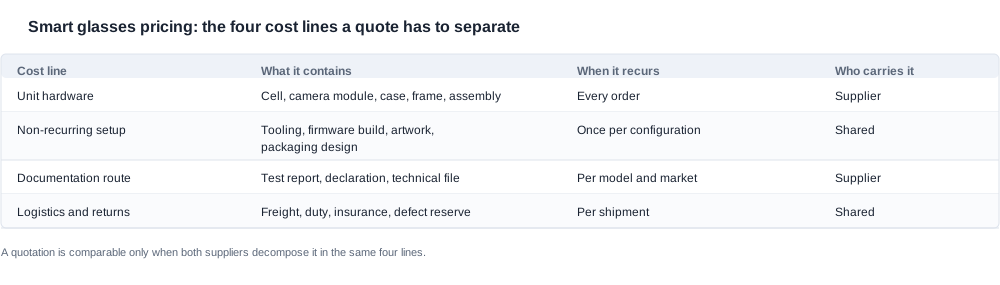
The useful output of a pricing conversation is not a figure. It is a cost structure you can put beside another supplier's cost structure and compare line by line. A quotation is comparable only when both sides have decomposed it identically, and the decomposition is decided by the buyer, usually before the first supplier is contacted. That is why the configuration question comes before the price question: a configuration described in general terms produces a price that cannot be compared with anything.
| Cost line | What it contains | When it recurs | Who carries it |
|---|---|---|---|
| Unit hardware | Cell, camera module, case, frame, assembly | Every order | Supplier |
| Non-recurring setup | Tooling, firmware build, artwork, packaging design | Once per configuration | Shared |
| Documentation route | Test report, declaration, technical file | Per model and market | Supplier |
| Logistics and returns | Freight, duty, insurance, defect reserve | Per shipment | Shared |
The four lines behave differently, which is why they must be separated before they can be negotiated. Unit hardware is a function of the build and repeats on every order. Setup is paid once and is the only line a buyer can amortise across volume, and it is amortised by the buyer, not by the supplier, which means the amortisation basis has to be stated in the quotation rather than assumed inside it. The documentation route reopens whenever the model count changes, so a price that covers three models does not survive a fourth. Logistics and returns are the only lines where a buyer can change the outcome materially by changing behaviour rather than by negotiating.
The reader behind this question is a procurement manager on the brand side, a channel buyer or an importer, and the situation is one of three: two quotations to compare, a new programme to open against a date somebody else has committed to, or a market to enter with no supplier chosen yet. The fear underneath the enquiry is rarely the unit price. It is a lot that differs from the sample that was approved, a paperwork trail that stops the shipment at a frontier, or a first batch that turns into a returns burden nobody carried. All three of those are pricing failures, because all three are costs that were missing from the quotation.
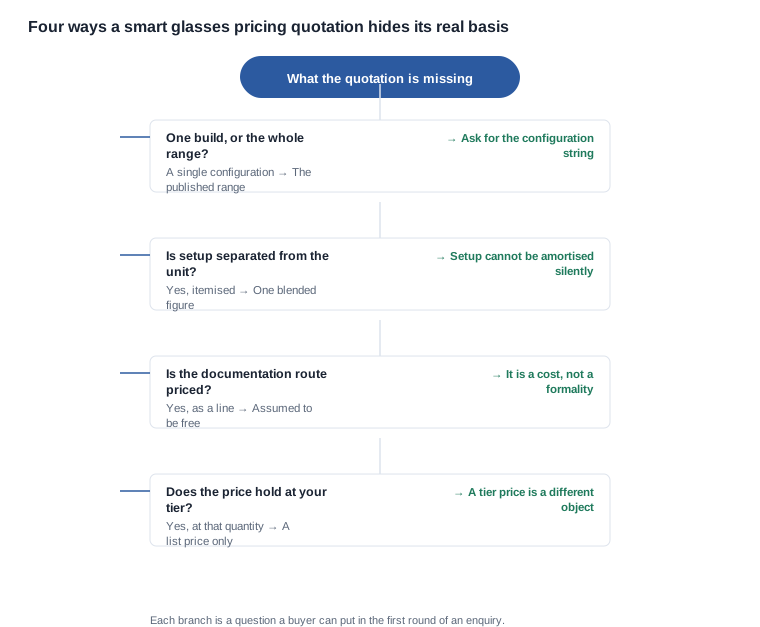
The decision tree above is the fastest way to find out which line is missing. Work down it in order rather than jumping to the branch that suits your negotiating position. If the quotation covers the whole published range rather than one configuration, no comparison is possible at all, because a range figure is an average over builds you are not buying. If setup is blended into the unit price, the price will appear competitive and the second order will appear expensive, because the blended figure was never paying for the setup at all. If the documentation route is treated as a courtesy, it will appear as an exception in month three, at a cost that has no line in the original quotation.
A final point about the arithmetic. The unit price is one term in a total cost, and it is frequently the smallest one. The total cost of a delivered unit is the unit price plus the setup amortisation you have decided on, plus the freight and duty under the agreed incoterms, plus the documentation route for the markets you are actually shipping into, plus a reserve for defects and returns. A buyer who negotiates the unit price down by four per cent and then discovers that the freight basis changed has not saved four per cent. This is the trade-off to hold in mind throughout: the number you can move is not always the number that decides the total cost.

Which parts of a price are decided by the build and which are open to negotiation
Some elements of a smart glasses price are settled before any commercial conversation starts, and trying to negotiate them is a waste of the meeting. The cell capacity is settled by the model. The camera tier is settled by the model. The charging interface is settled by the model — the catalogue carries a magnetic interface on seventeen models, a Type C port on seven, and no published charging-method row at all on the L1 Pro and the MT6, and the CY05 and the CY03, which means for those four the interface is something you request in writing rather than something you read off a specification sheet.
These are specification steps, not price steps, and treating them as price steps is the most common way a procurement manager loses a quarter of an afternoon. A 290 mAh build and a 220 mAh build are different products, and the price difference between them is a different product's price difference. The buyer who asks for a discount on the cell has asked for a discount on a component the factory bought at a cost the factory set.
The case is where the specification moves fastest in practice, and it is the line most often missed by a buyer reading only the model name. Published case capacities across the camera models are 900 mAh, 1200 mAh and 1400 mAh, and the L2 Utral is published at two capacities, 900 and 1400. The MT6 carries a 1200 mAh folding case, which is a different assembly from a fixed case and does not share a line time with one. The V03 Pro has no charging case in the box at all. The KY06 and the MT5 have a case whose capacity is not published. Any two quotations for "a camera model" are therefore potentially comparing different assemblies, and the case specification is the fastest way to find that out.
The setup layer behaves differently again. Tooling, the firmware build, artwork preparation and packaging design are paid once per configuration, and the right question is not whether they can be negotiated but whether they have been stated separately at all. A supplier who blends setup into the unit price is not being generous; the buyer is being asked to discover the amortisation later. Ask for the setup line, ask what it covers, and ask whether it is charged again if the configuration changes.
Once the setup line is visible, the amortisation decision belongs to the buyer and it is worth making explicitly rather than by intuition. Two suppliers quoting the same setup figure and different unit figures can be reconciled by spreading that setup over a volume the buyer has not yet committed to, and the volume that makes the lower unit figure win may be a volume the buyer cannot forecast. The comparison therefore has two inputs and not one: the unit figure and the volume at which it becomes correct. A buyer who takes the lower unit figure without the volume assumption has made a purchasing decision by accident, and will discover it at the second order, when the volume did not materialise and the setup still has to be paid.
The documentation route is the layer that surprises people who have not run a multi-market programme. It is scoped by model and by market, and it reopens whenever the model count or the destination changes. A quotation that covers one model in one market cannot be scaled to five models in three markets at the same number. That is not a pricing position; it is arithmetic.
Logistics and returns are the only layer where the buyer has genuine control. The incoterm decides who carries freight, insurance and duty, and the choice moves the landed cost more than any plausible unit price negotiation. The returns reserve is decided by how the shipment is inspected and what the acceptance window is, which is a procurement process question rather than a factory question.
The negotiation posture that follows from all of this is simple. Ask for two or three lines at full strength rather than eleven lines at half strength. A buyer who demands a decomposed cost structure, a dated production plan and a written slot rule in the same message usually gets a worse answer on all three than a buyer who asks for the decomposition first and the rest once it exists.

What the catalogue publishes that you can price against
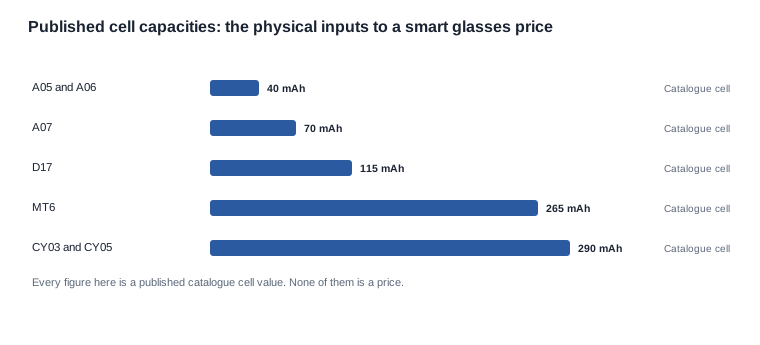
The 2026 catalogue is more useful to a pricing question than it first appears, because it fixes the physical inputs to the hardware line before any supplier conversation happens. It covers 28 models: eleven carry a camera, eight are audio models with a Bluetooth version published for each, and three are sport models. The cell capacity runs from 40 mAh on the A05 and the A06 to 290 mAh on the L2 Utral, the L1 Pro and the CY05, and the CY03, and it is published per model, so the input to the hardware line is knowable before you ask.
The camera tier is published with the same precision, and it is worth knowing that there are two tiers rather than a continuum: 8 megapixels across eight models — the CY05 and the V03 Pro, the V06 and the MT5, and the V03 and the CY03, and the MT6 and the KY06 — and 13 megapixels across three, the S7 and the L1 Pro, and the L2 Utral. A buyer comparing two quotations for the same camera line is therefore comparing two of three tiers, and the tier is a specification decision taken before the price.
Several other published rows are directly usable. Charge time is published for every one of the 28 models, with 26 at up to two hours and the D17 and the ZH12 at around one hour. Runtime is published for every one of the eleven camera models: 5 to 8 hours on the V03 and the V03 Pro, 6 to 8 hours on the KY06 and the MT5, around 7 hours on the CY05 and the L1 Pro, the MT6 and the CY03, and the L2 Utral, and 5 to 8 hours on the V06 and the S7. Twenty of the 28 models carry an AI function. These are the rows that make a quotation checkable, because a supplier's build has to be consistent with them.
One published row has to be handled with caution. The MT6 is the only model in the catalogue with a published weight: 158 g for the glasses body itself, including the battery and the camera and excluding the folding charging case. The case capacity is 1200 mAh and the case weight is not published. No other model publishes a weight, so a buyer who needs a frame weight for a shipping calculation or a sizing specification has to request it in writing for the specific model rather than generalising from a figure that exists for exactly one product.
What the catalogue does not contain is as important to a pricing question as what it does. It has no per-model certification row — the export certification material sits at company level, so the certification scope for a specific model is written material to be requested, not a line to be read off. It does not publish unit prices, minimum order quantities, tooling costs, non-recurring engineering charges, capacity figures, lead time commitments, defect rates or certificate numbers. It does not publish the Bluetooth version for the camera models. Buyers will ask about CE, FCC, RoHS and UN38.3 in every market; those are attention items in a conversation, and the honest position is that our catalogue does not carry a per-model certification line.
There is one further asymmetry worth putting in writing before a supplier quotes you. Our catalogue is a specification document, not a price document, which means a buyer can arrive at a comparison already knowing the physical shape of the product being quoted — the cell, the camera tier, the case, the charging interface, the charge time and the runtime — without asking anyone. A supplier who quotes against a configuration that contradicts those published rows is telling you something about their own operation, not about our catalogue. That is a cheap consistency check and it works in the buyer's favour, because it is performed on data the supplier has already seen.
Questions that move the price before you ask for it
Most price movements happen before the quotation is issued, and the questions that cause them are structural rather than adversarial. The first is the configuration string. Ask for the exact model codes, the case option, the colourway, the packaging type and the regional firmware, and ask for them as a written string that both sides quote against. A price for "the L2 Utral" and a price for "the L2 Utral with the 1400 mAh case in retail packaging for the European Union" are different prices for different products, and the second is the one that is comparable.
The second is the quantity tier. Ask whether the quoted figure holds at your volume, and ask what the ladder looks like below it. A price that is valid only at the quoted quantity is a list price with a date on it, and it should be treated as one.
The third is packaging. Retail box, bulk pack, insert count, manual language count, regional labelling and barcode configuration all change the packaging line and the assembly time, and a factory that quotes a bulk pack at the retail box price has not quoted the same build.
The fourth is artwork. Ask who owns the print files, how many rounds of proofing are included, and what happens to the setup charge if the artwork changes after approval. Artwork is one of the few recurring sources of a "change after the slot was booked", and the price of a change is rarely in the original quotation.
The fifth is documentation scope. Ask how many models and how many markets the file covers, and what a further model or a further market costs. The sixth is the freight basis, which decides the landed cost and the incoterm. The seventh is the returns and warranty position, which decides who carries the freight on a defective unit and how quickly a replacement reaches the channel. The eighth is the payment structure and deposit, which affect the priority your order receives in a constrained month.
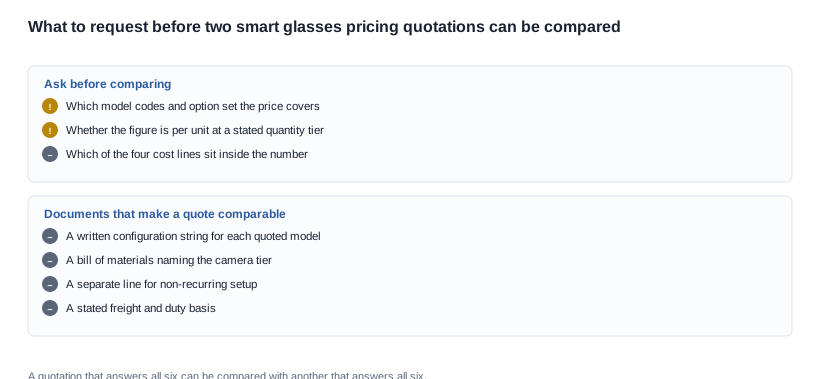
The questions to put in the first round, then, are these:
- Which model codes and option set does this price cover?
- Is the figure per unit at a stated quantity tier, and what is the ladder below it?
- Which of the four cost lines sit inside the number?
- Is the non-recurring setup quoted separately, and what does it amortise over?
- How many models and markets does the documentation route cover?
- What freight and duty basis is used, and under which incoterm?
- What is the returns and warranty position for a defective unit?
- Which stage of the production plan is binding for this configuration?
Red flags in a pricing conversation are worth naming precisely because they are unremarkable on their own. A single blended figure with no decomposition. A price for the range rather than for a build. A discount ladder with no floor and no stated validity. A quotation that expires in seven days with no tier attached. An assurance that the price "includes everything" with no list of what everything covers. None of these is a reason to stop dealing with a supplier; each is a reason to get the decomposition in writing before anything is signed.
One last operational point ties the pricing round to the production round, and it is the reason a price should never be negotiated in isolation from a schedule. A price is normally valid for a stated period, and a validity period usually expires on a date chosen by the supplier. If the order cannot be scheduled inside that window, the price that was agreed is not the price that will be invoiced, and the re-quote is where the decomposition tends to collapse back into a single figure. Ask two things together: the validity period, and the condition that extends it. The usual answer is that the price holds against a booked slot, which is a far better answer than a calendar date because it ties the commercial commitment to the thing that actually consumes the factory's capacity.
What we publish, and what a request for quotation has to carry
Stated plainly: deliberately narrow, and it is worth stating plainly because pricing is where suppliers are most often vague. We publish what the catalogue contains: the 28 models, the charge times, the case capacities, the electrical rows, the charging methods and the pixel tiers. Those are the facts that decide which configurations exist, and therefore which pricing question is worth asking at all. We do not publish a unit price, a price tier, a minimum order quantity, a tooling or NRE figure, a capacity number, a lead time commitment, a defect rate or a certificate number.
The reason is not caution. None of those figures is meaningful without a configuration, a quantity and a date range, and all of them move with the order book. A number that changes weekly is worse than no number, because it will be quoted back to you as though it were a standing commitment. We would rather hand you the inputs that let you check a price than a price you cannot decompose.
What we will do without a commercial conversation is answer the configuration questions. Send the model codes, the option set, the quantity, the destination market, the required arrival date and the packaging requirement, and we will tell you which configurations exist, which published rows apply to them, which of the eight questions above are worth putting to every supplier in the round, and where the binding stage sits in the production plan for that build.
For the pricing framework itself, see pricing tiers and cost structure. For the commercial terms that usually sit alongside the unit price, see payment terms. For the assumptions that are worth challenging before you sign, see pricing myths. For the camera configurations that carry the widest specification spread, see AI camera glasses.
Send the model codes, the option set, the quantity, the destination market and the required date, and we will tell you which parts of the pricing question are settled by the catalogue and which have to be answered by the factory.


