

Smart glasses pricing is where most procurement conversations begin and where the wrong number gets agreed. Five beliefs travel from one buying room to another, and each of them is cheap to state and expensive to hold. None of the five is repaired by a lower price; every one of them is repaired by a better-specified order, a decomposed quotation, or a question answered in writing rather than in a meeting. What follows sets out each belief, the published catalogue position it collides with, and the single question that settles it.
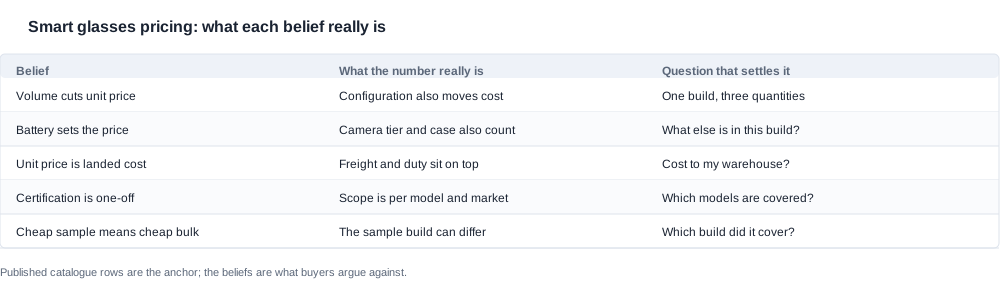
The five beliefs are not foolish. They are what a buyer concludes when the only information available is a catalogue page, and they survive because the correct answer demands work from the buyer rather than from the seller. We publish the electrical rows and the configuration facts for our models. We do not publish unit prices, minimum order quantities or production lead times, because those are properties of a configuration and a quantity rather than of a product family. That single editorial decision is the reason these beliefs are so common: the numbers a buyer can see are specifications, and the numbers a buyer needs are prices.
Smart glasses pricing myths: the five beliefs that cost real money
What a belief about price actually is
A belief about price is not a statement about cost. It is a rule learned in one negotiation and carried into the next, and it feels like knowledge because it produced a good outcome once. The problem is that a rule learned in one configuration gets applied in another without being checked, and the cost of that transfer is paid much later, in a landed figure that was never modelled, or in a first shipment that does not match the approved sample.
The five below are the ones that recur in this category. They are written as beliefs rather than as errors, because a buyer who holds a rule will not respond to being told the rule is wrong. Each is paired with the published row it runs into, and each carries one question attached to it, because a question with a written answer is the only thing that moves a specification and a price at the same time.
Why the same belief appears in five different buying rooms
A brand opening a private label programme, a channel buyer reordering a line that already sells, an importer moving a product into a new market, and a sourcing team qualifying a second supplier all reach for the same shortcuts. The situations differ in one way that matters. The brand has no history with the supplier; the channel buyer has a history with a product line. Both arrive at the same conversation, and the same belief does the same amount of damage in each.
The difference a buyer should exploit is the history. A repeat buyer already holds an approved sample, a signed configuration and a previous order. A new buyer holds none of those and will take longer to build them, which is an argument for asking more questions early rather than fewer. The pricing section sets out the structure that both kinds of buyer are working with, and it is worth reading before the first enquiry rather than after the second.

The volume belief in smart glasses pricing and the cost sheet behind it
A price that falls in steps is a different offer from one that falls smoothly
The first belief is that unit price falls automatically with quantity, and its practical form is that the bigger the order, the better the number. A cost sheet says something more precise than that. Component and assembly cost fall with quantity, but they fall with configuration too, and the two effects are routinely confused because both of them push the same number in the same direction.
The test is straightforward and costs nothing to run. Ask for the same configuration at three quantities and read the absolute difference between the points rather than the percentage. A price that drops meaningfully at the first step and then flattens tells you where the supplier's cost structure actually changes, which is more useful than the final figure. A price that barely moves across a wide range tells you that the quantity is not the lever here and the configuration is.
What a volume discount is actually made of
Three things move together when a buyer asks for a bigger quantity, and only one of them is a discount in the ordinary sense. The first is the component market: a larger commitment buys a better position on parts, and that is a real discount that survives scrutiny. The second is setup: assembly and calibration are largely fixed per run rather than per unit, so a larger order spreads that fixed cost further and lowers the effective unit cost. The third is configuration count, and it is the one that catches people out.
Ten colourways of five hundred units is a more expensive order than one colourway of five thousand, at a lower unit price, and the second is usually the cheaper order in total. Because the quote is expressed per unit, comparing two orders that differ in colourway count reads as a saving when it is in fact a penalty. The question that separates them is short: what changes in the build if the colourway count drops, and what does that change do to the unit price?
The three-quantity test in practice
Ask for one configuration at three quantities, on the same document, with the same delivery terms and the same destination. Then ask for a second configuration at the same three quantities. The comparison you want is not between the two quotes; it is between the slopes. A configuration whose price falls steeply and then flattens is a configuration where volume has been found. A configuration whose price is nearly flat is one where the specification is doing all the work.
This is also the cheapest way to distinguish a supplier working from a cost sheet from one working from a discount table. A supplier with a real cost sheet can answer three points for any configuration asked for. A supplier with a discount table can only answer them for configurations they have already built, and the answer arrives with a qualification attached.
There is a second reason to run the test early rather than at signature. The three points expose the shape of the supplier's cost structure, and that shape tells you where the negotiation will actually be productive. If the slope is steep at the first step, the argument is about committing volume. If the slope is flat, the argument is about the configuration, and pushing on volume will cost you goodwill without moving the number. Buyers who discover this at signature have already spent the leverage they needed at the right point in the conversation.
The battery belief and the specification it hides in smart glasses pricing
Why capacity alone cannot explain two prices for similar products
The second belief is that the battery sets the price, and it is the most defensible of the five because battery cost genuinely is a large part of the bill of materials for a device this size. It fails as a complete explanation because two products with similar capacity sit in different bands for reasons that have nothing to do with the cell.
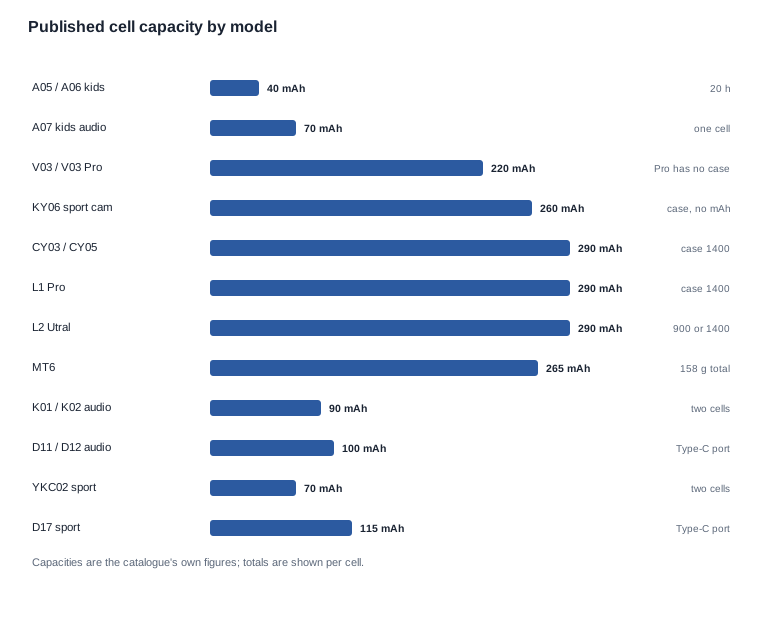
Take the camera range in our own catalogue. Eleven models carry a camera. Eight of them publish an 8 MP resolution tier and three publish a 13 MP tier. The 13 MP tier is not a single cell size: the L1 Pro and the L2 Utral sit at 290 mAh and the S7 at 260 mAh. The 8 MP tier is no narrower, running from 220 mAh on the V03, the V03 Pro and the MT5, through 260 mAh on the KY06 and the V06 and 265 mAh on the MT6, up to 290 mAh on the CY03 and the CY05. A buyer comparing an 8 MP model at 220 mAh against a 13 MP model at 290 mAh is comparing a module change and a battery change at the same time, then crediting the whole gap to the battery.
The camera tier and the case as the second and third lines
Resolution is the second line, because the camera module is a separate purchase with its own cost, its own tooling implications and its own footprint in the market access file. The case is the third, because it is a second product in the box carrying its own cell: three models publish a 1400 mAh case, one publishes a folding 1200 mAh case, one offers a choice of 900 or 1400 mAh, and two more carry a case whose capacity is not published. The V03 Pro publishes no case at all.
A buyer who prices the glasses and treats the case as an accessory is pricing the smaller half of the box, and the accessory half is frequently the part with the larger carton. It is also the part that most often changes the freight calculation, because a case adds volume to the consignment whether or not it adds much to the product weight.
Where the published capacity ends and the enquiry begins
Our catalogue publishes the electrical rows for every model: cell capacity, endurance, charge time, the charging method where it is stated, and case capacity where a case is included. It does not publish sensor part numbers, product weights for most models, or the charging method for the four camera models that publish a case capacity without publishing the method. Those gaps are not oversights to be smoothed over with a typical figure. They are the questions a procurement file should carry to a supplier.
The correct conclusion from the published rows is a boundary rather than a number. We can tell a buyer which models share a tier and which do not, and we can tell them precisely where the catalogue is silent. We cannot tell them what any of it costs, and we would rather say that plainly than print a figure that will not survive the first invoice.

Landed cost and certification scope: the two beliefs that survive longest in smart glasses pricing
Freight follows volume, not the product's own weight
The third belief is that the quoted unit price is the landed cost. It is attractive because the number on the quotation is labelled as a price and arrives in a place where prices are expected. It is also the belief that most often produces a supplier who wins on unit price and loses on landed cost, with the negotiation conducted on the number that was never going to decide it.
Freight on a product this size is usually governed by volumetric weight rather than by the product's own weight, and the catalogue publishes one product weight only: 158 g for the MT6 glasses body, which includes the battery and camera and excludes the folding charging case, whose own capacity is published as 1200 mAh and whose weight is not published at all. A configuration that ships with a case can therefore add more freight than a unit price negotiation saves, and the only way to find out is to ask for the price delivered to a destination rather than to the factory gate.
Certification scope belongs to a model, a configuration and a market
The fourth belief is that certification is a one-off for the company, and it is the belief that costs the most in schedule rather than in money. Our own catalogue illustrates the point neatly: it carries a company-level page for export certification and it does not carry a per-model certification row. That is the honest position of a catalogue, and it is a different position from a supplier who holds a technical file for each configuration you might order.
The scope that matters is the Radio Equipment Directive (EU) 2014/53/EU and the market access work attached to a specific model in a specific destination. A question that does not get a written answer is a schedule risk that has not been priced, because a file that cannot be produced within hours becomes a hold, and a hold becomes a launch window that does not reopen.
What our own catalogue does and does not publish
We publish the configuration facts and we mark the rows that are open. We do not publish unit prices, minimum order quantities or production lead times, because a published price in this range would mislead almost every buyer who reads it. Where the catalogue is silent we say so in the specification rather than filling the gap with a figure borrowed from a neighbouring model, and we would rather hand a buyer a short list of open rows than a long list of confident guesses.
That stance is why the fifth belief matters. If a sample looks cheap, the natural conclusion is that the bulk order will be cheap, and that conclusion quietly assumes the sample and the order are the same build. Most of the time they are not, and the quotation for the bulk order is the point where the difference becomes expensive.

The questions that settle each smart glasses pricing belief in writing
Turning a belief into a question
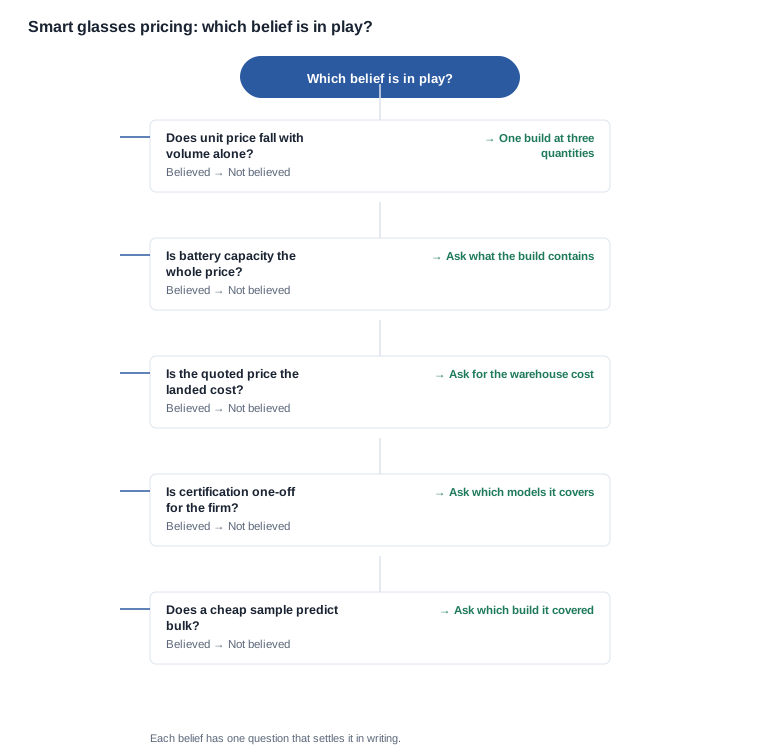
Every one of the five beliefs resolves the moment it is converted into a question that can be answered in writing. The conversion is mechanical. The belief about volume becomes a request for one configuration at three quantities. The belief about battery becomes a request for the bill of materials behind the quoted configuration. The belief about landed cost becomes a request for the price delivered to your warehouse. The belief about certification becomes a request for the models and markets covered. The belief about the sample becomes a request for the build the sample covered.
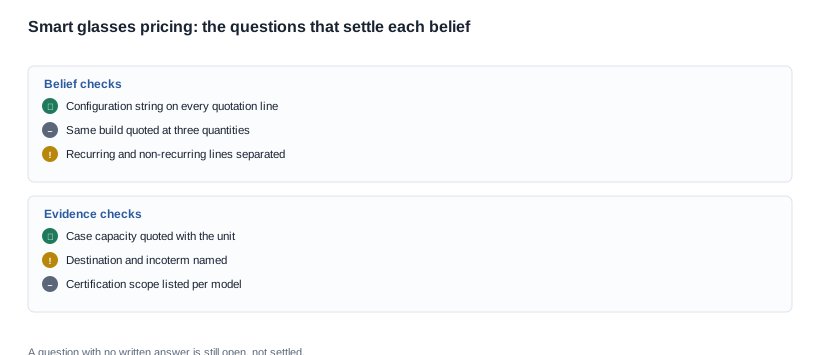
The five, written as a single list that can be pasted into an enquiry:
- Quote one named configuration at three quantities, on the same document, with the same delivery terms.
- Give the bill of materials behind that configuration, so the camera tier, the cell and the case can be read as separate lines.
- Give the price delivered to our warehouse at our destination, with the incoterm named, rather than the price at the factory gate.
- Name the models and the destination markets your market access file covers, and the date each file was issued.
- State which build the sample you quoted was made from, and whether that build is the one this price covers.
A worked reasoning path through one enquiry
Suppose a buyer holds two quotations for the same model family and one is visibly cheaper. The instinct is to ask for the gap to be explained. The better move is to ask the five questions and wait for the answers, because the answers usually reveal which belief is in play. A quotation that names the configuration, splits the one-off lines and carries a validity date is usually the better number even before freight is added to it. A quotation that does none of those is a number with a great deal of air around it, and the air is where the money went.
The order in which the five questions are asked matters less than the fact that all five are asked in the first round. Asking them early establishes which quotation is complete, because a quotation answering three of the five is answering a different question from one answering all five, and the two cannot be compared.
The five questions as a single sequence
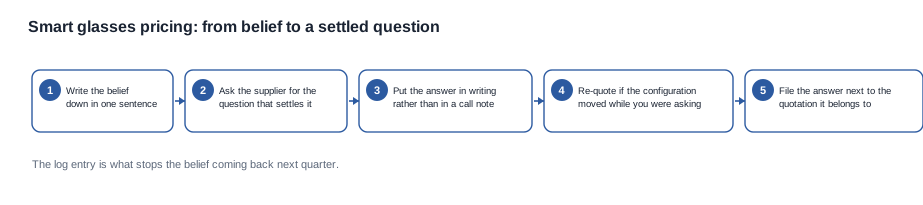
The sequence runs from the specification outwards. Freeze the build, ask for the split, ask for the price at your destination, ask which models the market access scope covers, and ask which build the sample covered. Each answer is written into the file against the quotation it belongs to, so the next order starts from an established position rather than from an introduction. That is the practical difference between a pricing conversation and a pricing process.
What we will put in writing about a smart glasses pricing answer
What a quotation will and will not lock
We will give you the recurring and non-recurring split for a configuration, a validity period, a configuration lock sheet, and a named list of the models our catalogue covers for a given destination. We will tell you when a change to your specification reopens the price, and we will tell you which rows of the catalogue are open rather than estimated. What we will not do is hold a price against a specification that has moved, and we will not re-quote a different configuration at the same number to avoid a conversation, because that number will not survive the first invoice.
Where we are not able to help
We cannot publish a price list, and the reason is structural rather than cautious. Unit price, production lead time and minimum order quantity are properties of a configuration and a quantity, and a list published without them would be read as a commitment to a product that does not exist. The same applies to the open rows: sensor part numbers, product weights beyond the MT6 figure, and the charging method for the four camera models that publish a case capacity but not the method itself.
It is worth being explicit about what this costs us, because a reader is entitled to know the trade-off behind the position. Publishing a price range would produce more enquiries and fewer useful ones, because the enquiries would arrive with a price already in mind and a specification still open. Declining to publish produces fewer enquiries, and the ones that do arrive carry a specification, a quantity and a destination. We would rather have the second kind, and we would rather be judged on whether the configuration we quoted is the configuration that shipped than on a number that would be wrong for most of the buyers who read it.
Sending the colourway count, and what a quotation has to itemise
Send the models, the quantities, the destination market and the number of colourways you intend to carry, and we will tell you which configurations exist, which of them are open on the published data, and what a quotation for them would have to itemise. The camera and audio smart glasses range shows the models these questions apply to, and a worked contract example shows what a complete file looks like once the answers are in.
For the specific questions to place in a technical file, the certification checklist lists them in the order we would answer them, and comparing two models on price positioning sets two configurations from the camera range against each other on the published rows.
Bring the models, the quantities and the market, and we will say which parts of smart glasses pricing are settled on the published data and which parts are yours to verify.


