

Smart glasses pricing case example is offered as a worked structure rather than as a customer quotation, and the distinction is deliberate. We publish no unit price, no non-recurring cost and no tooling figure for any model, because those are terms and they belong in a quotation against a defined configuration. What we can do is take one configuration — a real one from our own range — and show how the price is assembled, so that a buyer can compare two quotations on the same basis.
The configuration is a camera platform, one colour, a printed retail box, the standard cable set, and one destination market. It is described in full below, and every line in the worked structure either comes from a published catalogue row or is a decision the buyer would have to make.
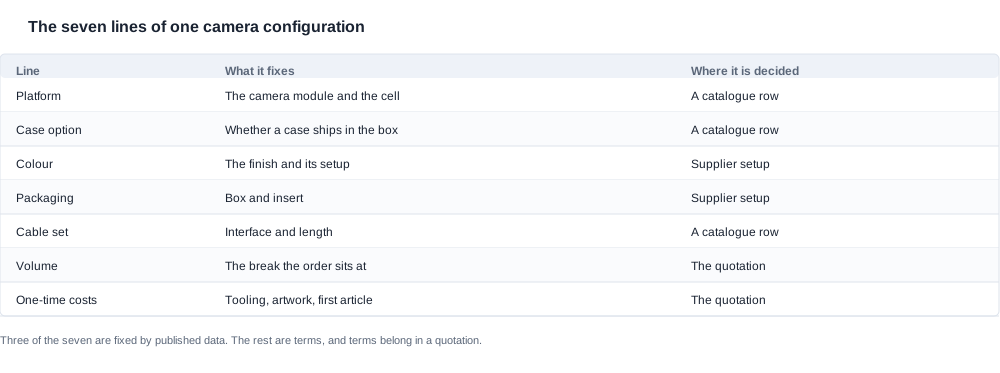
The table is the seven lines. Three of them are settled by published data before the quotation is written, and four of them are terms.
Smart glasses pricing: one configuration, seven lines, two totals
Why a worked structure and not a customer quotation
A quotation is a set of terms, and terms are only meaningful against a configuration, a volume, a destination and a date. Printing a quotation on a page would make it wrong for every reader except the one it was written for. A worked structure has none of that problem: it fixes the configuration, shows which parts of the cost are facts and which are decisions, and leaves the numbers out.
The second reason is that a worked structure is reusable in a way a quotation is not. A buyer can take the seven lines, put two suppliers' quotations into the same seven rows, and see immediately which line differs. The structure is the deliverable. The numbers belong to a conversation with a defined scope.
The published rows this configuration sits on
The platform chosen for this example is the L1 Pro, which is published as a 13-megapixel camera glasses model with a 290 mAh cell, a charge time of two hours or less, a rated use figure of about seven hours, and a 1400 mAh charging case. It is an unambiguous starting point for a worked example because nothing about it is custom.
Three of the seven lines are now settled by published data, before a single conversation takes place. The platform is fixed, including its resolution tier, its cell and its endurance figure. The case is fixed at 1400 mAh. The cable is fixed by the interface, and the interface on this model is the point at which the configuration is not fully determined — which is the subject of the next section.
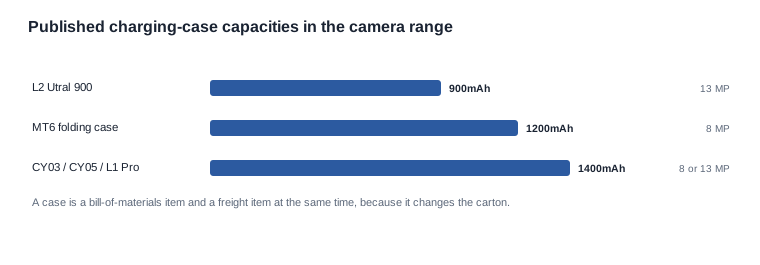
The case capacities are published per model and they are not interchangeable, which is why the case line in a quotation is a configuration decision rather than a rounding difference. A 900 mAh case and a 1400 mAh case are two products.
The line that is published and the line that is not
There is a row on this model's published page that a buyer should notice is missing. The catalogue publishes the cell capacity, the charge time, the endurance figure and the case capacity for this model, and it does not publish a charging method. The same is true for three other camera models in the range. For the models that do publish a charging method, the range divides between magnetic charging and Type-C, and the distinction matters for the cable line, for the box contents and for the customer's expectations about how the case is used.
The honest treatment of a missing row is to treat it as a question rather than to infer it from a neighbouring model. A buyer who infers the interface from the model family will eventually order a configuration that does not exist, and the discovery will come at the sample stage rather than at the specification stage.
The fourth configuration line is therefore a request: state the charging method and the interface for this model in writing. That request is worth making to every supplier in the round, because the answers will differ and the differences are configuration differences.

The seven lines, and where each of them is decided
The platform, the tier and the case
The platform line is the L1 Pro at 13 megapixels, one colour, one configuration, one price. It is the most unambiguous starting point for a comparison because nothing about it is custom, and the most unambiguous starting point for a question because the tier is published and a buyer can check the quotation against it.
The tier itself is a cost line rather than a free upgrade. The camera range splits into an 8-megapixel group of eight models and a 13-megapixel group of three, and the sensor, the cell and the endurance figure move together across that boundary. A buyer who moves between the groups is making a configuration decision that changes the bill of materials, and a quotation that offers one tier's price against another tier's specification is a scope difference in a discount's clothing.
The line a buyer almost never asks about
The silicon that carries the radio, the codec and the logic is where two otherwise identical configurations can differ, and it is the line a buyer almost never interrogates. We do not publish our component selection, so the honest version of this line in a buyer's analysis is a question rather than a claim: what in this configuration is doing the work in this number, and would a different choice at that position change the price by more than the change you are asking for.
That question is worth asking because of what it reveals about the quotation. A supplier who can point at the line that dominates the cost is describing a price they built. A supplier who cannot is describing a price they inherited, and an inherited price moves without explanation. It is the same diagnostic as asking which line was worth negotiating on their side, asked from a different angle.
The frame, and the decision that makes the one-time costs small
The frame in this example is an existing platform with no new tooling. That is a deliberate choice inside the worked example rather than a property of the model, and it is what makes the one-time costs in this structure small: there is no mould to cut, no tooling to recover and no lock-in created at the frame.
A buyer who wants a different temple shape or a different frame gets a project cost instead, and it should sit on its own line with its own terms. The oem ready products page lists the configurations that exist as platforms, and the point of a worked structure like this one is that the platform line and the tooling line are two different lines and are frequently confused.
The packaging, and the largest per-unit difference between two otherwise identical quotations
The packaging line in this example is a printed retail box against a plain carton, and it is the largest per-unit difference between two otherwise identical quotations. The insert is a further line, because a moulded pulp insert is tooling and a folded card is not, and a buyer who treats the insert as a printing cost will misjudge both the first order and the repeat.
This is a decision rather than a default. A printed box costs more per unit and it changes the freight band, and the two effects point in the same direction, which is why packaging is the line a first order most often gets wrong and the second order most often wants to change.
The volume, and the one-time costs
The volume line is the quantity in this configuration with its break points shown. A quotation that shows one price is not a quotation that can be planned against, and the volume mechanics are set out under minimum order quantity.
The one-time costs are setup, documentation and the first-article approval, quoted as their own lines and never folded into the unit price. Folding them in is the most common way a cheap platform turns out to be the expensive one, and the reason is arithmetic rather than deception: the one-time costs do not scale down, so on a small first order they are spread over few units and land on the unit price at a rate the buyer did not anticipate.
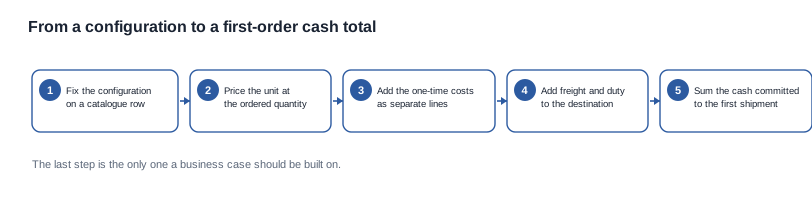
The flow is the order the seven lines have to be assembled in, and it is the order in which two quotations can be compared without the comparison being meaningless.
The questions to ask at each line, and what a complete answer looks like
The configuration question
Ask for the configuration as a string: model code, colour, case option, interface, firmware revision, box contents, packaging artwork, destination and volume. A complete answer is a single line that a factory would recognise as a build, and it should be possible to check it against the published model rows without asking anyone.
The case question
Ask whether the case is in the box, at what capacity, and what it does to the carton. A complete answer names the capacity, the carton change and the freight band, because those are three different consequences of one line and a buyer who has only the first of them has most of the problem.
The platform and tier question
Ask which model in the resolution tier is being quoted and which cell it carries. A complete answer resolves to a single published row, and the buyer can then check the endurance figure, the charge time and the case capacity against that row without further correspondence.
The frame and tooling question
Ask whether the frame is an existing platform and whether any tooling is recovered in the quotation. A complete answer separates the tooling from the unit price and states the volume the tooling is recovered over, because a tooling fee recovered in full on the first order is a fee the buyer has paid for rather than a cost of doing business.
The packaging question
Ask which box, which insert, which print run length, and whether the artwork is charged once or per unit. A complete answer identifies a moulded insert as tooling and a folded card as a printing cost, and it states the minimum print run, because that minimum is a constraint on the second order as much as on the first.
The volume question
Ask for the break table with the quantity next to each price, and for the price that applies at the quantity actually being ordered. A complete answer is a table rather than a sentence, and it should make the buyer's own volume assumption visible in it.
The one-time cost question
Ask for setup, documentation and first-article approval as separate lines with the recovery period stated. A complete answer distinguishes what falls away on the second order from what is recovered per unit, and it does not blend the two into a single figure.
A complete answer, in one line per line of the quotation
Put the seven questions together and the answer is a seven-row document with the quantity, the destination and the validity date attached. That document is the thing two quotations can be compared on, and it is the same document the pricing checklist for the first order asks for in a different order. A quotation that answers five of the seven questions is usable for a rough comparison and not for a business case, and the buyer can tell which one it has from the document alone.

The two totals, and why the second one is the one to use
The unit price, and what it leaves out
The unit price is the number a buyer quotes to a colleague, and it is the least informative number on the quotation. It is the smallest part of what a first order costs, and it is the only part that does not depend on the destination, the season or the channel.
It is also the number that a comparison is usually conducted on, which is why two quotations in this category can differ by a wide margin and still be describing different transactions. A quotation that shows only a unit price has not shown the freight, the duty, the one-time costs or the compliance scope, and those are not small lines.
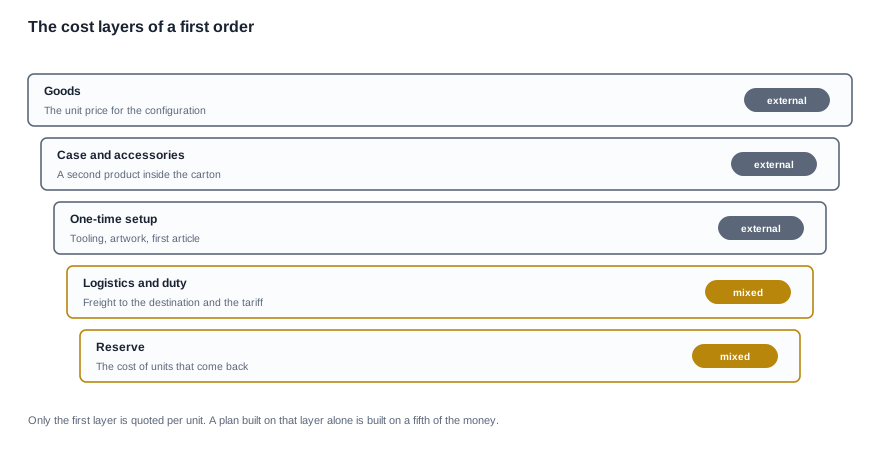
The layers show the whole money in a first order, and the first layer is a fraction of it. A buyer who has planned on the first layer has planned on a minority of the money.
The cash committed to the first sellable shipment
The total cash committed to the first sellable shipment is the number the business case should use: the unit price multiplied by the quantity, plus the one-time costs, plus the packaging setup, plus the freight and the duty to the destination. It is worth asking a supplier for this number directly, because a supplier who will produce it is a supplier whose numbers are internally consistent, and a supplier who cannot is telling you the lines have not been separated.
The difference between the two is not marginal in a first order. A first order can spend a substantial share of its total on the one-time costs and the freight, and a buyer who planned on the unit price has planned on a minority of the money. In a repeat order the balance shifts, because the one-time costs fall away and the volume break applies, so the two totals converge over the life of a programme.
Why the first order spends its money in the wrong places
A first order is structurally wrong: it carries a project cost, a freight cost and a compliance cost, and it does so over the smallest quantity. That is not a fault in the plan, it is the shape of a first order, and the correct response is to model it rather than to be surprised by it.
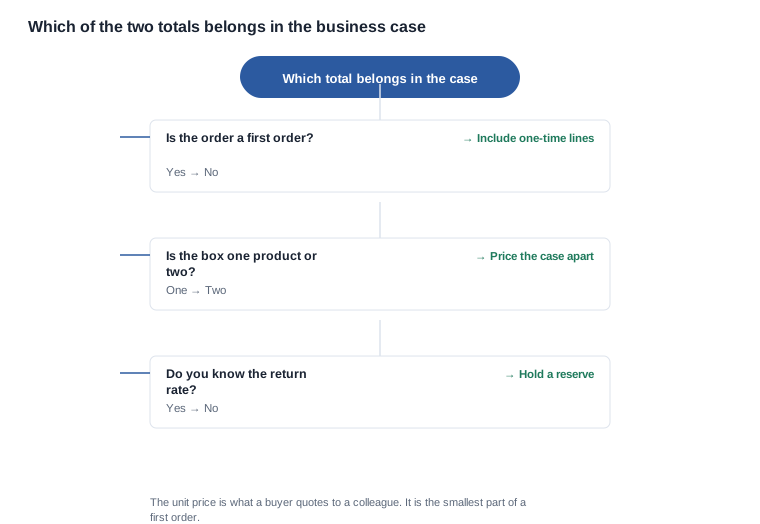
The decision chart is the short version of the argument. A business case built on the unit price will overstate the cost of the programme and understate the cash committed, and the second of those is the number that stops a programme being approved.

What this worked example does not tell you
The three things it cannot answer
First, it does not tell you what any of it costs, because we do not publish prices. Second, it does not tell you what the second order becomes, because the one-time costs fall away and the volume break may change the unit price. Third, it does not tell you whether this configuration is the right one for your market, because the destination determines the duty, the document set and the packaging.
There is a fourth limitation that is worth stating separately, because it is the one most often glossed over. This example does not tell you what the configuration is worth to a customer, and it is not designed to. The published endurance figures and the resolution tier are the data the customer will eventually judge the product on, and a configuration that is technically more capable is not automatically the one that will sell. In this range the camera tier is a cost line that moves the price, and justifying it from published data alone is not possible.
What the example does tell you to ask for
Seven lines, each quoted separately, and a total that is the number the cash plan should be built on. It also tells you what to ask, which is the part that has value after this page has been read: ask for the configuration string, ask for the inclusions list, ask for the one-time costs on their own lines, ask for the break table, and ask for the total for the first sellable shipment at the ordered quantity.
The pricing checklist for the first order turns those into a sequence that can be worked through, and the wider cost structure is under procurement pricing.
What we publish, and what we will build for you
Turning a silent catalogue row into a question
We publish the configuration facts and the structure of the cost, and a price without a configuration and a volume is not a price. We will not print a unit price on a page for a product that has not been specified, and we will not present a quotation as a published policy. Where the catalogue is silent — and it is silent on some rows, including the charging method for four of the camera models and the Bluetooth version for the camera series — we say so and convert it into a question, which is a more useful output than an invented number.
What we will build for a defined configuration
What we can do is quote this configuration for a defined volume, show which of the seven lines is doing the work in the number, and state the one-time costs separately rather than folding them into the unit line. We will also mark the rows that are open on our published data, so the buyer knows which questions to put to every supplier rather than only to us.
Send the configuration and the volume, and we will build the same seven lines for you, in the same order, with the open rows marked.
Related reading
- The cost logic — procurement pricing
- The first-order version — pricing checklist for first order
- The volume mechanics — minimum order quantity
- The platform configurations — oem ready products
Send us the configuration and the volume, and we will build the same seven lines for you.


