

Smart glasses pricing for a first order is ten lines, and the order is the argument. The first three decide what you are buying; the middle four decide what it costs; and the last three decide whether the number you have is the number your cash flow plan should be built on. A buyer who works through them in order ends up with a landed cost, which is the only pricing figure that survives contact with a business case.
We publish no unit price, no non-recurring cost and no tooling figure, because they are terms rather than facts. What follows is the sequence a first order has to clear, written for a brand-side buyer who has a specification and a budget and has not yet put a purchase order against them.
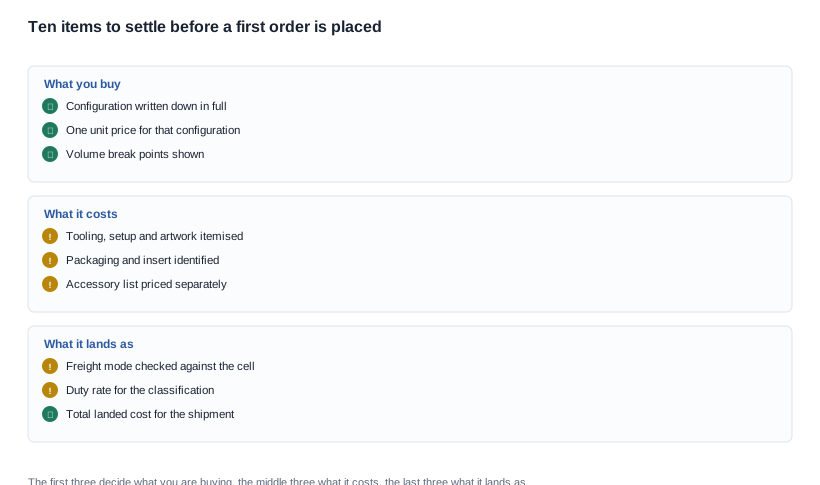
The checklist is grouped by what each group decides, not by where it appears on a quotation. That grouping is the argument: three lines to know what you are buying, four to know what it costs, three to know what the number becomes.
Smart glasses pricing: ten lines to settle before a first order
The order is the argument
A first-order checklist that is read as a list of items rather than as a sequence produces a different result. The sequence exists because each group depends on the one before it, and because the last group cannot be built at all until the first two are settled. A buyer who asks about the landed cost before the configuration has been written down will be given a number for a configuration the buyer did not choose, and will then have to do the whole sequence again.
The ten lines also have a property that a general procurement checklist does not: each one is answerable by a document. None of them requires a negotiation, and none of them requires information that only the factory has. That is what makes the sequence worth running before a conversation rather than during one.
Line 1: the configuration
Model, colours, packaging and accessories, written down. A price without a configuration is not a price, and a quotation that does not name the configuration is a generic one.
In this category the configuration has more forks than most buyers expect, which is why the published catalogue rows matter here more than in a later order. A camera platform is published in a 13-megapixel group of three models and an 8-megapixel group of eight, with cell values from 220 mAh to 290 mAh. One model is published with a 900 mAh or a 1400 mAh case, one with a foldable 1200 mAh case, three with a 1400 mAh case, two with a case whose capacity is not published, and one with no charging case at all. Colour options are published per model rather than across the range, and one model in the range publishes a photochromic lens configuration alongside a separate electrochromic model. Each of those is a decision that changes what is built, and a first order that leaves one of them open will have it made for it.
Line 2: the unit price
One number, for that configuration. If a supplier quotes a single price for a range, ask which configuration it is the price of, and be specific about which part of the answer satisfies the question: a model name is not enough, because the model name covers a family of published configurations.
This is the line that gets quoted first and revisited last, which is the wrong way round. A unit price is the output of lines one, three, four, five and six, and it cannot be interpreted until those are settled. A buyer who anchors on the unit price in the first conversation is negotiating over a number that is about to change.
Line 3: the one-time costs
Tooling, setup, the documentation and the first-article approval, as separate lines. This is the step that stops a cheap platform from turning into an expensive order, because these are the costs that do not scale down.
The reason to insist on separate lines is arithmetic. A setup cost spread across a small first order lands on the unit price at a rate that makes the platform appear expensive; the same setup spread across a programme reads as what it is. Folding the two together hides the shape of the programme, and the buyer learns the shape only when the second order arrives and the price changes for a reason nobody explained.
Line 4: the break points
The thresholds and the price at each one. A quotation that shows the breaks is a usable quotation and one that does not is asking the buyer to guess.
The breaks also answer a question that no factory will answer unless asked directly, which is what the supplier's own cost curve shows. A break with a large step at a round number suggests a quantity that was set to be reached rather than one where the cost genuinely falls. A break with a small step suggests the opposite. Either way the useful question is not whether the supplier will do better at a higher quantity; it is which quantity they would recommend for the programme, because a supplier recommending the quantity that suits the programme is telling the buyer something a price negotiation never will. The volume mechanics are set out under minimum order quantity.

The four lines that decide what it costs
Line 5: the packaging
Which box, which insert, which print run length. This is frequently the largest per-unit difference between two otherwise identical quotations, and it is a decision rather than a default.
The insert is the part that carries a trap. A moulded pulp insert is tooling and a folded card is not, and a buyer who treats the whole packaging line as a printing cost will misjudge both the first order and the repeat. The print run length is a second constraint, and it is one that binds on the second order rather than the first, because the second order is the one that has to live with the minimum.
Line 6: the accessory list
What is in the box, what it costs, and whether it is in the unit price. A case is a second product with its own cell, and treating it as a free accessory is how budgets go wrong.
This line is where the published case capacities become a commercial question rather than a technical one. A 1400 mAh case and a 900 mAh case are different products with different cost, different carton and different customer expectation, and the fact that one model in the range is published with both options means the choice has to be made in the specification and priced in the quotation. Two models publish a case whose capacity is not published, and for those the correct action is to request the figure rather than to assume one from a neighbouring model.
Line 7: the freight
The mode, the volume, and the battery constraints on the mode. On a lithium product the mode is partly chosen for the buyer, because the transport rules for a cell-bearing consignment are not the same as for general cargo, and a freight quotation that ignores them is a quotation for a different shipment.
The volume is the number that moves the freight band, and the volume here is the physical volume of the carton, which is set by lines five and six. This is why the freight line cannot be quoted properly before the packaging and the accessory list are settled, and it is the most common reason a landed cost comes out higher than expected.
Line 8: the duty
The rate that applies to this origin and this code, to the destination. Two things are worth asking. The first is which code is being used, rather than accepting whatever is filed. The second is whether the code changes if the box contents change, because the presence of a charging case in the carton can move the classification, and the case is decided on line six.
Duty is a small line relative to the goods in most markets and a large one in some, and it is also the line that is almost always accepted without question. Asking for the code costs one sentence.
The three lines that decide what the number becomes
Line 9: the total landed cost
Everything above, for the first sellable shipment. This is the number the business case should use, and it is the one most often missing. A unit price alone can be a small fraction of it in a first order.
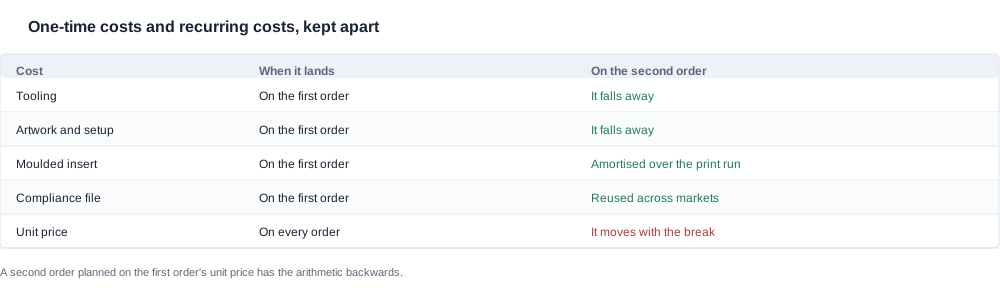
The table separates the costs that fall away from the ones that do not, and the separation is the reason the total has to be built for the first order rather than estimated from a unit price. A first order that carries no per-unit view of the one-time lines will be quoted a second order that appears to have got more expensive.
Line 10: the payment link
How the deposit relates to the total, and when the balance falls due. The deposit is the largest single early commitment, and it is made before anything exists.
This line is in the pricing checklist because it is a pricing line in one specific sense: the schedule changes the cash committed, and the cash committed is part of what the first order costs the buyer. A schedule that pays the balance against an inspection report and a schedule that pays it on dispatch produce different peak cash, and the difference is not visible anywhere else in the ten lines.
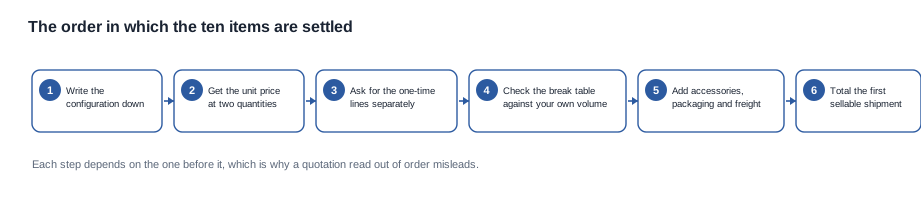
The flow is the sequence the ten lines are settled in, and it is the sequence the business case has to be built on.
A first order, from enquiry to sellable stock
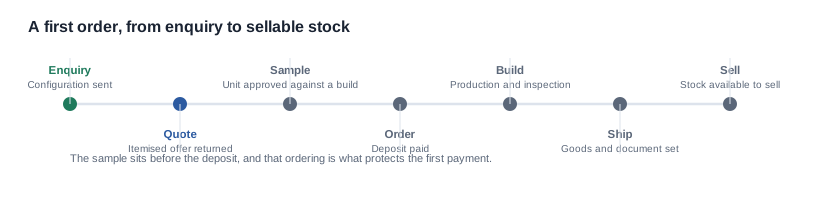
The timeline shows where the sample sits, and its position is the reason the sample is worth paying for. On a first order the sample is the only pre-payment evidence the buyer will get, and the deposit is what funds its production. A buyer who negotiates the deposit down without securing a production-equivalent sample is buying the deposit at the price of the only evidence in the transaction.

The three audiences a first-order cost has to satisfy
What the finance team needs from the ten lines
The finance team needs three things and none of them is the unit price. They need the cash total for the first sellable shipment, which is line nine. They need the peak cash committed inside the production window, which is line ten combined with line one. And they need the interval between the peak and the cash coming back, which is the selling period and is the one figure the ten lines cannot supply because it is the buyer's own data.
What a finance team will not accept is a unit price with a landed total somewhere else in the pack, because the two numbers will be compared against each other in the review and the smaller one will be used. The value of the ten-line sequence is that the landed cost is not a separate calculation. It is the same document, in the same order, with the same configuration.
What the channel needs, and where it is not on the list
The channel needs to know what is in the box and what a returned unit is worth, and the second of those is not on the list of ten at all. It is determined by line six and by the document set for the destination market, and it arrives later as a returns cost.
A retailer or marketplace seller that has not specified the box contents has delegated the value of a returned unit to somebody else. The unit will come back, the channel will decide on the basis of what it can resell, and the decision will have been made without the buyer. The remedy is not an argument with the channel, it is line six, and it costs nothing to settle at the specification stage.
What the factory needs, and why it explains the structure of a quotation
The factory needs the configuration frozen, a volume it can plan against, and the one-time costs recovered in a way it can forecast. That is why a quotation is shaped the way it is: the lines that appear to be administrative overhead to a buyer are the lines a factory uses to decide whether it can accept the order at all.
This matters for the negotiation, because it means the buyer's ten questions and the factory's ten questions are mostly the same questions. A buyer who asks for the ten lines in the order above is asking for the information the factory uses internally, which is why the answers are usually available even when they are not usually given.
Where the three audiences disagree
They disagree on the one-time costs, and the disagreement is structural rather than personal. The factory recovers them across a volume; the finance team sees them land on a first order; the channel sees none of them and prices the retail price against the goods alone. A buyer who does not model the amortisation will set a retail price that the factory's recovery schedule does not support, and the gap will appear as a margin problem in the second order rather than as a pricing problem in the first.
There is a second, quieter disagreement, and it is about the compliance scope. The factory prices the file per model and per market because that is how the work is done; the channel prices the document set as a precondition for selling into a market at all; and the finance team sees a fixed cost landing in the first order. A market that the factory priced because it was easy to include, and that the channel does not need, is a cost the buyer chose rather than a cost that was imposed. Removing it is usually worth more than any reduction in the unit price.
That is the real reason to work the ten lines in order. The order is not administrative tidiness; it is the sequence in which the three sets of numbers become one programme.

The two questions that make the other eight work
Which of the ten lines moved the price
A supplier who can name the driver of a number is a supplier whose numbers are stable. One who quotes a price without a driver is quoting a number that will move and will not say why. It is one question and it separates the two kinds of supplier more reliably than any comparison of their sheets.
The answer is also the place to start the negotiation, because the line that is doing the work is the line with the most room in it. A price driven by the packaging setup can be moved by reducing the scope or by increasing the run. A price driven by the silicon cannot be moved by a buyer at all. Asking the question costs nothing and tells the buyer which kind of conversation they are in.
What the second order becomes
The one-time costs fall away and the volume break may change the unit price. A second order planned on the first order's assumptions has the arithmetic backwards, and the second order is the one where the money is actually committed.
There are two questions inside this one, and both are worth putting in the first round. The first is what the price becomes at the next break. The second is whether the structure repeats or is renegotiated from scratch, which is a different question and has a different answer: a renegotiated second order means the first order's terms were a starting position, and the programme should be modelled accordingly.
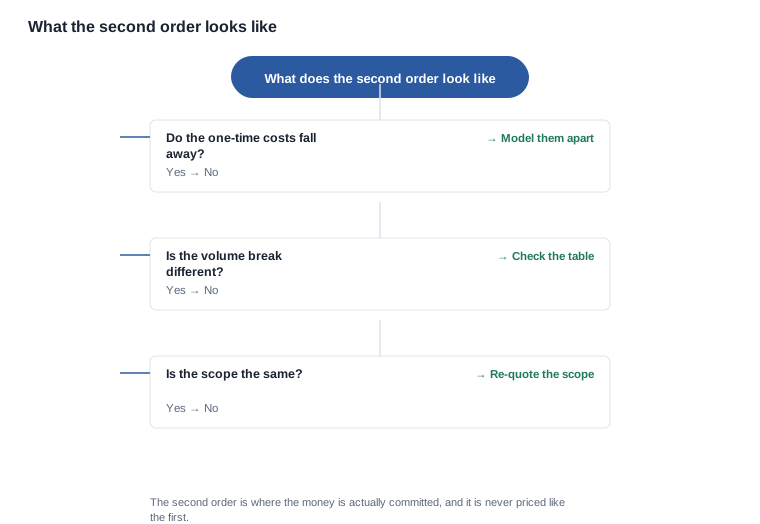
The three branches are the three answers a buyer gets, and only the first one produces a programme with a shape.
What we publish, and how we will fill the ten lines for you
A price is a term, and terms belong in an agreement
The working rule we apply: we publish the configuration facts and the structure of the cost, and we will not print a price on a page for a product that has not been specified, nor present a quotation as a published policy. A price is a term, and terms belong in an agreement. Unit prices, non-recurring costs, tooling figures, minimum order quantities and production lead times are not published in our documentation, because each of them is a function of the order rather than a property of the product.
What we do publish is the model data that decides which configurations exist: the cell values, the charging methods, the rated use figures, the resolution tiers and the charge times where the catalogue publishes them, the colour availability, the case capacities, and the IP rating where it is published. Where the catalogue is silent, including the charging method for four of the camera models and the Bluetooth version for the camera series, we say so and turn it into a question for the enquiry.
What we will do
What we can do is quote against this ten-line structure for a defined configuration and a defined volume, and show which line is doing the work. We will also tell you which lines cannot be answered yet, rather than putting a placeholder in the quotation and revising it later, and we will build the total for the first sellable shipment on the same ten lines so that your business case and our quotation are using the same arithmetic.
The cost structure is under procurement pricing, the worked example of a single configuration is in pricing case example, and the errors that survive a first round are in pricing common mistakes.
Related reading
- The worked example — pricing case example
- The errors to avoid — pricing common mistakes
- The cost structure — procurement pricing
Send us the configuration and the volume, and we will fill the ten lines for you.


