

Smart glasses production capacity is not one number. It is the product of four independent constraints — line and shift structure, changeover time, purchased material and inspection throughput — and a supplier who quotes a single figure is quoting you one of the four and leaving the other three to be discovered. The first question a buyer should ask is therefore not "how many can you build" but "which of those four is the one that binds my order". A factory with a full assembly hall and a cell shortage has capacity on paper and none in practice, and the difference between those two states is discovered in month one rather than planned for in month zero.
The second reason this ordering matters is that the buyer can do more work before the conversation than after it. The published catalogue contains enough configuration data to let you estimate your own changeover load, and enough battery and charging data to let you ask a sharper question about material. A buyer who arrives with a calculated changeover count gets a different conversation from one who arrives asking for a capacity percentage.
Smart glasses production capacity: the order the four constraints are checked in
The four constraints behave differently, and each has a characteristic failure.
Line and shift structure is the constraint a factory describes most readily and least usefully, because the figure is normally expressed per line or per shift and then scaled into a monthly total. It is rarely the binding constraint in this category, and it is the one buyers spend the most time on.
Changeover is the constraint buyers forget, and it is the one that decides whether a month works. Every distinct configuration is a separate material set and a separate setup. A programme with one model and one colourway has one setup. A programme with the same volume spread across three colours of the same model has three, and the third one is the expensive one, because the first two can be scheduled together.
Purchased material is the constraint that most often sets the real ceiling, because the cell is a bought component with its own lead time and, in a constrained market, its own allocation. This category publishes a wide range of frame cell capacities — from 40 mAh in the children's protective models through 220, 260, 265 and up to 290 mAh in the camera range — and each of those capacities is a different purchasing decision made some time before your order existed.
Inspection throughput is the constraint that surprises buyers who assume assembly is the slow part. A camera model has to be measured, and the measurement step, not the assembly step, is frequently where a programme queues.
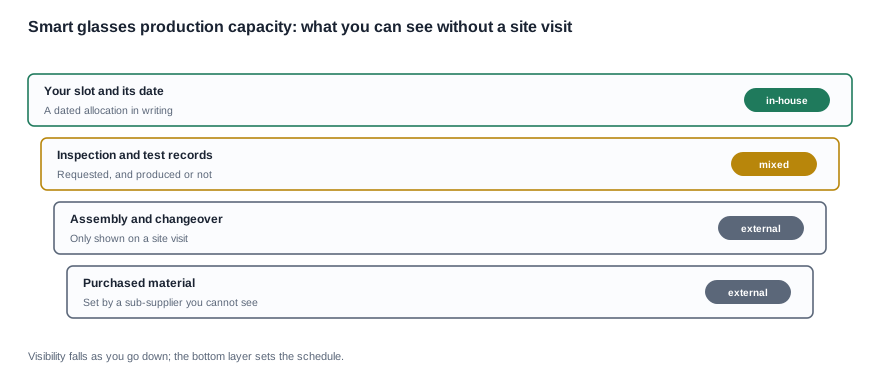
The layers above are ordered by how much of each you can see without a site visit. You can see your own slot. You can request inspection records. Assembly and changeover are shown to you. Purchased material is set by a sub-supplier you never meet. That visibility gradient is the practical reason a capacity conversation starts with the layer at the bottom rather than the layer at the top.

The constraint you can calculate before you ask: configuration count and changeover
This is the one constraint where the buyer can do the arithmetic first, and it is the constraint most often left uncalculated.
Every distinct configuration is a separate material set, a separate setup and a separate minimum order commitment. The published catalogue makes the size of that effect concrete. The V03 Pro publishes three colourways — orange, cream white and black. The V06 publishes four, including the black ice-blue option. The L2 Utral publishes two charging-case capacities, 900 mAh and 1400 mAh, which are two different products rather than one product with a choice. A programme carrying the V06 in all four published colours is not a programme with one configuration; it is a programme with four, each of which carries its own material set and its own changeover.
The estimate itself is simple. Take the number of distinct configurations, and treat each as one changeover event in the planning window. If the changeover time for your configuration is stated, multiply. If it is not stated, that is the first row to demand.
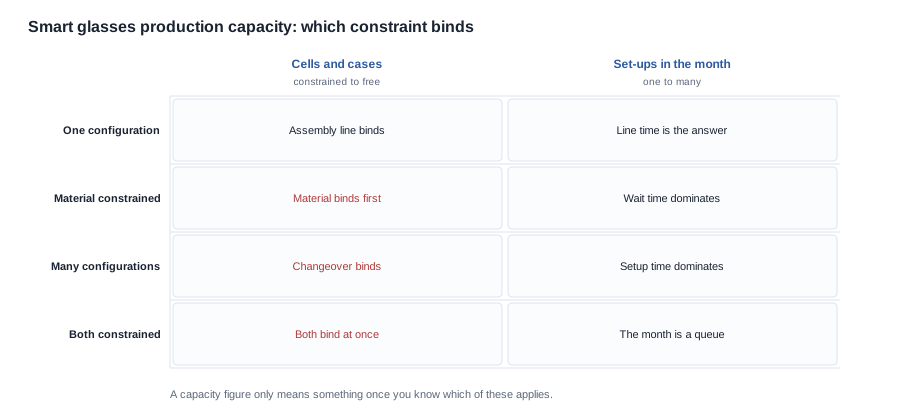
The matrix above is the version to carry into the meeting. One configuration and free material means the line time is the whole answer and the conversation is short. Constrained material with a single configuration means the wait time is the schedule and the line is irrelevant. Several configurations with free material means changeover dominates the month. And both constrained at once means the month is a queue, which is a different kind of programme and should be planned as one.
Two details are worth carrying into the estimate. The first is that a colourway is not free at the material level even when it is free at the tool level — the lens tint, the temple finish and the packaging art all change. The second is that the published colourway list is a list of options, not a list of commitments, and a programme that carries three of the four published V06 colours has made a decision that a capacity figure should reflect.
Counting configurations the way the factory counts them
Buyers and factories frequently disagree about the number, and the disagreement is worth resolving before the capacity conversation rather than during it.
A configuration is a buildable combination, and the factory counts the things that require a setup or a new material set. Four things change that count, and each is easy to overlook. A colourway changes the material set. A case option changes it as well, which is why the L2 Utral's 900 mAh and 1400 mAh options are two products rather than one. A charging method changes it, and this is the one buyers miss most often: the catalogue publishes magnetic charging on seventeen models, Type C on seven, and no charging-method row at all for the CY03 and the CY05, and the MT6 and the L1 Pro. Four camera models therefore have a build detail that cannot be counted from the catalogue and has to be asked for. And a destination market changes it, because a unit built for a market with different documentation requirements may not be interchangeable with one built for another.
The count the buyer should carry into the meeting is therefore conservative and written down: model code, plus colourway, plus case option, plus any charging method the catalogue leaves open, plus destination-specific variants. When the supplier's number is lower than the buyer's, the difference is usually one of those four, and the conversation is more productive than arguing about whose arithmetic is right.
The constraint that is rarely the line: purchased cells and cases
A camera model is, among other things, a battery with a module attached, and the battery is bought rather than made. The catalogue publishes the frame cell capacity for every model, which makes the purchasing question specific: which capacity does the ordered model code use, and is that capacity a standard catalogue purchase or a variant that has to be allocated?
The published values are worth knowing by heart in this family. The camera models run on 220 mAh (the V03, the V03 Pro and the MT5), 260 mAh (the KY06, the V06 and the S7), 265 mAh (the MT6) and 290 mAh (the CY03 and the CY05, and the L1 Pro and the L2 Utral). The audio models are smaller and use different cell configurations: 90 mAh × 2 in the K01 and the K02, 100 mAh in the D11 and the D12, and 55 mAh × 2 in the LC-105 pair, the G07 and the YK12. A programme that mixes a camera model and an audio model is mixing two entirely different material chains, and a capacity figure that treats them as one is arithmetic rather than planning.
The cases are a second purchased-material item, and they are a separate supply chain from the frames. The published case capacities are 900 mAh or 1400 mAh for the L2 Utral, 1200 mAh for the MT6's folding case, and 1400 mAh for the CY03, the CY05 and the L1 Pro. The KY06 and the MT5 are supplied with a case whose capacity is not published. The catalogue publishes no charging-case row at all for the V06 and the V03, and the V03 Pro and the S7. That last group is a material-planning fact as much as a commercial one: four models for which you cannot plan a case at all from the catalogue, and whose case position has to come back from the supplier before the material plan is frozen.
None of this is a capacity figure. It is a set of inputs that tells you which material question to ask, and the question is always the same: which purchased part would cap this order, and how long does it take to arrive.

The constraint that decides your launch date: your slot in a full month
Capacity and allocation are different questions, and the second one is the one that decides whether a launch date survives contact with the factory.
A factory with spare capacity and no allocation rule still cannot guarantee your date, because a slot in a full month is granted by a rule rather than by arithmetic. The questions that settle it are specific: what is the priority rule when the month is constrained, is the slot reserved in writing with a date, and what happens if it is missed.
Three answers, three different levels of risk. A supplier with a documented priority rule and a written slot confirmation is a supplier you can plan around. A supplier that answers "it depends on the season" has told you that allocation happens monthly and informally, and a launch date you announce in advance is therefore a risk you are carrying alone. A supplier that reserves the right to reallocate your slot at its discretion has kept the risk and passed you the consequence, and the right response to that is not a longer argument but a shorter programme, a written release notice and a defined re-sequence.
Volume commitments are the other side of this. A volume forecast buys nothing; a volume commitment can buy priority, because priority is what a constrained month allocates. That is the genuine commercial mechanism in this category, and it is worth understanding before the negotiation rather than during it.
What a volume commitment does and does not buy
It is worth being exact about the mechanism, because a volume commitment is often treated as a general concession when it is a specific one.
What it buys is position in the allocation queue. A factory in a constrained month decides which orders to build, and a committed volume gives the order a claim on capacity that a forecast does not. That claim is real and it is the reason buyers commit earlier than their own demand requires.
What it does not buy is speed on the material chain, priority with a sub-supplier for a cell or a case, or relief from the changeover time your own configuration count creates. A commitment made at the factory does not reach upstream, and a buyer who assumes it does will discover that the binding constraint was never in the factory at all. It also does not buy protection against a slot that is missed for a reason inside the factory's own control, which is why the remedy for a missed slot belongs in the agreement alongside the commitment.
The trade-off to price is therefore straightforward. A commitment costs working capital and forecast accuracy; it returns priority. A buyer with a fixed launch date and a single market is usually paying this trade deliberately, and a buyer with an uncertain demand curve is usually paying it by accident.
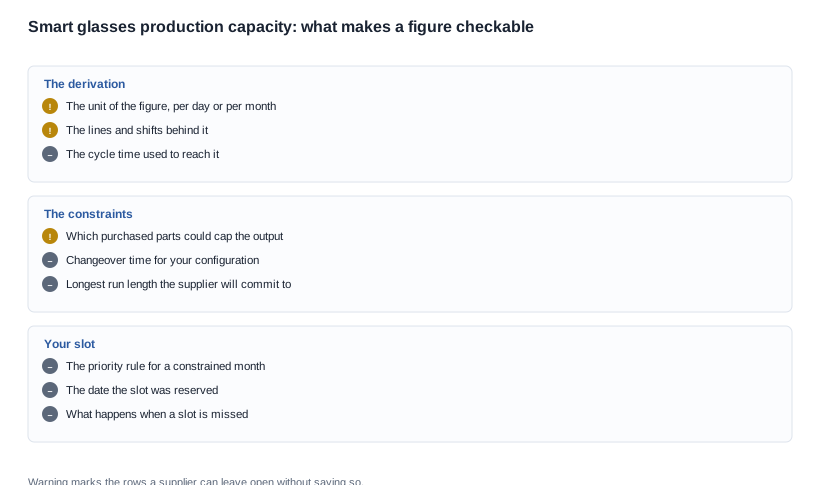

What a capacity claim must show before you plan a launch around it
The test of a capacity figure is not whether it is large. It is whether it is derived, because a figure with no derivation cannot be checked against your order, and an unchecked figure is a schedule assumption rather than a commitment.
- Ask for the derivation rather than the conclusion. A number that came from a line count, a shift pattern and a cycle time can be sanity-checked against the order you intend to place. A number that came from a sales figure cannot.
- Ask which purchased parts could cap the output below that figure, and carry their lead times into your own schedule rather than accepting the supplier's optimistic view.
- Ask for the changeover time for your configuration and the longest run length the supplier will commit to. A programme needing several colourways in one window has a schedule requirement that a single capacity number conceals.
- Ask what your slot would be in a constrained month, and get the answer in writing before the deposit rather than after the announcement.

The questions to ask are these four, and the order matters: the derivation first, because without it the other three cannot be interpreted. The red flags are specific. An annual figure with no unit and no basis. A capacity number that ignores material. A changeover treated as free and unlimited. A supplier with no written slot date. And an answer that depends on the season.
A launch planned against real capacity, and what we will not publish
Two capacity claims against a fixed launch date
The example below is constructed. No client, no order and no capacity figure is claimed; the camera model with a charging case, the two colourways, the European destination and the fixed launch date are all assumed, so that the sequence can be followed.
A brand is opening a European launch on a fixed date, and the date is already in the channel's marketing. Two suppliers quote. The first gives a monthly capacity figure roughly twice what the order needs, no derivation, and no mention of material. The second gives a smaller figure, shows the line and shift basis, names the purchased part that would cap the order, and gives a changeover time.
The buyer starts with the changeover arithmetic rather than with the numbers, because it is the part they can do themselves. The programme is one camera model in two colourways, with a case. That is two configurations, so two material sets and two setups. The buyer asks each supplier for the changeover time for that configuration and multiplies it by two, then compares the result against the window between the confirmed material date and the launch date. The larger capacity figure from the first supplier is irrelevant, because the window is shorter than the launch date requires.
The second conversation is about material. The model publishes a 1400 mAh case, and the case is a separate purchasing decision from the frame, so the buyer asks which one would cap the order if the schedule slipped. The answer names the case, and the buyer now knows that the case lead time, not the assembly line, sets the date.
The third conversation is about the slot. The buyer asks for the slot in writing, with a date, and asks what happens if the month is constrained. The answer is a documented priority rule and a dated reservation, and the buyer books the slot before announcing the launch — a decision that costs nothing and is the only one in this sequence that cannot be undone later.
The fourth step is the acceptance rule. A programme that is going to a fixed date with a constrained month will compress something, and the buyer decides in advance which thing compresses: the first-article approval, the inspection sample size, or the colour count. That decision goes into the order, and the order goes to both suppliers with the same conditions.
The result is a launch date that is defended by arithmetic rather than by hope, and a supplier relationship that began with a question about a derivation rather than with a discount request.
What we publish, and what we will not publish
The boundary we hold: the published rows are the part of the capacity picture we can stand behind, and the rest is a question for the supplier's own file. What the catalogue settles is the configuration structure: every distinct configuration is a separate material set, and the published options make that concrete in the colourways on the V03 Pro and the V06, in the two case capacities on the L2 Utral, in the charging-method split of seventeen magnetic models, seven Type C models and four models with no charging-method row, and in the cell capacities that separate the 220, 260, 265 and 290 mAh camera models from the smaller audio models.
What we will not publish is a production capacity figure, a line count, a shift pattern, a production lead time, a minimum order quantity or a monthly output number. Each of those depends on the configuration, the quantity and the date, and a published figure without those three is a figure that cannot be relied on and cannot be compared with anyone else's. We would rather tell you that than quote a typical number you cannot verify — a buyer who plans a launch against an estimated capacity discovers the estimate at the point where the launch cannot be moved.
What we will do is take a configuration, a volume band and a target month, and tell you which published rows constrain that configuration, how many distinct setups your colourway and case choices create, and which of the four constraints has to be settled with the supplier before a date can be defended.
Related reading
- production capacity step-by-step article
- MOQ advanced guide
- certification lead time answer
- certification documentation requirements
- production capacity who needs this article
- lead time schedule template
- lead time how it works article
- production capacity quality effects article
- procurement pillar
Send the configuration, the colourway count, the volume band and the target month, and we will say which constraint actually binds your launch date and which parts of smart glasses production capacity are already settled.


