

Smart glasses production capacity is quoted as a single number, and that number is the least reliable part of the whole quotation. A factory can state that it builds two hundred thousand units a month and be entirely truthful while the figure is useless to you, because the real question is never how many units a month in the abstract. The real question is how many units of your configuration, in your colourway, with your charging case, on your destination market's documentation, in the month your retailer has already committed to.
The test that separates a usable claim from a headline number is simple: can you take the figure apart and see the line, the shift pattern, the cycle time and the assumption behind it? A capacity figure that arrives without those four things is a marketing figure, and treating it as a commitment is the most expensive mistake available in this category.
So the documents to request are not a general list. They are a decomposition request. This article walks through what to ask for, in what order, what a good answer looks like, what a bad answer looks like, and where the commercial conversation sits once the documents have arrived.
Smart glasses production capacity: what a claim must survive before you plan
The reader for this article is a procurement manager working for the brand, a channel buyer or an importer, and the situation is one of three. A retailer has committed to an on-sale date and the quoted schedule does not fit it. Two suppliers have quoted the same configuration with materially different dates, and one of them is right for a reason that is not visible in the quotation. Or a repeat programme has gone well and someone wants to double the volume without anyone re-checking whether the factory can absorb it.
Underneath all three is a single question: is the capacity claim about the factory, or about your order? A factory-wide figure describes what the factory believes it can do in the best case, with the builds that are easiest to run and the documentation it has already filed. Your order is one configuration, possibly with a charging case that changes the packing list, possibly with a colourway that is not yet in production, and possibly for a destination market whose route has not been started.
Those two numbers are not the same number, and the gap between them is where a launch date gets missed.
Three things make the gap larger than buyers expect. First, capacity in this category is consumed by the number of distinct builds rather than by the total unit count. Our catalogue lists twenty-eight product rows, and each row is a build with its own material set, its own packing specification and its own documentation scope. The eleven camera models alone carry three published charging-case capacities, and the four colourways published for the V06 are four more material sets inside a single model row.
Second, the constraint is often not the assembly line. A factory with an idle assembly line and an out-of-stock camera module has zero capacity for a camera programme, regardless of what the line could do. Component supply caps output before labour does.
Third, the slot is a per-month allocation, and it is allocated against competing orders. Two hundred thousand units a month across the whole factory is not two hundred thousand units available to you in the month you need them.
None of this makes capacity a bad basis for a decision. It makes it a decision that has to be evidenced.
The five answers that make a capacity claim usable
Before the article turns to documents, it is worth naming what a completed request looks like, because "send us your capacity documentation" is not a request that produces an answer.
A usable answer names five things. The unit the figure is expressed in, and whether it is a line, a shift or a month figure. The structure behind it, which is the lines and shifts and how work is allocated between them. The cycle time for a comparable build. The constraint, which is the purchased part that would cap output below the claim. And the allocation rule that decides whose order gets the capacity when a month is full.
A response containing all five can be checked against your own order and turned into a schedule. A response containing only the first two is a brochure line, and a buyer who builds a launch date on it is planning against an assumption.

Who reads a capacity claim, and what decision is waiting on it
Capacity conversations sit late in a procurement process and get treated as a formality, because by the time capacity is discussed the configuration is usually already fixed and the date is usually already in someone's diary. That sequence is what makes capacity the most expensive thing to get wrong late and the cheapest thing to get right early.
The order of work that causes the trouble is this. A date is set from a commercial plan. The date is given to a supplier, who quotes a schedule against it. The schedule is decomposed into components, one of which is a production slot. The slot is allocated against whatever else is running. The commercial plan was built on the assumption that a slot was available, because nothing in the conversation established that it was.
The corrective is to move capacity forward rather than to argue with it later. Before a date is accepted, the configuration has to be specific enough that the supplier can say which line runs it, which parts feed it, and what the changeover costs. That is a document request, and it is cheap.
There is a second reader worth naming: the person who signs the purchase order. They will be asked why the programme slipped, and the answer they can give depends entirely on what is in the file. If the file contains a capacity claim with a derivation and an allocation rule, they can point at the month the allocation was decided. If the file contains a number in an email, they can only repeat the number, and it turns out to have been an aspiration.
Why two quotations for the same build disagree
Three mechanisms explain almost every case where two suppliers quote the same configuration and only one of them is right.
Different scopes behind the same total. One supplier is quoting the model alone. The other is quoting the model with the 1400 mAh charging case, which adds an assembly operation, a packing-list change and a separate material set. Both figures are honest, and they are not comparable because the builds are not the same.
Different constraint assumptions. One supplier holds stock of the purchased part and can start on the component as soon as the order is confirmed. The other buys against the order. Both quote a line capacity; one of them is limited by a procurement cycle that has not started yet.
Different allocation standing. One supplier has reserved a slot in the month, because the configuration is close to one already running. The other has a slot available in principle and no slot in practice. The second quotation is not dishonest — it is a quotation for a month that has not been allocated.
The third mechanism is the one that a document request catches and a price comparison does not. When you compare two prices, you are comparing a reserved slot with an unreserved one, and the second is cheaper for a reason.
Eight attributes a capacity document has to settle
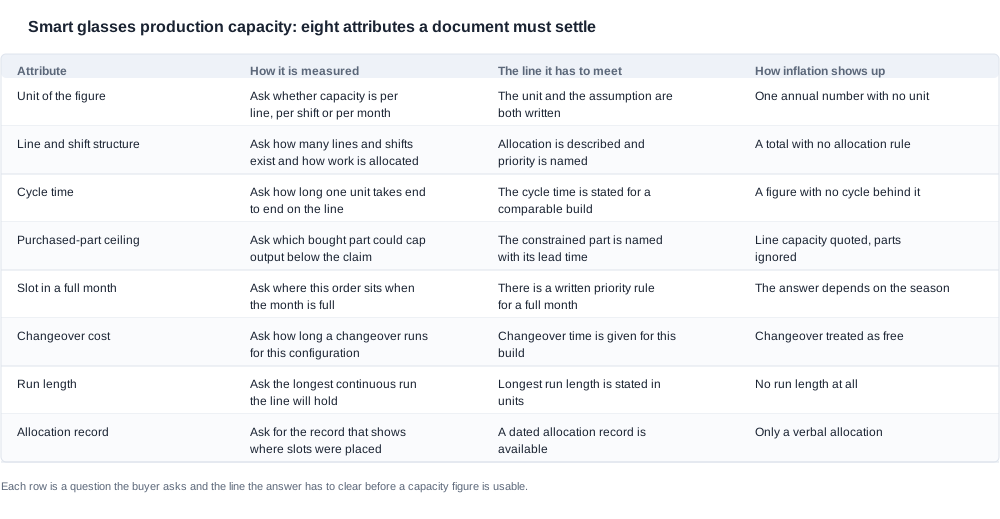
The table below is the working version of the capacity criteria list. Each row states how the attribute is measured, the line the answer has to clear, and how an inflated figure shows up in practice. It is a document checklist rather than a set of questions, because the difference is that a document arrives in writing and can be attached to the order.
| Attribute | How it is measured | The line it has to meet | How inflation shows up |
|---|---|---|---|
| Unit of the figure | Ask whether capacity is per line, per shift or per month | The unit and the assumption are both written | One annual number with no unit |
| Line and shift structure | Ask how many lines and shifts exist and how work is allocated | Allocation is described and priority is named | A total with no allocation rule |
| Cycle time | Ask how long one unit takes end to end on the line | The cycle time is stated for a comparable build | A figure with no cycle behind it |
| Purchased-part ceiling | Ask which bought part could cap output below the claim | The constrained part is named with its lead time | Line capacity quoted, parts ignored |
| Slot in a full month | Ask where this order sits when the month is full | There is a written priority rule for a full month | The answer depends on the season |
| Changeover cost | Ask how long a changeover runs for this configuration | Changeover time is given for this build | Changeover treated as free |
| Run length | Ask the longest continuous run the line will hold | Longest run length is stated in units | No run length at all |
| Allocation record | Ask for the record that shows where slots were placed | A dated allocation record is available | Only a verbal allocation |
Two rows deserve a second reading: the purchased-part ceiling and the allocation record. Both look like administrative detail until a shipment arrives late and it becomes clear which of the two was the binding constraint all along.
The changeover row is where configurations earn their cost. A programme with four colourways in one window carries at least four changeovers, and the changeover time is not the same for every pairing. The V06 publishes four colourways, the V03 Pro three, and the L2 Utral ships with either a 900 mAh or a 1400 mAh case. Each of those is a separate material set with its own set-up, and a factory that quotes one changeover time for the whole programme is quoting a time that does not apply to most of it.
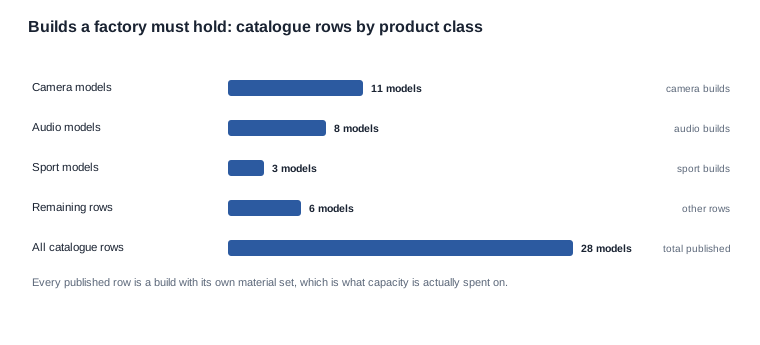
The bars above count the rows rather than the units, and that is the point. Capacity in this category is spent on distinct builds. A catalogue of twenty-eight rows is not one production job; it is up to twenty-eight material sets that a line has to be set up for, and a buyer who orders across several rows in one window is buying several changeovers, whether or not anyone named them.
Where the published catalogue does and does not settle this
Our own position on capacity is worth stating plainly here, because it determines which questions are worth putting to us and which are worth putting to another factory.
We publish the model data: the pixel tier of each camera model, the cell configuration, the charging method, the charging-case capacity where one is published, the published run time, and the colourway count on the models where it is stated. We do not publish our line count, our shift pattern, our cycle times, our component stock position or our monthly output, and we will not, because each of those is a function of the order in front of us rather than a property of the factory.
That is not evasion, and it is the same reason a quotation never contains a standard unit price. A capacity figure that applies to nobody in particular is worse than no figure, because it will be quoted back at you in week four as though it were a commitment.

Checking the claim: six documents in the order they should arrive
The request works best when it is sequential rather than a single list, because the later questions only make sense once the earlier ones have been answered honestly. Each step below has a completion condition you can check without a site visit.
-
The configuration sheet for your order. Model, colourway, charging-case option, packaging version and destination market, written down and confirmed by the supplier. Completion condition: the supplier repeats the same configuration string back to you. If the string changes between two emails, nothing after this point is comparable.
-
The derivation of the capacity figure. Which lines and shifts exist, the cycle time for a comparable build, and the assumption behind the total. Completion condition: you can multiply the cycle time by the shift pattern and land somewhere near the claimed figure. A derivation that does not reconcile is a figure that came from somewhere else.
-
The component constraint list. Which purchased parts would cap output below the claimed capacity, with their lead times. Completion condition: at least one part is named, with a lead time, and the lead time appears in the schedule you are being given. A constraint list with no lead times attached is a list of worries rather than a constraint.
-
The allocation rule for a full month. What happens to a slot when the month is over-subscribed, how priority is decided, and what notice you receive if your slot is reallocated. Completion condition: the rule is written, and it names your order's position rather than describing a general principle.
-
The changeover sheet. How long a changeover runs for this specific build and what the longest continuous run length is in units. Completion condition: the numbers are given for your configuration, and the run length is long enough to cover your order in one pass.
-
The allocation record. A dated record showing where slots have been placed in a recent month, redacted if necessary. Completion condition: it exists and it is dated. This is the only document that converts a capacity claim into a historical fact, and it is the one most often declined.
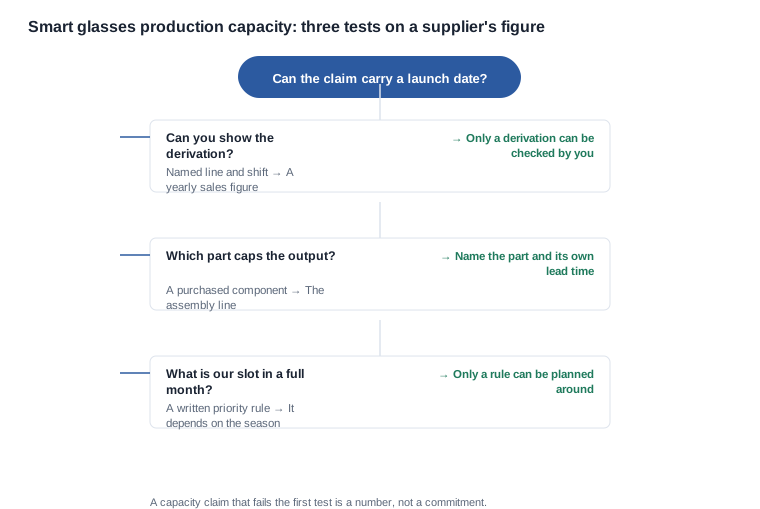
The three tests in the diagram are the ones to apply to any figure that arrives, whatever document it came in. A figure that cannot be decomposed fails the first test and is a number rather than a commitment. A figure whose ceiling is a purchased part with a long lead time passes the first test but should be scheduled as a component problem, not a production problem. A figure with no allocation rule behind it passes the first two and will still fail the month it matters.
Run the six steps in the order above rather than as one batch. A supplier who answers step six enthusiastically and step four vaguely has told you something about how the answers were produced, and you should weigh the rest accordingly.
The red flags that appear before any of the six steps
There is a short list of answers that should stop a buyer moving to the next question, and it is worth naming them because each one looks reasonable in isolation.
"Our capacity is flexible." Flexibility is not a figure and it cannot be checked. Ask for the unit and the assumption.
"We can usually fit a run in." Usually is not a commitment, and a run that is squeezed into a month is a run whose changeover is unpaid.
"It depends on the season." This is sometimes true and always unhelpful, because it describes a constraint without giving you the allocation rule that would let you plan around it.
"That is standard for this kind of product." A generic figure offered in place of a derivation for your build is an answer that cannot be reconciled against your order.
"We will confirm the slot once the deposit is in." A slot confirmed after the deposit is a slot you cannot verify before the deposit, which is the only time verifying it is worth anything.
None of these is a refusal, and none of them requires a site visit to address. They are all resolved by the same request for a document.
How to compare two capacity claims that look different
Two quotations for the same configuration will rarely present their capacity in the same form, so a buyer comparing them has to normalise before comparing anything. The order of operations matters, because the first step decides whether the second step is even valid.
The first step is to confirm that both claims cover the same build, down to the charging-case option and the colourway count. If they do not, the difference between their numbers is not a capacity difference at all, and the comparison stops there. The second step is to put both claims into the same unit — a per-month figure against a per-month figure — and to write down what each one assumes about shifts and cycle time. The third step is to identify which purchased part caps each claim, because that part's lead time is the real schedule input in both cases, and a claim with no named constraint is a claim you cannot schedule against.
The total cost of the comparison, and of the programme behind it, is not the unit price. It is the unit price plus the cost of the documentation route plus the returns reserve, and the trade-off between them is settled in the quotation rather than after the first shipment. How to evaluate a capacity claim in isolation is easier than evaluating two of them together, which is why the normalisation step is where most buyers skip ahead.
What to settle before you order
Before you order, the document set is short and the order of work is not negotiable: the configuration string first, then the derivation, then the constraint, then the allocation rule, then the changeover sheet, then the allocation record. Six documents, in that sequence, each one attached to the purchase order file rather than kept in a mailbox.
A supplier who answers all six in the first round has passed the due diligence that matters most in this category, because it demonstrates that the factory can describe its own operation in a form a buyer can check. A supplier who answers none of them has not refused to be audited; they have simply declined to make a claim that could be tested.
The red flags worth carrying forward are the ones above, and the trade-off worth naming is this: a capacity claim with a visible derivation is worth more than a shorter date without one, because the second one has to be defended rather than met.


Where capacity programmes break before the goods are built
The failures below are the ones that reach a buyer as a surprise, and each is written as a symptom, the root cause and the control that stops it.
The number that came from last year's sales. A total is quoted with no unit, no derivation and no assumption, and it turns out to describe shipments rather than build capability. The control is step two: require the line, the shift, the cycle time and the assumption, and reconcile them yourself. A figure that does not reconcile is a figure that was not built.
The month that was already allocated. The order was booked into a period whose slots had gone to other programmes, and the supplier discovers this at the point where the slot is confirmed. The control is step four, read as a contract term rather than a courtesy: get the priority rule and the reallocation notice in writing before the deposit.
The part that capped the line. Assembly capacity was available and a single purchased component set the real limit, so the schedule slipped by that component's lead time and nothing in the quotation reflected it. The control is step three, with the constraint list attached to the schedule rather than kept separately.
The changeover that nobody costed. Four colourways in one window consumed the slot that the order had assumed was free, and the fourth colourway shipped two weeks after the others. The control is step five, with the run length checked against the order quantity so that a single-pass build is actually possible.
The document that was never asked for. Everything above the factory level was settled and the allocation record was never requested, so a year later there is no way to show when the slot was actually reserved. The control is step six, and it is the cheapest of the six because it costs nothing to request and almost nothing to produce.
None of these is a reason to change supplier. Each is a reason to have one more line in the purchase order, which is a much cheaper outcome than a lesson learned after the goods have been paid for.
Priority, terms and the line we will not cross
The commercial question attached to capacity is priority, and priority is a contract term rather than a goodwill gesture. The lines worth having are the date the slot was reserved, the rule that applies in a constrained month, the notice period for a slot release, and the remedy when a slot is missed for reasons inside the factory's control.
Volume commitments are the usual route to priority, and the trap is that a forecast is not a commitment. If the priority rule requires a volume commitment and you only have a forecast, you have not bought priority; you have written down a number the supplier can use against you later. Be precise about which one you are signing.
Two terms are worth resisting. An open-ended priority clause, where the supplier reserves the right to reallocate your slot at its discretion, has kept the risk and passed you the consequence. And a capacity warranty stated as a best-efforts undertaking, which sounds like protection and functions as nothing. Where neither can be avoided, the answer is to price the schedule risk into your own model rather than to assume it away, and to know before you sign that this is what you have done.
What goes in the enquiry, then, is a short set of questions where each answer changes either the price or the schedule:
-
What is the unit of the capacity figure, and what is the derivation behind it?
-
Which purchased parts could limit output below this figure, and what are their lead times?
-
What is our slot in a constrained month, and what is the written priority rule?
-
How long is a changeover for our configuration, and what is the longest run length?
-
Can we see a dated allocation record for a recent month, redacted if necessary?
A buyer who asks all five in the first round is not being difficult. They are establishing which of the quotations in front of them are complete enough to be compared at all, and a supplier who answers all five has told you something about how their operation runs that no site visit would have told you as precisely.
Where our own commitments sit
Stated plainly: the published model data is the part of the specification we can stand behind, and everything else about capacity is a question for the supplier's own file. We publish the model data and we do not publish capacity, line count or cycle times, because those are functions of the order rather than of the product.
What we will do is take a configuration, a quantity, a destination market and a date, and tell you which build your configuration produces, what material sets it draws on, and where the published charging and run-time data constrains the product itself. Where the answer sits in the factory rather than in the catalogue, we will say so rather than substitute a typical figure that you cannot verify.
There is one part of capacity that the catalogue does settle, and it is worth naming because it changes what you ask for. The published configurations differ in ways that determine how many builds you are buying: three charging-case options across the camera models with a published case capacity, magnetic and Type-C charging split across the range, and a set of models where the charging method is not published at all. Each of those is a configuration question that has to be settled before a capacity question can be answered, because the capacity answer depends on the build.
Two quotations, three weeks apart
Consider a constructed case rather than a client project. A brand-side procurement manager needs a camera model with a charging case for a fixed retailer on-sale date, and has two quotations that differ by three weeks on the same configuration.
The first step is not to accept the shorter date. It is to establish that both quotations are for the same build. The first quotation is for the model with the 1400 mAh case; the second is for the model with the 900 mAh case, and the second is cheaper because it is a smaller material set. That single check dissolves most of the three-week gap before anyone has discussed priority.
The second step is the derivation. The supplier who quoted the longer date supplies a line, a shift pattern and a cycle time that reconcile to a figure materially below their headline number, and names the camera module as the constraint with a lead time that sits inside their own schedule. The supplier who quoted the shorter date supplies a headline figure and no derivation.
The third step is the allocation rule. The longer-dated supplier has a written rule for constrained months and a dated allocation record showing where slots have actually been placed. The shorter-dated supplier describes priority as something handled case by case.
The decision at the end of this is not which date to accept. It is that the first quotation has a schedule with a visible structure and the second has a date with no structure behind it, and a date with no structure is a date that will be defended rather than met. The buyer takes the longer date with the allocation record, freezes the configuration with the 1400 mAh case because the retailer packaging is already designed around that carton, and negotiates the changeover count by cutting the second colourway out of the launch build and adding it at reorder.
The commercial decision was the colourway, not the date. That is usually how these resolve once the documents are in the file.
Send the models, the quantities and the target market, and we will tell you which configurations exist, which of them are open on the published data, and which parts of the capacity question have to be answered in writing before a date can be committed to.
Related reading
- The eight capacity fields and their reasoning — production capacity
- The mistakes these documents expose — capacity common mistakes
- Finding the answers on site — factory audit SOP
Send the configuration, the quantity and the market, and we will say which parts of the capacity question are settled by the catalogue and which are the supplier's to answer in writing.


