

Smart glasses quality consistency is what a procurement team means when a supplier promises the goods will be the same as the approved sample. It sounds like one property. It is four, and they fail in different ways, at different stages of the programme, at different cost. Five questions account for most of what buyers ask about it, and the honest answer to four of them starts with a published specification and ends with a caveat. Defect rate, yield and rework policy are Not published for this range — those are commercial commitments that belong in an agreement, not figures on a web page. What follows sets out what consistency actually means here, which published rows you can hold a supplier to, which ones cannot support the claim, and how to tell the difference between a gap in the record and a failure of the supplier.
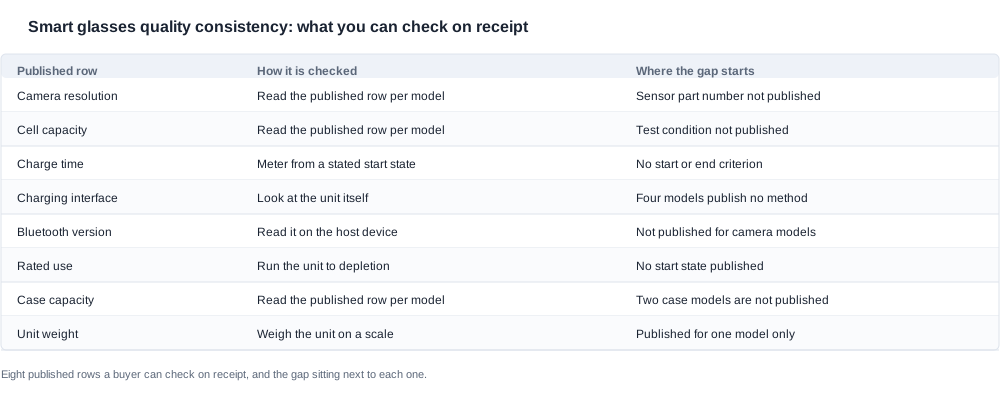
Before you order, write down what you will check. A receiving inspection is the cheapest quality system available to a buyer, and it costs nothing but a list and a decision rule.
Smart glasses quality consistency: the four levels a buyer is actually buying
The phrase covers four kinds of sameness. Most disagreements between a buyer and a supplier are not about the same level, which is why the conversation stalls: the supplier is talking about level one, the buyer is paying for level three.
Level one: the specification, where every unit matches the published row
This is the cheapest level to verify and the one most suppliers can genuinely evidence, because the specifications are published and comparable. For our range that means the camera resolution tier per model, the cell capacity per model, the charge time, the charging method, the rated use, the case capacity where a case exists, and the Bluetooth version where the catalogue publishes it.
Two things are worth knowing about that level. First, the published row is the reference, so a mismatch is a factual dispute rather than an argument about quality. Second, level one is genuinely enough for a large part of what buyers think they are buying. If a shipment matches the published rows, it matches the specification. That is a real and valuable guarantee. It is not the same guarantee as consistency across a run.
Level two: the configuration, where the same specification is assembled differently
The V03 Pro publishes orange, cream white and black. A run assembled from mixed batches can carry the wrong colour without failing any published specification, and it will still pass a level-one inspection. The same applies to the case configuration, the firmware build, the plug, the packaging artwork and the accessories in the box. A buyer who specifies "L1 Pro" and receives a unit with the 1400 mAh case has received a compliant unit that is not the unit they wanted.
Level two is where most first-shipment surprises live, and it is the level that a configuration string fixes. If the order names a model code and nothing else, the configuration is whatever the factory has on the shelf.
Level three: the function, where behaviour matches against a defined test
This is the level the specification gaps bite hardest, because for most of the published rows there is no test criterion in any published material. Nobody has published a rule for what counts as a pass on charge time, because charge time is published without a starting state of charge and without a termination criterion — no published document says what level the battery should be at when the clock starts or how full "charged" has to be. You can measure something. You cannot yet say what a pass is.
Function is also the level where component-level variation shows up. Two units built to the same published rows, with the same published cell capacity, can behave differently if the cell behind the capacity figure is not the same part. Nothing on the published record would reveal that, which is why level three needs a written method and a repeat count rather than an adjective.
Level four: the appearance, where the unit in the box is the same as the reference
This is the level a customer notices latest and complains about first: scratches, seam marks, lens tint, printing position, the box. It is also the level most often handled by a general line check at the end of production rather than by a definition, which is exactly why it drifts. The cost of drift at this level is rarely a technical return; it is a review listing, a marketplace score, or a returns reserve you budgeted on a number nobody wrote down.
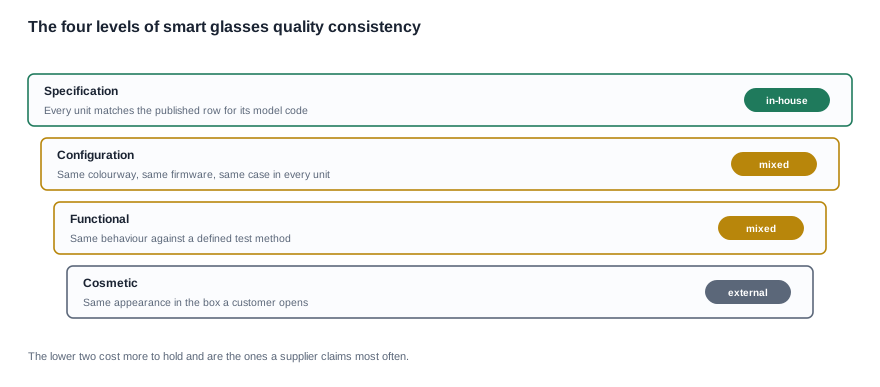
The order matters commercially. Levels one and two can largely be settled by the order document and the goods-in check. Level three needs methods you agree before the run. Level four needs a retained reference unit and somebody empowered to reject against it. A buyer who knows which level a complaint belongs to can route it, and a supplier who knows which level a buyer means can answer it.

The five questions behind nearly every consistency enquiry
Buyers rarely arrive with a clean specification problem. They arrive with one of five questions, and the questions come in an order that can be worked out. The sequence below is roughly how a programme proceeds, and each one has a different answer.
One: what will the units be measured against?
The answer is the approved reference unit, and it has to be a physical object rather than a description. This is the cheapest and most important object in the whole system, and a reference unit that has been carried in a sample bag for six months is not a reference any more. Write down where it is held, who holds it, and how a current production unit is compared with it. If the answer to "what will the units be measured against?" is a specification sheet, you are at level one and no higher.
Two: what happens to a unit that does not match?
The disposition has to be written before the first one, because the decision taken in the moment is the decision taken badly. Reject, rework, downgrade, scrap or accept under concession are all legitimate answers, and they have very different commercial consequences. A buyer who has written a disposition rule has preserved the balance of the argument; a buyer who has not will settle the same question on the evidence of whichever party happens to hold it.
Three: who decides, and at what point?
Ask this as a question about the programme, not about the factory. The person who signs a first article against the reference unit, the person who signs the final inspection, and the person who signs the shipment are often not the same person, and the gap between them is where inconsistency is manufactured. A ramp that is shipped rather than held back is a different commercial proposition from one that is held, and the published data will not tell you which you have.
Four: how will I know that it went wrong?
Returns data is the answer, and the shape of it matters more than its size. A percentage without a denominator is not actionable. Returns per hundred units shipped, separated by cause, tracked per batch, is actionable. A batch-level figure can identify a bad build; a quarterly figure cannot, and a quarterly figure is what most buyers actually receive.
Five: what evidence will I have afterwards?
This is the question that is usually deferred and never answered. The evidence is a batch record: which batch, which date, which line, which units, which cell lot, and which firmware build. Without it, a complaint cannot be traced to a production event, and a fault that affected one day of production becomes a fault attributed to every unit you have ever shipped. The batch record is also the only way a returns reserve can be defended later, because it is the only way to argue that a fault was contained.
Six: what are you actually buying, and what would you have to buy separately
One question sits behind all five, and it decides how much of the above is worth negotiating for. A buyer who needs a specific colourway, a specific firmware build and a specific case configuration across three markets is buying a build, and the controls that matter are level two and level three. A buyer who needs a standard model in a standard configuration for one market is buying a specification, and level one plus a good delivery clause is usually the whole requirement. Buyers routinely over-engineer the second programme and under-engineer the first, and both errors cost money in the same place: the acceptance rule they never wrote down.
Which published rows hold up, and which ones are a marketing figure
Several published rows are objective, comparable and checkable on receipt, and a buyer who writes them into the goods-in list has a real baseline. The important discipline is knowing which rows those are.
The rows you can check on receipt
Camera resolution is published as 8 MP or 13 MP per model, and eight of our models sit in the 8 MP band while three sit in the 13 MP band, so a resolution claim can be checked against the model designation on the unit. Cell capacity is published per model and can be read against the model designation. Charging interface is published as magnetic or Type C for all but four models, and for those four the catalogue publishes no charging method at all — a detail worth noting rather than glossing over, because it changes what you can ask. Rated use and charge time are published for every model, and the charge time is published for the whole range, at two hours or less for twenty six models and around one hour for the two sport models that publish it that way.
Bluetooth version is published for the audio, sport, children's, lens and AR entries. It is not published for the camera models, and a supplier claiming a Bluetooth version for a camera model is adding a figure the catalogue does not carry.
The rows that are not published
Not published for this range: defect rate, yield, rework policy, first-article approval criteria, frame weight for all but one model, camera sensor part numbers, field of view, video specification, microphone pickup distance and noise reduction method, ingress test report numbers, and certification numbers.
The catalogue carries a company-level export certification page, but it gives no per-model certification row, and it contains no CE, FCC or RoHS text at all. That does not mean a model lacks them. It means our published material does not evidence them, so a per-model certificate is written material you have to request and verify. Buyers ask about CE, FCC and RoHS, and the right answer is that those are exactly the documents to ask for in writing, not figures to take from us.
Unit weight is published for one model only. The MT6 glasses body is published at 158 g, which includes the 265 mAh cell and the camera and excludes the 1200 mAh folding charging case; the weight of the case itself is not published, and no frame weight is published for any model. Anyone quoting 158 g as a frame weight is quoting something the catalogue does not say.
The numbers that invite the wrong comparison
The most dangerous published figure in this category is the one that is technically true and practically misleading. A cell capacity of 100 mAh appears on the AR entry, on the photochromic lens entry, on the D11 and D12 audio models and on the ZH12 sport model — four different products, three different charge methods and two different rated-use figures. A buyer who reads "100 mAh" as a tier has read a number that means nothing on its own. The row is comparable; the figure is not.
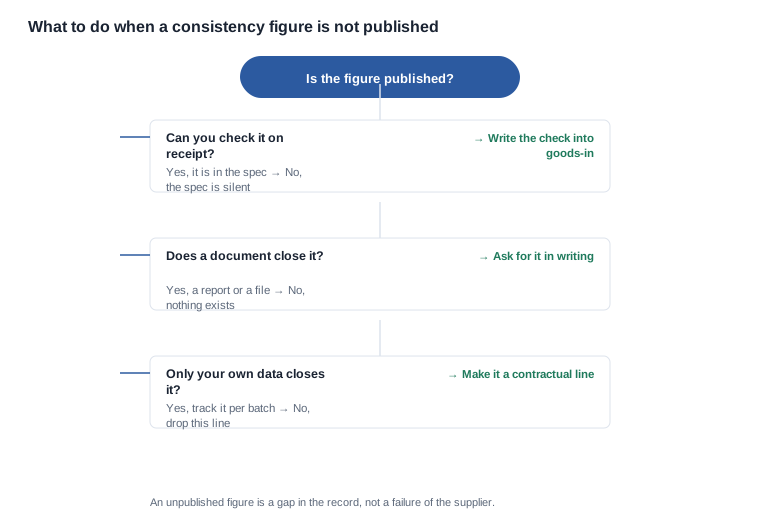
If a supplier offers a defect rate for this category as a published figure, treat it as a benchmark from somewhere rather than a measurement of the units you will receive. The only defensible version is a contractual defect rate measured on your own production runs and tracked per batch.

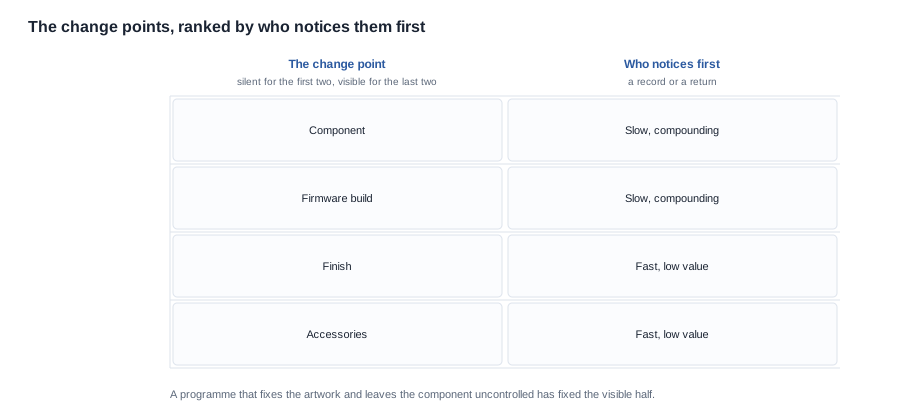
The three ways a batch drifts away from the approved unit
Understanding the drift is cheaper than discovering it. Three mechanisms account for most of it, and each one leaves a different trace.
Configuration drift, which is visible on the unit
Mixed colour batches, a firmware build that moved without an approval, a case option that was swapped, a carton artwork revision that was never signed off. This is the most common and the cheapest to stop: a configuration string on the order, and a goods-in check that compares what arrived against the string. It is also the only drift that a level-one inspection reliably catches.
Process drift, which is invisible on the unit
The same published rows, built on a line whose settings moved. This is where the specification gaps bite, because the published rows cannot show a process that has shifted while the numbers still read correctly. The controls that work here are in-process checks at the stations where the defects actually appear — the channel balance and speaker seating on an audio model, the charging contacts, the port, the temple joint — and a written pass criterion for each, because a check without a criterion is an observation.
Supplier drift, which is invisible in both the unit and the record
A component or a sub-supplier changes underneath the published rows, and the change is at the same nominal capacity, so every published figure still reads correctly. This is the mechanism that took six months to find in the worked example elsewhere in this series, and it is the reason a component list written by part number is worth more than a specification sheet. The trace is in the batch record, or it is nowhere.
The practical test of whether a drift mechanism is under control is simple: could you name the production date on which it happened? If a supplier cannot answer that, a fault cannot be contained, and the returns cost lands on the whole programme rather than on one shipment.
There is a fourth mechanism that belongs on the list because it is the one buyers do not think of at all: the change that was announced correctly and handled badly. A supplier who notifies you that the case supplier has changed has done nothing wrong, and a programme that treats a notification as a crisis will pay for it twice. A change notification is a routing event, not a fault. The correct response is to ask whether the changed part affects any published row, and if it does not, to acknowledge it and move on. Buyers who use a change clause as a veto on every notification end up with a supplier who stops notifying them, and that is a worse outcome than the change was.

What we will not put in writing, and why that is a position
We will not publish a defect rate, a yield figure or a rework policy as a fixed number for this range, because none exists in the manufacturer's published material and an invented figure would be worse than an honest gap. Defect rate, yield and first-article approval criteria are Not published. We would rather tell a buyer that than quote a typical figure they cannot verify, because a buyer who builds a claim on an estimated number finds the error in the field rather than in the quotation, and the correction is more expensive than the question.
What we will do is give you the published specification set for a configuration, so that your receiving inspection is grounded in facts, and tell you plainly which consistency claims we cannot evidence. The rows our published data does settle include the resolution tier, the cell capacity, the charge time, the charging method, the rated use and the case capacity for the models where a case is published. The rows it does not settle are marked as open rather than filled with a typical value.
We will also tell you which of the four levels above a given programme actually needs, because they are not all needed on every order. A single-country, single-model, single-colour programme may need level one and level two and very little of level three. A multi-market programme with a case option needs all four, and the reason is different in each case.
If a consistency commitment matters to your programme, it belongs in the agreement as an obligation on both sides — and that is a conversation we can have directly, rather than one you need a website number for. Unit prices, minimum order quantities and lead times are confirmed per enquiry rather than published as fixed numbers, because they depend on the configuration and the quantity rather than on the model.
What to send us so the answer is specific
The most useful enquiry we receive names four things: the models, the configuration of each, the quantity, and the target market. With those, we can tell you which published rows exist for the configuration, which are open, what a receiving inspection would look like against them, and which questions have to go into the quality agreement rather than into a specification.
If the programme is at the sampling stage rather than the order stage, the sample policy red flags article covers the documentation habits that predict how quality data will be handled later. For the full consistency programme, quality consistency overview covers the batch-tracking structure, and what to check when a sample arrives covers the inspection baseline.
Related reading
- Quality consistency overview — the batch-level programme
- Sample policy red flags — documentation habits to check early
- What to check when a sample arrives — the inspection baseline
Send the models, the configurations, the volume and the market, and I will give you the published specification set to build a receiving inspection around — and tell you plainly which parts of smart glasses quality consistency are settled and which are yours to close.


