

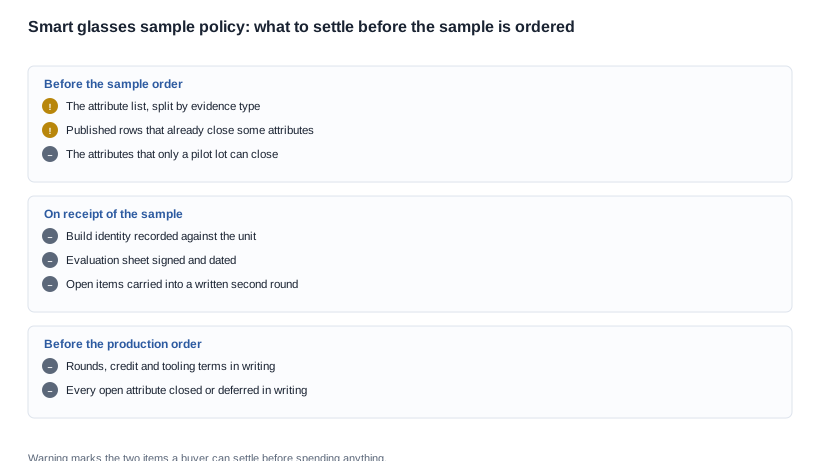
What a smart glasses sample policy really decides is not the sample charge. It decides which attributes of your programme will be settled on evidence and which will be settled by assumption, and a sample programme that does not make that split explicitly will settle a large part of the specification by default. The split is worth building before any sample is ordered, because the published catalogue lets you do most of it for nothing: read the published rows against your requirement list, and you can see immediately which attributes need hardware in the room with you and which need only a written answer.
That is the practical point about this category. A sample is a measurement instrument, and its cost, its number of rounds and its calendar time are all determined by how well the instrument was specified. A buyer who arrives with a signed attribute list closes most of the specification in one round; a buyer who arrives with a product and an opinion buys a round, then a second round, and then a pilot lot to settle what neither round could.
Smart glasses sample policy: who answers for what a sample cannot
The four things a sample can settle
A sample is real hardware, and it settles four groups of question well.
The build identity. Whether the unit you are holding is a stock unit, a modified unit or a pre-production build, and whether its identifiers tie it to a configuration at all. This is the precondition for every other answer, because a measurement taken on a unit whose build is unknown tells you about that unit and nothing about the production lot.
The physical attributes. The unit weight as shipped, the finish, the case-to-unit pairing, the charging path as actually built, and the presence or absence of the interfaces the buyer intends to use. These are measurable, they are comparable, and a written specification cannot substitute for them.
The interface behaviour. How the controls respond, how the firmware presents itself, how the unit behaves over a normal session. This settles the questions about the product as an object, and it settles them well provided the session is scripted rather than improvised.
The physical presentation. Colour, packaging, artwork and print, which are reviewable against a mock-up and against the finished unit.
The four things it cannot
Production consistency. Whether the hundredth unit matches the first is not a property of the first unit, and a hand-built or single-off sample proves nothing about it. This needs a pilot lot or production data, and a sample programme that judges consistency on one unit has produced an opinion rather than evidence.
Certification outcomes. A compliance route for a Bluetooth-equipped device in a given market is settled by documents and tests, not by a unit on a desk. For the European Union the framework is the Radio Equipment Directive (EU) 2014/53/EU, and the general product safety regulation has applied since 13 December 2024. A sample can tell you what the device is; it cannot tell you what the market accepts.
Long-run behaviour. Cell ageing, battery degradation over months, thermal behaviour under sustained load, and the behaviour of a firmware update path over a version cycle are all outside what a short evaluation can establish.
The commercial and documentary attributes. Lead times, minimum order quantities, price tiers and the document set that will accompany the goods are all things a supplier states rather than demonstrates, and they belong in the order rather than in the evaluation sheet.
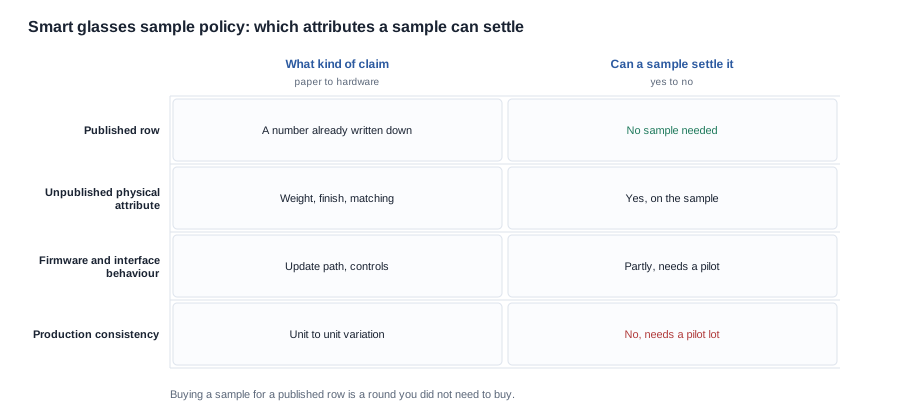
The matrix above is the sorting rule in one picture. An attribute in the top row is already written down somewhere and needs no hardware at all. The second row needs the unit in front of you. The third needs the unit plus a production run. The fourth cannot be settled by any sample at all, and the only honest answer is to schedule the evidence that will.
Telling a stock unit from a pre-production build
Three different objects are sold as samples, and the difference between them is the difference between a measurement and an impression.
A stock unit is a catalogue configuration, unmodified. It can settle the physical attributes of that configuration — the finish, the case pairing, the charging path as built on that model — and it cannot say anything about your build, because your build does not exist yet. A modified unit is a production or retail unit that has been reworked to look like your configuration: a logo applied, firmware loaded, packaging substituted, sometimes a lens or temple swapped. It is a legitimate and common way to approve appearance, and it is close to useless as a first-article reference, because the modifications are exactly the points where a production build differs. A pre-production build is assembled on the production line against a real work order, with production tooling, and it is the only one of the three that can carry the identifier of a production unit.
The questions that settle which one you have are short. Does the unit carry identifiers that tie it to a configuration string? Was it assembled under a work order for your order, or was it taken from stock and reworked? Are the modifications listed anywhere, and does the list include the charging path?
That last question matters more than it looks in this category. Four camera models publish a case capacity with no charging-method row at all — the MT6 and the CY03, and the CY05 and the L1 Pro — so for those four the charging interface is a build detail rather than a published specification. A modified sample can carry a charging arrangement the production build will not have, and the sample will therefore appear to contradict the eventual delivery. The safe procedure for those four is to require the method in writing and to treat the sample's charging path as indicative rather than as evidence.
There is a second version of the same trap with the case. Four camera models publish no charging-case row at all — the S7 and the V03 Pro, and the V06 and the V03 — and none of the four is published as having no case. If a sample for one of those models arrives with a case, the reasonable question is whether it is an evaluation accessory rather than a production accessory, because a programme that plans a case it will not receive discovers it at the goods-in stage.

The attribute ledger, and why it is built before the sample is ordered
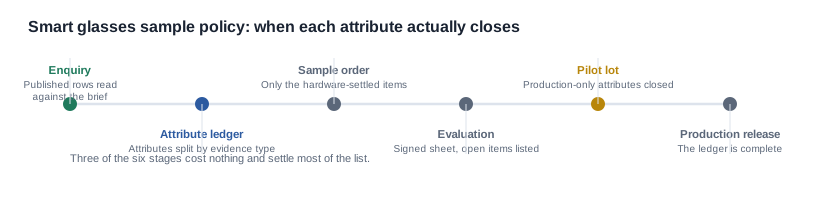
The attribute ledger is a single sheet with one row per attribute and four columns: what the attribute is, what evidence would close it, what closes it today, and who signs. It is the artefact that makes a sample programme cheap, because it converts an open-ended evaluation into a countable list.
The reason to build it first is arithmetic rather than administrative. Every attribute on the ledger that is closed before the sample is ordered is an attribute that does not have to be re-argued in round two, and round two is where sample programmes lose money.
Writing the evaluation sheet so the answer is signed
The ledger decides what has to be tested. The evaluation sheet decides what a test result means, and the two documents are not the same thing.
A workable sheet has five columns and one row per attribute: the attribute, the method, the pass condition, the result, and the signatory. The method is the part that is usually left out, and its absence is what turns a sample round into an opinion. "The unit weight is acceptable" is an opinion; "the unit weight of the evaluated unit, measured on a calibrated scale with the charging case and packaging removed, is within the range stated on the order" is a result that can be reproduced and filed. The pass condition is the part that prevents the round from running late, because it fixes in advance what counts as a pass and therefore how many disagreements are possible.
Three further practices make the sheet worth keeping. Record the build identity of the unit that was evaluated against each row, so that a later reader knows which object produced the number. Record what was not tested on the same sheet, so the gap is explicit rather than implied — the production-consistency line is the usual example, and its presence on the sheet as "deferred to pilot lot" is what stops it being judged on the sample. And keep the published rows alongside the measured ones, because a sheet that separates the two shows which numbers came from the catalogue and which came from the supplier, and that distinction is exactly what a receiving inspection at goods-in will need later.
The total cost of a sample programme is dominated by the number of rounds rather than by the unit price of the samples, so the sheet is the cheapest control available. The red flags are specific: a sheet with no method column, a sheet signed by nobody, a second round triggered by a disagreement about a term rather than a measurement, and an evaluation that was never written down. Those are the pitfalls worth designing out, and the questions to ask before you order are the ones that establish whether the supplier will treat the sheet as a document or as a courtesy.
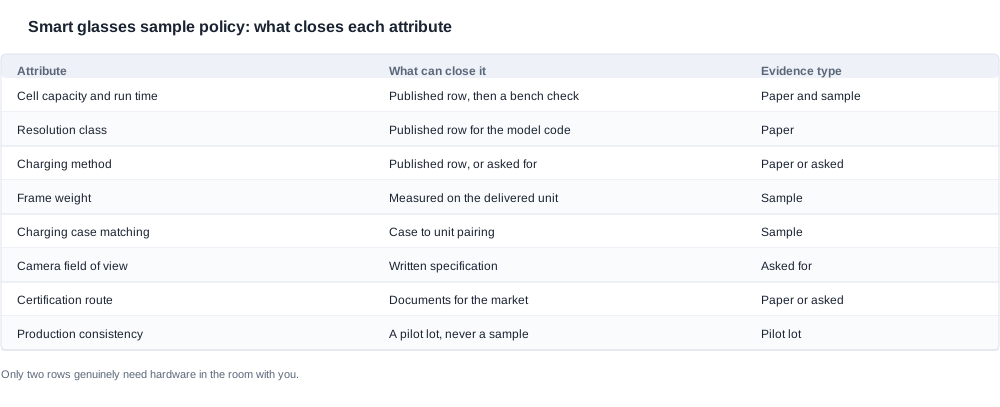
The table shows a realistic split for a camera model, and the pattern generalises. A small number of attributes genuinely need the unit in front of you. A larger number need a written answer that costs a supplier nothing to supply but a great deal for the buyer to chase. And one category — production consistency — cannot be closed by any of it, which is why a sample programme that omits it from the ledger will discover it at the pilot lot, at the worst possible moment.
How the published catalogue decides how much a sample programme costs
This is where the catalogue earns its place in the sample conversation, and it is not a small effect.
The catalogue publishes twenty-eight models, and for each of them it publishes rows that are already closed before a sample exists. Every camera model publishes its resolution class — eight of the eleven camera models at eight megapixels, the L1 Pro, the L2 Utral and the S7 at thirteen. Every model publishes a frame cell capacity and a run-time band. Twenty-four of the twenty-eight publish a charging method: seventeen magnetic, seven Type C, and four — the MT6 and the CY05, and the CY03 and the L1 Pro — publish no charging-method row at all. Five camera models publish a case capacity, at 900 or 1400 mAh for the L2 Utral, 1200 mAh for the MT6's folding case and 1400 mAh for the CY03, the CY05 and the L1 Pro. Two models publish an ingress marking, the V06 and the S7. One model publishes a weight, the MT6 glasses body at 158 g including its 265 mAh cell and its camera and excluding the foldable charging case whose own weight is not published.
Read that list against your requirement list and you can tell, before you spend anything, which of your rows are already answered. A requirement for the run-time band of the V06 is closed. A requirement for the charging method of the CY03 is not closed, and the sample may not close it either, because a charging method is a build decision rather than a measurement — it has to be asked for in writing.
The catalogue also tells you what it does not hold, and the absences are more useful than the presence in a sample programme. There is no sensor part number, no field of view, no video resolution, no frame rate, no stabilisation figure, no microphone pickup distance, no defect rate, no ingress test report number and no per-model certification row for any model. Those are not sample attributes. They are attributes that require a written specification, and the ledger should say so.

The terms that decide the programme: rounds, credit and tooling ownership
The commercial treatment of a sample programme is worth settling early, because three items determine whether the programme is a fixed cost or an open-ended one.
The number of rounds. One evaluation round should be the plan, and the second should be the exception. A supplier who will not state how many rounds are included has not priced the programme, and the second round always costs more than the first because it carries the rework as well as the unit. The clause worth having states the number of rounds included, what triggers another one, and what each additional round costs.
The sample credit. The sample charge is usually fixed and rarely worth negotiating. The condition under which it is credited against the first production order is where a real amount sits, and it has to be attached to a trigger that will actually happen — the value of the first order, the date the order is placed, and the date the credit is applied. A credit condition that depends on the programme continuing is worth nothing to a programme that has been cancelled.
The tooling. The mould or tooling fee is the item that catches buyers out, because it behaves like a non-recurring cost amortised across the programme rather than a one-off. Three questions settle it: who owns the tooling, how it is amortised across the first order, and what happens to it if the programme is cancelled before it is used. A buyer who has not asked the third question owns an asset in someone else's building.
The terms worth keeping in the order document are the build identity, the evaluation sheet as an agreed document, the number of rounds, the credit condition, and the tooling ownership and amortisation. A supplier who accepts the evaluation sheet as part of the agreement has accepted your acceptance criteria, which is a far stronger position than a supplier who has agreed verbally to make changes.

A sample programme worked through, and what we will not publish
Eleven requirement lines, asked of two suppliers
The example below is constructed. No client, no order and no sample outcome is claimed; the camera model with a charging case, the European destination and the two suppliers are all assumed, so that the sequence can be followed.
A brand is opening a European programme on a camera model with a charging case, and it has to decide whether to buy samples from two suppliers before committing to either. The requirement list is eleven lines: run time, charge time, charging method, case capacity, case pairing, unit weight, resolution class, camera field of view, ingress position, the certification route for the destination market, and production consistency.
The first step is reading the published rows against the list, and it is decisive. The resolution class, the run-time band and the charge time are published for the ordered model and are closed. The charging method is published for this model and closed. The case capacity is published and closed. Four of the eleven lines close without spending anything.
The second step is sorting what remains. The unit weight is not published for this model, so it is a sample attribute — a measurement on a delivered unit. The case pairing is a sample attribute. The camera field of view is not published and is not really a measurement on one unit; it is a written specification that the supplier must supply. The certification route is a document set. And production consistency is not closable by any sample at all.
The third step is the supplier question, and it is a single question: which of these remaining items will you state in writing before the sample ships. The first supplier answers with a written specification for the field of view, names the certification documents, and says the unit weight will be stated with the order. The second supplier offers a pre-production sample and says the rest can be discussed after the review. The second answer produces a sample round that settles two lines and leaves the rest open.
The fourth step is the evaluation sheet. It is written before either sample ships, with a row per attribute, the method, the pass condition and the signatory. It contains the six lines that were not already closed, and it contains the note that production consistency is excluded from this round and scheduled against the pilot lot. That note is the single most valuable line on the sheet, because it is the one that stops a subjective judgement becoming a production problem.
The fifth step is the order. Rounds, credit condition and tooling ownership are written into the order document, with the credit attached to the value of the first order and to a date. The programme now has a fixed cost, a fixed number of rounds, and a list of attributes that are open by design rather than by neglect.
What we publish, and what we will not publish
Concretely, a sample programme should be settled against a written attribute list rather than against an opinion about a product, and the published rows are the part of the specification we can stand behind. We publish the resolution class for the eleven camera models, the cell capacity, the run-time band, the charge time and the charging method for every model that has one, the case capacity for the five camera models that publish one, the colourways, the ingress marking on the two models that carry it, and the single published weight. Those rows are the parts of your ledger you do not have to buy.
What we will not publish is a sample price, a sample credit, a number of rounds, a tooling fee, a minimum order quantity or a lead time. Each of those depends on the configuration, the quantity and the date, and a published figure without those three cannot be compared with anyone else's. We would rather tell you that than quote a typical number you cannot verify.
What we will do is take a configuration, a requirement list and a destination market, and tell you which of your lines the catalogue already closes, which need a written specification, which need the sample, and which have to wait for a pilot lot. That division is the cheapest work in the whole programme, and it is the work that determines what the sample has to do.
Related reading
- factory audit documentation requirements
- sample policy step-by-step article
- sample policy cost breakdown
- samples pillar
- AI camera glasses range
Send the requirement list, the configuration and the destination market, and we will say which lines a smart glasses sample policy can close before you buy a single unit.


