

Smart glasses shipping is easiest to understand through one worked order, and the order worth working through is the mixed one: several models, different charging case situations, one destination market, one consignment. This is a hypothetical case, written as a reasoning exercise rather than as a customer project. No client is described, no order was placed, and no figures are claimed as ours. The models, the quantities and the market are assumed so that the reasoning can be followed step by step, and the four failure modes that come out of it are the ones that actually reach a buyer.

Smart glasses shipping: a mixed order worked through to close-out
The scenario, and what is assumed
Assume a brand-side procurement manager is opening a wearable line for sale into one European market through two channels. The first order has four line items rather than one: a camera model that ships with a 1400 mAh charging case, a camera model that ships with a foldable charging case, a camera model whose charging case status the catalogue does not state, and an open-ear audio model in a retail box. Quantities are in the low thousands for the camera lines and high tens of thousands for the audio line. One destination market, one ship window, one freight booking.
Three things are assumed to be settled before the walk-through begins, because they are not what this exercise is about. The product selection is settled, in the sense that the models have been chosen for the channel. The commercial terms are settled in outline. And the buyer has already decided to ask for a written document set rather than a verbal assurance, which is the decision that makes the rest of the walk-through worth reading.
What is not assumed is anything about the freight rate, the lead time or the certification evidence, because none of those are published and none of them can be reasoned about without the supplier's own file.
Why a mixed order is the hard case
A single-model order teaches a buyer one thing per consignment. A mixed order teaches four things at once, and it compounds them, because the configurations are not independent of each other: they share a carton, a packing list, a container and a single set of shipping documents.
The three camera lines alone produce at least four distinct case situations, because the catalogue distinguishes four of them. Five camera models publish a charging case capacity: the L1 Pro and the CY03, and the CY05 — each at 1400 mAh, the L2 Utral at 900 mAh or 1400 mAh, and the MT6 at 1200 mAh in a foldable case. Two more, the KY06 and the MT5, publish the fact of a case without publishing its capacity. One model, the V03 Pro, has no charging-case row. And three models, the S7 and the V06, and the V03, have no charging case row at all.
That last group is the one that catches people. A missing case row is not a published absence of a case; it is the catalogue being silent. A buyer who reads the silence as an absence will pack a carton that does not match the goods, and a buyer who reads it as a presence will pack a carton with an accessory nobody ordered. The only safe reading is the third one: it is an open row, and it has to be closed by asking.

How three configurations change the carton
The three case statuses and what each one means
The practical effect of the four case statuses is that the carton cannot be specified until every line has been asked about. A camera model with a 1400 mAh case produces a two-item parcel. A camera model with a foldable case produces a parcel of similar footprint, because the case lies flat rather than sitting inside the box. A camera model with no case produces a single-item parcel. An open-ear audio model in a retail box produces the smallest parcel of the four and therefore the largest unit count per carton, which is the line that dominates the container arithmetic in this order even though it is the smallest value.
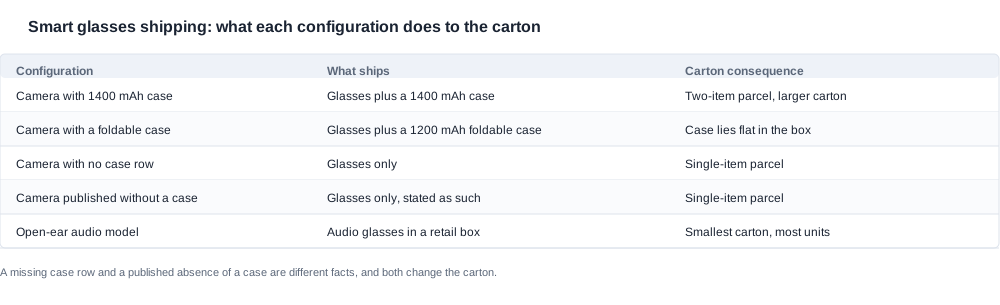
The shipping cost of this order is therefore not one number with four models in it. It is four different parcels with four different chargeable weights, and the per-unit freight figure that comes out at the destination will be a weighted average that no single line item predicts. Any comparison against another supplier has to be made on the same configuration mix, which in practice means comparing the configuration matrix rather than comparing a total.
Why the case option belongs in the configuration string
The configuration string is the thing that identifies a build, and the case option has to be inside it because it changes what is in the carton and therefore what the battery transport file has to cover.
A device that ships with a charging case carries a second cell, and that second cell changes the declaration, the packed weight and the classification question. A file written for the bare device does not cover the device plus a case, and a carton that mixes the two is a carton whose contents the file cannot be reconciled against. The buyer does not have to understand the transport rules in depth to see the logic: if the file names one cell and the carton holds two, something in the paperwork is wrong, and finding that out at the terminal is far more expensive than finding it out in the specification.
The same logic applies to the shipping documents themselves. A packing list that says "1400 mAh" is not a description of the goods; it is a description of a power source. The packing list has to describe the goods, and the charging case, because the case is a separate cell in the same carton.
The four ways this order fails
The designation that does not match
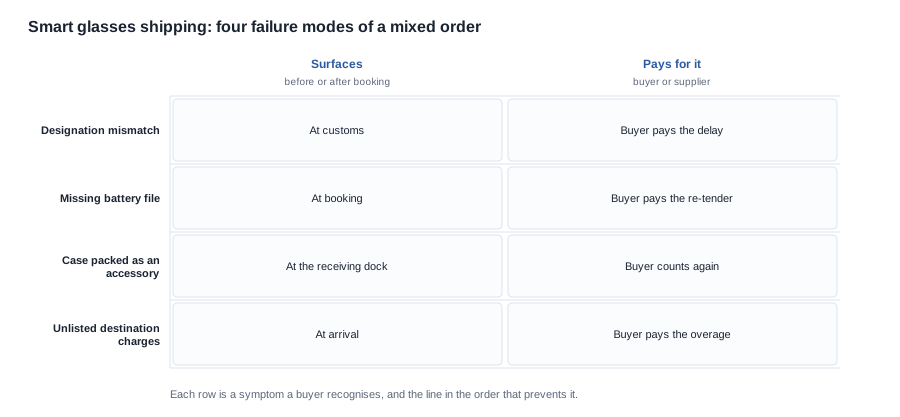
The first failure is the oldest one and the most avoidable. In a mixed order with four line items, the paperwork is generated from a spreadsheet that somebody will eventually edit, and the edit that gets made is usually a suffix: the V03 becomes the V03 Pro, or the L1 Pro becomes the L2 Utral. Those two substitutions are not cosmetic. The V03 Pro is published without a charging case, and the L2 Utral is published with two possible case capacities.
The symptom arrives at customs as a document that does not match the goods. The root cause is a configuration that lives in an editable spreadsheet rather than in a configuration matrix that the packing list, the carton mark and the paperwork are all generated from. The preventive control is a single source: one matrix row per configuration, with the designation written exactly as it appears on the carton artwork, and every downstream document derived from it.
The file that was never requested per configuration
The second failure is the battery transport file, and it is specific to the mixed order because the order contains several cell arrangements. The request went out once, for the category, and produced one summary. That summary covers one configuration.
The symptom is a load that is refused or held, depending on the mode and the carrier. The root cause is a request that named a product family rather than the four line items, so there was nothing to hold the supplier to. The control is one request per configuration, with the model designation on the summary compared against the designation on the unit and the carton artwork before the order is released.
The charge that was never itemised
The third failure is the landed cost. The quotation carries a delivered-duty-paid number with no breakdown, and the destination charges inside it were estimated against a carton that does not exist, because the carton was still being discussed when the quote was produced. The symptom is an invoice that is higher than the business case allowed. The root cause is that the quotation was produced before the configuration was, which is a sequencing failure rather than a pricing failure.
The control is to produce the carton matrix before the quotation, not after it. A supplier who quotes a delivered price against four configurations can only do it properly if the four carton dimensions are already known, and asking for them before the quote is the way to force the quote to be built on the real thing.
The fourth failure, which happens at close-out
The fourth failure is quieter and it recurs. The consignment arrives, the carton count matches, the units are counted, and the close-out note is never written. Nothing has gone wrong, so nothing is recorded, and the next consignment repeats the same ambiguity.
There is a fifth possibility that belongs in the same list because it is the one that costs the most to detect: the order was built correctly, packed correctly, documented correctly and shipped correctly, and the configuration in the carton is still not the configuration in the buyer's own plan. It happens when the buying brief said "camera model with a charging case" and the factory read it as the L1 Pro rather than the L2 Utral, both of which publish a 1400 mAh case option but only one of which also publishes a 900 mAh option. Nothing in the shipment is wrong. The order is simply not the order that was intended, and the only place it surfaces is in the channel.
The reason this matters more in a mixed order is that a mixed order is where ambiguity lives. The close-out note is what converts a consignment into a procedure, and in a programme with four configurations it is the only document that carries the outcome of the previous one forward.

What the case changes in the commercial conversation
What the freight rate is worth once the rule is named
In this order the freight rate is not the interesting number, and the reasoning is worth stating because buyers often negotiate the wrong line. The interest comes from the fact that the audio line dominates the unit count while the camera lines dominate the parcel volume. A rate quoted per kilogram and a rate quoted per carton will therefore rank the configurations differently, and the two quotes will look incomparable when they are actually comparable.
The way to compare them is to name the shipment rule in each quotation: whether the goods travel consolidated or alone, whether the order is one consignment or split by configuration, and where the cost basis changes. Splitting an order by configuration is worth discussing carefully rather than dismissing, because one consignment with a mixed packing list is simpler to handle at customs than four consignments, and the freight saving from consolidation can outweigh the paperwork cost of the mixed list.
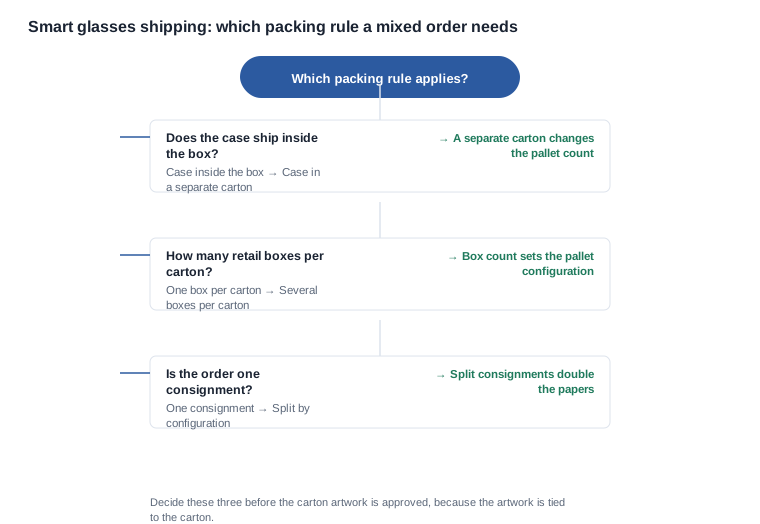
The rule about who books the freight matters just as much, and for a mixed order the answer is usually the buyer's own forwarder, because the buyer's forwarder can optimise the consolidation across the four configurations while the supplier's forwarder optimises for the factory's own schedule. The payment terms section covers the other side of the same commercial relationship, and the audio line itself is described on the Bluetooth audio glasses page.
What the case does to the seller's risk
A mixed order also changes what the seller can promise, and a buyer who does not ask about this will discover it later. A seller who commits to one delivery date for four configurations with four different case situations is committing to the slowest of them. A seller who commits to a rolling release against a frozen configuration is making a different and more valuable commitment, because it separates the schedule from the configuration.
This is a question worth putting in the enquiry rather than assuming an answer: can the release be split by configuration, with each configuration shipped against its own packing list, and can the ship window for each be stated separately? Where the answer is yes, the schedule risk in this order collapses from the slowest configuration to the average. Where the answer is no, the buyer should price the delay into the launch date rather than discovering it.

The questions to send before accepting this order
The document request, in the order it has to go out
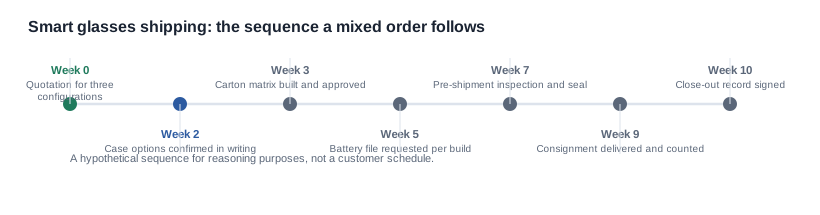
The request for this order is one message with four blocks, and the order of the blocks is the order in which they have to be resolved.
- The configuration block: one row per line item with the model designation exactly as it will appear on the carton artwork, the charging case option, the colour option where one is published, the packaging version, the shipping carton dimension, the gross weight, the units per carton and the carton mark.
- The battery block: a transport file per configuration, with the model designation on the summary to be checked against the unit and the artwork.
- The freight block: the shipment rule, the cost basis and its break points, the mode, the transit time in weeks, and the destination charges itemised separately.
- The close-out block: the packing list format, the document issue owner and the name of the person who signs the close-out record.
The audio line deserves its own note inside the configuration block, because it is the line that behaves differently. The eight audio models in our catalogue, from the K01 and the K02 through to the G07 and the YK12, are specified with published cell capacities and published charge times, and their cartons are the smallest of the four, but their unit count is large enough that the carton mark and the count discipline matter more on that line than on the camera lines.
The four questions that have to be answered before the deposit
Four questions have to have written answers before the deposit goes out, and none of them is about price.
The first is whether every one of the four line items has a confirmed charging case status, including the model whose case the catalogue does not describe. The second is whether the four shipping carton dimensions exist as stated figures rather than estimates. The third is whether the freight quotation names its shipment rule and itemises the destination charges. The fourth is who signs the pre-shipment inspection result and who signs the close-out note.
How to evaluate the answers when they come back
The questions to ask above produce answers of very different quality, and the evaluation criterion is not whether the answer sounds right but whether it carries something checkable. A case status that names the model and the case capacity can be checked against the catalogue for the models the catalogue describes, and cannot be checked for the three models where the catalogue is silent, which is exactly why the silent ones are the ones to escalate. A carton dimension can be checked against the physical carton at the pre-shipment inspection. A shipment rule can be checked against the booking confirmation. A named signatory can be checked by the fact that a document arrives with their name on it.
There are three red flags in this order specifically. The first is a single carton dimension offered for all four line items, which means the supplier has assumed the case does not affect the carton and has therefore not thought about the case. The second is a battery file offered as one document for the whole order, which means one configuration has been assumed for four. The third is a delivered price with no itemisation, which means the destination charges were estimated against something.
The trade-offs inside the request are real and worth naming rather than pretending they are not. Asking for four carton dimensions takes longer than asking for one. Asking for a document per configuration rather than per category takes longer and produces a file set that is harder to administer. Asking for the freight quotation to be rebuilt after the matrix is settled can delay a quote by days. Against that, the total cost of guessing is a consignment that stops at the terminal, and it is worth naming the usual pitfalls here because they are not exotic: a designation that changed in a spreadsheet, a file that covers the family instead of the build, and a charge that was never broken out are the three that recur in mixed orders.
How to evaluate a mixed-order quotation, then, is a four-step check: confirm that every configuration has its own case status, its own carton dimension and its own battery file; then check the freight block for a named rule and itemised destination charges; then check the matrix for the four failure modes above; and only after that compare the total cost of this order against the alternative, on the same configuration mix.
Where the walk-through stops and the contract begins
On this category, that the published material settles the product half of a shipment and none of the shipment half. We publish the configurations, the case options, the interface rows, the colour availability and the electrical rows, because those are product facts that do not change with the order. We do not publish prices, lead times or capacity, and we will not fill a matrix cell with a typical figure taken from a general supplier list, because a plausible number that turns out to be wrong is more expensive than an acknowledged gap: it gets built into a carton drawing, a cost model and a quotation.
What we will do is take a configuration, a quantity and a market, and tell you which parts of the shipment are settled, which are open, and which have to come from the supplier's own file. Certificate numbers, issuing bodies and validity dates are not published in our documentation, and we will say so rather than quote a figure we cannot trace to a document.
The logistics and shipping section sets out the commercial framework that surrounds the same relationship, and the shipping step by step article covers the sequence between the quotation and the container.
Send us the four line items, the quantities and the destination market, and we will tell you which configurations exist for each, which of them are open on the published data, and what to request in writing for each one that is not.


