

Smart glasses shipping is not a single event between the factory and the warehouse. It is a sequence of six steps, and the reason it fails is almost never a failure of any one of them — it is a handoff that happened in the wrong order, or an output that was produced verbally instead of in writing, or a document that was opened after the slot it belonged to had already been reserved.
The six steps below are the ones that recur in this category. Each one has an output, each output is a document rather than a feeling, and the last step closes the loop the fourth one opened.
Smart glasses shipping: what six steps and their documents leave open

Step one: freeze the configuration and name the incoterm. Before anything else, the order has to carry a dated configuration string that identifies the model and the variant, and an incoterm with a named place. Both are easy to defer and expensive to defer, because every later step inherits them. This category in particular punishes a loose configuration string: the V03 and the V03 Pro are separate products with different charging arrangements and different lens options, the V06 is published in four colours and the V03 Pro in three, and the L2 Utral page carries a second designation string next to its published name. Any of those can be mis-transcribed into a string that no longer identifies one product, and a receiving team will not detect it, because the error is a plausible name rather than an obvious one.
The incoterm belongs in the same step because a term without a place is not a term. It also determines who carries the duty, who files the customs entry and where the risk passes — three consequences that move together and should not be separated into a side letter.
Step two: confirm the carton and the charge method for that model. The shipping carton is quoted by drawing revision with its packed dimensions, and the charge method comes from the specification sheet. Both are per-model, and the second one is a published gap for four camera models: the charging method is published for twenty-four of the twenty-eight models in the range, and it is not published for the L1 Pro and the CY03, and the CY05 or the MT6. For those four, the method has to be requested in writing, because it decides what power accessories travel in the box.
The case status is confirmed in the same step, for the same reason. Seven camera models publish a charging case row, and the catalogue publishes no charging case row at all for the V03 and the V06, and the V03 Pro and the S7, which is a line the supplier has to fill in before the packing instruction is written. That last group is an open question rather than an absence, and it has to be closed before the carton can be specified, because the case is the largest single volume difference inside the box.
Step three: open the transport document file before the production slot is reserved. The document set for a lithium-equipped consignment applies without exception, since every model in this range ships with a cell. What varies is the market-access scope, and the catalogue cannot shortcut that: it carries one company-level export-certification page and no per-model certification rows at all, so the file for a destination is agreed with the supplier rather than read off a specification. Opening the file before the slot is reserved is what makes step four possible, because the release conditions have to be known before the goods are packed for them.
Step four: count and photograph at the packing station. The count is taken at the station, not estimated afterwards, and the sealed carton is photographed with its number visible. This is the cheapest control in the sequence and the only one that produces evidence about the shipment rather than about the intention to ship it. A count reconstructed from a production record is not a count, and a photograph taken at the gate is not evidence of what was inside the carton.
Step five: book against the release conditions and the consolidation window. The booking is placed against confirmed release conditions and a stated consolidation window, not against an optimistic date. A rate quoted for a consolidated movement without the window attached is not a schedule, and a load that is held at the origin for a documentation reason costs days rather than hours.
Step six: reconcile the cartons against the packing list on arrival. The cartons are counted at the gate against the packing list, before anything is broken down. A discrepancy found at the carton stage can still be attributed to the packing station; the same discrepancy found after the units are in the distribution centre is a claim about a number that three parties will now describe differently.
What "frozen" has to mean for step one
The word frozen is doing a lot of work in that step, and it is worth defining it, because a configuration that is settled in principle and still open in practice is the most common state a step-one order is actually in.
A frozen configuration has four components, and each of them closes a different kind of error. The model designation closes a transcription error. The variant closes an ordering error — in this category that means the charging case option, the lens option and the colour, because the V03 Pro is published in three colours and the V06 in four, and a colour ordered for one market and shipped to another is a difference a receiving team cannot see. The quantity split closes a packing error, and it has to be a split into units and cartons, because the catalogue publishes no unit count per master carton for any model and therefore no way to convert one into the other without asking. The date and revision close a version error, and they are what allow step six to compare a carton against an order rather than against a memory.
There is a fifth item that belongs in step one even though it is not part of the configuration: the approved packaging revision. It is listed there because a configuration that is frozen against a carton specification that is not yet fixed is only half frozen, and the half that moves is the half that determines the freight band and the level of protection available.

Where the sequence slips, and why the slip is always upstream
The calendar below is the same sequence laid out against time. It is worth reading it for one feature: the first three steps all sit before the goods exist, and the last three all sit after they do. The slip that hurts a programme is almost never a delay in transit. It is a delay in the three steps that happen before loading, because those three are the only ones that can still be corrected without money already spent.
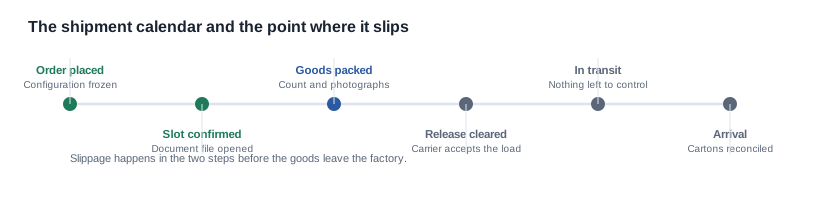
A documentation problem discovered while the goods are packed has an obvious remedy, and the remedy costs a day. The same problem discovered at the port has a remedy that costs a day as well, but the day now sits in front of a launch date that has already been announced to a channel. The cost is identical in hours and completely different in kind, and the only way to tell them apart is to know which step the goods are sitting at.
That is why step three sits before the production slot rather than alongside it. A file opened after the slot is reserved cannot influence how the goods are packed, so it does not function as a control on anything except the booking. A file opened before the slot can, because the packing specification is still open at that point.
The same logic applies to the configuration string. It is step one because a string that is still provisional when the packing specification is written will be resolved informally, by whoever is available, and the resolution will not reach the carton artwork.
There is a fourth reason to look upstream, which is commercial. The total cost of a shipment is dominated by the per-consignment lines — documentation, clearance, terminal handling, the booking and the release work — and those lines are charged once per consignment rather than per unit. A delay that pushes a shipment into a later consolidation window therefore costs more than the days it adds, because it can also add a second set of per-consignment lines. This is why the consolidation window belongs in step five but has to be diarised much earlier, and why a sequence that treats the window as a booking detail rather than a commercial variable will keep underestimating the total cost.
It is worth being precise about the size of that effect, because it is the difference between a schedule problem and a margin problem. The per-consignment lines are what make a small order expensive per unit and what make a split order worse rather than better, so a slip that adds a consignment is a slip that adds a fixed block of cost to an order that was already priced on the assumption of one consignment. The published endurance figures do not help here, and neither does the published charge time: every model in the range publishes a charge time, twenty-six of them at two hours or less and the D17 and the ZH12 at around one hour, but there is no starting state of charge and no end criterion attached to any of them, so the figure cannot be turned into an interruption window either.

What each step must output, and what it prevents
The table below is the working version of the sequence: for each step, the output that has to exist, the failure that output prevents, and what the failure costs when it is skipped. It is a useful document to hand to a supplier, because it converts a request for "goods to be ready" into a list of six specific deliverables.
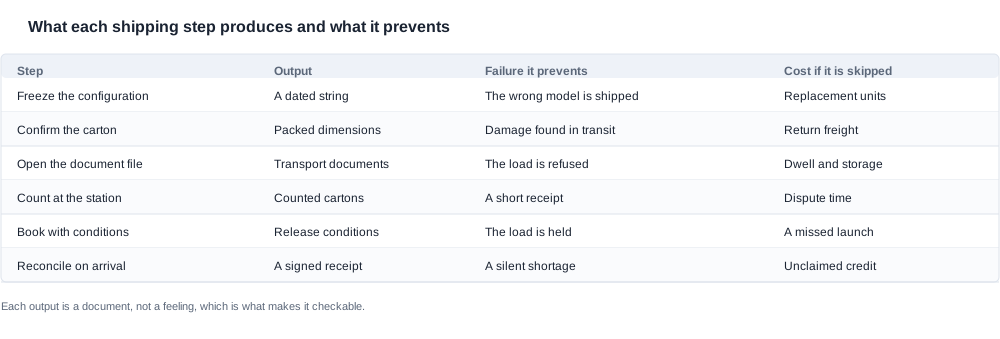
Two of the outputs deserve more attention than the table gives them, because they are the ones that are routinely produced in a form that cannot be checked.
The counted carton count. A count has to be a number produced at a point where it can be attributed, which means at the packing station and against a defined unit. The catalogue publishes no unit count per master carton for any model, so the count is entirely supplier-derived, and a count that is an estimate will look identical to a count that was taken until the arrival reconciliation is attempted. The sequence is what separates the two: a counted carton count at step four and a reconciliation against the packing list at step six are the same number seen twice, and only the pairing makes it meaningful.
The dated configuration string. A string that names a model but carries no date and no revision cannot be checked against an order, because there is nothing to compare it to. The comparison also needs to be possible by a receiving team that has never seen the product, which means the string has to carry the variant, not only the model name.
There is a third output worth naming even though it is not on the list: the release conditions themselves. Confirming them is a step, and confirming them in advance is what stops a load from being held. A buyer who learns the release conditions at the booking desk has learned them at the point where they can no longer be influenced.
The last column of the table is the one a buyer should read twice, because the costs listed there are not all the same kind of cost and only two of them are visible in the freight line. A replacement unit and a return movement are both real costs, but they land in different places: the first in quality control and the second in freight, and a returns problem tracked only in the freight budget will always look smaller than it is. The two costs that are hardest to see are the dwell-and-storage line and the missed-launch line, and both are the direct consequence of a step that was skipped rather than a step that was done badly. Doing a step badly is usually visible on a document. Skipping a step is visible only in the calendar.

The readiness check before anyone calls a shipment ready
Before a shipment is described as ready, two separate checks have to be done, and they are separated deliberately because they are performed by different people with different access.
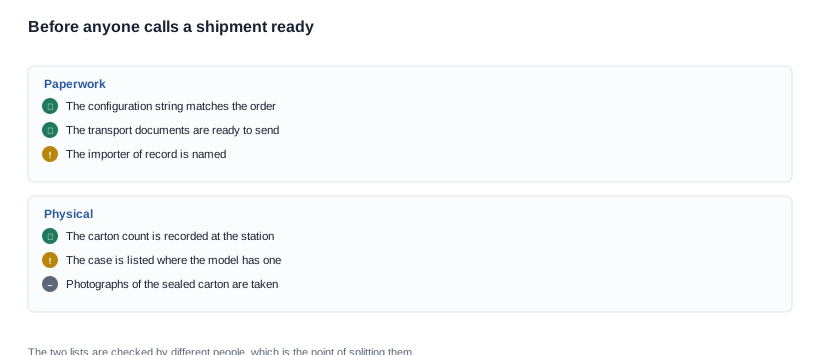
The paperwork check confirms that the configuration string matches the order, that the transport documents are assembled and ready to send, and that the importer of record is named. Each of those three is a question that can be answered yes or no against a document. The physical check confirms that the carton count was recorded at the station, that the charging case is listed where the model has one, and that the sealed carton was photographed. Each of those is a question that can only be answered by someone who was there.
Splitting the two lists is what makes the readiness call meaningful. One person confirming both produces a readiness statement with no independent content, because the second confirmation is a recollection of the first. Two people confirming separately produces a statement that will fail on something, and the something is what the buyer wants to know about before the goods leave.
The readiness call also needs a rule about who may make it, and the rule should exclude the person whose work is being confirmed. In a small team that rule is impractical, and the workable substitute is a second pair of eyes on a different set of artefacts: the person who ran the packing confirms the paperwork, and the person who chased the documents confirms the count and the photographs. Where the volume is not large enough for that, the fallback is a dated readiness record with both sets of observations written on it, so that the record shows two sources rather than one assertion repeated. Either way, the call is a gate rather than a status, and a gate can be held closed.
When something does fail, the recovery route is determined by which step broke, not by how loud the symptom is.
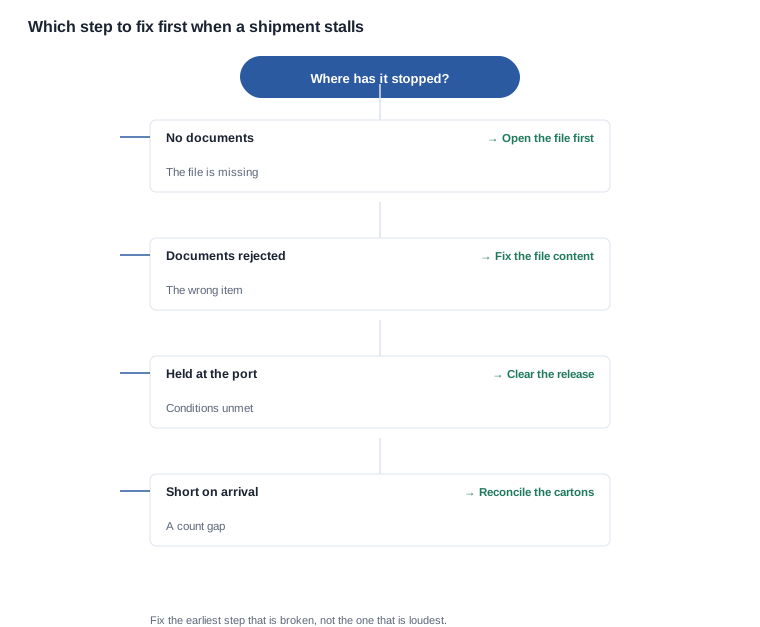
A missing document file means the file was never opened, and the remedy is to open it — not to chase the missing item, because the missing item is a symptom of a file that does not exist. A rejected document means the file exists but its content is wrong, and the remedy is a correction with a different cost. A load held at the port means the release conditions were unmet, and the remedy is a clearance task rather than a document task. A short receipt on arrival means a count gap, and the remedy is a reconciliation against the packing list rather than a search of the warehouse. Fixing the earliest broken step is the rule, because every later step is running on the output of the earlier one and will produce a second, compounding failure if it is repaired first.
Handoffs, and where our position sits
Six steps means five handoffs, and a handoff is where a sequence quietly becomes a series of unrelated actions. Each handoff needs three things to be safe: an output that was written down, a named person who produced it, and a named person who accepted it. Where those three are missing, the sequence still appears to run — the goods still ship, the documents still arrive — and the failure surfaces later, in a place where the evidence no longer exists.
The handoffs also vary in how forgiving they are. The configuration string handoff is unforgiving, because a wrong string produces goods that are wrong in a way nobody can see at the gate. The carton count handoff is forgiving in form and unforgiving in effect, because a wrong count is discovered at arrival, when the cost of the remedy is a return movement rather than a replacement unit.
The short answer: the sequence should be run from written outputs, and a step whose output is a conversation is not a step. We will provide the configuration, the charge method, the case status and the endurance figures for every model in the published catalogue, and we will mark the rows that are not published, because a sequence that relies on a buyer guessing those rows will produce the same failure twice. We do not publish packed carton dimensions, gross packed weights, units per master carton, unit prices, minimum order quantities, lead times or production capacity; those are configuration-specific or project-specific and we will not substitute a typical figure for them.
We will also say plainly which steps we can hold and which we cannot. Steps one, two, four and six are ours to hold: the configuration, the charge method, the case status, the count and the photographs are things we produce. Step three is shared, because the document file is ours to assemble but the destination scope is the buyer's to define. Step five belongs to the forwarder and to the supplier's production calendar, and no amount of procedure on our side will move it. A buyer who knows which steps are negotiable and which are structural will spend their effort in the right places, and will not spend a quarter negotiating a consolidation window that was never ours to give.
Where a buyer wants the same discipline applied to the document side rather than the physical side, the shipping documentation requirements sets out the file, and the shipping SOP template turns this sequence into a standing procedure.
Related reading
- Smart glasses shipping SOP template
- Smart glasses shipping documentation requirements
- Smart glasses shipping first-order checklist
- Smart glasses shipping cost breakdown
- Battery transport compliance
- Logistics and shipping
Send the model, the quantity and the destination, and we will tell you which of these six steps the published configuration settles for you, and which three have to be agreed with the factory before the slot is reserved.


