

Smart glasses sourcing risk is not reduced by a better supplier or a longer negotiation. It is reduced by a routine. The advice below is a ninety-day routine for a first or repeat programme in this category: six stages, twelve questions sent identically to every supplier, and six artefacts, each with a named owner. None of it requires a new system, a new platform or a new budget, and all of it can be started before the first enquiry goes out.

The reason a routine works here, where more advice usually does not, is that the category's real failures are sequencing failures rather than negotiation failures. A specification written after the quotations cannot be compared. A market list confirmed after the sample cannot be costed. A deposit paid before the acceptance method exists cannot be refunded on a fair basis. In each case the mistake is not a judgement call, it is an ordering, and ordering is what a routine fixes.
Smart glasses sourcing risk: the routine in one page
What the ninety days actually cover
The routine below runs from the first week of an enquiry to the week the order is placed against a frozen configuration. It is written for a buyer who is doing this for the first time in this category and for one who is doing it for the fifth time with a different team, because the second case is the more dangerous one. A team that has done it before often believes it has absorbed the method, and what it has absorbed is the answers rather than the questions.
There is a deliberate choice in the design: the routine produces documents, not decisions. Documents survive a staff change, a supplier change and a bad quarter, and they can be handed to a broker, a compliance colleague or a finance team without a further conversation. A decision that lives in one buyer's head survives none of those things.
Why the routine starts with the specification
Most programmes start with a request for quotation, because a request for quotation is what a supplier can answer. It is the wrong first step in this category, because the things that most often go wrong later are things that could have been written down in week one at no cost.
Three of them are worth naming. The destination market list has to exist before a compliance scope can be quoted at all, and it is usually confirmed after the sample, which is the single most common reason a documentary cycle lands in the middle of a build. The box content has to be specified to the unit — device only, or device and charging case, and which case — because our published rows show how much that choice moves: a 1400 mAh charging case for the CY05 and the CY03, and the L1 Pro, 900 mAh or 1400 mAh for the L2 Utral, a 1200 mAh folding case for the MT6, a case of unstated capacity for the KY06 and the MT5, no case at all for the V03 Pro, and no published case row for the S7 and the V06, and the V03. And the claim the business intends to make has to be checked against the published rows before the listing is written, because the published resolution class, the published runtime and the published ingress marking all differ across the range and only the V06 and the S7 carry an IP54 marking.
None of that is negotiation. It is a page of writing, and it is cheaper than any of the alternatives.

Week one: the specification, not the request for quotation
The three things to write before anybody is contacted
- The model, the configuration and the destination market list. Not the product family and not "European market" — the countries by name, because a compliance scope is scoped by country and a European scope and a United Kingdom scope are different scopes with different documents and different timings.
- The shipped box content, to the unit. Device, cable, case, artwork, insert, and anything else that travels. This is the specification that determines the carton, and the carton determines the freight line, the carton count and the clearance questions.
- The claims the business intends to make, and the published row that supports each one. This is the piece most buyers skip and most buyers later regret, because a claim is easy to write and slow to withdraw.
What the specification has to do for a supplier
The purpose of the first page is to make the quotations comparable, and that means the supplier has to be able to answer without asking a follow-up question. Four properties make that possible.
It is specific enough to order from. A specification that says "a camera model with a case" is a category. One that says "a camera model with a 1400 mAh charging case, magnetic charging, for the French, German and Dutch markets, in a retail box of one unit" is a product, and it can be quoted, built and checked against a golden sample later.
It names what is not included. The single most useful line on the page is often the list of open questions — the charging method for the four camera models where our catalogue does not publish one, the Bluetooth version for camera models where it is not published, the case row for the three models where the catalogue does not publish one. Naming an open question converts it from a gap into a request, and requests have owners.
It states the quantity band. Not a quantity, but the band, because a quotation for a band and a quotation for a single number are different documents. Our catalogue does not publish minimum order quantities or price tiers, so whatever band a supplier quotes is the only one you will see.
It survives being read by somebody else. If a colleague could not build the goods from this page alone, the page is a description rather than a specification, and the acceptance method that comes later will have nothing to test against.
The two published rows worth checking on day one
There are two specific checks that are cheap on day one and expensive on day forty, and they are worth naming because both concern rows that are published for some models and not for others.
The first is the charging method. It is published as magnetic charging for seventeen of the twenty-eight entries in our catalogue, as Type C for seven, and is not published at all for the MT6 and the CY05, and the L1 Pro and the CY03. For those four, the interface is a request, and until it is answered the cable decision, the tooling decision and the packing sequence are all suspended.
The second is the case row. As the list above shows, the case situation is published for some models, published as present but unstated for two, published as explicitly absent for one, and simply absent as a row for three. A buyer who reads that as "no case" for the last three has made a factual error from a documentation gap, which is exactly the kind of error this category punishes.
The twelve questions, sent identically to every supplier
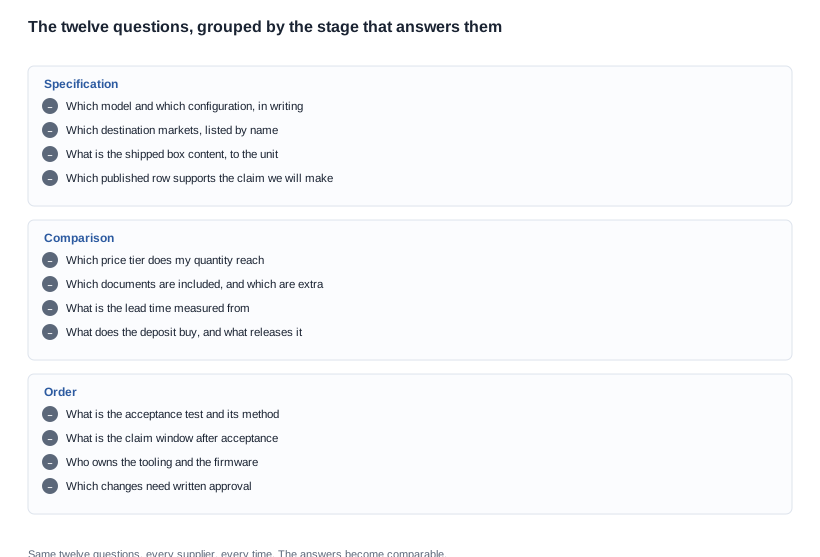
The same twelve, every supplier, every time
The value of a fixed question set is not that the questions are clever. It is that the answers become comparable, and comparability is what makes a shortlist possible. If each supplier is asked something slightly different, the three replies describe three different enquiries and the buyer has to do the comparison work from scratch.
The twelve above fall into three stages, and each stage has a completion condition that is a document rather than a reply.
Stage one, specification. Which model and which configuration, in writing. Which destination markets, listed by name. What is the shipped box content, to the unit. Which published row supports the claim we intend to make. Completion condition: a written specification exists, versioned, and the open questions are named.
Stage two, comparison. Which price tier does my quantity reach. Which documents are included and which are charged separately. What is the lead time measured from. What does the deposit buy, and what releases it. Completion condition: a comparison sheet with the same columns for every supplier, with "not stated" written in the empty cells rather than left blank.
Stage three, order. What is the acceptance test and its method. What is the claim window after acceptance. Who owns the tooling and the firmware. Which changes need written approval. Completion condition: a purchase order in which all four appear as clauses.
What to ask about the rows we do not publish
Three questions belong in stage two even though they are not in the twelve, because they are the ones most often answered by assumption. What is the production lead time measured from. Which parts of the compliance scope are included for the markets I named, and which are excluded. And what does the quotation not include.
That last one is the most valuable question in the set, and it is the one most often skipped. A supplier who answers it accurately, even at length, is telling you how their process works. A supplier who says nothing is excluded is telling you the price is provisional, and you should treat it as such.
Our own position makes this easy to state: we publish minimum order quantities, unit prices, production lead times and defect rates nowhere, because all four are not published in our documentation. So for a buyer, any of those appearing as a standing figure is something to interrogate rather than something to rely on.

Six artefacts, and who signs each one
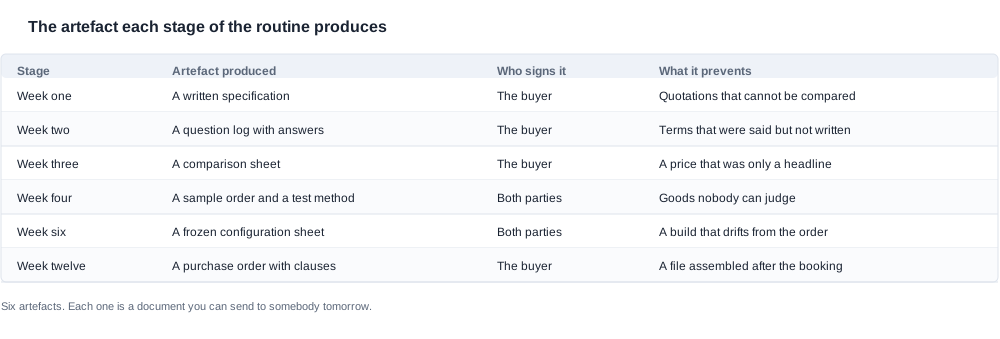
Why six and not one
One document would be easier to manage and worse in every respect. A single file that accumulates a specification, a set of answers, a comparison, an acceptance method and a purchase order has no owner, and a document without an owner is the thing this whole routine is designed to prevent.
The six artefacts each have one owner and one completion condition, and four of them are the buyer's alone. That is worth noticing, because the instinct in a procurement process is to assume that most of the artefacts depend on the supplier. Four of the six do not.
- The written specification, signed by the buyer. Prevents quotations that cannot be compared.
- The question log with answers, signed by the buyer. Prevents terms that were said but not written.
- The comparison sheet, signed by the buyer. Prevents a price that was only a headline.
- The sample order and the test method, signed by both parties. Prevents goods that nobody can judge.
- The frozen configuration sheet, signed by both parties. Prevents a build that drifts from the order.
- The purchase order with clauses, signed by the buyer. Prevents a file assembled after the booking.
What the routine does not do
It is worth being explicit about the limits, because a routine that appears to solve more than it does gets abandoned the first time it does not.
The routine does not make a supplier better, and it does not produce a lower price. It produces comparable answers and a file that survives the programme, and those two things are the precondition for everything else rather than the whole of it. It does not remove the risk of a sub-supplier changing a component, because that risk lives in the supplier's own supply chain and is managed by a change-notification clause rather than by anything a buyer writes. And it does not replace judgement at the two points where judgement actually matters: whether a configuration is specific enough, and whether an answer is honest.
What it does remove is the category of failure where a perfectly good supplier is judged badly, and the category where a bad answer is never questioned. Those two account for a large share of the losses in this category, and neither is fixed by buying from somebody better.
The two artefacts that need the supplier to agree
The sample order with its test method, and the frozen configuration sheet, are the two that cannot be produced unilaterally, and they are where a programme waits longest if they are not scheduled properly.
The sample order is where the acceptance method is written, and it is much cheaper to write it there than later. "Quality acceptable" cannot be audited by a third party and will produce a dispute; a stated sample size, an inspection checklist, a defect threshold, a treatment of borderline units and a window in days will produce a number. The same method is reused on the next order, which is where the economics of this category actually live.
The frozen configuration sheet is the artefact that makes the second order safe, and it is the one most often skipped because it feels redundant after the specification. It is not redundant: a specification can be a moving document, and a frozen configuration is a dated one. Everything after the freeze is a change, and a change is a decision with a cost and a date, which is exactly what the six hidden costs in this category are.
Who owns each stage, and the three places the routine breaks
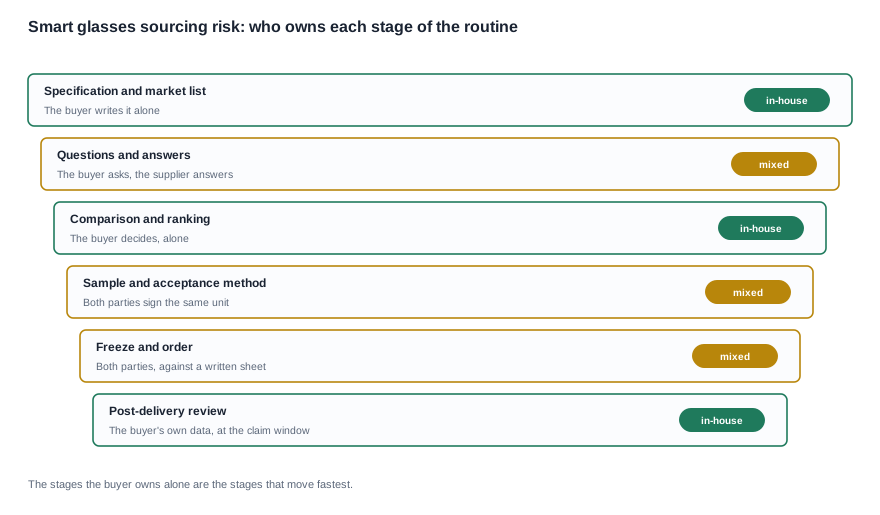
The stages the buyer owns alone
The ownership chart above is the argument for the whole routine. Three stages belong to the buyer alone — the specification and the market list, the comparison and the ranking, and the post-delivery review — and those are also the three stages that move fastest. Nothing has to be agreed with anybody, so they are decided in a day rather than a fortnight.
The fourth stage, the questions and the answers, is mixed, and it is the stage most often allowed to run long because the other side is busy. It is worth putting a date on it rather than a follow-up, because a quotation that arrives without an answer to one of the twelve is usually a quotation that has been assembled to be acceptable rather than to be comparable.
The stage that happens after the order, and is usually skipped
The post-delivery review is the sixth stage in the ownership chart and the one most often dropped, because the programme has by then been closed and the people who would run it have moved on. It is also the stage that makes the next programme cheaper, because it is the only place where the two cells that a margin model cannot fill before the first run — the returns rate and the support load — acquire real values.
The review does not need to be a meeting. It needs four numbers and one decision, taken at the end of the claim window rather than at the end of the quarter. The returns cost per hundred units sold. The support contacts per hundred units sold. The number of units that came back with a reason code that was not a physical defect. And the number of changes that were made during the build without a record. The single decision is what changes in the specification because of them.
The discipline that makes this stage work is the same one that makes the rest of the routine work: write the finding into the specification, in the place where the ambiguity was. A returns reason code filed under a defect category teaches the programme nothing, because the next specification is written by somebody who never reads the returns log.
The three places this routine usually breaks
The specification is written for a supplier rather than for a file. It reads well and it cannot be used to check anything, because it describes a product family. The tell is that it could be sent to three different suppliers and would be equally true of all three.
The comparison sheet is built after a preference has formed. The moment one quotation starts to look attractive, the remaining ones get summarised rather than read. The countermeasure is structural rather than moral: complete every row for every supplier before any ranking, and write "not stated" rather than leaving a cell empty, because an empty cell in a comparison sheet is an invitation to skip it.
The freeze is announced but not dated. "The configuration is final" is a preference; a configuration frozen on a named day is a decision with consequences. The difference between the two is worth a week of production time and a great deal more in the second order, because a dated freeze is the point at which every later change becomes a priced event rather than a conversation.
What to send us at each stage
Stated once because it applies at every stage of the routine: a quotation from us names a configuration, itemises the setup charges, states the compliance scope for the markets it covers, and names the scope lines it does not cover. The commercial figures a buyer usually asks for first — unit price, production lead time, minimum order quantity, defect rate — are not published in our documentation, which is why the stage-two question in the routine is written as what the quotation does not include rather than as a request for a price list.
We also do not publish per-model certificate numbers, and our catalogue contains no CE, FCC or RoHS text at all, so model-level conformity evidence for a given configuration is something we produce and hand over rather than something you can read off a page. Where a document has to be commissioned rather than issued, we will say so. And the one published weight in the whole range is scoped narrowly: the MT6 unit at 158 g, including its battery and camera and excluding the folding charging case, with no bare frame weight published for any model.
The sourcing risk section covers the assessment behind this routine, and the glossary defines the terms the artefacts depend on, which is worth reading before week one rather than after month six. The supplier verification walkthrough covers the due diligence on the counterparty, and the comparison template gives you the columns to put the stage-two answers into.
If you want to start the routine on a real configuration, send the model, the configuration, the quantity and the destination markets. We will tell you which of the twelve questions we can answer from published rows today, which need a document, and which are still open — and we will answer with a list and a date rather than with an assurance, because the list is what you can put in front of a broker and the date is what you can put in front of a launch plan.


