

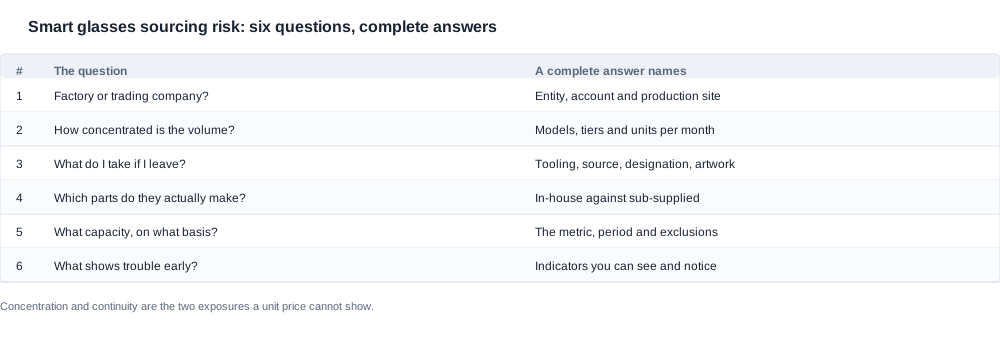
Six questions come up in almost every sourcing conversation in this category, in roughly this order, and the answer to each is either documented somewhere or genuinely missing. Is this counterparty a factory or a trading company, and what does the difference change for you? How concentrated is your volume — across models and across product tiers — and what happens to your programme if one supplier stops? If you leave, what do you take with you? Which parts of what you sell are actually made by this supplier rather than bought by them? What capacity are they claiming, and on what basis? And what would tell you early that this relationship is turning? Sourcing risk is not the question of whether one supplier is good. It is the question of what your exposure looks like when the good supplier has a bad quarter, and that is what the six questions below are built to answer.
Smart glasses sourcing risk: six questions about concentration and continuity
The buying situation behind these six questions
The reader is a procurement manager working for the brand, a channel buyer or an importer who has shortlisted a supplier and is now deciding how much of the programme to place with them. The decision in front of them is rarely "do I trust this company". It is a position-sizing decision: how much of my volume, how many of my models and how many of my product tiers sit inside one supplier's operation, and what my alternatives are if that operation has a problem.
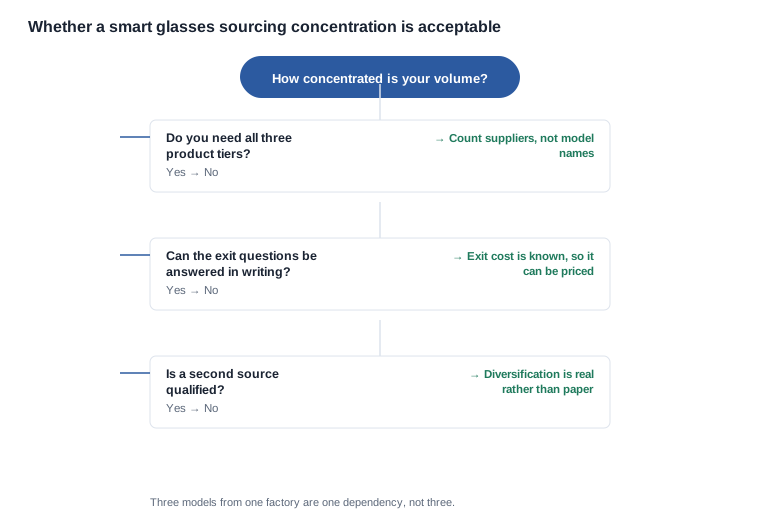
The fear underneath is concentration risk, and it has a specific shape in this category. A supplier who makes a camera model, an audio model and a sport model for the same brand is not three suppliers. It is one supplier with three product lines, and a fire, a component shortage, a certification failure or a quality collapse at that one factory reaches all three at the same moment. A buyer who is exposed to three models from one factory has less diversification than the product count suggests, and the diversification appears in the retail range rather than in the supply base.
The second fear is continuity. In a category where the product is a piece of firmware running on somebody else's hardware, the exit cost is not only the tooling. It is the firmware relationship, the compiler and toolchain access, the model designation, the artwork and the packaging files, and the question of whether the same configuration can be built by somebody else without a dispute. A buyer who has not asked about these before signing has not assessed the sourcing risk; they have assessed the purchase price.
Why one supplier across three tiers is one risk, not three
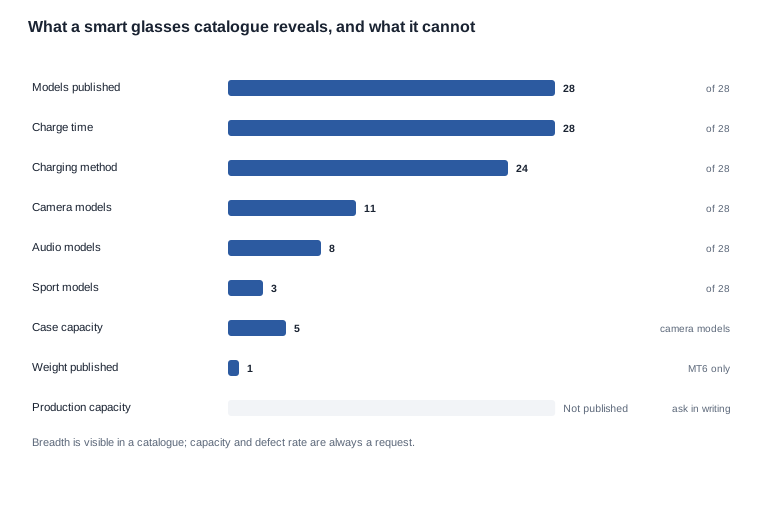
Our catalogue spans twenty-eight models across three distinct tiers: eleven camera models, eight audio models and three sport models. That structure is the reason the concentration question is worth asking explicitly, because a buyer who wants presence in all three tiers can obtain it from a single supplier and will often assume that this is diversification.
It is not. What it is, is three product lines sharing one set of dependencies: one factory, one set of management, one quality system, one component supply chain, one certification posture, and one financial condition. The correlated failures are the ones that matter, and they are the ones that arrive together.
The practical consequence is that the number of independent suppliers behind a range should be counted in suppliers, not in SKUs. Two suppliers who each make two of your three tiers are more diversified than one supplier who makes all three, even though the second arrangement is simpler to administer. That trade-off — administrative simplicity against correlated exposure — is a real one, and it is usually made implicitly by whoever places the first order, without anybody deciding it.
The other side of the same point is that a supplier's breadth is evidence. A catalogue that carries twenty-eight models across three tiers, with eleven camera models at two published resolution tiers, and charging arrangements that differ by model rather than being uniform, is describing an operation with more than one production path. That is a qualitative signal, and it is worth something — but it is breadth, not capacity, and the two are routinely confused.

What a complete answer to each sourcing question contains
The six sourcing questions, side by side
| # | The question a buyer asks | A complete answer names | An incomplete answer sounds like |
|---|---|---|---|
| 1 | Factory or trading company, and what changes? | The legal entity on the contract, the bank account name, and where the work happens | "We are the manufacturer" |
| 2 | How concentrated is my volume? | The models, tiers and units per month inside one operation | "We can supply all your models" |
| 3 | If I leave, what do I take? | Tooling ownership, firmware and app source, model designation, artwork | "We will hand over everything" |
| 4 | Which parts do they actually make? | The in-house operations against the sub-supplied components | "The production is under our control" |
| 5 | What capacity are you claiming, and on what basis? | The metric, the period it refers to, and what it excludes | "We can handle 100,000 units a month" |
| 6 | What would tell me early it is going wrong? | The indicators you can see, and the notice you would get | "We will keep you informed" |
What separates an answer from a claim
The first row is where sourcing risk is usually first detected, and the documentary check is more reliable than the visit. A business licence matching the legal entity named on the contract, and a bank account name matching that same entity, is a low-effort test with a high hit rate. Payment into a third-party account is one of the clearest red flags in the whole category, and it is worth refusing over rather than negotiating. A video call is the other test, and the useful version of it is not a sales presentation: ask to see the assembly line for the specific model you are buying, ask the supplier to walk a finished unit through the last station, and ask to see the packaging line. A supplier with capacity in another product type will show you that line, and the question is whether you notice.
The third row is the one that decides whether an exit is possible. Firmware developed to your specification and running on their hardware is the most exposed asset in the arrangement, because the hardware relationship and the compiler setup sit with the factory. The questions that matter are written ones: whether your application source is escrowed anywhere, whether the factory may sell the same configuration to another buyer, and whether a distinct model designation or a custom firmware signature can be applied to your units so that the two are distinguishable in the field. A supplier who will not answer those three in writing has told you the answer.
The fifth row needs the sharpest reading, because capacity claims in this category are almost always quoted as a number without a definition. What is the metric — units per day, units per month, or the theoretical line rate? Which model? Which shift pattern? Does it include the operations you would need? A number without those four attachments is a marketing figure, and the comparison that matters is not between two capacity claims but between a capacity claim and your own volume. We publish no capacity figures for our own range, and a buyer who needs one should ask for it in the metric above and then test whether the answer survives contact with a first order.
The catalogue rows that show a supplier's breadth, and the ones that do not exist
The breadth our catalogue shows
Three published things are worth reading as evidence of an operating pattern rather than as product features.
The first is the model count and its structure. Twenty-eight models split across eleven camera models, eight audio models and three sport models means at least three different production paths: a camera path with optics, a sensor and a storage card, an audio path with speakers and a battery, and a sport path with a different charging and control arrangement. A supplier who runs one line and rebadges it cannot publish that structure honestly, because the differences between the tiers are structural rather than cosmetic.
The second is the charging arrangement, which varies across the range rather than being uniform: magnetic charging on seventeen models, Type C on seven, and no published charging method at all for four camera models. A supplier with a single universal production board would not need four models to publish no charging method, and a supplier who does publish a method for every other model has a line discipline worth noting.
The third is the publication of detail that could have been withheld. Runtime is published for all eleven camera models, charge time for all twenty-eight, the camera resolution tier for all eleven, the charging case capacity where one exists, an ingress marking on two models, and a single weight figure in the whole catalogue. The volume of published detail is itself a signal about how the supplier operates, because detail that is not published is detail that somebody has to go and ask for every time.
The figures we keep out of the catalogue, and why that is the right answer
Our catalogue does not publish production capacity, minimum order quantities, defect rates, yield figures, certificate numbers or test report numbers, and the reason is the same in every case: we would rather state that a number is not available than publish a figure that cannot be traced to a document. An untraceable figure in a buyer's file becomes a commitment the buyer has to defend, and if it later proves wrong the correction lands in the field rather than in the negotiation.
There is one category where the absence is deliberate rather than accidental. The catalogue carries a company-level export-certification page and no per-model certification rows, and the text of the catalogue does not contain the marks that buyers look for. That is a statement about our documentation, and it is exactly why certification scope for any named model is a written request to the supplier rather than something a buyer can infer from a brochure — including ours.
The practical rule for a buyer is to treat every unpublished number as a request, and to ask for it with the metric attached: capacity per month for a named model, defect rate against a stated denominator, minimum order per model and per configuration. A supplier who answers all three with the attachment has given you something comparable. A supplier who answers with a bare number has given you something you cannot use.

Verifying a supplier before the volume moves, not after
The four checks to run before volume moves
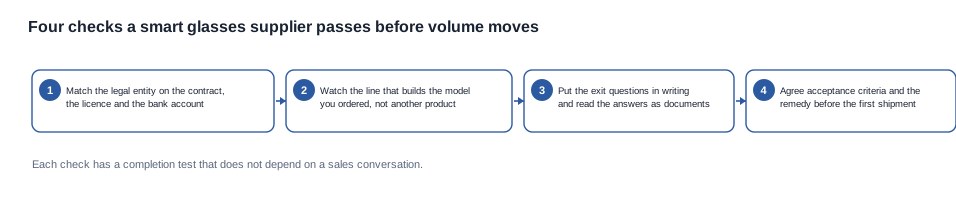
Verification happens before the first order and again before the volume increase, and it is four checks rather than a long audit.
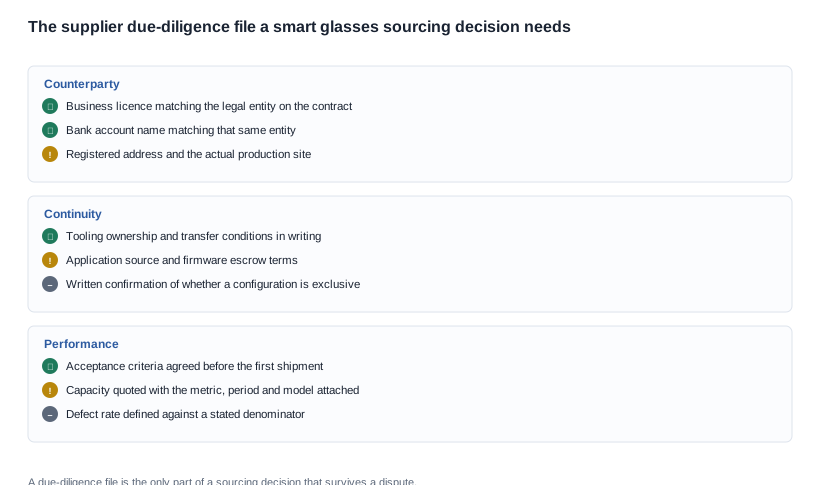
- Identify the counterparty on paper. Legal entity, business licence, and a bank account in the same name. A mismatch on any of the three is a stop, not a question to be resolved later.
- See the line for the model you are buying. Not a presentation, not a stock video, not a tour of another product type. The model you have ordered, moving through the last station.
- Ask the exit questions in writing. Tooling ownership, application source and escrow, model designation, artwork and packaging files, and whether the same configuration may be built for another buyer.
- Agree the acceptance criteria before the first shipment. What a conforming unit is, how a non-conforming batch is handled, and where the remedy sits — in the contract or in an assurance given verbally during a call.
The questions that decide which supplier you actually want
When you have two candidates that both answer everything, the choice is made on the shape of their answers rather than on their words. Three comparisons matter more than the rest.
The first is concentration versus breadth: does the candidate's strength sit in the one tier you need most, or across the range you have planned? The second is whether the continuity answer is a document or a promise, and the distinction is easy to spot — a document has a signature on it, a promise has a name attached. The third is what the supplier is willing to be measured against later, which is the acceptance criteria in the contract rather than the defect rate quoted in the meeting.
The questions to ask are the same for both candidates, in the same order, with the same deadline, because a comparison between answers obtained under different conditions is not a comparison at all.

Where sourcing risk actually crystallises
Four places a sourcing decision quietly fails
The sub-supplied component nobody mapped. A unit is assembled in one place and depends on components bought from several others, and the riskiest single component in a smart glasses product is frequently not the one on the drawing — it is the cell, the speaker, the lens or the sensor, each of which may sit with a different sub-supplier whose own continuity the factory does not control. The symptom is a stoppage that nobody can explain because the dependency was never in anyone's file. The control is to ask which inputs are bought rather than made, and to ask what happens to your lead time if one of them is unavailable for a quarter.
The configuration that only one supplier can build. A custom colourway, a bespoke firmware feature or an artwork package that was designed around one factory's tooling makes that factory the only source for that product, whatever the contract says. The symptom is that a price negotiation one day becomes an inability to move. The control is to keep one product deliberately standard and moveable, so that the exit test is never hypothetical.
The second supplier that was never really qualified. A dual-source plan that exists on paper and not in practice — because the second supplier was audited once, in a year when nobody was watching, and has never built your configuration. The symptom is discovering during a crisis that the alternative cannot actually make the product. The control is to place a real, small order with the second supplier, on your configuration, at your quality criteria, so that the capability is demonstrated rather than assumed.
The relationship that degrades without a notice period. Most sourcing risk is not a sudden failure; it is a slow reduction in responsiveness — longer quotes, fewer suggestions, less willingness to hold a date — and the buyer who is watching only the unit price sees none of it. The symptom is that the fourth order takes longer than the first, with no event to point to. The control is to record the indicators you can see without asking — quote turnaround, date reliability, the number of clarifying questions — and to set the threshold at which you act.
The commercial exposure sitting behind each answer
Every one of the six answers carries a commercial consequence that belongs in the same spreadsheet. A trading company arrangement adds an intermediary margin and an intermediary's reliability to every unit. A concentration in one factory removes your negotiating position precisely when you need it most, because a supplier who knows you cannot leave has no reason to move. A configuration that only one supplier can build caps your price upside permanently. An unresolved exit question turns into a dispute at the worst possible moment.
The trade-offs between those consequences are real and they are not symmetrical. Breadth over a single supplier's capability costs you margin and attention. An exit arrangement costs you a small amount of supplier comfort. A second qualified source costs you time that has to come out of the launch. What is not acceptable is buying none of them and discovering the gap during a disruption, because the total cost of a supply interruption is an order of magnitude larger than any of the premiums involved.
A sourcing decision worked through, and the limits of what we publish
A dual-supplier scenario reasoned through
What follows is a constructed scenario, not a report from a client engagement. No customer, order or engagement is described; the volumes, the product range and the market are assumed so that the reasoning can be followed from the shortlist to the signed arrangement.
A brand-side buyer wants presence in three tiers — one camera model, one audio model, one sport model — and has three candidate factories. Factory A quotes all three from one operation and offers the lowest unit price. Factory B quotes only the audio model but is visibly deeper in that single product type. Factory C quotes the camera model and the audio model and will not quote the sport model at all.
Step one is the concentration question, and it changes the ranking before anything else does. Factory A looks like the diversified option and is the opposite: all three lines sit on one set of dependencies, so the failure modes are correlated. Factory B is narrow but genuinely independent in its product type. The buyer restructures the plan around this, and the commercial comparison follows it rather than preceding it.
Step two is the exit questions, put to A and B in writing. Factory A answers the tooling and artwork ownership questions clearly and answers the application-source question with a commitment to escrow. Factory B answers faster and more completely, including the question of whether the same configuration may be built for another buyer, and states a period for the escrow that the buyer can check against the contract.
Step three is the acceptance criteria, agreed before the first order with both. The published catalogue rows give the buyer something concrete to test against — the runtime band for the camera model, the charge time for all of them, the charging method where it is published — and the remainder becomes a written request rather than an assumption.
Step four is the split. The camera model, which carries the most exposure and the most value, goes to the supplier with the deeper answer on continuity, and the audio model — the highest-volume, lowest-complexity line — goes where the price and the independence are best. The sport model, which Factory C will not quote, stays with Factory A on a deliberately standard configuration, so that it remains moveable.
What we publish and what we keep out of the catalogue
The short answer: the published rows of the catalogue are the part of a sourcing assessment we can stand behind, and the rest of it is a question for the supplier's own file. We publish the model structure, the electrical rows, the camera resolution tiers, the charging arrangements, the ingress marking where one exists, and the single weight figure we have measured. We do not publish capacity, minimum order quantities, defect rates, yield figures or certificate numbers, because we would rather say that a figure is not available than publish one that cannot be traced to a document.
That position applies to us as well as to anybody else in this category, which is the point: a sourcing risk assessment that only ever examines the other supplier's documentation is not an assessment. Apply the same four checks — entity, line, exit, acceptance criteria — to us, and ask the same questions about the configuration you intend to place, rather than about the range we publish.
What we will do is take a model, a quantity and a target market and tell you what exists, what the published data settles, and what has to be requested in writing. Where the answer is that a figure is not published, we will say so rather than estimate it.
A sourcing assessment
Send the models, the quantities, the target market and the configuration you have in mind, and we will tell you which of the six questions above can be answered from the catalogue, which require a written answer from us, and which require a document you should request from any supplier you are comparing us against. If you are weighing two candidates against each other, say so and we will mark the rows where a bare number is not enough.
Related reading
- sourcing risk
- Factory audit and supplier verification — what to check on site
- Quality consistency across runs — defining acceptance criteria
- Lead time and the six constraints — where the calendar actually goes
Send the models, the quantities and the target market, and we will show you which parts of a smart glasses sourcing risk assessment are settled by published data and which are yours to request in writing.


