

Availability in wholesale gets quoted as a single word — in stock, or not — and that word means at least three different things at once. A model can be in the catalogue and unavailable in the configuration the buyer needs; it can be available with a lead time attached to it; or it can be available and still impossible to repeat, because something behind it has changed. Smart glasses wholesale stock availability is therefore not a yes-or-no property of a model. It is a structure with three layers, and a buyer who cannot tell the layers apart will get an answer that is true about one of them and useless about the other two.
This catalogue publishes no stock position, no production capacity, no lead time, no restocking interval and no allocation policy, and none is invented here. What the catalogue does publish is a specification set, and that specification set is what makes an availability answer verifiable rather than merely reassuring: a buyer cannot check whether a configuration exists until they know what a configuration is.
The relevant published facts are specific. Twenty-five catalogue entries carry a formal name and three do not, and of the named twenty-five the camera range takes eleven, the audio range eight, the sport range three and the children's range three. Charging method is published for seventeen models as magnetic, for seven as Type-C, and for four camera models it is not published at all. Six case arrangements sit inside the camera range, two of the models publish colours, two carry an IP54 marking, and one model in the whole range publishes a weight.
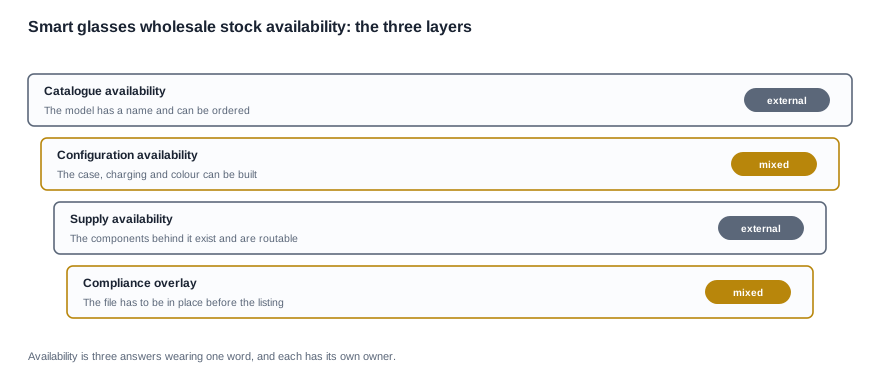
Smart glasses wholesale stock availability: three layers that are routinely confused
The first layer is catalogue availability: the model exists in the range, it has a name, and it can be written into an order. Twenty-five of the catalogue's twenty-eight entries clear this layer, and the other three cannot, which makes their availability undefined rather than zero. They cannot be named in an order, counted in a minimum or repeated on a reorder, and a buyer who asks about them is asking about something the catalogue does not contain.
The second layer is configuration availability: the specific case state, charging method, colour split and packaging can actually be built or assembled. This is the layer where most availability answers go wrong, because it is the layer that the model name does not determine. In this catalogue the camera range contains six case states across eleven models and four camera models publish no charging row whatever, so a basket of camera models is a basket of several distinct configurations, and an availability answer given at the model level says very little about any of them.
The third layer is supply availability: the components behind the configuration exist and the route into them is open. This is the layer a buyer cannot see at all, and it is where the risk sits. A model can be in the catalogue, in the right configuration, with a delivery date, and still be unavailable because a component has moved, because a platform has been superseded, or because the supplier has reallocated production.
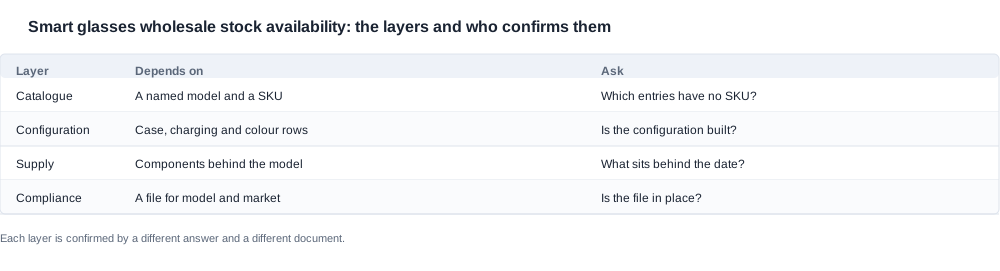
There is also a fourth layer that overlays the other three rather than sitting inside them, and it is the one a distributor feels first. A model can be available, correctly configured and supplyable, and still be impossible to list, because the compliance file for it is not in place. Availability in the commercial sense and availability in the listing sense are different properties, and a buyer who treats them as one property will commit a channel to a launch date the supplier never agreed to.
The practical consequence of separating the three layers is that they need three different kinds of evidence, and a buyer who asks for one kind of evidence gets answers to one question. Catalogue availability is confirmed by a name and a SKU, which costs nothing to establish. Configuration availability is confirmed by a supplier statement that can be checked against the published rows, which takes a written answer. Supply availability is confirmed by a dated position from the supplier's own planning system, which has to be requested in a form that can be recorded. The compliance overlay is confirmed by a document, and until that document exists the fourth layer sits on top of whatever the other three have produced. Asking for the right kind of evidence for each layer is what makes an availability answer usable rather than merely complete.
Smart glasses wholesale stock availability: how to get an answer that survives the first order
The reason an availability answer fails is rarely that it was false. It is usually that it was true about a different thing than the buyer understood. Six questions turn an availability statement into something that can be acted on, and they are worth sending as a list rather than as a conversation.
- Ask for availability per configuration rather than per model, because a model name plus a case state plus a charging method is an orderable unit of supply.
- Ask what the word available is standing in for: components on hand, production scheduled, buildable once a slot opens, or shippable from finished stock.
- Ask when the answer applies, because a statement without a date describes the moment the conversation happened.
- Ask what evidence sits behind the answer and in what form, and whether it came from a planning system or from a sales call.
- Ask what happens when the answer changes and how much notice the buyer gets before a channel order has to move.
- Ask when the answer will be re-confirmed, and set that cycle from the shortest configuration in the programme.
Those six questions are cheap to ask and expensive to skip, because the cost of a wrong availability answer is not the order that was late. It is the channel commitment that was made against it.
Smart glasses wholesale stock availability: what the catalogue does and does not tell you
The catalogue's role here is narrow but genuinely useful, and it is worth being precise about it.
What the catalogue establishes is which configurations exist. It publishes a charging method for seventeen models as magnetic and for seven as Type-C, which means twenty-four models in the range have a charging method the buyer can rely on. It publishes no charging-method row for four camera models, which means those four lines carry a configuration question that has to be answered by the supplier before anything else about them can be settled.
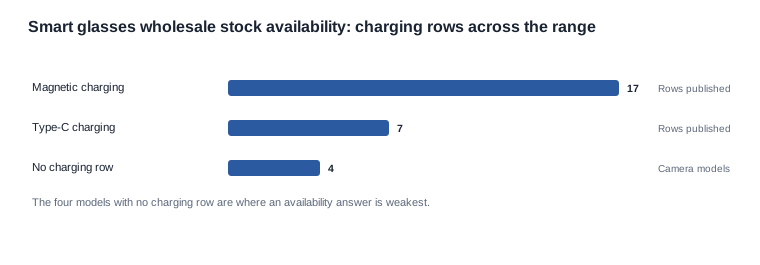
That single published fact is the most useful diagnostic in the catalogue for a buyer planning availability, because the four models with no charging row are precisely the models where an availability answer is most likely to be wrong. A model with a published row has a defined bill of materials; a model without one has an undefined one, and an undefined bill of materials cannot be turned into a delivery date by arithmetic.
The catalogue also establishes which configurations are bounded. Six case states inside the camera range means a camera basket contains at least six distinct production set-ups. Two models publish a colour split, so for those two the variant count is known and bounded, while for every other model it is a matter for negotiation. Two models publish an IP54 marking, and because a published specification can be checked against the physical goods at receipt, that marking is useful as an acceptance check on a first shipment rather than only as a marketing line.
What the catalogue does not publish is any statement about stock, capacity, lead time or allocation. Only one weight appears anywhere in the range, and it describes the glasses body of a single model rather than that model with its foldable case, so it is a specification rather than a logistics figure. A buyer who wants to know when goods can arrive has to ask, and the honest answer from the catalogue is that the range tells the buyer what to ask about rather than when the answer will come.
There is a second asymmetry worth putting in the same frame, and it works in the buyer's favour. Because the catalogue publishes the specification rows, a buyer can evaluate a supplier's configuration answer against a published figure rather than accepting it as an assertion. A supplier who confirms a case capacity that matches the published row, a charging method that matches the published row and a colour split that matches the published row is demonstrating something specific and checkable. A supplier who cannot be checked against a published row is asking the buyer to take the configuration on trust, and that is worth knowing before the commercial conversation rather than after it.

Smart glasses wholesale stock availability: the wholesale trap in a quoted lead time
The trap in this category is a lead time quoted for a model and applied to a configuration. A lead time is a statement about a route through a supply chain, and the route through a configuration the supplier already holds is different from the route through a configuration it has to assemble.
Three specific things make this dangerous in a wholesale programme. The first is that a channel commits to a date. A distributor's downstream commitment is made against a number the distributor received, and the number was about a model. The second is that a lead time quoted for an order above a floor says nothing reliable about an order below it, because the route through a small build is usually longer than the route through a stocked one. The third is that the documentation component of a delivery date is the one most often left out of the quotation, and it is the one a private-label programme cannot compress at all.
The practical form of the question is therefore: what is the lead time for this configuration at this quantity, and what does it consist of? The second half matters more than the first. A lead time that is made up of material procurement, production and documentation is a schedule with three dependencies, and a buyer who knows which of the three is the longest knows which question to ask next. A lead time given as a single number is a number the buyer cannot interrogate.
The second half of the trap is the reordering cycle. A programme that recorded an availability statement at order stage and reuses it at reorder stage is working with a snapshot rather than with a position, and snapshots decay. The minimum re-confirmation cycle for a programme that intends to reorder is set by the shortest configuration's lead time rather than by the longest, because the shortest one is what determines when the availability picture as a whole becomes stale.
There are three signs that a quoted lead time is being applied to something other than the intended configuration, and they are worth watching for before you order. The first is a lead time given without a quantity, because the route through a small build is usually longer than the route through a stocked one. The second is a lead time whose components are not named, which hides the documentation step that a private-label programme cannot compress. The third is a lead time that appears in a document without a configuration attached to it, which is the version of the number that gets carried from one quotation to the next by mistake. The evaluation criteria for any quoted date are therefore the same three every time: the configuration, the quantity, and the components.

Smart glasses wholesale stock availability: the questions at the certification level
Availability questions change character at the compliance level, because there the constraint is not physical but documentary, and a documentary constraint does not resolve by waiting.
The questions are specific. Which file covers this model and this variant for this destination market. Who holds it, in what format, and for how long. Whether it is tied to a particular production site, because a file held for one site does not automatically cover a second supplier's site. What happens to it if it lapses, and who is responsible for tracking the renewal. And, for the two models that publish an IP54 marking, whether a third-party test report reference exists, because the catalogue publishes the marking without one.
Two further positions come from the published record and should be carried into the conversation rather than assumed away. On the record, the camera, audio and sport categories each carry a certification claim whose certificate numbers at model level are still pending confirmation, while the children's category carries nothing at all. Nothing in the catalogue text names CE, FCC or RoHS, and no per-model certification row appears in it. What it offers instead is a company-level export page built from images, showing ten certificates in total: eight of them appearance-design and two of them utility-model patents.
The availability question that follows from all of this is the one a buyer should ask first, because it reframes the whole planning exercise: is the availability of this model conditional on its compliance file being in place? If it is, then the file is on the critical path, and a programme that plans inventory without planning the file is planning a date that depends on a document nobody is tracking. If it is not, the file is a parallel activity and can be scheduled separately.
That single question changes the shape of the plan in two ways. It brings the documentation calendar into the inventory calendar, which means the earliest date a model can be listed is the later of the date the goods can arrive and the date the file can be used, and a programme that plans only the first of those will discover the second at launch. It also changes what the buyer's shortlist should contain: a model whose file is not in place is not a shorter lead time, it is a model that cannot be sold yet, and including it on a shortlist on the strength of its availability date alone puts a product into the plan that the plan cannot legally execute. The criteria for a shortlist in this category therefore have to include the file position, not only the date.
Smart glasses wholesale stock availability: how availability should be recorded
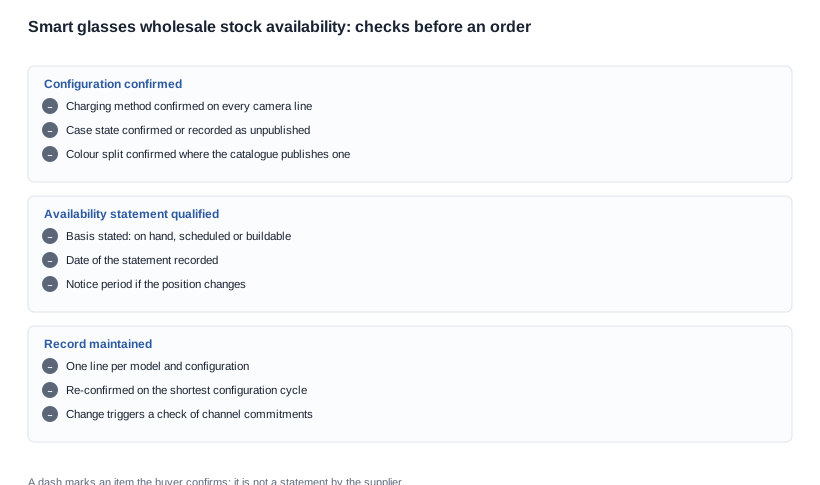
Availability that lives in a conversation cannot be used, so the record matters more than the answer. One line per model and configuration, with a fixed set of columns, is enough.
The catalogue row confirmed yes or no, the charging method confirmed or outstanding, the case state confirmed or outstanding, the colour split confirmed where one is published, the compliance file position, the availability statement itself, the date of that statement, and the basis on which it was given. That last column is the one most often omitted and the one that makes the difference between a usable record and a list of reassuring words, because it is what allows the statement to be interpreted rather than simply repeated.
Two habits make the record work. The first is to re-confirm on a cycle set by the shortest configuration in the programme rather than by the calendar. The second is to treat a change in the record as an event that triggers a check of the downstream commitments, because that is the moment a channel order has been placed against a position that no longer holds.
The same record answers a question that comes up in every due-diligence conversation about a wholesale supplier, which is whether the supplier's own position is stable enough to be planned against. A supplier who holds a dated, configuration-level record of its own availability can answer a buyer's question about timing. A supplier who answers from a sales conversation cannot, and the difference between the two is not a matter of confidence. It is a matter of whether the underlying position exists in a form that can be shared, and the buyer's request for that form is itself a reasonable due-diligence criterion to set before the first order.
What CYNRIN publishes about smart glasses availability
The published side of this article is the structure that an availability answer has to be checked against: twenty-eight catalogue entries divided between four families and three that have no SKU, the publication split for charging methods, the six case arrangements inside the camera range, the colour coverage on two models, an ingress marking on two models, one published weight figure that covers one model's glasses body, and the absence of any per-model certification row.
What is not published here is a stock position, a production capacity, a lead time or a restocking interval, because none of those figures exists, and the consequence of planning against an unverified one is a plan built on the wrong figure. What we will do is take a model list and check it against the published rows — which configurations exist, which rows are outstanding and therefore which lines need a supplier confirmation before they can carry a date, and which entries have no SKU at all — and say plainly which part of that check is ours and which part has to come back from the supplier.
Two supporting readings sit alongside this one: how a wholesale programme runs end to end covers where availability sits in the sequence of stages, and what a full-range minimum involves covers the floor that availability has to be planned against. The OEM-ready platform range describes the engagement, and the wholesale programme entry point is where that enquiry begins.
Smart glasses wholesale stock availability is three questions wearing one word: does the configuration exist, can it be built, and can it be repeated. Ask them separately and the answer becomes a schedule; accept them together and it becomes a guess.


