

Smart glasses wholesale shipping is harder than the weight of the goods suggests, because the weight is the least of what governs a consignment in this category. Every unit in the range is a battery product, so the shipment is governed by a transport regime rather than by a general cargo rule, and the documentation that regime requires has to describe what is actually inside the cartons rather than what the product usually contains. On top of that, the range mixes models with and without a charging case, mixes a rigid case with a foldable one, and mixes models whose charging method is published with four camera models whose charging method is not published at all. A first shipment makes all of that visible at once, which is why the questions below are worth asking before the first container is booked rather than after it is on the water.
No freight rate, transit time, production capacity, insurance arrangement or forwarder is published for this catalogue, and none is quoted here. What follows is the logistics readiness of a wholesale programme in this category: what makes a consignment difficult, what travels with it, which packaging decisions reduce damage claims, what to ask before the first shipment, and what to put into the agreement so that the handover does not have to be renegotiated later.
The catalogue contributes more to logistics than it might appear to. The range it publishes is 28 models: a camera group of eleven, an audio group of eight, a sport group of three, a children's group of three, and three entries with no formal SKU. It publishes six case states inside the camera range, including one foldable case and two models that publish a case without publishing its capacity. It publishes colours for two models, remote shutter accessories for two sport models, a removable inner frame for two camera models and a detachable temple for one audio model. And exactly one weight appears anywhere in it, belonging to a single model and describing the glasses body rather than that model with its foldable case.

Smart glasses wholesale shipping: what makes a consignment difficult in this category
Five factors decide whether a consignment in this category travels easily or becomes a problem to solve at the border.
The first is the battery regime. Every model in the range is a battery product, and battery transport is not a line item on a shipping quote but a regime with its own classification, its own documentation and its own acceptance criteria at the carrier. The documents involved typically include a test summary for the cell and the finished product, a classification statement, and marking and packaging instructions that depend on the mode and the destination. What makes it awkward for a wholesale programme is not the regime itself, which is well established, but the fact that the document set has to describe the specific cell configuration in the consignment — and in this catalogue the cell configurations vary across the range, from a single 100 mAh cell through paired configurations published as 55, 70 and 90 mAh times two, up to the 290 mAh cells used in part of the camera range.
The second is the mixed geometry. A consignment that mixes models with a 1400 mAh case, a foldable 1200 mAh case, models published with a case of unpublished capacity and models published with no case row at all is a consignment of several different shapes, and the master carton has to accommodate all of them or the models have to be packed separately. Which of those two happens changes the freight arithmetic and the handling, and it is decided by the supplier rather than by the buyer unless the buyer asks.
The third is the weight data gap. One model in the whole catalogue publishes a weight, and even that figure covers the glasses body with its battery and camera while excluding the foldable case. The weight of the case is not published, the weight of the pack is not published, and the weight of the master carton is not published. A buyer who tries to build a freight budget from the catalogue has one figure for one model, and no basis at all for the shipping weight of a carton.
The fourth is the document set, which has to match the goods model by model. A packing list that says "smart glasses, mixed models" is not a document that satisfies a carrier or a customs authority, and the mismatch is discovered at the border rather than at the factory.
The fifth is the number of handling points. A consignment in this category is handled at the factory, at the forwarder, at the destination depot and at the channel's own warehouse, and each point is an opportunity for a carton to be dropped, crushed or opened. The product is small, light and relatively fragile in the way that small electronics with glass and a hinged temple are fragile, and the protection has to survive the whole chain rather than the first leg.
The six factors are not independent, and a buyer who treats them as a checklist rather than as a system will fix one and break another. Compressing the pack to reduce the freight basis makes the carton more vulnerable in the stack, and a carton that fails in transit creates a damage claim, which creates an inspection, which creates a document that has to be reconciled against a packing list that was itself written for the original configuration. A shortening of lead time that removes the documentation step does the same thing in a different place. The useful question is therefore not which factor to optimise but which one the buyer's programme cannot afford to have fail, and the answer is usually the same: the handover record, because everything else can be reconstructed and that cannot.

Smart glasses wholesale shipping: the documents that travel with the goods
A consignment document set for this category has five parts, and each part answers a different authority's question.
The commercial invoice describes the transaction and the goods for customs purposes. The packing list describes the physical contents, and it has to identify each model and its configuration rather than a product family. The transport document moves the consignment under the terms of the carriage. The battery documentation supports the transport regime and has to match the cells actually present. The conformity documentation covers the destination market's requirements and is per model and per market.
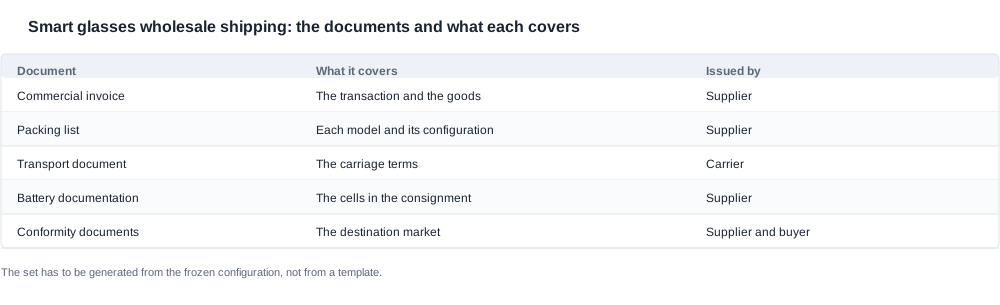
The rule that ties the set together is that it has to be generated from the same configuration that was frozen at order stage, not assembled afterwards from a template. A document set produced from a template describes a typical consignment, and a typical consignment is the one the supplier ships most often, which in a mixed order is rarely the one actually in the carton. Where a model with no published charging row is included, the battery documentation has to be issued against the confirmed configuration rather than against the model name, because the model name does not determine the cell.
Two further questions belong with the document set rather than with the shipping quote. The first is who holds the compliance file for each model and variant, in what format and for how long, because that is a document question rather than a freight one but it travels with the same programme. The second is what happens to the file and to the paperwork if the supplier changes, which for a distributor serving several markets is not a hypothetical.
The importer side deserves attention too. For each destination the programme needs to know who is the importer of record, what evidence the destination requires at the border, and what happens to a consignment that cannot be cleared. That last question is the one that decides whether a shipment problem is a cost or a crisis: a consignment that is refused has a defined route back, a defined cost and a defined timeline, and a programme that has agreed those three in advance treats the event as a process rather than as a loss.
There is a fourth document question that is worth raising in a wholesale programme specifically: the relationship between the document set and the packing list. The packing list is the document that has to describe the consignment as it actually is, model by model, and in a mixed order it is the document most likely to be generated from a template because it is the one with the most rows. A packing list that describes a typical consignment rather than the actual one is the failure that produces a mismatch at the border, and the mismatch is discovered by an authority rather than by the parties who could have corrected it.
Smart glasses wholesale shipping: the packaging decisions that reduce damage claims
Damage claims in this category are rarely about the product being fragile in the way the buyer feared. They are about the product moving inside a package that was designed for a presentation rather than for a journey, and about accessories that were never counted.
The first decision is the restraint method. A unit held in a rigid tray inside a carton resists compression; a unit in a bag inside a carton does not, and the failure appears as a carton that has been crushed in a stack rather than as a unit that has been dropped.
The second is the case recess. Where a model ships with a charging case, the cavity that holds it determines whether the case contacts are protected or abraded in transit. A loose case in an over-sized carton is a case that moves for the whole journey, and the damage it causes appears months later as a charging fault rather than as a transit claim.
The third is the accessory set. A remote shutter appears for two sport models, and that accessory travels in the same pack as the unit. A removable inner frame is published for two of the camera models and a detachable temple for one of the audio models, which means parts that the channel assembles rather than the customer. Every one of those items needs a defined cavity, and a pack that has no cavity for an accessory will lose it.
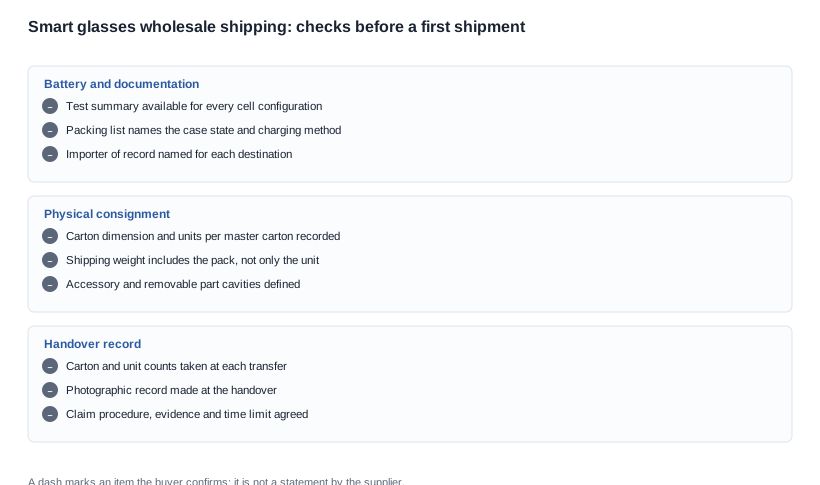
The fourth is the handover evidence. A carton count, a unit count against the packing list and a photographic record at the point where the consignment changes hands are what make a claim arguable. Without them, a damage claim is an assertion; with them, it is a document.
The fifth is the return path. If the pack is opened and re-closed by the channel, it has to survive that as well as the journey. A pack designed only for the forwarder leg will produce a second wave of damage claims from the channel, and those claims are harder to attribute because the damage occurred inside the buyer's own operation.
One point of care: an ingress marking published on a product is a statement about the product, not a statement about its packaging. Two models in this catalogue publish an IP54 marking, and no third-party test report reference is published for either. A buyer should not treat that marking as evidence that the product is protected in transit, because transit protection comes from the pack rather than from the product.
There is a sixth packaging decision that is worth naming because it is easy to miss and expensive to retrofit: the pack for the return journey. A channel that receives a unit and sends it back has to reuse the original pack or find a replacement for it, and neither option is costless. A pack that survives being opened and re-closed can be returned in, and a pack that cannot has to be destroyed and replaced, which turns a single return into a new consignment with a new document set. For a programme whose return rate is decided by the after-sales position rather than by the product, that difference is worth more than most of the packaging decisions that get argued over.

Smart glasses wholesale shipping: the questions to ask before the first shipment
The list below is the one to send before the first booking, and each item is a question with a specific answer attached.
- Which battery transport regime applies to each mode and each destination, and who prepares each document?
- Is a test summary available for every model and every cell configuration in the consignment?
- What is the carton dimension, the units per master carton, and the shipping weight including the pack?
- Which model configurations can share a master carton, and which have to be packed separately?
- Does the packing list identify the case state and the charging method for each model line?
- Which conformity documents accompany which model, and who is the importer of record?
- What insurance terms apply, and what evidence does the carrier require to support a damage claim?
- What is the claim procedure, the evidence it needs and the time limit it runs to?
- What is the storage and demurrage position if the consignment is held at the destination?
- What is the route, the cost and the timeline for a consignment that cannot be cleared?
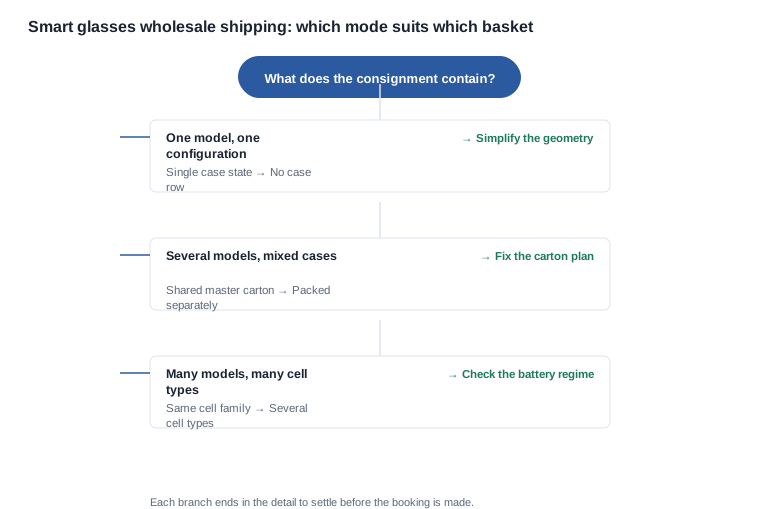
The first and the third questions are the ones that most often change the answer. A battery regime that differs between air and sea changes the mode, and the carton dimension and units per master carton change the freight basis. Both are knowable before the booking, and both are expensive to discover afterwards.
The list is deliberately framed as questions rather than as a specification. A buyer cannot specify a freight solution from a catalogue, but a buyer can specify what has to be answered before a booking is made, and that requirement can then be written into the agreement with the supplier. What follows from the answers is a shipping plan; what follows from the questions is a commitment that the plan will exist.
A useful discipline for the whole exercise is to treat the first shipment as a specification test rather than as a delivery. The first consignment carries more configuration combinations than any later one will, because the range is being tested against the channel for the first time. Everything that was guessed rather than confirmed in the documentation, the pack and the handover record will show up there, and the cost of showing up once is far lower than the cost of showing up on every subsequent shipment.
Smart glasses wholesale shipping: the contract terms that settle the handover
The handover is the point at which risk, documentation and money change hands, and it is worth putting the terms down rather than leaving them to practice.
The first term is the delivery basis, named precisely together with the named place, and the second is the point at which title and risk pass, which need not be the same point as the delivery basis. The third is the importer of record, named as a party. The fourth is the accuracy obligation: whose responsibility it is that the documentation matches the goods, and what follows if it does not. The fifth is the damage claim procedure, including the evidence required, the time limit, and who bears the cost of re-delivery or of replacing a consignment. The sixth is storage and demurrage allocation, which matters more than it sounds for a mixed consignment arriving in several cartons that may not be released together. The seventh is the insurance scope and the evidence the carrier requires, which is where the handover photographs become a contractual document rather than a courtesy. The eighth is the retention period for the compliance file, so that the obligation survives the person who handled the shipment.
Two provisions belong in a contract that expects the programme to repeat. The first records that the packing list, the document set and the carton specification for the repeat order are the ones from the original order unless a revision is issued. The second records the agreed handling of a consignment that cannot be cleared, so that the decision is a process rather than a negotiation under time pressure.
Smart glasses wholesale shipping: where the catalogue stops and the forwarder starts
The catalogue's contribution to a shipping plan is the physical fact set: the physical fact set behind every consignment: the twenty-eight entries the catalogue holds, the six case arrangements that exist across the camera range, the four camera models whose charging method is not published, the two models that publish colours, the two that publish an IP54 marking and the single weight figure that covers one model's glasses body only.
What the catalogue does not publish is everything about the movement itself: freight rates, transit times, carrier acceptance criteria for a given configuration, the packing performance of a given pack, insurance terms, demurrage, and the production or component position behind any availability statement.
We will map a consignment against the published rows, state which configurations it contains, identify which documents each of those configurations needs, and say plainly which questions have to be answered by the forwarder, the carrier and the destination authority rather than by us. Where a number is needed that the catalogue does not carry, the answer names the question to put to the carrier rather than inventing a figure.
Three supporting readings sit alongside this one: battery transport documentation covers the regime in detail, shipping damage claims covers the evidence and the claim process on the other side of the handover, and the procurement logistics page carries the wider commercial frame. A first enquiry through the wholesale programme entry point starts with a model list rather than with a container.
Smart glasses wholesale shipping is decided by three things the catalogue cannot show you: whether the documentation matches the goods, whether the pack survives the chain, and whether the handover was recorded. Settle those three before the first booking and the consignment becomes a routine event rather than an incident.


