

Shipping damage is the one fault category where the evidence disappears fastest and the money is smallest, which is why it is handled badly more often than any other. After sales support shipping damage claims usually fail for one of two reasons: nobody photographed anything before the carton was opened, or the claim was filed days later with a narrative that nobody can corroborate. Both failures are avoidable at the point of delivery for the cost of a short instruction, and neither is recoverable afterwards.
The second reason these claims go wrong is structural. A damage claim is the only claim in this category where the counterparty is frequently neither the buyer nor the supplier but a carrier, and carriers operate to their own deadlines with their own evidence requirements. A claim filed against the wrong party, or filed in the wrong window, or filed without the photograph, has no commercial route at all.
That structural difference has a consequence buyers often miss: the money is smaller and the deadline is shorter, so the case is worth less and must be worked faster. A transit claim in this product category is usually a single unit rather than a batch, which means none of the batching leverage a quality claim carries, and the carrier's window is usually measured in days rather than weeks. Processes designed around quality claims — comfortable, evidence-rich, escalating over days — routinely lose transit claims because they were built for the wrong clock. The remedy is not a second process; it is a separate intake lane with its own deadline and its own photographs.

After sales support shipping damage claims: where responsibility actually sits
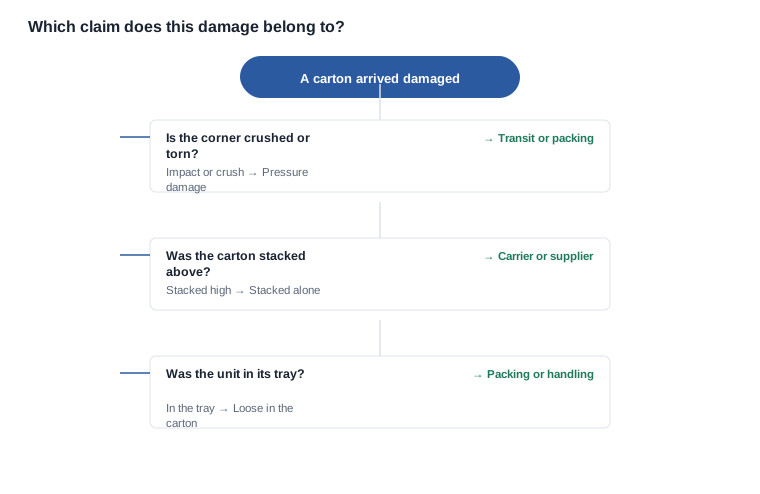
Three parties can carry a transit damage claim, and choosing the wrong one is the most common single failure.
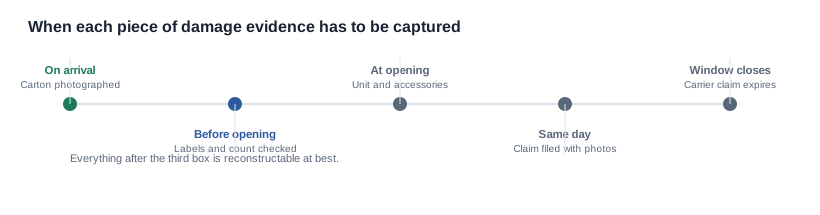
The carrier, where the damage happened in transit and the shipment was booked with the carrier by the party who shipped it. Carriers have short claim windows measured from delivery, and in most cases the burden of proof sits with the claimant: the photograph has to exist, and it usually has to show the outer carton as well as the contents. In practice the window is short enough that the decision to file has to be made the same day, because a claim filed "within the window" is frequently interpreted by the carrier as "within the window and with complete evidence".
The supplier, where the damage happened before the carton left the factory — a crushed corner in the stack, a pallet overhang, a carton that was already compromised when it was sealed. The tell for this is usually in the photograph: damage consistent with pressure or stacking rather than with a single impact.
The buyer or the distributor, where the damage happened in the buyer's own warehouse during unloading or internal handling. This is more common than buyers expect, and it is invisible unless the receiving instruction requires the carton to be inspected before it is signed for.
The determination is not always possible, and the honest position is that a damaged unit is sometimes simply a damaged unit. What changes the outcome is not certainty about who caused it but the existence of a photograph at the moment of opening, because a photograph is the only thing that can settle the question later. A claim with a photograph is usually resolved, whichever party it is filed against. A claim without one is usually credited, whichever party should have paid.
For a buyer doing supplier due diligence, this is one of the few areas where the evidence question is more informative than the commercial answer. A supplier that can describe its packing configuration, its stacking limit and its receiving instruction has usually thought about the delivery chain; one that cannot usually has not, and will discover the problem during the first peak rather than during the quotation. Ask for the packing specification as a document, and treat a verbal answer as an answer about last year rather than about the next shipment.

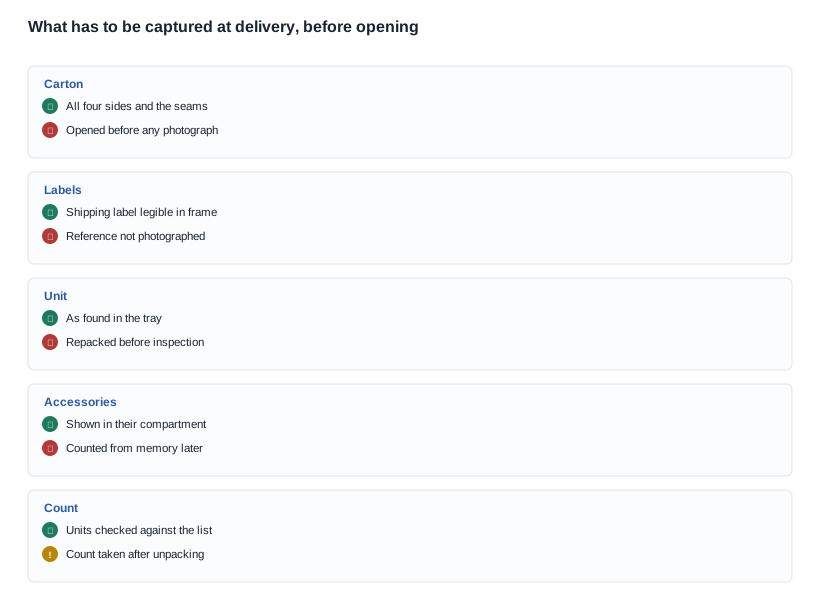
Evidence that survives a courier's condition report
A condition report at delivery is worth little on its own. It records what a person wrote on a handheld device at a loading bay, usually in a sentence, usually without a photograph, and usually before the carton has been opened. The evidence that carries weight is a small, specific set of items captured in a fixed order.
The outer carton, before it is opened. All four sides, the seams, and any corner that looks compressed. This is the photograph that decides between transit damage and pre-transit damage.
The shipping label and any carrier label, legible in frame. A damage claim without a legible reference is a claim nobody can process.
The unit as found in the tray. One wide photograph, then close-ups of each area of concern. The tray matters: a unit that has left its tray and is sitting loose in the carton has been through a handling event that the packaging would otherwise have absorbed.
The accessories in place. Missing accessories are the single most common finding on opening, and they are impossible to prove later unless they are photographed where they were supposed to be.
The count. Number of units in the carton against the number on the packing list. An under-shipped carton is a different problem from a damaged one, and both are found in the same thirty seconds.
The rule that makes this work is that it happens before anything is unpacked, moved or repaired. A unit that has been re-packed, cleaned or left in a warm van overnight has lost most of its evidentiary value regardless of what is eventually found. In warm markets that loss is fast enough to matter, which is why the instruction has to be short and immediate.
The instruction itself is short enough to write in five lines and should be treated as part of the delivery, not as part of the after-sales operation. Something to the effect of: photograph the carton before opening it, keep the label in frame, open it on the dock, count against the packing list, and if anything is wrong stop and call before you repack. That last clause is the one people drop, and it is the one that matters — a unit repacked out of habit cannot be put back into the state it arrived in, and the photograph that would have settled the claim no longer exists.
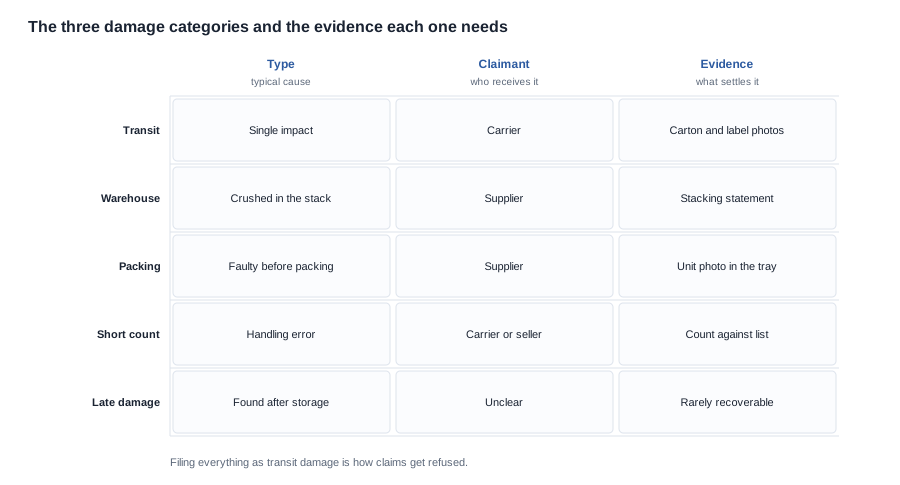
The three damage categories and what each one needs
Separating three categories at intake saves most of the argument later.
Transit damage. A single impact, a crushed corner, a puncture, a tear. The claim goes to the carrier. The evidence needed is the carton photograph, the label photograph and the unit photograph. The timing rule is short and unforgiving.
Handling damage in the warehouse. A carton that was crushed by something on top of it, or dropped, or stacked incorrectly. The claim usually goes to the supplier, because the packing was inadequate for how the goods were handled. The evidence needed is the carton photograph plus a statement of how the pallet was stacked and how high the cartons were.
Manufacturing damage found at opening. A unit that was already faulty, or physically damaged, before it was packed. The claim goes to the supplier as a quality matter rather than a transit matter. The evidence needed is the unit photograph with the tray still in place, because the tray is what proves the unit was protected at packing.
Between the carrier's claim and the supplier's quality process, the second is usually easier to run and the first is usually the one worth pursuing. A quality claim benefits from the buyer's own evidence discipline, can be batched when a pattern appears, and produces information about the next order. A carrier claim produces a payment and no information at all, and the carrier's response time is not something either party controls. Where a programme has to choose where to spend its diligence effort, the quality route is where the return is.
The three categories have different deadlines, different recipients and different remedies, and a process that files everything as "damaged in transit" will eventually be told by a carrier that the claim is not theirs. Sorting at intake takes two minutes; sorting after three weeks takes two weeks.
There is a fourth pattern that shows up in programmes shipping mixed configurations, and it is worth naming because it is mistaken for a third category. A carton containing units from more than one configuration, opened at the distributor rather than at the end customer, produces a "wrong item" or "short" finding that is usually a picking error upstream. The evidence that distinguishes it is the batch marking per unit rather than per carton, and the practical consequence is that the case belongs to the pick-and-pack process rather than to transit at all. Buyers who have not asked for unit-level markings find these cases genuinely unresolvable.

Freight terms, insurance and the conversation that usually goes wrong
Freight terms decide who has the practical ability to claim, which is not always the party that suffered the loss.
Incoterms determine which party arranges the carriage and therefore which party holds the carrier contract. A shipment sold on terms where the seller arranges carriage gives the seller the claim; one where the buyer arranges carriage gives the buyer the claim. Where a distributor in the middle does not hold the carrier contract for either leg, nobody in the chain can file against the carrier without paperwork that takes weeks to obtain.
Insurance is where the gap usually appears. Cargo cover is commonly arranged by the party that books the carriage, for a declared value that is set at booking, and a unit valued for carriage at a figure far below its retail value can only be recovered at the lower figure. This is a decision made at booking, days before anybody thinks about damage, and it is effectively unrecoverable afterwards.
Declared value and packing list accuracy matter more than most buyers expect, because a claim above a declared value is either reduced or refused. A packing list that does not match the contents creates a second, independent problem at claim time.
The conversation that usually goes wrong is the one about who pays while the claim is open. The unit has arrived broken; the customer wants a replacement immediately; the carrier claim will take weeks. If nobody agreed who carries that interim cost, the customer waits for the carrier — which is the correct answer commercially and the worst possible answer for the relationship. Writing a short bridge rule into the agreement — the party that will ship a replacement first, and the mechanism by which the cost is settled once the carrier pays — is the cheapest risk reduction available in this category.
The trade-off buyers should weigh before negotiating hard on the freight terms is that a very long claim window and a very high declared value usually cost more in the freight rate than they recover in claims. In a category where the units are small and the return population is low, the money is often better spent on the receiving instruction and on packaging than on insurance terms. Where the units are expensive, the ratio reverses. Deciding which side of that line a programme sits on is a shortlist question, and it should be asked before the quotation rather than after the first peak.
What to ask a forwarder, a supplier and a buyer
Three conversations, three sets of questions, all of them answerable before the first shipment.
To the forwarder. What is the claim window, measured from what? What evidence do you require, in what format, and is a photograph mandatory? Which of our shipments are insured, at what declared value, and who set that value? What happens to a claim filed inside the window but without the required evidence?
The last question deserves emphasis because the answer determines the entire process. If incomplete claims are simply rejected rather than invited to be completed, then the receiving instruction has to guarantee completeness, and a photograph missed at the dock is a lost claim rather than a delayed one. If the carrier invites completion, the same miss costs days instead of the claim. Either answer is workable; not knowing which one you have is not.
To the supplier. What is your packing configuration for this product, and does it assume stacking? What is the maximum stack height you have validated? How are cartons sealed, and is the seal number recorded? Will you support a transit claim against the carrier if the carrier rejects it, and on what basis?
The seal question is small and disproportionately useful. A carton seal that carries a number turns "the carton was intact on arrival" from an assertion into a reference, and it also settles the short-count case, which is otherwise the hardest damage claim to resolve because both parties genuinely do not know what was inside when it left. It costs nothing at the packing line and it changes the resolution rate on an entire category.
To the buyer's own receiving operation. Who inspects cartons, and before what point in the process? What happens to a carton that is visibly damaged when it is signed for — is it refused, or signed and photographed? Who is allowed to authorise destruction of a damaged unit, and is that recorded?
The last of those three is the one most often missing and the one with the largest effect. A receiving operation that signs everything and inspects nothing converts a carrier claim into a customer claim, because the buyer has accepted the goods. A receiving operation that photographs before opening preserves every downstream option at essentially no cost.
Where to negotiate is also a fair question. The receiving instruction and the freight terms are usually straightforward; the declared value and the claim window are the two that most often need work, and the window is the one that silently determines whether a claim is possible at all.
Two questions belong in the checklist for any supplier evaluating this. Ask what their published claim rate is and how it is measured — a figure with a stated denominator is useful, and one without is decoration. And ask what proportion of their damage claims are settled by the carrier rather than credited by the supplier, because that ratio is the closest available proxy for whether their packing specification is right, and it is rarely published by anyone.
Our published position, and the terms we will write
Better to set out at the outset which parts of this answer we can actually measure.
Our packing configuration is not published. Our shipping cartons, stacking limits and seal method are not published. Our declared-value policy is not published. Our carrier arrangement and claim window are not published. Our warranty duration is not published, and our returns freight policy is not published either. Every one of those is a hole in what we hold rather than something we have chosen to keep quiet about.
The specification rows we do not have constrain the answer in the same way. One model publishes a weight, the MT6 at 158 g; every other weight is Not published. The video specification, the sensor model, the field of view and the microphone specification are Not published. No ingress test report numbers appear in the catalogue. The catalogue publishes no CE, FCC or RoHS text and no per-model certification row, so a certificate for a given model is still pending a written request; no regulatory position has been published for the children's models. The names in the catalogue are loose as well: "L2 Utral" appears with a note saying it is a typographical rendering of "Ultra", "Utral Pro Max" appears with nothing published about what it denotes, and the light-responsive and bone conduction entries are named by neither. For a damage claim this has a practical edge: where the packaging has not been validated for a given route, the defensible statement is that the unit was packed to a stated configuration for a stated carrier, not that it is damage-proof.
What we will do for a named programme is write the transit terms into the quotation: the packing configuration, the stacking limit, the seal method, the carton specification, the freight direction under each incoterm, the receiving instruction for the buyer's warehouse, and the bridge rule for interim cost while a carrier claim is open. For each of those we will separate what can be evidenced today for that configuration from what would need validating first, and we will tell you where the answer is a physical test rather than a document.
Send us the configuration, the target markets, the expected volume and the delivery routes you intend to use, and we will produce the transit terms as a written proposal rather than a set of assurances.
One limitation should be stated rather than discovered. Where a route involves an unusual carrier, an intermodal leg or a destination our team does not normally ship to, the packing validation may be a physical test rather than a document, and that test takes time we cannot compress. We will tell you which routes we have validated and which we have not, rather than quoting a packing specification and discovering the gap during a peak.
Related reading
- The receiving side of the evidence — packaging for returns
- The claim once it is inside — quality claims
- The process that receives it — returns and RMA
Send the configuration, markets, volume and delivery routes and we will write the transit terms.


