

What is the minimum for a full range is really two questions carried by one phrase, and the honest answer is that the second one is the useful one. The first is how many models you need in order to call it a range; the second is how much working capital, documentation effort and channel commitment a range of that size actually consumes. Our catalogue does not publish a minimum for either, and the reason is that the number is not a property of the range — it is a property of a range, held at a quantity, with a configuration, for a market, on a schedule. So this article does what a catalogue can do: it sets out the criteria that determine the answer, the costs that multiply with every additional model, the things a range genuinely buys, the things it does not, and the questions that turn the vague question into one a supplier can quote against.
The question behind the phrase is usually "how do I get breadth without committing my whole working capital to it", and it is asked by people who have correctly identified that a single-model programme leaves them exposed and a full-range programme drowns them. Both of those positions are rational and the criteria below are designed to tell you which one you are actually in, rather than to tell you which one to take. A range is defensible when the demand is already known and the channel already exists; a narrow first order is defensible when the demand has to be discovered. Which of those describes you is a fact about your market, not a rule.
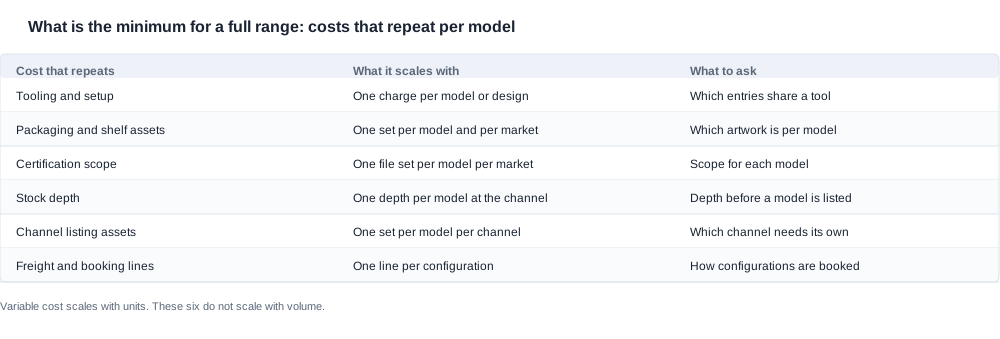
The table above is the core of the answer. Every row is a cost that arrives per model rather than per unit, which is why the total for a range is not the unit cost multiplied by a bigger number.
What is the minimum for a full range, and why no catalogue answers it
A range is a set of configurations, not a set of names. Our catalogue holds twenty-eight entries across seven groups, and the entries are not the unit of stocking. The real count is higher, because several entries resolve into several units. One entry resolves into four colour options and another into three. One entry prints two variant names and two charging-case capacities without stating which capacity goes with which name, so it resolves into at least two units and possibly four. One camera entry publishes a foldable charging case as a separate item with its own capacity. Four camera entries carry no charging-case row at all, so the case question has to be settled before they can be counted.
So the honest arithmetic is that a buyer asking for "a full range" is asking for a range of configurations, and the number of those is a calculation that has to be made from the published rows plus the answers to the open ones. That is why no catalogue can quote the minimum as a number: the number changes with the answers.
The fixed cost is the part that multiplies. A unit cost is close to linear in quantity — order twice as many units and you pay roughly twice the variable cost. A fixed cost per model is not: order twice as many units of the same model and you pay the same tooling, the same artwork and the same listing work. That is the mechanism behind the whole question, and it is why the size of a first order matters more than its depth.
The channel has its own threshold. A distributor or a retailer will generally want depth on a model before it will list it, and depth on eight models ties up eight times the stock of depth on two. The trade-off is that the models that sell fastest are the ones you cannot predict before the data exists, so the breadth that reduces risk on paper can increase it in cash.
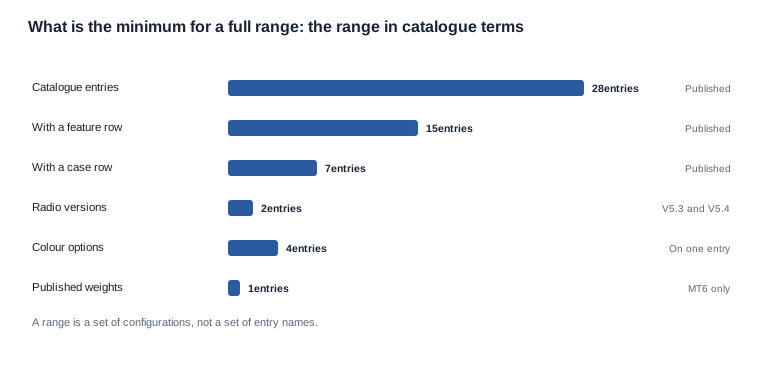
The counts above are the range expressed in the only terms the catalogue can publish: how many entries exist, how many carry each kind of row, how many variants one entry expands into. A buyer planning a range starts from these numbers and applies the answers to the open questions, and the numbers themselves are never a commitment.

The fixed costs that multiply with every model
Six categories of cost arrive per model rather than per unit, and they behave differently enough that a range decision has to examine each of them.
Tooling and setup. Charged per model, and where a design change is involved the number is hard rather than soft — it does not halve when the volume halves. This is the cost that punishes breadth most severely, because it is also the cost that a rebrand or a private-label arrangement can sometimes avoid entirely. It is also the cost that a supplier quoting a range may not mention unless asked, since it is a one-off rather than a unit cost.
Packaging artwork, inserts and shelf assets. Per model, and per market if the artwork differs by market. The printing artwork, the leaflet, the barcode configuration, the carton markings and the shelf or listing assets are all produced for a specific model in a specific market, and none of them is shared. This is the cost that a buyer most consistently forgets when the range is decided in a showroom rather than in a spreadsheet.
Certification and documentation scope. Per model, and it is the cost with the widest spread in this category, because the scope depends on the radio configuration, the destination market and the battery. Our catalogue publishes no per-model certification row at all, and its text names no CE, FCC or RoHS; the company-level export-certification page is a set of images carrying ten patent certificates, eight appearance designs and two utility models, with nothing tying them to a model. On certification the working record carries an absence per category rather than a status, and the categories differ only in what they leave open: for the camera, audio and sport categories there is no certificate number to quote, while the children's category has nothing published against it at all. A buyer taking a range into two markets is therefore taking on two document sets per model, and the scope has to be established per model rather than per range.
Stock depth. Per model, at whatever depth the channel requires, and it is the only one of the six costs that is pure working capital rather than a one-off. It is also the cost that determines how quickly a model can be replaced once it starts selling, which is the reason a range is sometimes worth carrying even when the first order on each model is small.
Channel listing and per-channel assets. Per model, per channel. A retailer that requires its own asset set turns one artwork cost into several, and a marketplace listing is per model and per market rather than per range.
Freight and booking lines. Per configuration. Each configuration is a separate line in a booking, a separate carton or inner pack and a separate line in the documentation, and a consignment of six configurations is not one consignment of six models. This is the cost that is invisible in a per-model spreadsheet and visible in a per-configuration one.
What a range actually buys, and what it does not
The reason a range is proposed is usually that it reduces the risk of having nothing to sell. That is a real benefit and it is worth being precise about which risk it reduces, because the precision determines whether the range is the right instrument.
A range reduces the risk of a single entry failing. If the model you bet on turns out not to sell, a range gives you other models to sell instead. This benefit is real in a category where the demand curve for any one configuration is hard to predict in advance, and it is the strongest argument for breadth.
A range does not reduce the risk of the category failing. If your channel does not sell this kind of product, a range of twenty-eight entries fails as thoroughly as one entry, and it fails with more working capital committed. Breadth diversifies within a category and does nothing across categories.
A range does not reduce the cost of discovery. A first order across a range is still a first order, and the information it produces is weaker per model than the information a focused first order produces. The models in a range that have not sold have taught you less than the model you focused on would have, because the range order was spread thin.
A range does reduce the cost of a second order. Once the artwork, the documentation, the tooling and the channel listing are paid for, adding volume to a model that is already listed is a different economic proposition from listing it for the first time. This is the real argument for breadth, and it only pays out if the first order is large enough to make the setup worth having paid for.
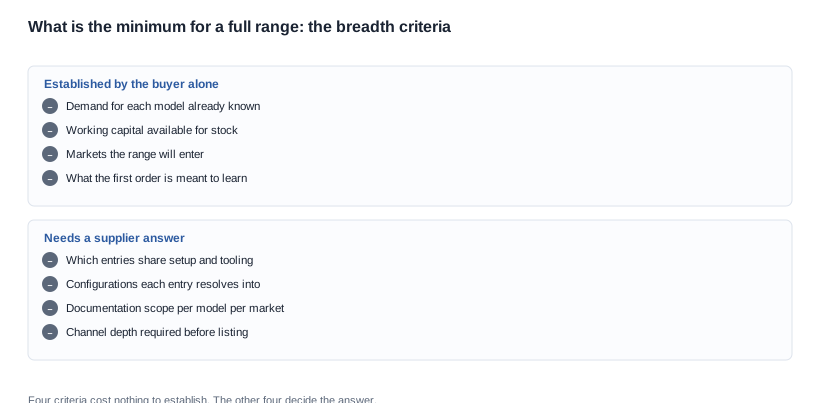
The checklist separates the two situations clearly. When the demand is already known and the channel already exists, breadth is a distribution decision. When the demand has to be discovered, breadth is a research method with an expensive price tag, and a narrower order buys the same research for less.

The criteria that decide how much breadth is right
Six criteria decide the question, and they can be applied in order. None of them needs a supplier to answer it, which is the point: the criteria are what a buyer can establish before the first quotation, and the quotation comes later.
- Do you already know which models sell in your channel? If the answer is yes, breadth is being bought for distribution coverage. If the answer is no, breadth is being bought as a research method and it should be bought at the smallest size that produces the information.
- Does the range share setup cost or not? A range whose models share a tooling family, a packaging structure and a certification scope carries less duplicated fixed cost than one whose models each need their own. Ask the supplier which entries in a proposed range share setup, because that question changes the arithmetic more than any other.
- How many configurations will each model resolve into? One entry in this catalogue publishes four colour options and another publishes three, and one publishes two case capacities under two variant names. A range of six models can be a range of twenty configurations, and the second number is the one that has to be stocked.
- Which markets will the range enter, and does the documentation scope multiply? Two markets means two document sets per model, and the scope has to be established per model.
- What is the working capital you are willing to have in stock at once? Depth times models times configurations, with a margin for the depth the channel requires.
- What will you do with the information from the first order, and does it change the second order? If the answer is "we will read the sell-through", breadth is defensible at a modest size. If the answer is "we will order more of whichever worked", a narrower first order is usually the better research instrument, and the mixing models to meet a minimum material covers how a split order is counted when it is placed.
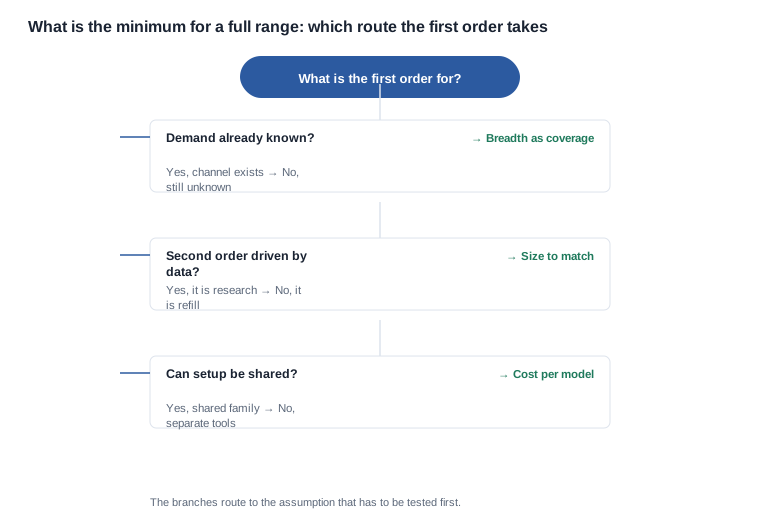
The decision chart is a summary rather than a recommendation. It routes a buyer to the assumption that has to be tested first, because the two branches need different evidence and different evidence is expensive to collect the wrong way.
Running the arithmetic before the quotation arrives
The range question can be answered without a supplier in the room, and doing it first is what makes the quotation readable. Five steps, and the inputs are either published rows or four questions you can ask in a single email.
Count the configurations each entry resolves into. Start from the published rows: colour options where they are published, case states where they are published, charging method where it is published, and the variant naming where it appears. Four camera entries publish no charging-case row, so those contribute a question rather than a number, and the count stays open until the question is answered.
Apply the depth the channel requires. A model is not listed at one unit. It is listed at whatever depth lets it trade, and that depth is a per-model number in the channel's own terms. Multiply it by the configuration count and you have the stock requirement for that entry.
Add the first replenishment. A first order that cannot be replenished without a new setup is a different programme from one that can. Ask which entries can be reordered against the same setup and which cannot, because the second group determines how much of the range has to be committed on day one.
Price the setup separately. Tooling, artwork, listing assets and the documentation scope are four separate lines, and they are the four that a supplier's total obscures. Asking for them separately tells you which part of the range is actually expensive, and it tells you whether the expensive part is one entry or all of them.
Compare against the working capital you have. The output of the arithmetic is not a model count. It is a number of configurations that can be carried at a given depth, and the number of entries those configurations correspond to. A range of three entries might be a range of nine configurations, or it might be a range of twenty, and the difference is not visible anywhere in the catalogue.
What comes back from the supplier is then a small set of numbers that can be checked against that arithmetic: the minimum per configuration, the setup charge per entry, the depth the channel requires and the schedule position. What is the minimum for a full range becomes a question those four numbers answer, rather than a question that has to be believed.
The ongoing cost of a range, which is not in the first-order budget
A range carries a second set of costs that do not appear in a first-order budget at all, and they are the reason a range that seemed economical at the start can stop being economical two quarters later.
The aftersales exposure is per model. Each model has its own failure profile, its own diagnostic route and its own spare-parts requirement, and a range multiplies the number of routes a service function has to support. The after-sales section covers how that arrangement is structured, and the point for a range decision is that a service capability sized for one model is not sized for eight.
The listing maintenance is per model and never ends. Assets, content, descriptions and prices are kept current per model per channel for as long as the model is listed, and a range that is not being actively managed still generates the work.
The inventory risk is per configuration. A configuration that turns out not to sell is not a slow-moving line; it is a line that has already consumed its setup cost and its floor space, and the recovery on it is close to zero because the artwork and the tooling are specific to it.
The obsolescence risk is per model. A model that was the right match for a channel two years ago is not necessarily the right match now, and a range that was assembled to cover a market carries the risk of covering it badly.
None of this argues against a range. It argues for counting the ongoing costs when the range is sized, because they are the costs that determine whether a range is a distribution position or an accumulation of inventory. A buyer who has compared the six criteria above and then added these four to the arithmetic has a range decision that will still hold together two quarters later.

What the catalogue carries and what a range still has to settle
What follows is our own position, set out in the format used across this category.
Published. Seven groups, twenty-eight entries. What every one of them carries is the same four things: cell count and capacity, runtime, charge time, charging method. Eleven camera entries add a resolution class, five publish a charging-case capacity, two publish a case with no figure for it and four publish no case row at all. Two of them carry an ingress marking, a colour range appears on two and a surround-sound row on five. Fourteen publish a radio version. One publishes a weight, and that figure belongs to the MT6 glasses body at 158 g with its foldable case left out; no other entry gives a mass.
Not published. Minimum order quantity, minimum range size, a price, a price tier, a delivery time, a warranty period, tooling charges, mould charges, artwork charges, sample charges, certification costs and certificate identifiers. None of them is published for a structural reason: every one of them varies with the configuration, the quantity band, the documentation scope and the current schedule, and each one is confirmed per enquiry.
What to ask. The minimum per configuration and the factors it was derived from. The minimum for a stated set of configurations, and whether a split order counts each configuration separately. Which entries in the range share setup and which do not. Which certification scope applies to each model in each destination market. Which artwork is per model, per market and per channel. What depth each channel requires before it will list a model, and what the sample stage involves before any of it happens. The samples page covers the stage that usually comes first.
The practical next step for a full range
Before asking a supplier what the minimum is, count the configurations your proposed range actually resolves into from the published rows, and decide which of the six criteria above you are optimising for. The answer you get back will then be a number you can use, because you will know which of the variables it depends on.
Then send us the entries you have in mind, the destination markets, the documentation scope and the quantity bands you are working to, the reply will carry the catalogue rows for each entry, the configuration count behind the range as published, and the list of what has to be settled before a minimum can be quoted per configuration.


