
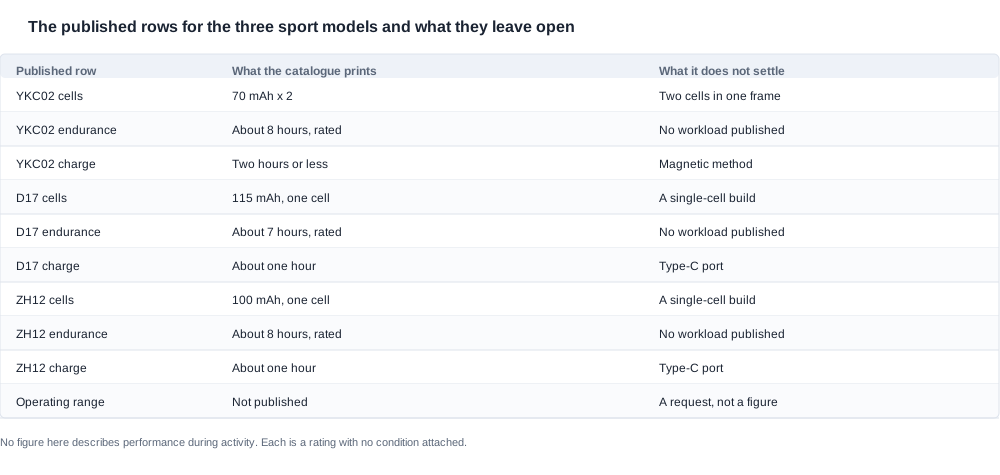
The honest opening on this subject is a negative one: our catalogue does not publish a single figure describing how long any of the sport models lasts during activity, and a page that promised one would be inventing it. What the catalogue does publish for the three sport models is a set of rated endurances — approximately eight hours for the YKC02, approximately seven for the D17 and approximately eight for the ZH12 — with no workload, no start state and no end criterion attached to any of them, and with no operating temperature range published for any of them. What it also publishes is something more useful than a second endurance figure: two of the three models reach a full charge in about an hour, while the third is capped at two hours or less. That difference, not the endurance number, is what a buyer can actually plan a season around.
Sport smart glasses battery during activity: what the catalogue does and does not rate
A rated endurance is a measurement result, and a measurement result is meaningless to a buyer without the conditions under which it was taken. The catalogue prints the results and not the conditions for the three sport models, and the gap is not an oversight in the sense of carelessness: the conditions belong to the test, and a test condition is the kind of thing that belongs with a product's technical documentation rather than on a catalogue page. A buyer therefore cannot read an activity figure off our material, and a channel cannot write one into a listing without a document behind it.
That leaves the buyer with two honest options, and both of them are work. The first is to accept the published rating as a schedule input and to plan against the bottom of it, while asking the supplier for the workload behind it. The second is to run the figure themselves, on a sample, under a workload that matches the deployment — which is the subject of the last section of this page and is the only route to a number that a buyer can put in a listing, a tender document or a support script.
What makes the first option reasonable rather than merely expedient is that the published ratings in the sport line sit in a narrow band, between approximately seven and approximately eight hours, and that the published charge ceilings sit in two clearly separated groups. A buyer planning a session of a length comfortably inside the shortest of those ratings, and who can reach the product's charge point between sessions, is in a position where the missing conditions barely matter. A buyer planning a full day, or a multi-session day with no charging point, is in a position where the missing conditions decide the programme, and needs the second option.
There is a third thing the published rows settle, and it is the thing buyers most often ask about first. Two of the three sport models publish a feature row describing a remote control for photography, and one of them publishes that row in Chinese rather than in English. Whatever the remote does, its existence is a published fact, and the existence of a control that a participant can operate changes the activity profile of the product: a function that can be triggered without stopping changes what the radio and the electronics are doing during a session. That is a reason to ask about the workload in detail rather than to assume it.
It is also worth saying what this page will not do, because the temptation is strong. It will not state how many hours any of these models lasts on a run, in the rain, at a given volume or at a given temperature, because we do not publish that and we have not measured it. It will not state that any of them improves a sporting result, and we make no such claim for any model. And it will not convert a rated endurance into a promise, because the difference between a rating and a promise is exactly the set of conditions the catalogue does not print.
The three sport models and their two different charging architectures
The three sport models are published as 运动眼镜, and their published rows separate them in ways that matter for an activity plan. The YKC02 carries two 70 mAh cells, a rated endurance of approximately eight hours, a charge ceiling of two hours or less, magnetic charging and Bluetooth version 5.4, with a surround-sound row and a long-endurance note. The D17 shows one 115 mAh cell, an endurance rating of about seven hours, a charge ceiling of roughly an hour, a Type-C port and version 5.4, with feature notes for a photography remote and a surround-sound configuration. The ZH12 carries a single 100 mAh cell, a rated endurance of approximately eight hours, a charge time of about an hour, a Type-C port and version 5.4, with a Chinese-language remote-photography row and a Chinese-language stereo surround-sound row.
The charge architecture is the practical headline, and the two groups are genuinely different rather than differently worded. Two of the models reach a full charge in about an hour; the third is capped at two hours or less. A product that can be brought back to full in about an hour can carry a mid-session top-up in a way that a product capped at two hours or less may not, because the question is not the charge time in isolation but whether the charge time fits inside the gap between two blocks of activity. A fifteen-minute break and a one-hour charge do not combine, and a buyer who plans a two-hour session followed by a short recovery has to check which architecture is in the product.
The cell arrangements differ too, and they differ in a way that has nothing to do with capacity. Two of the three models use a single cell, and one uses two. The published values are the value and the count rather than a total, and a buyer comparing them should compare the arrangements rather than add them up. A buyer who wants a combined figure may derive one for internal capacity planning provided it is labelled as a derivation, and should keep the published form in anything that will be read by a customer.
The endurance ratings then do something that is worth reading carefully. The two models with the larger published cell values are not the two with the highest published endurance, and the model with two smaller cells publishes the higher of the two eight-hour figures. That tells a buyer that the rated endurance in this line is not a simple function of published capacity, which is a reason to ask about the workload rather than a reason to assume the workload is irrelevant. It is also a reason to be careful about a line that reads a catalogue as a specification sheet: in this range, the published rows describe the products accurately and they do not, on their own, explain why the products behave as they are published to behave.
The variables that decide the real figure, and how to ask for each one
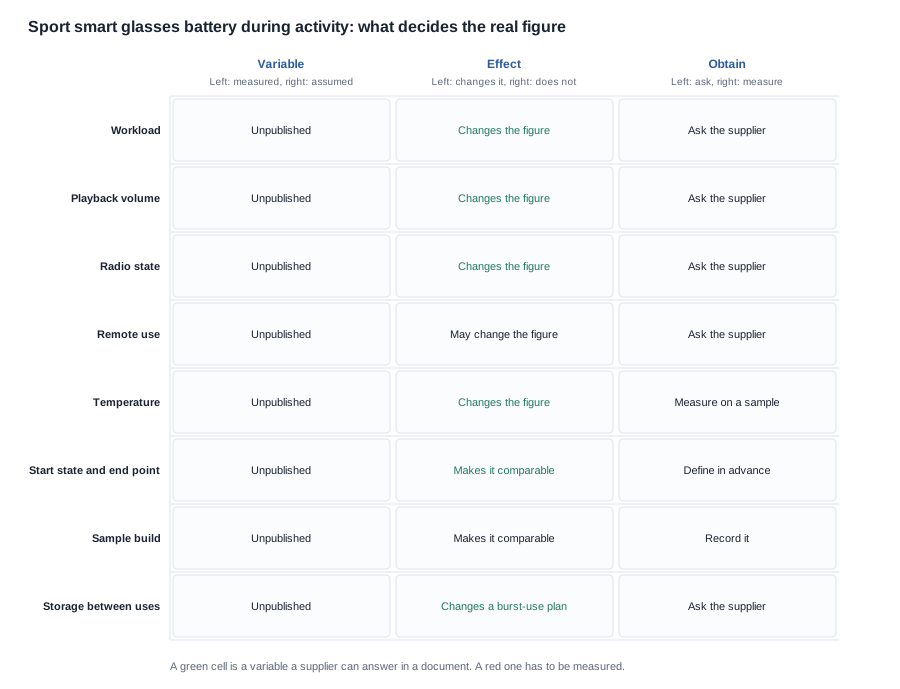
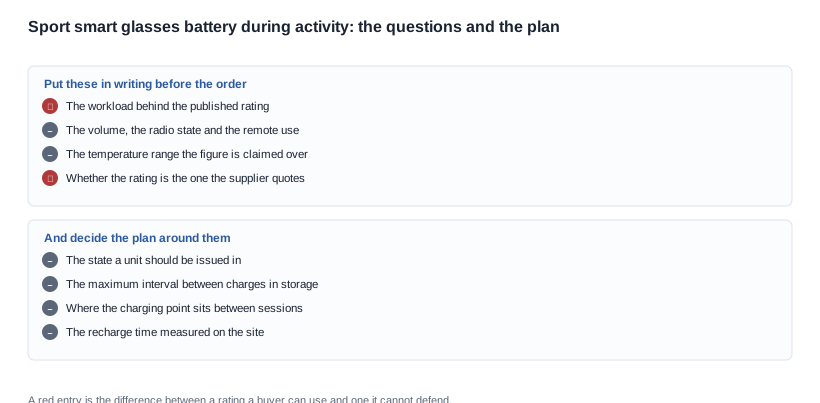
The variables below are the ones a buyer should name when asking a supplier what the published rating means. None of them is published for any sport model, and each of them is a specific request rather than a general question. A request that names a variable gets an answer; a question about "battery life in use" gets a paragraph.
- The workload behind the published rating: continuous audio playback, intermittent use, a mixed session, or something else.
- The playback volume used, and the audio configuration, including whether the surround-sound row is engaged during the measurement.
- The radio state during the measurement: connected and idle, connected and in use, or disconnected.
- Whether the remote-photography function is used during the measurement, and what it does to the power draw.
- The temperature and humidity conditions of the measurement, and the range over which the figure is claimed.
- The start state and the end criterion, so that a measured result and a published figure can be compared at all.
- The build configuration of the measured sample, including the radio stack and the firmware level.
- The expected effect of a paired phone in a pocket against a phone in a bag, if the supplier has measured it.
- Whether the rating is the figure the supplier supports commercially, or a best case that is not quoted.
- The charging method's own consumption, and whether a partially charged unit reports the same figure.
The third and fifth of those are the two that most often change the commercial answer, and they are the two that a buyer is most likely to leave out of a request because they sound like laboratory detail. The radio state matters because a connected radio is not an idle radio, and the difference between a phone in a pocket and a phone in a bag is a difference in connection maintenance rather than in usage. The temperature matters because a cell's behaviour in a cold morning and a hot afternoon is not the same behaviour, and because a sport deployment is outdoors by definition.
The ninth question is the one to insist on. A supplier can quote a figure that is technically true and commercially useless, and the way to find out which one has been quoted is to ask whether the figure is the one the supplier supports in a listing. A rating that a supplier will not put on its own material is a rating a buyer should not put on theirs, and this is the shortest useful question in the whole enquiry.
A buyer should also be careful about the criteria it uses to compare two suppliers' answers here, because the answers are easy to make look complete. The first criterion is whether the supplier names a workload rather than describing one in general terms, because a supplier who will say "continuous playback at half volume with the phone connected" has told the buyer something they can plan with, and a supplier who says "designed for all-day use" has told the buyer nothing. The second is whether the answer separates the published rating from the commercial claim, which is the distinction that protects a channel from quoting a number the supplier would not quote itself. The third is whether the answer can be verified, which in practice means whether a buyer could run the described test on a sample and expect to land in the same place. The fourth is whether the supplier will say which of its answers would change if the configuration changed, since a workload figure that depends on a firmware level is a figure with a shelf life. Those four criteria are how to choose between two suppliers, and they are worth more than the figure itself.
The practical output of this section is therefore a request list rather than a set of numbers, and that is the honest shape of the answer. A buyer who runs it will end up with a workload definition, a set of conditions and a figure that belongs to them, which is worth considerably more than a figure that belongs to somebody else and cannot be defended.
Building a session plan around a published rating
A sport deployment is a structure of sessions, and the plan has to be built around the session structure rather than around the clock. The published ratings in this line — approximately seven to approximately eight hours — comfortably cover a single block of activity for a participant who is moving for a couple of hours. They do not comfortably cover a full day of back-to-back blocks with a long gap in the middle, and they do not cover a week-long camp in which a unit may sit unused for days between uses.
That last case deserves a paragraph of its own, because it is the one that catches buyers out. A unit that is used in bursts and then sits in a bag for days is in a different state from a unit that is used continuously, and the published rating says nothing about storage, about self-discharge over days, or about whether a unit that has been idle should be recharged before its next use. Our catalogue publishes no storage temperature range, no recommended maximum interval between charges, and no self-discharge figure for any of the three models. A buyer running a camp, a course or a season of intermittent activity therefore has to ask three separate questions — what a stored unit should be brought to before use, how long a unit may sit, and what a unit left in a vehicle in summer should be expected to do — and none of them can be answered from our material.
There is a commercial consequence to getting this wrong that is worth stating in plain terms. A unit that is flat when the participant picks it up is a unit that produces a support contact, and a support contact in the first ten minutes of a session is a very different commercial event from one that arrives in a returns queue. The cheapest protection is a plan rather than a hope: a stated interval between charges, a stated state at the point of issue, and a charging point that is available where the units are stored rather than where the activity happens.
The other thing that belongs in the session plan is the charging point itself, and the choice of model affects it. A model that reaches a full charge in about an hour can be recharged in a car park between two blocks; a model capped at two hours or less needs a longer gap or a second unit per participant. A second unit per participant is a cost that has to appear in the business case, and it appears there only if the plan is built from the charge architecture rather than from the endurance figure. This is the practical reason why the difference between a one-hour ceiling and a two-hour ceiling matters more to a sport buyer than several hours of published endurance does.
The measurement protocol a buyer can run on a sample order

The last section is the part a buyer can act on immediately, and it is deliberately a protocol rather than a result. What follows is how to obtain a figure you own, on a sample, under a workload that matches the deployment, and how to record it so that it can be quoted afterwards.
- Write the session down first: block lengths, gaps, environment, and whether the unit is in use or stored.
- Define the workload in the supplier's terms, so that the measured result and the published rating are comparable.
- Set the start state and the end criterion before the run, and write both into the record.
- Record the temperature and the conditions at the start, at the end and at each gap.
- Run the session twice on the same unit, and once on a second unit, so that a unit-to-unit difference can be separated from a workload effect.
- Recharge under the conditions the deployment will actually provide, and time the recharge against the published ceiling.
- Record the results against the published rows, including the conditions, and file the record with the model.
The fifth point is the one that makes the result defensible. A single run on a single unit cannot distinguish a workload effect from a unit effect, and a buyer who has quoted a single-run figure has quoted a number that may not survive a second sample. Two units and two runs each will separate the two, and the difference between them is itself a finding about the product that a buyer can use in a support script.
One practical note on running the protocol: a buyer who has a deployment that repeats weekly can spread the two runs across two real sessions rather than running them back to back, which removes the temptation to optimise for the sample rather than for the activity. A buyer who has a single event can still run the protocol on two units on the same day, but should record that the second unit was not run on a different day, because a reviewer will ask. Recording the limitation is cheaper than being asked about it.
The record also has to say what it does not establish. A measured figure under one workload, on two units, in one temperature range, establishes a number for that combination and nothing more. It does not establish a product specification, it does not replace the published rating, and it does not travel to another market. What it does is give a buyer a number that they observed and can describe, which is the difference between a figure that can be quoted in a listing and one that cannot.
On the temperature question specifically, which is the one that most often turns up unanswered in a sport context, the general treatment of how a cell behaves outside a nominal range is set out in the material on cold weather and battery life. What it cannot do is supply a figure for any of the three sport models, because our catalogue publishes no operating or storage temperature range for any of them, and the answer has to come from the supplier with the configuration it applies to.
The offer we can make from our side is bounded and we will keep it that way. Send us the session structure you are planning, the workload you expect, the three published rows for the models you are considering, and the copy you intend to publish, and we will show you which parts of the published material support what you want to say, which parts have to be measured before they can be said at all, and which questions have to be put to the supplier in writing. We will not give you an activity figure we cannot source, and we will tell you plainly when the answer is a measurement rather than a specification.


