

Yes, and the reason is ordinary lithium chemistry rather than anything peculiar to this product category. A cell that is cold does not empty faster in the way a leaky capacitor empties; it delivers less of the charge it is holding, so a session that lasts five hours at room temperature ends sooner when the same device is cold. That is the whole of the mechanism, and it is well established across cell chemistries.
The more useful answer for a buyer is narrower than the yes. How much it matters depends on three things: how cold it actually gets in your market, what the device is doing while it is cold, and how long the cold exposure lasts. A pair of glasses worn on the head in a cyclist's winter commute is a harsher thermal environment than the same glasses sitting on a desk, and the difference between those two cases is larger than most of the published runtime figures will suggest.
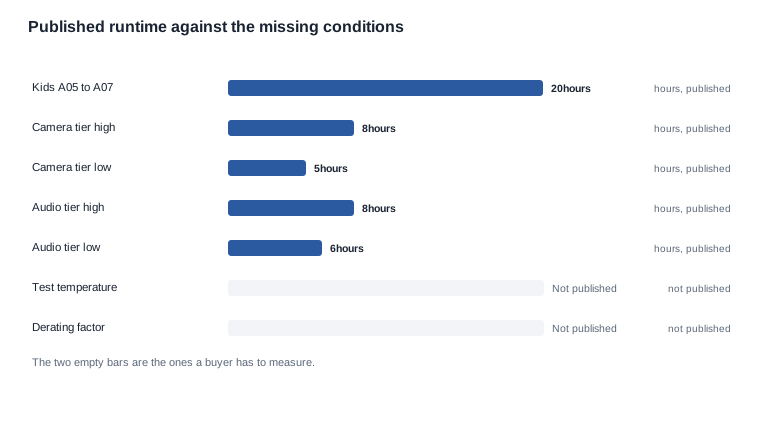
Here is our published position, stated before anything else. The catalogue publishes a runtime figure for every model in the range — about twenty hours on the A05, A06 and A07, about five to eight hours across the camera tier, about six to eight hours across the audio tier. It publishes no test temperature for any of them. It publishes no temperature range, no cold-weather derating factor, no cell chemistry and no cold recharge count anywhere in the catalogue. That is why this article is about how to produce a figure you can defend rather than about a figure we can hand you.
If you want the underlying battery behaviour before the cold-market question, battery life in real-world performance covers what a rated figure becomes under ordinary daily load, and why it matters for battery life covers the commercial reasoning behind treating runtime as a buying question rather than an engineering detail.
Does cold weather affect battery: what the published figures cover
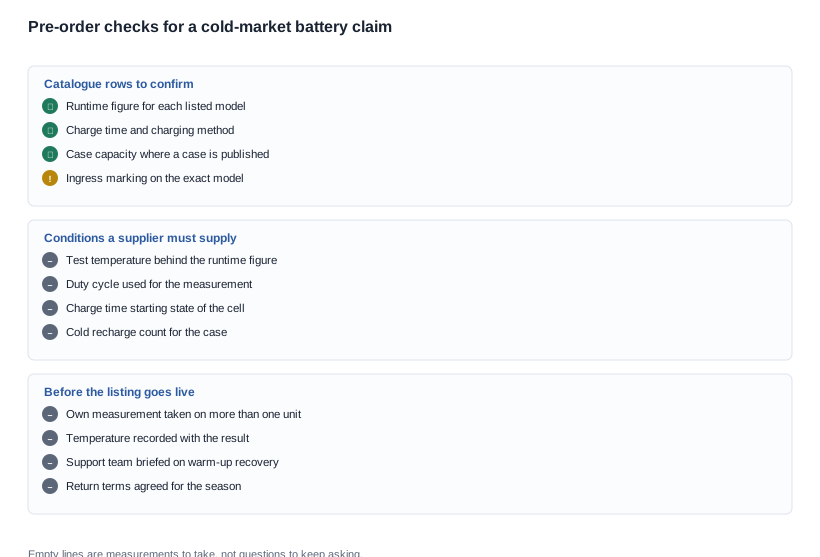
A runtime figure without a condition attached is a reference point, not a guarantee, and the difference between those two things is the whole substance of this question. The table below sets out what the catalogue publishes, and then what is missing from each row.
| Published row | What the catalogue states | What it does not state | The condition to obtain |
|---|---|---|---|
| Runtime | About twenty hours on A05, A06 and A07; about five to eight hours across the eleven camera models; about six to eight hours across the eight audio models | The ambient temperature, the duty cycle, the volume level, the transmit power and the sample size behind any of them | The test temperature and duty cycle, per model, on request |
| Cell capacity | The camera tier publishes cell capacities in the range of 220 to 290 mAh | The chemistry, the cell part number and the supplier for any model | The cell part number, if the supplier will name it |
| Charge time | Twenty-six models publish 2 hours or less; only D17 and ZH12 publish about one hour | The starting state of the cell, the ambient temperature, the charger and the cable | The charge-time starting point, and whether the figure is from a cold cell |
| Charging method | Magnetic on seventeen models, Type-C on seven; not published for CY03 and L1 Pro, and CY05 and MT6 | Whether a cold cell charges on the same interface under the same conditions | The interface and the cold charging behaviour |
| Case capacity | 1400 mAh on CY05 and CY03, and L1 Pro; 900 or 1400 mAh on L2 Utral; a foldable 1200 mAh case on MT6 | The number of cold recharges the case actually delivers, and the case's own charge time | A cold recharge count measured on a sample |
| Ingress marking | Only V06 and S7 publish IP54, and both are camera models | Any protection basis for the sport models YKC02, D17 and ZH12, which carry no IP marking | The report and the configuration it covered, if a sport claim depends on it |
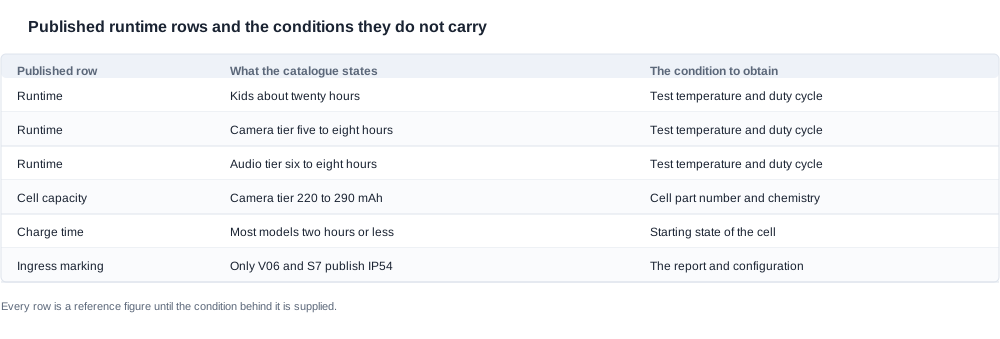
Two things in that table deserve to be read twice. The first is the charge time row. A published ceiling of 2 hours or less is a ceiling, and it says nothing about the condition the cell started in. A unit charged at minus five degrees is not the unit the figure was measured on, and the gap between those two charge times is exactly where a support ticket comes from.
The second is the ingress row, and it corrects a common assumption. The IP54 marking in this catalogue sits on V06 and S7, which are camera models. The sport range — YKC02, D17 and ZH12 — carries no IP marking at all, so there is no published protection basis to lean on for a sport SKU, even though a sport product is the one most likely to be used in cold and wet conditions. If your cold-market claim is also a wet-weather claim, check which of the two you are relying on before you rely on either.
The mechanism behind does cold weather affect battery in a wearable
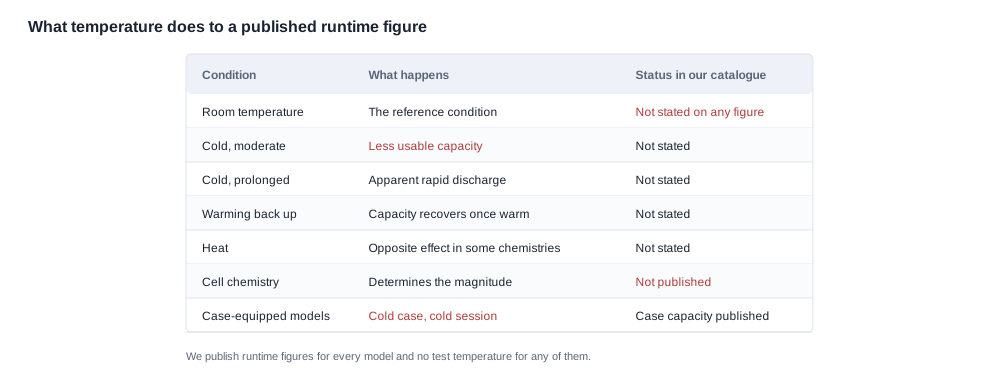
Understanding the mechanism tells you which measurements matter, and it is worth being precise because "cold batteries drain faster" is a loose description of a specific and more useful effect.
A cold cell delivers less accessible charge. The stored energy is largely still there, but the cell cannot deliver it at a useful voltage. From the user's point of view the device reports a lower remaining charge and the session ends earlier. The consequence for a buyer is that the derating is a function of temperature and duration of exposure, not a flat percentage that can be printed on a spec sheet.
Warm-up recovers capacity, and this confuses customers. A unit brought in from the cold and left in a warm room can visibly regain charge, because the charge was there all along and became accessible as the cell warmed. Staff in a shop or a support team that has not been told this will read the behaviour as a fault and will start replacing units that do not need replacing. If you sell into a cold market, this recovery behaviour belongs in your training material before it becomes a returns driver.
A phone is a warmer device than glasses. A phone is carried against the body and pocketed against skin, so it raises its own cell temperature. Wearable glasses are worn on the head with the temples and the electronics exposed to moving air, and in an outdoor or cycling use case they are exposed for the entire session. The cold effect in this product class is therefore larger than a phone's, and larger than a generic battery figure would suggest, without the chemistry being different at all.
Charging from cold is a separate behaviour from discharging in cold. A cell that has been cold will generally accept charge more slowly, and some designs will not begin charging until the cell has warmed. This is a support script as much as a specification: a customer who takes a pair of glasses from a cold car to a warm desk and puts them straight on charge may see a charging indicator behave unusually for a while.
The case is not an escape route. A case capacity of 1400 mAh is a capacity at room temperature, and a cold case recharges less efficiently, so the number of useful recharges in a cold environment is lower than the capacity suggests. A cold cell in a cold case is still cold. This is the point where cold-market claims most often go wrong, because the case appears on the packaging as the answer to the endurance question.
How to measure does cold weather affect battery in your own market
Nobody can hand you a derating factor that is right for your market, your duty cycle and your supply chain. It has to be measured, and the method is not complicated. The work is in the discipline of recording the condition alongside the number.
- Write down the temperature range your market actually sees, and the duty cycle that goes with it. The winter average in a city is not the number that matters; the morning temperature during a commute, and the length of time the device is exposed to it, are. Then write down the room temperature the catalogue figure was presumably measured at, if you can get it, so you have something to compare against.
- Run the real duty cycle, not a drain test. A product that is used for a twenty-minute recording session, a phone call and a navigation prompt is not a product running a continuous playback test. Cold derating differs by duty cycle, and a test that does not match how the product is used will produce a number you cannot publish.
- Use several units per configuration. A single unit tells you about that unit. At least three units per model you intend to list gives you enough spread to state a range, and it gives you the evidence to say "measured on three units" in your listing without inventing a precision the sample cannot support.
- Record the temperature with the result, in the file, on the sheet, next to the elapsed time. A measurement without its condition is a number with no meaning, and it is the reason most cold-weather claims in this category are not defensible.
- Measure the case cold and separately. Count the actual recharges the case delivers from a cold cell in cold conditions. That number will be lower than the capacity implies and it is the number most likely to be published by mistake, because it is the one nobody thinks to check.
- Ask the supplier for the conditions behind their published rows, in writing, and accept that the answer may be that the condition was not recorded. That answer is itself useful: it tells you the figure is a reference point and the marketing copy must treat it as one.

The commercial version of this is straightforward. A runtime figure with a temperature attached is narrower than one without, and in a cold market the narrower one is worth more, because it is the version that survives the first complaint. The measurement itself is cheap — a few units, a thermometer and a week of time — and it is the cheapest insurance available in this category.
There is one more thing to settle before the first production order, and it belongs in the purchase order rather than in a marketing plan: what happens to the returns when a customer in a cold market says the unit did not last as long as the listing claimed. If the listing says "up to eight hours" and the agreement says nothing about conditions, you have a dispute with no anchor. If both say "measured at X degrees, Y hours", you have a specification.

Six ways a does cold weather affect battery claim goes wrong in the field
These are the recurring patterns we see when a cold-market claim goes wrong, written as risks to design out rather than as a list of things that went wrong for somebody else.
The catalogue figure was published with no condition. The listing says "up to eight hours", the customer is standing outside in January, the unit stops, and the returns column takes the hit. The root cause is that a room-temperature reference figure was treated as a guarantee. The prevention is to measure it yourself and publish your own figure with its temperature.
A derating factor was invented. A plausible number such as "twenty percent less in winter" appears in copy because it sounds reasonable and nobody checked it. The moment a customer or a reviewer measures the actual behaviour, the claim is both false and indefensible. We will not publish one, and a buyer who has not measured one should not print one either.
The case was assumed to solve the cold. The packaging shows a 1400 mAh reserve and the marketing implies all-day endurance. In practice the cold case recharges less efficiently and the cold cell in the cold case is still cold. The prevention is to count cold recharges on a sample before the claim is written.
The cell chemistry was never asked for. The magnitude of the cold effect is a property of the cell, and suppliers often treat cell identity as proprietary, which is a reasonable position. It means the buyer has to measure rather than derive. Ask anyway, and measure if the answer is no.
A warm-up artefact was read as a fault. A unit that appears to recharge itself in a warm shop is reported as defective, returned, and replaced, at three to five times the cost of the unit. The prevention is to train the support team on the recovery behaviour and to script the response before the first cold week, not after it.
The charge time was quoted without a starting point. A customer charges from a partial cell, or from a cold cell, and the claim that it takes 2 hours or less does not hold. The prevention is to obtain the starting condition and publish the figure with it.

What a cold-market battery claim is worth commercially
A conditioned runtime claim is a narrower claim. Narrow claims are harder to write in a product title, and in a cold market they are the ones that survive scrutiny. The trade-off is worth taking deliberately, because the alternative — an unqualified figure — produces a liability that shows up in the returns column and, worse, in the reviews.
There is a second commercial consideration that is specific to seasonal channels: the calendar. A winter-market programme has a selling season, and the units that reach the customer have usually been in transit, warehouse storage and a distribution network through the cold part of the year. Cell storage conditions are part of the picture, and asking your supplier how cells are stored between production and dispatch is a reasonable due diligence question, even if the answer is that they are not measured. A unit that has been sitting in a cold warehouse and is charged on arrival is a unit whose first charge cycle you do not control.
On the negotiation side, the lines worth spending time on are the ones that change when you move volume or change the season:
- Unit price and volume tiers, with the tier boundary stated in units and in time, so you know which tier you are in when the order actually ships.
- The accessory and case set with its own minimum order quantities, which is a separate commitment from the glasses and often a bigger one.
- Packaging specification, including whether the packaging is cold-rated for a frozen distribution environment or merely robust.
- Delivery splitting, so that a seasonal order can be delivered in tranches rather than into a single peak week.
- Payment nodes tied to inspection, which matters more in a seasonal programme where the selling window can close before a long payment cycle ends.
- The warranty period with a stated response, and specifically what the warranty does for a unit that has been exposed to conditions outside the published conditions.
- Return terms for a seasonal channel, including how the returns window interacts with the end of the selling season.
- The terms of a pilot order, which in a cold market is the cheapest way to buy the measurement described above.
A shortlist built on published runtime figures alone will produce the wrong shortlist, because every supplier will quote a number from the same family of reference figures and the differences between them are smaller than the differences your own market will introduce. The criteria that separate suppliers are not the runtime number; they are whether the supplier will tell you the condition behind its figure, whether it will run the measurement you need, and whether it will put a measured figure with a condition into a specification rather than a marketing sentence. That is a due diligence question, and it is the one worth carrying into the negotiation. The same logic applies to the model shortlist itself: two models with identical published runtimes can behave very differently in a cold market if one is carried against the body and the other is worn in moving air, so the choice should be made on how the product is used rather than on the headline hours.
Some cost lines are not really negotiable and are worth identifying early so they do not absorb negotiation energy. Certification cost and lead time follow the testing body and the process. Tooling is often amortised across the first order while certification cost is charged per product family, and these two are frequently bundled into a single line that hides which one you are being quoted — ask which one is which, because the distinction decides whether the cost scales with your first order or with your catalogue.
What belongs in the agreement: the published rows for the exact configuration ordered; the runtime with its test temperature and duty cycle; the cold case recharge count; the charge-time starting point; the cell part number and chemistry if the supplier will provide it; the warranty period with a stated response; and the return terms.
What belongs nowhere near it: any derating factor you have not measured, any runtime claim without a temperature, and any recharge count measured at room temperature and presented as a winter figure.
What we publish about does cold weather affect battery, and what we do not
We publish the runtime figures, the cell capacities where they are published, the charge-time ceilings, the case capacities, the charging methods, and the one ingress marking in the range. We publish them as reference figures, because that is what they are.
We do not publish a cold-weather derating factor, a test temperature, a temperature range, a cell chemistry or a cold recharge count, for any model. There is no measured basis in the catalogue for those numbers, and an invented factor would be a fabricated specification rather than a marketing convenience.
What we will do is straightforward: confirm the published rows for a named model, state plainly which of them carry a condition and which do not, and give you the published charge time, charging method and case configuration for the model you are looking at. Where we hold test data for a configuration we will pass it on; where we do not, we will say so rather than fill the gap.
If you want this settled for a specific programme, send us the models, the configurations, the ambient temperature range your market sees, the duty cycle and the channel. We will tell you which published rows exist, which conditions are missing from them, and what you would need to measure to produce a claim you can put on a listing and defend in a return.
Related reading
- Battery life real-world performance — what the rated figure becomes under ordinary daily load.
- Why it matters for battery life — why temperature is a buying question and not only an engineering one.
Tell me the ambient temperature range your market sees and I will say what we can and cannot answer.


