

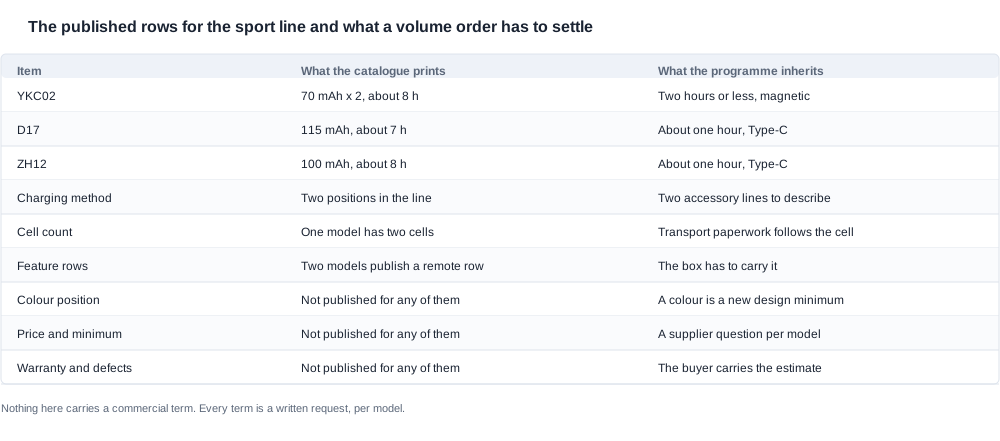
A bulk order in this category is a commitment to a set of decisions that have to be made before the first unit exists, and the interesting part of the commitment is that most of it is invisible on a quotation. The three sport models publish a complete electrical profile and almost nothing else: no price, no minimum order quantity, no lead time, no packaging specification, no colour list, no warranty term, no defect rate and no per-model conformity record. A buyer who has read the published rows therefore knows what each model is and knows almost nothing about what ordering it will cost, and the gap is where the bulk-order risk sits. This page is about the decisions a volume order commits a buyer to, and about the order in which they have to be made.
Sport smart glasses bulk ordering: what a volume programme actually commits you to

A programme also has to make its choice on what each model does to the operation rather than on the figures alone. One of them charges magnetically and reaches a full charge in no more than two hours, so the accessory a customer can lose is specific to it, the field stock has to be specific to it, and the customer-support script has to describe a magnetic interface rather than a port. The other two reach a full charge in about an hour over a Type-C port, which is the friendlier position for a customer who has lost a cable and the more awkward position for a programme stocking a proprietary interface. One of the three carries two cells and the other two carry one, and that difference decides how many transport documents the programme is handling rather than how long the units last. Two of the three publish a feature row describing a photography remote — in one case printed in English and in the other printed in Chinese — and the third publishes no such row, so a programme cannot assume that every unit in it will respond the same way when a participant presses something on it. The published endurances sit close together, at approximately eight hours, approximately seven and approximately eight, and because none of them is published with the workload behind it, the gap between them is a question rather than a ranking.
The differences that matter to a volume programme are not the cell values. They are the three structural ones. The charging architecture splits the line, with two models reaching a full charge in about an hour and the third capped at two hours or less, and that split propagates into the accessory line a channel has to stock, into the charging point it has to provide, and into the support scripts it has to write. The cell count splits it again, with one model carrying two cells and the other two carrying one, and that split propagates into the transport paperwork for every consignment. The feature rows split it a third time, and they do so in a way a buyer should notice carefully: two of the three models publish a remote-photography row, and the third does not, so a programme cannot assume that every unit in it will behave the same way when a participant presses something on it.
A bulk order also commits a buyer to the artwork, to the packaging and to the accessory set, and in this line none of the three models publishes a colourway. That is a quieter fact than it sounds, and it is worth ten minutes of thought before a programme is designed and a minimum is quoted for it. A model with no published colour position is a model whose colour, if there is one, is a question for the supplier, and a colour question in a volume programme is a minimum-order question, because a second colour is a second artwork and in most programmes a second minimum.
The fourth commitment is the one a buyer is most likely to make without noticing, and it is the aftersales provision. Nothing in our published material covers what happens when a unit fails, so the cost of a faulty unit at volume is entirely the buyer's own estimate. At a sample size of one, a bad estimate is a single unit. At a volume order, the same bad estimate applied to a thousand units is a number that appears in the business case, and it appears there as a number nobody sourced. That is a planning risk rather than a specification gap, and it is one of the reasons a volume order needs a different kind of supplier conversation from a trial order.

The three sport models and what each one adds to a bulk programme
Working model by model is the only way to see what a programme is actually carrying, because the three models do not fail in the same places. A programme built around the YKC02 carries a magnetic charging interface into the field, which means the accessory that a customer can lose is specific to that model and has to be described in the box. It carries two cells per unit, which is a transport question rather than a packing one. It carries the two feature rows that describe a surround-sound configuration and a long endurance note, and the second of those is a qualitative statement that a listing should not turn into a second measurement.
A programme built around the D17 or the ZH12 carries a Type-C interface, which is the friendlier accessory position in the field, and a charge time of about an hour, which is the more forgiving recharge position. It carries a single cell, and therefore the simplest transport position. It carries a remote-photography row, which means the box has to contain something, that something has to be described, and the programme has to decide whether the remote is in the box for every unit or only some.
The one difference between the D17 and the ZH12 in the published rows is the language of the feature rows, and it is a difference with a practical consequence rather than a cosmetic one. One of them publishes those rows in English and the other in Chinese. A buyer building a single programme around both has to establish what the Chinese-language rows denote, and a buyer whose channel runs in one language has to know that a row printed in another language is still a published row and not a loose description. Our catalogue prints them as they are, and a buyer who translates them for a listing is making a translation decision that has to be reviewed rather than a translation that can be assumed.
The two are also separated by the published endurance figure, with one at approximately seven hours and the other at approximately eight, and by cell value, with one at 115 mAh and the other at 100 mAh. Neither difference is large enough to decide a programme on its own, and neither is large enough to be comfortable either, because a rated endurance without a workload condition is a number whose comparability is unknown. A buyer comparing them should be asking the supplier for the workload behind both, not choosing on the larger number.

The order-level questions, and the ones a catalogue cannot answer
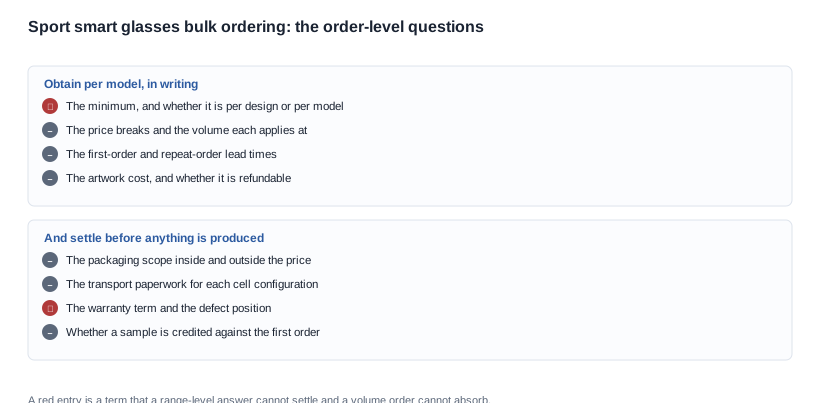
The request list below is the part of a bulk enquiry that the catalogue cannot contribute to at all. Every item is a commercial term, and every item has to be obtained in writing, per model, because a range-level answer is not an answer for a volume order.
- The minimum order quantity for the quoted configuration, and whether it is per artwork, per colour or per model.
- The price breaks above that minimum, and the volume at which each break applies.
- The lead time for the first production order, and the lead time for a repeat order of the same configuration.
- Whether the first order and a repeat order are priced differently, and why.
- The artwork or plate cost per design, whether it is one-off, and whether it is refundable.
- The sample cost, the sample lead time, and whether it is credited against the first order.
- The warranty term, what it covers, and how a unit is returned for service.
- The defect allowance a buyer should carry, and whether the supplier will support a claim against a specific lot.
- The packaging scope inside the quoted price, and the packaging scope excluded from it.
- The transport documentation for the cell configuration in each model in the programme.
The tenth question is the one that catches a programme that spans more than one model, because the transport documentation follows the cell configuration and the three models do not share one. The first and the fifth are the ones that decide whether a range of two or three models is even practical: a programme with three models, two colourways and two artwork versions each is six design minimums, and a buyer who has not established what a design minimum is in this line has no idea whether that programme is viable. The eighth is the question that protects the business case, because an allowance set by a buyer and not by a supplier is an assumption, and at volume an assumption is a liability that has been given a number.
A buyer who wants to compare two suppliers on a volume programme should put the same ten questions to both, in the same order, and score the answers against the same four criteria: that the answer names the model and the configuration, that it is dated, that it is consistent with the rest of the reply, and that the supplier would put the same figure in an agreement. How to choose between two suppliers on a programme of this kind is therefore a process rather than a preference, and the process is what makes the comparison defensible when the volume is decided. The fifth question a buyer should add is the one that separates a programme from a one-off order, which is whether the supplier will hold a price for a period, and what triggers a review. Nothing in our published material speaks to that, and a volume order that has no review mechanism built into it is a volume order that can be repriced between the order and the delivery without either side noticing.
The criteria for judging the answers are straightforward and are the same ones a buyer applies to any supplier: does the answer name the model and the configuration, is it dated, is it consistent with the other answers in the same reply, and would the supplier be willing to put the same figure in the agreement. An answer that is precise about the minimum and vague about the warranty is telling the buyer which side of the negotiation the supplier regards as fixed, and that is useful information even when the answer is not.

Packaging, artwork and the accessory line across a sport programme
The physical side of a bulk order is where a sport programme quietly multiplies. Every model in the programme needs a box, every design needs artwork, and every model needs an accessory set described, and in this line the accessory question is not uniform because the charging methods are not. A programme carrying one magnetic-charged model and two Type-C-charged models has two accessory positions to describe, and a customer support script that covers both has to cover a magnetic interface and a standard port in the same breath.
The remote-photography row on two of the three models adds a third element, because a remote is a component in the box, a component that can be lost, and a component that is small. Whether it ships with every unit, and how its absence is described on the carton, is a decision the buyer has to make and the supplier has to implement, and neither of them can make it from the published rows. A buyer who has not settled it will find out from the first returns.
The artwork question is the one with the largest commercial swing and it is the one most often deferred to the point where it is expensive. Because no sport model in our catalogue publishes a colourway, a programme that wants a colour position is asking the supplier to define one, and a new colour is a new design minimum and usually a new artwork charge. The sequence that avoids the expensive version is to fix the model, the colour count and the artwork language set before the first artwork is drawn, and to ask what the design minimum is before anything is produced. A buyer who fixes all three at once and then asks for a price is in a completely different conversation from one who asks for a price and then adds a colour.
The packing and consolidation question sits alongside all of this. A programme with several models in one consignment is a packing question rather than a commercial one, and the answer depends on the carton dimensions for each model, which are not published, and on the case position, which differs by model across this line. A buyer who has not established the case position for a model cannot finalise the carton, and a carton that changes after the artwork is tooled is one of the most expensive mistakes available in this category.
There is one further dimension of a volume programme that deserves its own paragraph, because it is the dimension buyers most often forget to ask about: the aftersales consequence of the programme itself. A channel that has sold one model in a sport line carries one set of answers, one set of spare parts and one set of scripts. A channel that has sold three carries three, and the difference shows up as a support cost per unit rather than as a cost per order. The question to put to a supplier is not about defect rates — our catalogue publishes none for any model in this line, and a supplier who quotes one for a product they have not measured is quoting something else. The question is about continuity: whether the same build, the same accessory and the same documentation will be available on a repeat order twelve months later, because a programme that cannot be reordered is a one-off order with a large first shipment.
That continuity question also decides the shape of the volume break. A price break that a buyer reaches in the first quarter and never again is a discount, and a break that a buyer expects to return to every year is a programme, and the two behave very differently. The first can be planned around a single order; the second needs a written position on what happens to the price and the configuration at the point the break is reached, which is a question about the supplier's planning horizon rather than about the product. Nothing in our published material speaks to any of it, and a buyer who has not asked will be negotiating it at the moment the second order is due, which is the worst possible moment to negotiate anything.
What a bulk order changes about your risk, and what it does not
It is worth being clear about the things a volume order does not change, because a buyer who believes it does will budget for the wrong risks. A volume order does not improve the published rows. The rated endurances, the charge ceilings, the charging methods, the cell arrangements, the radio versions and the feature rows are exactly what they were at a sample size of one, and a unit at volume is built to the same published configuration or it is not. A volume order does not improve the missing information either: the price, the minimum, the lead time, the packaging, the warranty, the defect rate and the conformity record are all still unpublished, and the only thing a bigger order changes is the consequence of getting them wrong.
What a volume order does change is the cost of a mistake and the cost of a delay, and that is worth putting a number on even though we cannot. A packaging error found on a sample costs a sample. The same error found on a consignment costs the artwork, the tooling, the freight and the shelf time. A missing accessory in the box, which is invisible on a working sample because the customer can still use the product, becomes a returns problem at volume. And a certification file that does not cover the configuration being shipped blocks a whole consignment rather than one unit.
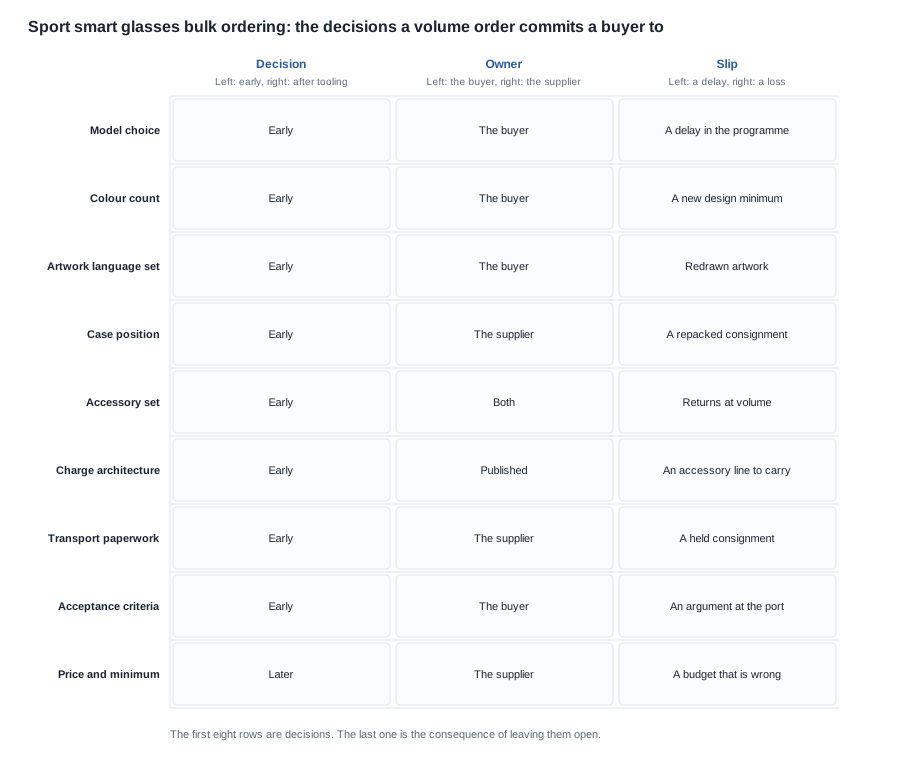
That is the honest shape of the risk in a sport bulk order, and it points at the sequence rather than at a number. The decisions that are cheap to make early and expensive to make late are the model, the colour count, the artwork language set, the case position for each model, the accessory set, the charge architecture of the programme, the transport documentation per cell configuration, and the acceptance criteria for the incoming shipment. The commercial terms then follow from those decisions rather than the other way round.
The range-level selection work that has to happen before the enquiry is set out in the page that works through which of the three sport models fits which use. What we can add from our side is the published half of the answer and nothing more: the rows for each model, the structural differences between them, and an honest account of which questions a catalogue can close and which have to be closed by the supplier in writing. Send us the models you are considering, the volume bands you are working to, the markets, and the packaging you have in mind, and we will tell you which published rows settle which of your decisions, which decisions the three models make for you, and which are yours to make and then to write into the order.


