

A buying guide for this line has to start somewhere, and the honest place to start is the question every buyer opens with: what happens to this product when it gets wet? The answer our catalogue gives is a fact about the catalogue rather than about the sport products, and the distinction has to be made before anything else. Two models in our range carry a published IP54 marking — the V06 and the S7, both camera products. No model published as a sport product carries an ingress marking at all. That is not a gap in the sport line; it is a different published position, and a buyer who starts from the ingress question has to start by establishing what the supplier states about the environment in writing, because our published material states nothing for these three products.
That is what this guide does: it takes the questions a buyer brings, in the order they actually arrive, and says for each one whether our published rows can answer it, whether the answer belongs to the supplier, and what to ask for if it does. The output is a decision sequence and a request list, not a recommendation, because the commercial terms for this line are not published and a recommendation would have to invent them.
Sport smart glasses buying guide: the decision sequence from requirement to evidence

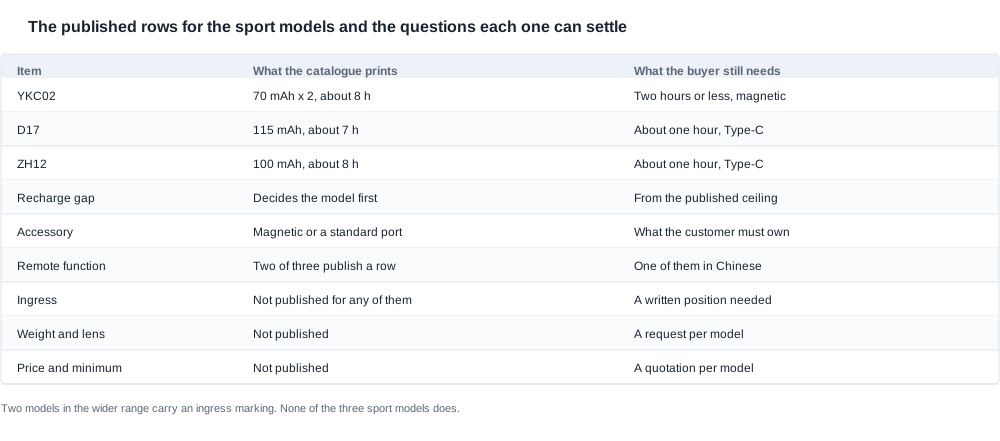
The first question in a buying guide is usually "which model should I buy", and the useful answer is that the model cannot be chosen until the requirement is written down, because the three sport products differ in ways that only matter relative to a use. The three published positions are these. The YKC02 is published with a pair of 70 mAh cells, an endurance rating of around eight hours, charging capped at two hours, a magnetic interface and version 5.4, and two feature notes describing a surround-sound configuration and a long endurance. The D17 shows a single 115 mAh cell, a charge ceiling of roughly an hour, an endurance rating of about seven hours, a Type-C port and version 5.4, plus feature notes for a photography remote and a spatial audio configuration. The third shows one 100 mAh cell, a charge ceiling of about an hour, a Type-C port and version 5.4, with its feature notes printed in Chinese for a photography remote and for a stereo surround-sound configuration; the endurance rating is approximately eight hours.
A fifth requirement belongs in the same list, and it is the one most buyers forget: how the product is to be returned when it fails. Nothing in our published material says what happens when one of these units fails, so a buyer who has not established the return route has not qualified the product, however well the rest of the file is filled in. A product that a participant can only return by posting it to an address in another country is a different product from one that can be returned through the channel, and the published rows cannot tell the two apart.
Four requirements decide between them, and the order matters because each one eliminates models before the next is asked.
The first requirement is the recharge. Two of the three reach a full charge in about an hour and one is capped at two hours or less, and the question is whether the recharge fits into the gap between two blocks of activity. A buyer whose deployment has a long gap between sessions can use any of the three. A buyer whose deployment has a short break between sessions is looking at the two that charge faster, and the one that does not is eliminated by the schedule rather than by the specification.
The second requirement is the accessory the customer has to own. A magnetic charging interface is a specific part that a customer can lose and that a channel has to stock; a Type-C port is a cable the customer can buy anywhere. That difference is invisible in a price comparison and visible in a support line.
The third requirement is what the product is expected to do in a session. Two of the three publish a photography remote and one does not, and a deployment that involves a participant taking a picture needs to know which position it is in. The remote is also a component in the box, and therefore a small part, a packing item and a potential return reason — none of which is published.
The fourth requirement is the environment, and here the published position is silence rather than an answer. There is no ingress marking for any of the three, so a buyer whose deployment involves water has to obtain the supplier's written position, and a buyer who cannot obtain one has to plan the deployment around the absence of the claim rather than around a claim.
The sequence that follows from those four requirements is short: write the requirement, eliminate on the recharge, eliminate on the accessory, eliminate on the function, then establish the environment position in writing, and only then ask the commercial questions. A buyer who asks for a price first will get a price for a product they have not specified, and will find the specification work again at the point the product arrives.

What our published rows settle, and what they leave open
There is a second way to describe the same material, and it is the way a channel that is about to publish a listing should look at it. Of everything in the catalogue for these three products, some of it belongs in public copy and some of it belongs in the buyer's own file, and the test is simple: a line belongs in public copy if the catalogue prints it and a supplier document confirms it, and it belongs in the buyer's file if it is a condition, a workload, a figure or a commercial term. A cell capacity, a charge ceiling, a charging method and a radio version are on the first side, provided the supplier confirms them for the configuration being shipped. An endurance figure belongs on the second side until the workload behind it is documented, because a rating without its condition is a number a customer cannot check. Everything commercial sits on the second side by definition, since none of it is published at all.
This distinction is worth making early because it changes what a buyer asks a supplier for. A request for "information about your product" produces a brochure. A request that names the published rows, confirms them for the configuration, and asks for the conditions behind each figure produces a document. The second request is also the only one that can be filed and reused, which matters more than it sounds, because the buyer who qualifies three models for a range will qualify a fourth at some point and would rather not restart the conversation.
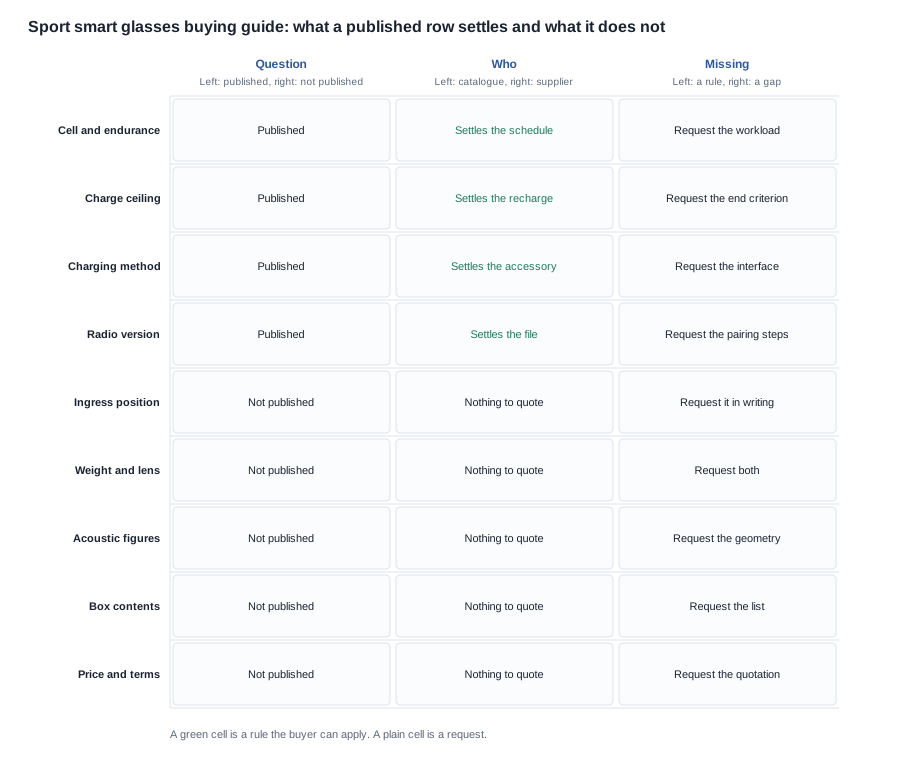
It is worth separating the two explicitly, because the published rows settle more than buyers expect and leave open more than the marketing of the category suggests. On the settled side, a buyer can state the electrical profile of all three models without asking anyone: the cell arrangement, the endurance rating, the charge limit, the charging method and the radio version, together with the feature notes as rows. A buyer can therefore rule a model out on a charging or a connectivity basis, and can describe the product accurately in a technical file.
On the open side, the list is long and it is uniform across the three models. No frame weight is published for any of them. No lens material, thickness, tint or coating is published. No ingress marking is published. No control method and no pairing procedure is published. No acoustic figure of any kind is published — no driver size, no response curve, no output level, and no figure for how much of the programme is audible to a listener beside the wearer rather than to the wearer. No colourway is published. No charging-case capacity is published, and no charging-case row is published for any of the three. And no commercial term is published: not the price, not the minimum order quantity, not the lead time, not the sample terms, not the warranty term, and not a per-model conformity record.
That last group is where a buying guide has to be honest about its own limits. A guide that presented a shortlist with the published rows and a comparison of the models would look complete and would be misleading, because the rows describe the products and not what they cost, when they arrive, or what happens when one fails. The output of this guide is therefore a request list and a sequence, and the shortlist that comes out of it is a list of candidates for a supplier conversation rather than a purchase decision.
The feature rows deserve one more note, because they are the most over-read part of the published material. The two rows printed in Chinese are rows in the same sense as the rows printed in English: they record what is fitted and what the catalogue lists. They are not an outcome statement, they are not a performance figure, and they do not tell a buyer what a participant will experience. A buyer who reads the stereo surround-sound row as a description of a spatial effect, or the photography remote row as a description of a camera, has read more into the row than it carries. The rows can be reproduced in a listing; what they imply has to come from the supplier.

The checklist, and how to use it in a supplier conversation
A buyer should also decide, before the first conversation, what the conversation is for. There are two possible outcomes and they are not compatible. The first is a product qualification, in which the objective is to establish whether a model can be used in a given deployment, and the commercial terms are a secondary output. The second is a commercial qualification, in which the objective is to establish whether a supplier will do business on terms a channel can live with, and the product questions are a filter. Both are legitimate, and mixing them produces the worst outcome, which is a long conversation in which neither the product nor the terms are settled.
The practical recommendation is to separate them into two exchanges with a decision in between. The first exchange settles the product: the four requirement eliminations, the environment position, the acoustic position, the weight and the lens. If a model survives that exchange, the second exchange is about terms, and it can be shorter because the product question has already been answered. A buyer who has tried to do both in one meeting has usually got a product briefing and no terms, and has to book the second meeting anyway.
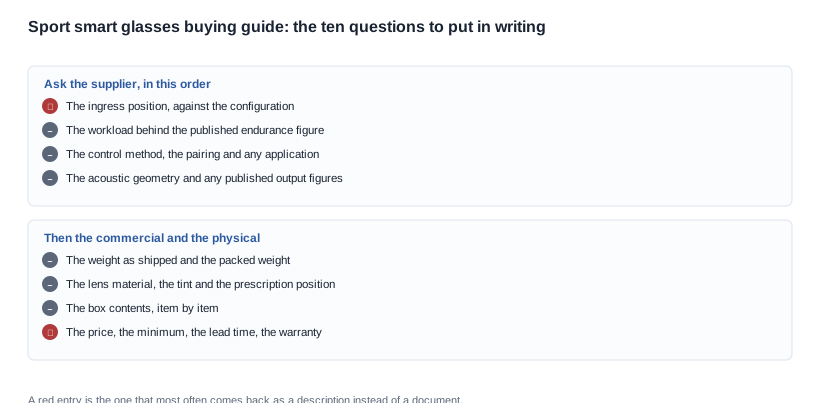
The list below is the deliverable of this guide. It is written in the order a buyer should ask, and each line is a request that a supplier can answer from documentation they already hold.
- What is the ingress position for the model in writing, and against which configuration.
- The workload behind the published endurance figure, with the start state and the end criterion.
- The control method, the pairing procedure, and whether an application is required.
- The acoustic position, including the driver position relative to the ear and any published output figures.
- The frame weight as shipped, and the packed weight.
- The lens material, the tint, the coating, and whether a prescription insert is supported.
- The box contents, item by item, and whether the photography remote is included.
- The charging interface in detail, and what a customer must own to charge the product.
- The price, the minimum order quantity, the lead time and the sample terms.
- The warranty term, the defect replacement route, and the conformity record for the configuration that will ship.
The order of the ten matters as much as their content, because the first four are questions a buyer can answer from the catalogue and the fifth is the first one that cannot be. A supplier who answers the first four accurately and the fifth vaguely has still given a usable answer set, because the buyer can see which part is thin. A supplier who answers the fifth precisely and the first four in general terms has not, and the buyer has to go back to the start. The same logic applies to the commercial block: a quotation that names a minimum, a lead time and a price, and is silent on the warranty, has told the buyer something specific about what the supplier treats as settled.
The first five are the questions that decide whether a model is usable in a given deployment, and the last five are the questions that decide whether it can be bought. A buyer who asks all ten in one message gets a reply that can be compared across suppliers, because the questions are fixed. A buyer who asks them in a conversation gets ten answers of varying specificity, and cannot compare them.
There are two questions on that list that are worth a second paragraph, because they are the ones that most often come back with a description rather than a document. The first is the acoustic position, and the trap is that a supplier will happily describe how the product sounds; what a buyer needs is the geometry and the figures, because a description cannot be compared and a figure can. The second is the ingress position, where a supplier may reasonably describe the product as being built for outdoor use — which is a statement about intent, and a buyer needs a statement about the configuration the claim covers. The technique that works on both is to ask for the position to be stated against the configuration, in writing, and to accept a written statement of absence as an answer, because a documented absence is something a buyer can plan around and an undocumented one is not.
Where buyers go wrong with this line
There is one more trap in this line that is specific to it, and it is the temptation to read the sport designation as a statement about environment. A product published as a sport glasses product is, on the face of it, a product for a particular set of conditions, and a buyer who has read nothing else may reasonably infer that the manufacturer has established something about those conditions. Our catalogue does not support that inference for these three products, because no published ingress position exists for any of them, and because the rest of the published material — the cell, the endurance, the charging method — says nothing about the environment at all. The designation tells a buyer where the product is meant to be used; it does not tell a buyer what happens to it there.
The consequence for a listing is specific. A listing that says "designed for sport" is describing the product's purpose, which the catalogue supports. A listing that says "built to withstand the elements", or that names a protection standard, is making a claim our material does not carry for this line, and the claim has to be sourced from the supplier before it is printed. Buyers who keep those two sentences apart have no problem with this line; buyers who let the first slide into the second have a problem that surfaces as a customer complaint rather than as a catalogue error.
Three errors account for most of the trouble in this category, and none of them is about specifications.
The first is claiming an ingress protection that our catalogue does not publish for these products. It is the most tempting claim in the line because the product type invites it, and it is the one that attracts the most attention when it turns out to be unsupported. A channel that has a written supplier position can say something accurate; a channel that has inferred one has a problem that will surface as a complaint.
The second is quoting a rated endurance as though it were a measured figure under the customer's own conditions. The published endurances are approximately eight, approximately seven and approximately eight hours, and none of them is published with a workload. The figures are usable as schedule inputs; they are not usable as activity claims.
The third is building a shortlist on the acoustic row, which is the row with the least content behind it in this line. Two of the three models publish something that reads as a sound description and one publishes a Chinese-language equivalent, and none of the three publishes a figure. A buyer who differentiates on sound without a figure is differentiating on a word.
The way to avoid all three is procedural rather than analytical, and it is what the checklist is for. A buyer who has the answers to the first five questions in writing can publish the product accurately, and a buyer who has them only verbally cannot.
The fit and sizing side of the same decision, which our published material does not address either, is set out in the material on fit and sizing for this product type. Our own position on the rest is narrow and we will keep it narrow: we publish the rows for the three sport models, we will show a buyer which published row settles which part of the decision, and we will say plainly that the environmental position, the commercial terms and the conformity file for a given configuration all have to come from the supplier in writing.
Bring us the deployment, the session structure, the environment, the markets and the volume you are working to, and we will walk through the three published models against the ten questions above, mark which ones the published rows can settle, and tell you which of the remaining questions are the ones that decide the programme. We will also tell you where our own catalogue is silent, because in this line it is silent in several places and a buyer who plans around that silence is better placed than one who discovers it at the point of order.


