

A size chart is the cheapest document in this entire category and the one most often missing. It is cheap because it costs a manufacturer nothing to publish: six numbers, a diagram, done. Its absence is expensive for a buyer because sizing determines the return rate, the channel complaint volume, the size of the sample a buyer has to order before ordering anything, and whether the product can be sold to a customer who is not standing in front of you.
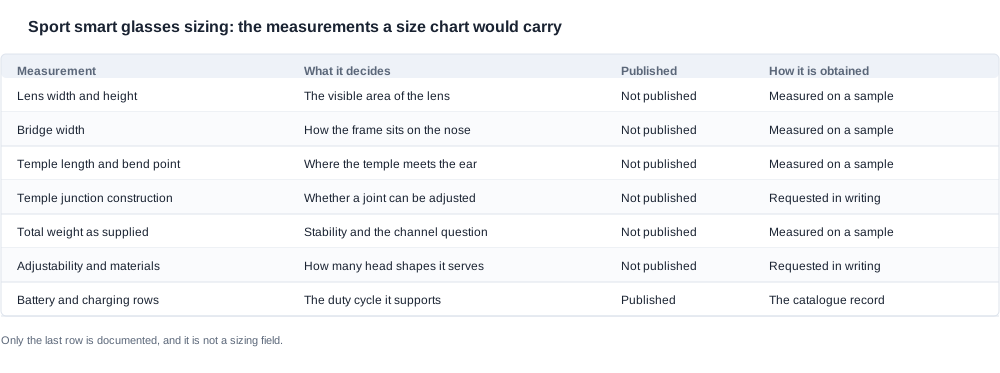
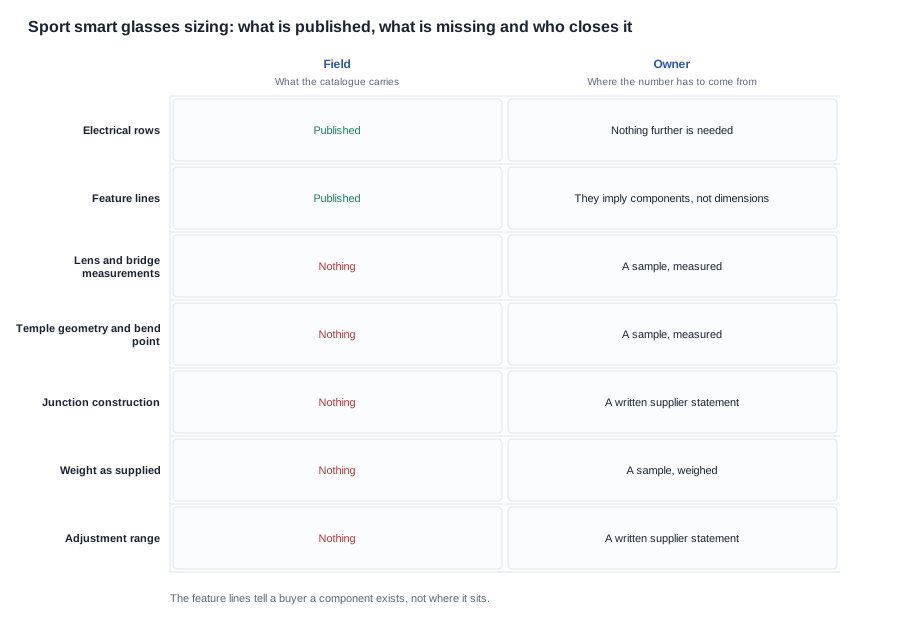
For this range the situation is straightforward. There are three products in the sport segment, and for all three the catalogue publishes the electrical rows and a small set of feature lines. It publishes no temple length, no lens width, no bridge measurement, no frame material, no weight, no adjustability and no size chart of any kind. The geometry of the product is therefore entirely undocumented, and a buyer who has to size a product for a channel cannot do it from the published record.
That is not a reason to skip the sizing work. It is a reason to do the sizing work properly, from samples, and to write the result down as a specification the supplier can be held to. This article sets out what a size chart normally contains and why each field matters for this segment, what the published feature lines quietly imply about where components sit on the frame, how to run a sizing sample when nothing is documented, how to turn that sample into a written specification, and what a sizing failure costs.
The companion note on weight covers the one measurement that changes more of a buying decision than any other and that is also absent from the published record.
Sport smart glasses fit and sizing: what the catalogue does and does not give you
The temptation, when a size chart is missing, is to assume that the absence of a chart means the product is a standard size. That assumption is the expensive one, because it replaces a measured question with an unmeasured one and the bill arrives at the retail counter.
What the published record actually gives a buyer for this segment is short. There are three sport products, and for each of them the published fields cover the cell, the endurance, the ceiling, the charging method and, where it is published, the radio. On top of that each of the three carries a small feature line: one describes a surround-sound arrangement together with a long battery life, one describes a remote shutter for photographs together with a surround-sound arrangement, and one describes a remote shutter together with a stereo surround arrangement. Those lines describe what the product does. They do not describe what the product measures, and they are the whole of the structural information available.
That last point is worth developing, because it is the part that a buyer reading the catalogue will miss. A feature line that names a remote shutter implies a physical control somewhere on the product: a button, a touch surface or a rocker, on a temple or a frame. A feature line that names a surround-sound or stereo arrangement implies more than one transducer, each of which needs somewhere to sit, and implies the width of the temple or the depth of the frame has been designed around them. A feature line that names a long battery life implies the cell arrangement has been considered against the rest of the design.
Every one of those components has to occupy space, and every one of them changes the geometry that a size chart would otherwise describe. A frame with a shutter control is not the same frame as one without, in the region where the control sits, and a frame with stereo transducers has a different temple profile from one with a single transducer. So the absence of a size chart is not merely an administrative gap in this segment. It conceals the fact that the three products in it are not geometrically interchangeable, which is precisely the thing a size chart exists to communicate.
The practical consequence is that a buyer cannot treat the three products as variants of one shell, and cannot put a single size on a single listing. Whatever the eventual answer turns out to be, it has to be a per-model answer, and it has to come from measurement.

The six measurements that replace a size chart
A conventional size chart carries a handful of fields, and they are worth listing in the order a buyer should collect them, because each one answers a different commercial question and the shortlist of questions a supplier has to answer is built from them.
Lens width and lens height. The visible area of the lens, and the first thing a customer perceives as the size of the product. It also determines how much of the user's field of view the frame occupies, which is a purchase criterion in this segment more than in others, because the product is worn during movement rather than inspected at close range.
Bridge width. The distance between the lenses, and the field that most often separates a product that seats correctly from one that does not. The bridge is where the frame's geometry meets the shape of the nose it has to sit on, and it is the reason two products of identical declared lens width can feel completely different to two people. It is also the measurement a buyer is least likely to think to ask for.
Temple length, and specifically the bend point. The total length of the temple is less informative than where it bends, because the bend point is what has to sit over the ear. A temple that is nominally long but bends early will slide; one that bends late will press. A buyer who asks only for the total length will get a number that does not predict the outcome.
The junction position. Where the temple meets the lens, and how that point is constructed — whether it is a fixed connection, a screw, or a moulded joint. This is the field that determines the service story: a screwed joint can be adjusted in the channel, a moulded one cannot. It is also the point of highest stress in a frame used in movement.
Total weight. Not published for any of these products, and the single measurement that a buyer in this segment will be asked for by a customer before they will buy. Weight also interacts with stability, because a heavier frame resists movement differently, and because a heavier product on a longer day is a different product in the customer's assessment. Weight is dealt with separately in the companion note on that measurement, and it is worth saying here only that the two questions are linked: a sizing specification that omits weight is not a complete specification, and a weight figure without geometry is not usable either.
Adjustability and the materials of the temple and the lens. Whether the temple can be shortened or its angle changed, what it is made of, and what the lens is made of. Adjustability is what allows one frame to serve a range of head shapes; a fixed frame serves one. In a segment where the customer is moving, a fixed frame that does not seat is a product that comes off the head mid-session.
Six fields, and none of them is published. Which means the sizing specification for this segment has to be built from a sample, and the first job is to work out what to measure on that sample so that the measurement is a specification rather than an anecdote.

Running a sizing sample when there is no published geometry
A sizing sample is not a product trial, and the distinction matters commercially. A trial answers "do I like this"; a sizing sample answers "what is the geometry, and what range of head shapes does it serve". The second question needs a protocol, and the protocol has to be written before the samples arrive, because a buyer who measures whatever seems interesting on the day will end up with a description of one person.
The protocol below is the working version for this segment, and the criteria it has to satisfy are simple: a method that two different people would apply the same way, and a record that survives being read by somebody who was not in the room.
- Decide the population the specification has to cover, and write it down as head-shape and head-size ranges rather than as a single average. A channel that sells to a broad consumer base and a channel that sells to a professional user base need different specifications, and the difference is usually in the adjustment range rather than in the nominal size.
- Take a sample of each of the three products, and take them from a production window rather than from a showroom, because a showroom unit and a production unit are not always the same thing.
- Measure the six fields on each unit, with a defined method for each: the lens width measured at the widest point of the lens, the bridge at its narrowest, the temple length to the bend point and then to the tip, the weight with the cell and everything fitted as it would be supplied.
- Record the variation between units of the same product, not just the average. A product whose three samples vary by half a millimetre in a critical field is a different product from one whose samples are identical, and only the first set of numbers tells you that.
- Have the sample worn by a small panel drawn from the population in step one, and record what happens in movement rather than standing still. A frame that seats correctly on a stationary head can still shift during the activity, and the shift is a sizing finding, not a preference.
- Record the failures explicitly, including the ones that appear minor. A temple that slides a small amount on a long head and a lot on a large head are two data points, and averaging them into "slides" is how a sizing specification becomes useless.
- Write the result as a specification with tolerances, with the tolerance set by the observed spread plus whatever manufacturing allowance the supplier will commit to, and with the tolerance expressed as a band rather than a number so that a good unit and a rejected unit are both unambiguous.
Step five is the one that most often gets skipped, and it is the one that turns a measurement task into a product decision. A sizing sample taken on a desk measures the product; a sizing sample taken while the user is moving measures the product as it will be used, and in this segment the difference between the two is where the returns come from.
The second thing the protocol has to settle is the sample quantity, and the total cost of getting that number wrong is a number of sampling rounds that nobody has budgeted for. It is not published, and it depends on the population, on the spread observed and on the tolerance a buyer is willing to accept. The honest answer is that the first sample cannot answer it either: a first sample establishes the measurement method and the first indication of spread, and the sample quantity is set once the second and third production windows have been measured against it. Budgeting for a repeat measurement is part of the cost of buying an undocumented product, and it belongs in the plan rather than in the contingency.

Turning a sizing sample into a written sizing specification
The output of the protocol should be a document, and the document has to do two jobs at once: it has to let a customer choose, and it has to let a business reject. That double purpose is what turns a set of measurements into a specification, and the red flags to watch for in a supplier's own sizing document are the ones that resolve only the first of the two. A sizing specification that only does the first job is a marketing page; one that only does the second is an inspection criterion. The useful document does both, and it is written as a set of ranges rather than a set of points.
Four elements make it work in practice.
A reference geometry for each product, with a tolerance band. The measurements from the sample, expressed as a nominal plus a permitted range, so that a unit outside the range is a defect rather than a variation. This is the part the supplier can be held to, and it has to be agreed before the first production run, because a tolerance agreed afterwards is a tolerance nobody meets.
An adjustment range, if the product has one. If the temple can be shortened or angled, the range is what determines how many head shapes the product actually serves. If it does not, that is a more important fact than the nominal size, and it belongs in the specification as an explicit statement.
A statement of what is fixed and what is variable, per model. The three products in this segment are not geometrically interchangeable, and the differences between them are not in the catalogue. Putting the three geometries side by side is what stops a channel from treating the range as one size in three colours, which is the most common merchandising error available in a segment with no published size chart.
A service note on the construction of the temple junction, because that is where a sizing complaint and a damage complaint meet. A frame that has come off the head because it was the wrong size and a frame that has come off the head because the joint has failed are two different claims, and a buyer who has written the construction detail has a way of telling them apart.
None of this replaces a published size chart, and the honest commercial conclusion is that the buyer is paying for a specification the supplier should have published. That is a legitimate negotiation point, and it belongs in the discussion about documentation scope rather than about unit price. A supplier that will supply the geometry for the product it sells is a different proposition from one that will not, and the difference is worth more than a small price movement because it removes a category of returns.
There is one more element that belongs in the document and is easy to leave out, which is what happens when the size is wrong. Whether a unit that does not seat is returned, graded or accepted is a decision about total cost and about what a channel will believe, and it should be taken before the first order rather than after the first complaint. The disposition has to be decided in advance: a unit that does not seat is returned and refunded, a unit that seats but has a visible cosmetic fault is graded or discounted, and a unit that seats is accepted. Without that, a sizing failure arrives as an ambiguous complaint and is handled as one, at the full cost of a return, and the buyer never learns how many units were actually mis-sized because the data was never collected.

What a sizing failure costs, and where it shows up first
A sizing failure is expensive in a way that is easy to underestimate, because the first cost is small and visible and the second is neither. The total cost of the two together is worth putting next to the price of a sample programme, because that is the comparison a buyer is actually making.
The first cost is the return. A product that does not seat comes back, and the handling, the freight and the inspection are all paid for by the business, and in this segment the return also arrives with the customer's account of the activity rather than with the product, so it has to be triaged by a person.
The second cost is the channel complaint, and it is the more expensive of the two because it is not proportional to the number of units affected. A distributor who receives a consistent stream of complaints about sizing stops selling the product, and the inventory on their side does not come back. The business that caused the problem is often unaware of it, because the return rate appears tolerable and the complaint is happening in somebody else's relationship.
The third cost is the sample cost, and it is the one that appears in the budget before the others and is easy to under-budget. A product with no published geometry has to be sampled several times, across production windows, before a buyer can write a specification it will accept. That is a real cash cost for a small order, and it is a cost that a buyer who assumed a standard size never incurred.
The fourth cost is the mis-stated expectation. A customer who has been told a product is a standard size, and who receives one that does not seat, does not report a sizing problem. They report a quality problem, and the business then spends effort on a quality investigation of a product that is exactly as specified. In a segment where a good part of the conversation with a customer happens while they are moving, that mis-stated expectation is a particularly expensive one to correct.
And there is a fifth, which is the one most likely to be missed entirely: a sizing specification that is written once and never re-verified. The geometry of a product is not fixed by the brand, it is fixed by the production run, and a supplier that changes a component, a process or a sub-supplier can change the geometry without changing the model designation. So the sampling protocol is not a one-off exercise at the start of a programme; it is a recurring control, and its frequency has to be agreed, because that is the point at which an undocumented product starts to cost money in a way nobody budgeted for. How to choose that frequency, and what to ask the supplier to commit to as a re-measurement obligation, is a negotiation item that belongs next to the tolerance rather than after it.
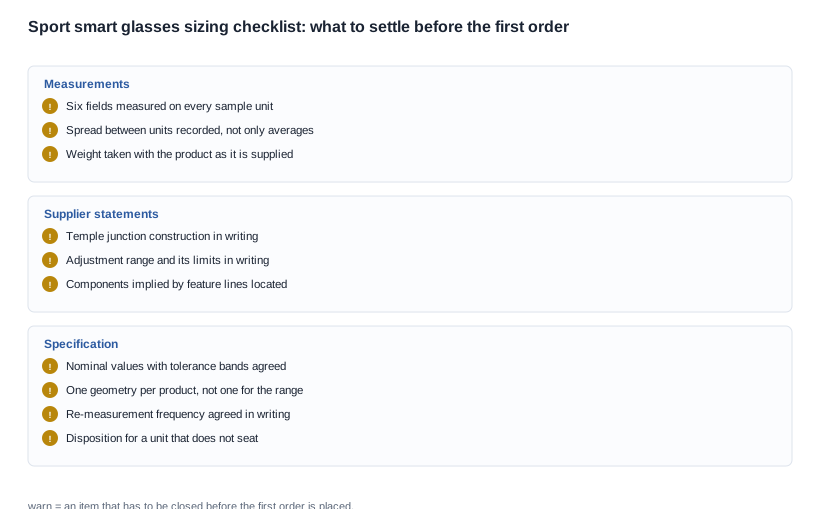
Our own position on this is the one we keep to across this range. The catalogue publishes the electrical rows and the short feature lines for the three entries in this segment, and it publishes no geometry and no weight, so we will not quote a temple length, a lens width or a weight for any of them, and we will not present a typical figure from the industry as though it described these products. What we can do is set out the six measurements, the sampling protocol and the specification format that turn an undocumented frame into a documented one, and tell you which of them have to be settled with the supplier before the first order and which can be settled from the sample.
If you are sizing this segment for a channel, send us the head-shape range you need the product to cover, the sample quantity you are able to carry, and the countries you are shipping into, and we will return the measurement protocol, the fields the supplier has to commit to, and the tolerance format we would put in the purchase specification.


