

A sport product is not a regulated category in itself, and the most common misunderstanding in this line is the belief that it is. What makes a product a sport product in our catalogue is that it is published as 运动眼镜, and there are three such entries: the YKC02, the D17 and the ZH12. A designation tells a buyer what a product is for. It does not determine which requirements apply to it, and a buyer who assumes that a designation carries a compliance profile will find that the profile has to be established from the ground up for each market in which the product will be sold. This page is the ground-up version, and it is the only page in this set that deals with the conformity file as a whole.
The scope of the file follows from what the sport products actually are. All three are radio products, with a published Bluetooth version of 5.4. All three contain a rechargeable cell, and the cells differ in configuration across the line: the YKC02 uses two 70 mAh cells while the D17 uses one 115 mAh cell and the ZH12 one 100 mAh cell. All three are sold to consumers, which places them inside the general product safety framework rather than outside it. And none of the three is published with any environmental protection marking, so the file cannot be assembled on the assumption that a standard test exists for the conditions the product will meet.
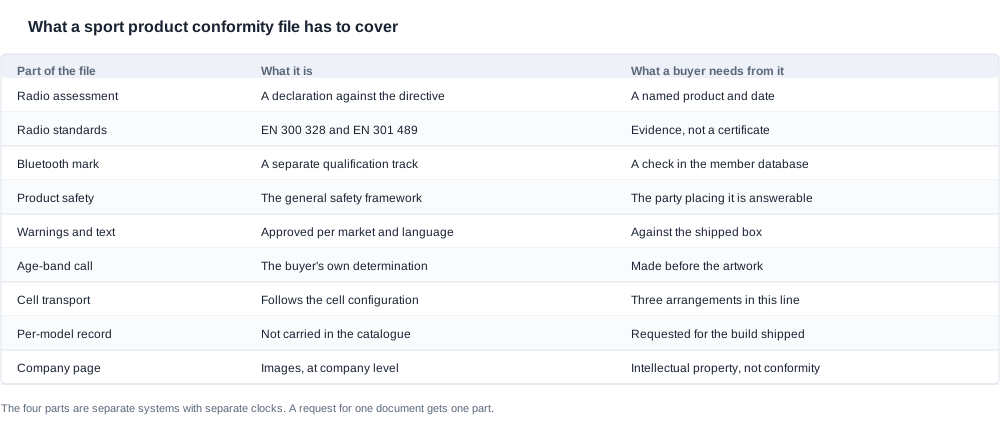
Sport smart glasses certification for sport glasses: the file a buyer has to assemble
The file has four parts, and the mistake is to treat them as one. A radio assessment, a general product safety file, a cell and consignment set of papers, and a set of model-specific records sit in different systems, are produced by different parties, and expire on different clocks. A buyer who requests "the certificates for this product" is asking for a thing that does not exist, and the answer they get will be a single document that covers one of the four parts while appearing to cover all of them.
The radio assessment is the first part, and it is the one with the most familiar vocabulary. A radio product placed on the European Union market is governed by the Radio Equipment Directive, (EU) 2014/53/EU, and what a buyer needs is the manufacturer's declaration against it, not a summary of it. Two harmonised standards come up repeatedly in radio assessments in this category: EN 300 328, which covers the radio equipment itself, and EN 301 489, which covers electromagnetic compatibility. A file that cites either of them is evidence that an assessment was carried out against that standard. It is not a certificate, and a buyer who records a standard citation in a compliance file as though it were a certificate has created a file that will fail the first time somebody asks what the declaration says.
The second part is the general product safety side, and for a consumer product in the European Union the governing framework is the General Product Safety Regulation, (EU) 2023/988. This is the part that catches private-label programmes, because the obligations sit with the party that places a product on the market, and in a private-label arrangement that party is the buyer rather than the factory. The obligations that matter operationally for a sport product are the ones about identifying the product, about traceability, about the information supplied with the product, and about the person who is answerable for it in the destination market. None of those is a matter of product construction; all of them are matters of packaging, artwork, documentation and the contractual structure of the programme.

The third part is the cell and the consignment, and it is a separate set of papers that follows the cell configuration rather than the model. The YKC02's two 70 mAh cells, the D17's single 115 mAh cell and the ZH12's single 100 mAh cell are three different transport situations, and a consignment that contains all three in the same programme needs the documentation for each of them. A buyer who has been given a transport document for one cell configuration has been given a document for one cell configuration, and it is worth saying so in the request.
The fourth part is the model-specific record, and this is where the catalogue's own position has to be stated plainly. Nowhere in our range is there a per-model certification row, so there is nothing in our published material that a buyer can copy into a compliance file for a sport product. There is also a company-level export certification page in the catalogue, and a reader should understand exactly what that page is: its content is images rather than extractable text, it sits at company level rather than at product level, and it carries intellectual-property documents. A granted patent protects an invention and says nothing whatever about whether a product meets a requirement. A buyer who has seen a patent certificate has not seen a conformity file, and a page of patent images is not a substitute for one.

The radio side: the directive, the standards and what a declaration is
The radio part of the file is the part where buyers most often accept a document that does not do the work. A supplier who sends a summary of a test report has not sent a declaration, and a supplier who sends a page of logos has sent less. What a buyer needs, in a form that can be filed and shared with a compliance team, is the declaration of conformity itself: the product it covers, the directives and regulations it is declared against, the standards used in the assessment, the date, the manufacturer or the responsible economic operator, and the signature.
The specificity of the product description in that declaration is the detail that decides whether it is usable. A declaration that names a model has to be checked against the configuration that will actually ship, because a declaration is issued for a product and a variant may sit outside it. In this line the variants that matter are the ones the published rows describe: a colour difference, an accessory difference, a packaging difference and a market difference. The published rows for the three sport models give a buyer the vocabulary to ask the right question — which cell configuration, which charging method, which radio version, which box contents — and the question has to be asked against the configuration that will be produced.
Two further points belong in the radio part. The first is that the Bluetooth qualification is a separate track from the regulatory declaration, and a buyer has to run both. A declaration against the radio directive covers the product; the Bluetooth member database holds the product's qualification for the Bluetooth trademark and the version it was qualified against, and a buyer who has only the declaration has not checked the qualification. The way to run that check without inventing a process is set out in the buyer checklist for the Bluetooth qualification.
The second is that the radio file does not discharge the product-safety obligations, and the general product safety obligations do not discharge the radio ones. A buyer who has received a single document and concluded that the file is complete has made the first of the four-parts error, and it is the error that tends to surface during a market surveillance enquiry rather than during an internal review.

The product-safety side and the responsibility a private label carries
The product-safety part of the file is where the commercial structure of a programme becomes visible. A product sold to consumers in the European Union has to be identifiable, traceable and accompanied by information, and the party that places it on the market is the one that carries those obligations. In a private-label programme that party is the buyer, and the consequences are concrete: the product identification on the carton has to be the identification in the file; the batch marking has to be a marking a buyer can trace; the instructions and the warnings in the box have to be the approved text; and the economic operator who is answerable in the destination market has to be a party the buyer has actually appointed rather than a name on a purchase order.
The warnings are the item that causes the most delay and the most rework, and the reason is worth naming. A warning is a set of statements about a product, and a set of statements has to be approved by whoever is answerable for them, in the language of the market, against the configuration being sold. For a sport product the practical difficulty is that the box content differs across the three models — two of them publish a photography remote and the third does not — and a warning set that assumes a remote is in the box is wrong for one model. The same applies to the charging arrangement, which differs across the line, and to the cell arrangement, which differs across all three.
A buyer who is assembling this file should also decide the criteria it will be judged on, because the parts of it are assessed against different standards and the weakest part determines the outcome. For the radio side the criteria are that the declaration names the product, that it is dated, and that the assessment behind it is available. For the product-safety side they are that the identification on the pack matches the file, that the warnings are the approved text, and that the responsible party is appointed. For the transport side the criteria are that the test summary names the cell configuration and that the documentation covers the packed unit. A buyer who evaluates a supplier on these criteria rather than on how quickly a file arrives will find that the suppliers who answer quickly are usually the ones whose file is incomplete, and the comparison a buyer should make is between complete files rather than between fast replies. What to ask, in other words, is a fixed list with a fixed order, and how to choose between two suppliers is to score both against the same list.
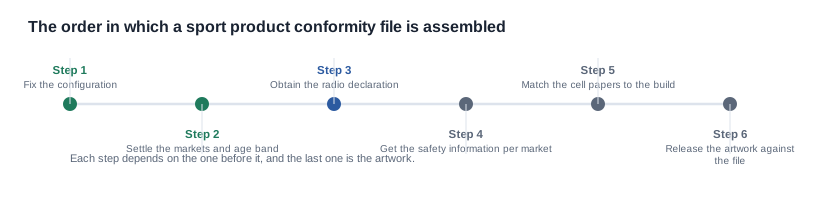
There is a related point about sequencing that is worth making explicitly, because getting it wrong costs a rework cycle. The age-band determination and the box contents feed each other: the determination affects which warnings are required, and the warnings are printed on the box, and the box has to match the file. The determination therefore has to be made before the artwork is released, and the artwork has to be released before the file is complete, which means the determination sits at the front of the critical path rather than at the end of it.
The age question is the one that has to be handled early and correctly, and it belongs in this part of the file rather than in the marketing discussion. Whether a product intended for sport use falls inside a category that carries age-specific requirements is a determination for the buyer's own compliance function, made after the product has been classified for its intended use and for the age band it is being placed for, and after the market has been fixed. It is not a determination the catalogue can make and it is not one a factory makes on the buyer's behalf. A buyer who has not made it cannot write the warnings, cannot finalise the artwork, and cannot sign off the file, and all three sit on the critical path.

The cell and the consignment: a second set of papers
The transport documentation for the cell is a separate file from the conformity file, it follows the cell rather than the product, and it governs the consignment rather than the sale. A buyer working in this line needs three of them if the programme carries all three models, because the cell configurations are three different arrangements. The practical content a buyer should ask for is the test summary for the cell configuration in question, the applicable transport documentation, and a statement of how the documentation relates to the packaging the product will actually travel in, since a document written for a bare cell does not necessarily describe a packed unit.
There is a second reason to insist on the cell documentation at the point of ordering rather than at the point of shipping, and it is a commercial one. A consignment that is held at a border because the documentation does not match is a delivery that has already cost the buyer a month of shelf time, and the cost of that month is very unlikely to be recoverable from the supplier. It is cheaper to discover the mismatch in a sample shipment than in a production consignment, and the cheapest place to discover it is still in the enquiry.
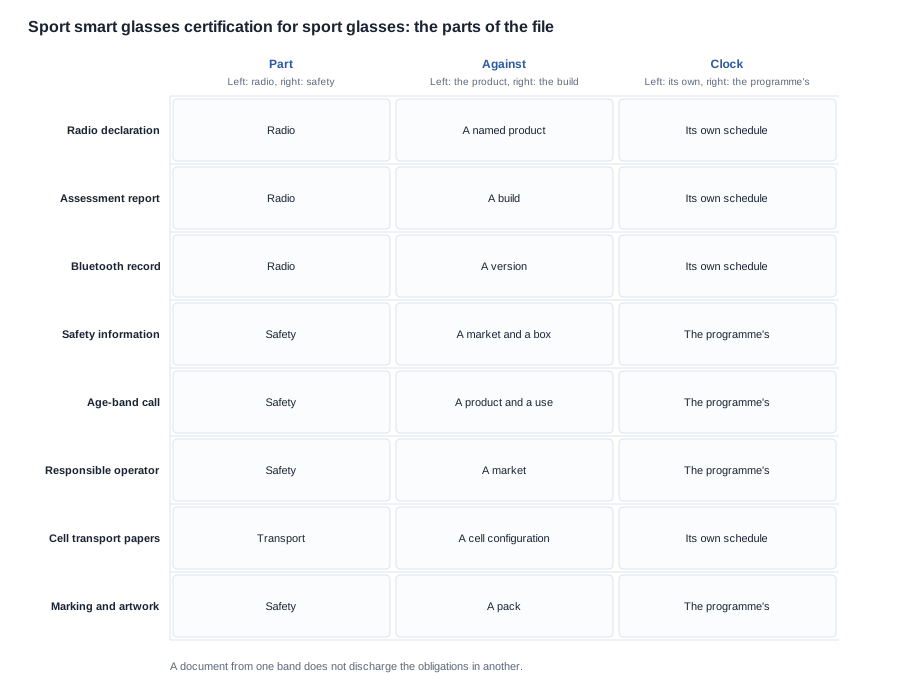
What connects the four parts into one file is the configuration, and that is the organising idea for the whole request. Every part of the file is issued against a product as built and packed, and the only way to know whether the parts agree with each other is to describe the configuration once, in writing, and to have every part checked against that same description. A buyer who writes the description down is doing the single most useful thing available; a buyer who asks for documents in the abstract is doing the least.
Keeping the file: what a buyer retains, and the request list that fills it
Records. A conformity file that is not retained is a document that will have to be re-obtained, and the cost of re-obtaining it rises with every year that passes, because the supplier's records move and the configuration drifts. The record set a buyer should keep, per model and per market, is: the declaration itself; the assessment documentation behind it; the general product safety information as approved for the box; the cell transport documentation for the configuration; the artwork and the label as released; the batch marking specification; and the record of the responsible economic operator. All of it is dated, and all of it is versioned, because the value of the set is that it can be compared with what the product actually is.
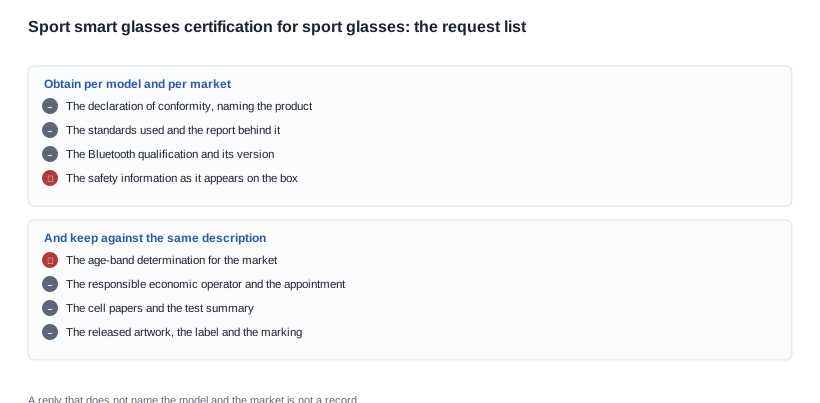
The request list below is what fills that set, and it is written so that a supplier can answer it in one reply. Every line names the model and the market, because a reply that does not name them is not a record.
- The declaration of conformity for the model, naming the product it covers.
- The standards used in the assessment, and the assessment report behind the declaration.
- The Bluetooth qualification for the model, with the version it was qualified against.
- The general product safety information as it will appear on the box and in the leaflet.
- The age-band determination for the model, made for the destination market.
- The responsible economic operator for each destination market, and the appointment document.
- The cell transport documentation for the cell configuration in the model.
- The test summary for that cell configuration.
- The product identification and the batch marking, and where on the pack each is placed.
- The packaging configuration the documentation covers, including the box contents.
The tenth line is the one that catches people, and it catches them because the documentation is usually assembled before the box is designed. Our catalogue publishes no box-contents list and no packaging row for any of the three sport models, and the fact that two of them publish a photography remote while the third does not means that a contents list is a model-specific document rather than a range document. A final point belongs to the closing of this page, and it is about what happens when a buyer finds a file that does not match. In practice the mismatch is almost never a defect in the product; it is a change in the packaging, the accessory set or the market that nobody notified the file owner about. That is why the change process is a conformity issue rather than a logistics one, and why the request for it belongs in the same list as the request for the file itself. A buyer who has obtained a complete file for a configuration and has not asked how the configuration may change has a file that is correct for a moment and unreliable thereafter, which is the least useful state a compliance file can be in.
The order of work is therefore: settle the configuration, write it down, obtain the file against that description, and then design the pack around what the file says.
The offer from our side is bounded. We publish the product rows for the three sport models and we do not publish a conformity file for any of them, because a conformity file is issued for a configuration in a market and a catalogue is neither. What we can do is tell a buyer exactly which parts of the file the published rows bear on, which parts depend on decisions the buyer has not yet made, and which questions have to be asked in which order so that the file is assembled once rather than three times. Send us the models, the markets, the age band you intend to position for and the packaging you have in mind, and we will map the four parts against your configuration, list the open questions in the order that unblocks the most, and tell you plainly which parts of the file have to come from a supplier in writing and cannot be assembled from a catalogue.


