

A FAQ is only useful if it answers the questions customers actually ask, and in this line the questions fall into a small number of recurring families that a channel can prepare for once. Six of them recur in almost every enquiry: how it fits, whether it can get wet, how long it lasts, how it charges, what the remote on it does, and whether it records anything. The answers below are organised around those six, and each one is marked for who has to supply it, because that is the part a FAQ page usually leaves out. Three of the six are settled by our published rows, two need a written answer from the supplier, and one is settled by the absence of a row — which is a real answer and a useful one, provided it is stated properly.
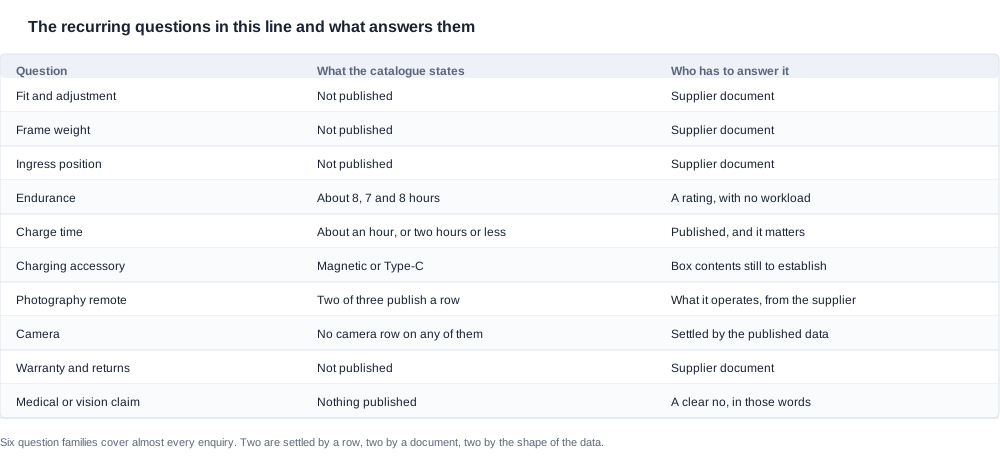
Sport smart glasses common questions: the ones that come up in every enquiry
The three products this FAQ covers are all published as 运动眼镜. All three are radio products with a published Bluetooth version of 5.4, all three contain a rechargeable cell, and the cell configurations differ across the line: two cells in the YKC02, a single 115 mAh cell in the D17, a single 100 mAh cell in the ZH12. The charging arrangements differ as well, with the YKC02 using a magnetic interface and the other two using a Type-C port, and the published charge ceilings split the same way, with the YKC02 capped at two hours or less and the other two at about an hour. Two of the three publish a photography remote as a feature note and the third does not, and the notes are printed in Chinese on one of the two that have them. Those are the differences a customer can be shown, and they are enough to answer most of the questions below without a single further document.
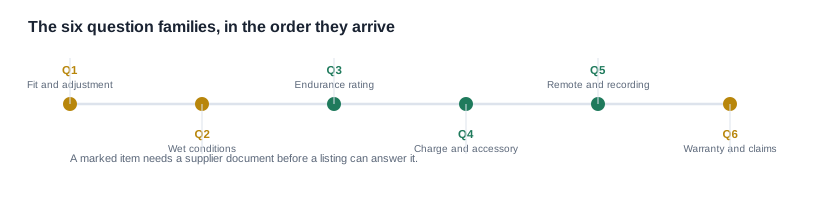
The six families below are the ones a channel should prepare for, and the order in which they arrive is roughly the order in which a customer asks them.
- Fit and adjustment — not settled by any published row, so it needs a supplier document before a listing can describe it.
- Wet conditions — the catalogue publishes no ingress marking for any of these three, so the answer has to be a written position.
- Endurance — published as a rating without its conditions, so it is usable as a figure and not as a claim.
- Charging — the one family where the published rows decide a real difference between the products.
- The photography remote and the recording question — the sharpest one, because the answer is short and the wrong answer is costly.
- The warranty, the return route and the claim the product must not make — the two that a channel is least prepared for.
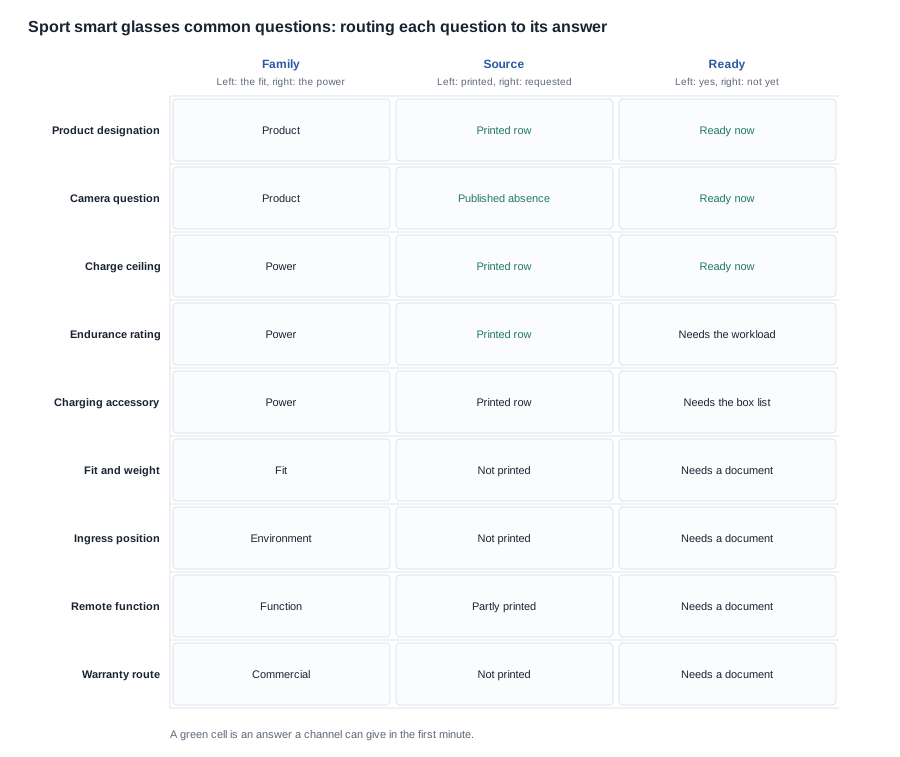
What this table adds is the routing. For the six questions below, two have an answer in our published rows, two have no answer in our published rows and need one in writing from the supplier, and two have an answer that comes from the shape of the published data rather than from any individual row. A channel that has decided in advance who answers which question can answer a customer in the first minute instead of the first week, and that is the whole commercial value of a prepared FAQ.
A buyer who is building this FAQ for a channel should also decide who in the organisation is allowed to change an answer, because a FAQ that anybody can edit stops being a record and becomes a source of contradictions. The answer sheet behind a published FAQ should have an owner, a version and a date, and a change to it should be a deliberate act with a reason attached. That is a small administrative point and it is the difference between a channel whose answers are consistent and one whose second and third calls contradict its first.
There is one framing point that belongs at the top of a FAQ in this line, and it is the point that most of the answers below return to. Our catalogue publishes a complete electrical profile for all three products and publishes nothing at all about how they are fitted, how they sound, what they weigh or what they withstand. That is not a gap in the products; it is where the published data stops and the supplier's documentation starts. A customer-facing answer that draws on both is accurate, and an answer that draws on only one of them is either incomplete or unsupported.
Fit, adjustment, and what the catalogue actually says about it
How does it fit, and can it be adjusted? Our published rows for all three products are silent on this. There is no temple length, no nose-pad specification, no adjustment range, no frame weight and no head-size guidance printed for any of the three. What can be said from the published material is only that all three are published as 运动眼镜 and that one of them, the YKC02, publishes a feature note describing a long endurance rather than any structural characteristic. The fit answer has to come from the supplier, and the specific things to ask for are the temple length, the nose-pad geometry, the adjustment range, the frame weight, and whether the product is supplied in more than one size. A channel that has those five answers can describe fit accurately; one that has only the product designation cannot.
Will it stay on during movement? That is partly a fit question and partly a weight question, and neither is published. What is published is that none of the three carries an environmental protection marking, which is the subject of the next section, and that two of the three publish a photography remote, which is a component on the temple and therefore part of what is carried by the frame. A supplier's written position on retention under movement, together with the frame weight, is what a buyer needs in order to answer this honestly.
Is it comfortable? This is the question a customer means when they ask about fit, and it is the question a published specification cannot answer at all. We do not publish a comfort figure for any of the three, and we are not going to manufacture one. The honest version of the answer is a description of the construction, the weight, the adjustment range and the material at the contact points, all of which come from the supplier, and a note that a child's head is not a fixed object, which is why a fitting guide and a return route matter more than a comfort claim.
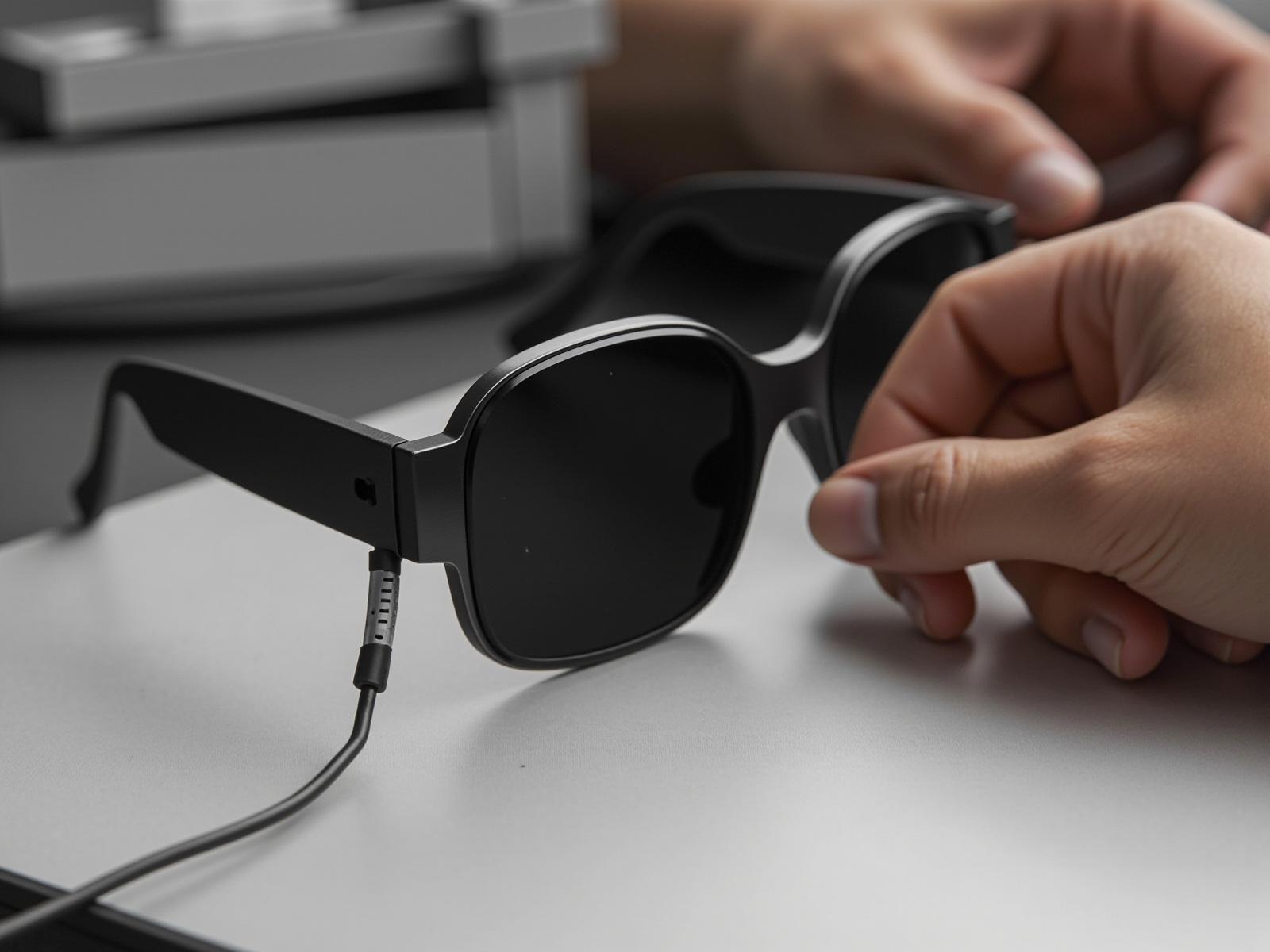
Water, sweat and the question the catalogue leaves open
Is it waterproof? Can it be used in the rain? This is the question in the line that most often gets answered wrongly, and the answer has to be stated in two parts. The first part is a fact about our catalogue: two models in the wider range carry a published IP54 marking, and neither of them is published as a sport product. The second part is equally a fact: none of the three sport products carries a published ingress marking of any kind. Our catalogue therefore does not support a water statement for these products, and a listing that makes one is a listing that has gone beyond the published data.
Then what is the answer I give the customer? The answer a buyer can defend is the one that comes from the supplier in writing: what the supplier states about the product's use in wet conditions, against which configuration, and with what test evidence if there is any. A documented position is usable in a listing and in a support script. The absence of a documented position is also usable, in the sense that a channel can then say plainly that it makes no such claim. What is not usable is an inference from the product's designation, and it is worth naming that specifically because a product published for sport use invites the inference.
What about sweat? A related and more specific question, and one that a buyer should ask separately rather than folding into the water question. Our catalogue publishes no material specification, no surface finish, no coating and no seal description for any of the three, so there is nothing from which a sweat position can be derived. A supplier can state the material at the skin-contact surfaces and the cleaning regime the product expects, and a channel can publish that as care guidance. What no channel can publish without a document is a claim that the product resists sweat, and a buyer who has asked the question and received a clear answer is in a much better position than one who has assumed an answer.

Battery, charging and the two architectures in this line
How long does the battery last? The published figures are one of them rates at around eight hours, one at about seven and the third at around eight, and none of them comes with the test conditions that would let a buyer compare them against one another. So the answer to a customer is a rating, stated as a rating, and the useful follow-up is the workload behind it — which is a question for the supplier and which a channel should have answered before the question is asked.
How long does it take to charge, and does that matter? Yes, and this is where the two architectures in the line earn their place. The D17 and the ZH12 are published with a charge time of about an hour, while the YKC02 is published with a ceiling of two hours or less. For a customer that is the difference between a product that can be recharged over a break and one that cannot, and it is the single most useful published distinction in the line for a buyer selling into active use. The two models with the shorter published charge time use a Type-C port, so they also charge from a cable the customer is likely to own, while the YKC02's magnetic interface is a specific accessory. That is a second, quieter difference in the same answer.
What does the customer need to charge it? For the two Type-C models, a cable. For the YKC02, the magnetic charging accessory, and our catalogue publishes nothing about the accessory, the cable or whether a dock is supplied. A channel that has not established what is in the box for the YKC02 will generate avoidable support contacts in the first week of a launch, because the customer will reach for a USB cable and there is no port.
Can it be charged while being worn? Nothing in our published material says either way, and the answer is worth having, because a customer who expects to charge through the temple and cannot will treat it as a fault. It is a supplier question, and it is an easy one to ask and an expensive one to discover late.
The remote, the recording question and what a customer is really asking
What does the remote on it do? Two of the three products publish a feature note describing a remote control for photography, and the third does not. The YKC02 publishes no such note. That is a real difference between the products and a customer can see the difference in the box. The published note does not say what the remote operates, and the products themselves publish no camera specification at all, so the honest position is that the note records a photography remote as a fitted element and the details behind it have to come from the supplier.
Does it record anything? Here the published data gives a clear answer and it is worth stating it plainly: no camera specification is published for any of the three sport products, and a product with no published camera specification is not a product that records. A customer who asks this question in a shop is asking because they have heard about wearable recording in this category generally, and the answer for these three products is a short one. A buyer who uses a longer answer is likely to be answering about a different product.
Does it come with a charging cable, and what else is in the box? Our catalogue publishes no box-contents list for any of the three, and it publishes no charging-case row for any of them either, so the contents of the box are a question for the supplier in every model. For the two Type-C products the answer a customer cares about is whether a cable is included, and for the YKC02 it is what the magnetic charging accessory actually is, because a customer who expects a USB cable and finds a magnetic end will treat the product as faulty. A channel that has the contents list and the accessory in the listing and in the insert will not see that complaint, and one that has neither will see it in the first week.
So what is the remote for? That is the question the published note leaves open, and the answer is for the supplier. What a channel needs is the pairing requirement, the supported device list, and whether the remote is in the box for every unit. Those three determine whether the feature works on arrival and whether a customer returns the product because it does not.
How long does the answer take to get right? That is a channel's own decision, and it is worth making it deliberately rather than discovering it. A product with no published fit specification and no published position on wet conditions cannot be described accurately in a listing until two supplier documents have arrived, and a channel that publishes before they arrive is choosing speed over accuracy. The trade-off is real and it is not always the same decision: a channel with a specialist sales team that can describe the product in person can often proceed on a short answer sheet, while a channel selling through a marketplace depends entirely on the listing and has to wait. What to ask, then, is which of the six families the channel is exposed to first, and the answer decides the order of the work rather than the content of it.
What else should a channel be ready for? Two more recur often enough to prepare for. The first is the warranty and the return route, and our catalogue publishes no warranty term, no defect rate and no return position for any of the three, so a channel without a written position will improvise one in front of a customer. The second is the question about what the product is not: whether it is a medical device, whether it treats anything, whether it protects the eyes, whether it improves performance. None of those is supported by anything in our published material, and the correct answer is a short, clear no that a customer will accept, followed by a description of what the product is fitted with and what it does.

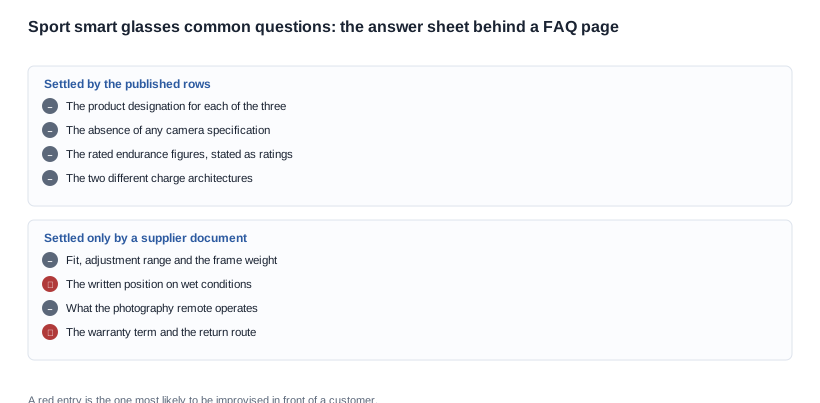
A buyer preparing these answers should also set the criteria by which they will be judged, because a prepared answer is easy to write loosely. An answer qualifies to be published if a published row supports it, if a supplier document supports it and the document is held on file, or if it is a statement of what the catalogue does not claim. An answer that relies on any of the three is usable, and an answer that relies on a fourth thing — an inference from the product's designation, a comparison with a competitor, or a description of how the product feels — is not. How to choose between two suppliers' answers is then a simple matter of asking the same question in the same form and checking whether the reply names the model, the configuration and the market, because a reply that does is a record and a reply that does not is a conversation.
That framework is also how a buyer decides which of the six families to settle first. The charging family can be settled from the catalogue and therefore needs no supplier time, and the recording question can be settled from the absence of a camera row. The two that need a supplier document are the ones with the longest lead time, because the wet-conditions position and the fit specification both have to be in the hand before the artwork is released. Working back from the artwork deadline is what turns a list of six questions into a schedule a team can actually run, and it is the step that most often gets skipped in a category where nobody has said out loud that two of the six cannot be answered without asking somebody.
The final point is a process one, and it is the reason a FAQ is worth preparing at all. A channel that has written the six answers down, knows which two of them are still outstanding, and has asked the supplier for those two in writing will answer a customer in a minute and will not contradict itself in the third call. A channel that answers from memory will be right about the electrical rows and improvise about the rest, and the improvisation is where the complaints come from.
For the questions this page cannot answer, the practical next step is the product-selection work, which is set out in how the three published models are compared against a use. From our side the offer our position is the same one we take everywhere else in this category: we publish the rows for the three sport products, we will tell a buyer which of the six questions above those rows settle and which need a document, and we will not supply a fit figure, a water position or an activity endurance that our material does not contain. Send us the deployment, the environment and the questions your own customers ask, and we will mark the answers you can publish today against the ones that have to wait for a supplier document.


