

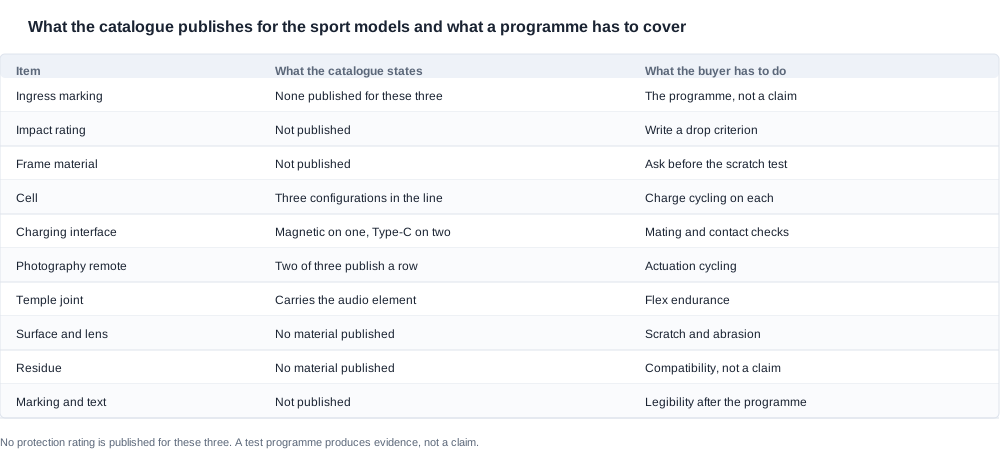
The first thing to establish before designing a durability programme for this line is what our catalogue does and does not say about durability. It says nothing. There is no published ingress marking for any of the three products published as 运动眼镜, no published impact rating, no published drop figure, no published material specification for the frame, the lens or the surface, and no published statement about resistance to sweat, to rain or to abrasion. The two products elsewhere in our range that carry a published IP54 marking are camera products, and the marking does not transfer to anything else. What that means in practice is that a buyer cannot inherit a durability claim from the catalogue in this line and has to build one from tests — and a test programme produces evidence, not a claim, which is a distinction that has to be respected all the way through to the listing copy.
Sport smart glasses durability testing: what the catalogue does and does not give you
A durability programme is easier to design than it looks, because the published rows tell a buyer which components are doing the work and which interfaces are going to move. Each of the three carries a radio, and the published Bluetooth version for all of them is 5.4. Each also holds a rechargeable cell. The arrangements differ across the line, and the cell is the component most likely to fail in a way that matters commercially, because a failed cell is a unit that cannot be used and a unit that has to be returned. The charging arrangements differ as well: one product uses a magnetic interface and two use a Type-C port, and those are different mechanical interfaces with different wear behaviours and different failure signatures. A magnetic contact can be contaminated, can be shorted by a metal object and can be pulled apart; a Type-C connector has a mating cycle count and a latch.
The third thing the published rows point at is the feature notes. Two of the three products publish a note for a photography remote, and a remote mounted on a temple is a component that takes the wear a temple takes plus the wear a button takes, and it is a small part that a customer can lose. A programme that ignores the remote because the published rows describe it as a feature note rather than as a component will miss one of the most likely sources of a customer complaint in this line.
What a buyer should take from all of this is a principle rather than a list. The durability programme has to be built around the components the published rows identify, and the acceptance criteria have to be written before the tests are run, because a test without a criterion is a demonstration and a demonstration is not evidence. The commercial consequence of getting this wrong is specific in both directions. A programme with no criteria produces results nobody can act on and no defence when a customer reports a failure. A programme with criteria and no record produces results that cannot be shown to a customer, a channel partner or an insurer.
It is worth adding a short note on why a durability programme in this line is worth doing at all, because the absence of a published marking is usually read as a reason not to test. It is the other way round. A product published for sport use will be used in conditions its supplier knows about and its buyer does not, and the only way a buyer finds out whether a unit survives those conditions is to test it. A programme that produces a record of what happened is worth having precisely because the catalogue does not answer the question; a channel that has tested a thousand units and kept the record can answer a customer, a channel that has not can only repeat the supplier's marketing.
There is one further thing the published rows make clear, and it is the point at which a lot of durability work in this category goes wrong. The absence of a published ingress marking is not a claim that the product resists nothing; it is the absence of a published statement. A supplier may well hold a test result, and a programme that asks for it may well find one. What the programme cannot do is convert a result into a marking that the catalogue does not carry, and what a channel cannot do is advertise a protection it has not been given. The relationship between the test result and the listing is a decision, and it is made in the marketing copy, long after the testing is over.

The test programme, and the order to run it in

The sequence below is ordered by what breaks first and by what a buyer learns earliest, and it is a programme rather than a set of isolated tests. The order matters because the early tests are the ones that determine whether the later ones are worth running, and because a failure in an early test usually invalidates the samples for the later ones.
- Packaging and transit: a packed drop and a compression test on the shipped configuration, with the closure and the internal arrangement as the variables.
- Unpacked handling drop: a defined height onto defined surfaces, repeated on a defined number of units, with the lens, the temple and the charging interface inspected afterwards.
- Temple and joint endurance: repeated flexing of the temple and the joint that carries the audio element, on the models that publish an audio note.
- Lens and surface: a scratch and an abrasion pass on the lens and on the temple surface, with the result recorded against the material once the supplier confirms it.
- Charging interface cycling: repeated mating for the Type-C products and repeated attach-and-detach for the magnetic one, with the contact condition and the retention checked at intervals.
- Button and remote cycling: the actuation count on the models that publish a photography remote, with the confirmation behaviour checked for consistency.
- Charge-cycle endurance: repeated full charge and discharge cycles across the published ceiling and the rated endurance, watching the cell for drift.
- Environmental conditioning: temperature and humidity exposure, as a conditioning step before the mechanical and electrical checks rather than as an end in itself.
- Residue compatibility: a sweat-and-salt residue treatment on the surfaces that meet the skin, assessed as a materials question and recorded as one.
- Marking and labelling legibility: whether the batch marking and the safety text survive the programme.
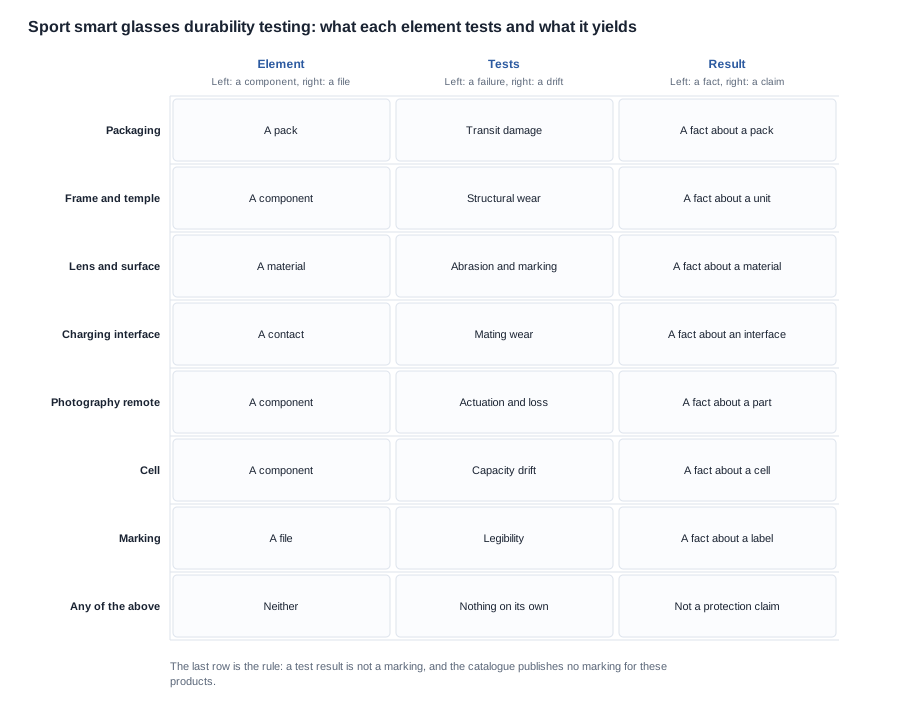
Three of these need a word of explanation, because they are the ones where a buyer's instinct leads in the wrong direction. The residue test is a materials-compatibility question and nothing more: it tells a buyer whether the surface degrades and whether the cleaning regime works, and it produces no statement about the product withstanding sweat. The environmental conditioning step is conditioning, and a failure in it invalidates the samples for the mechanical tests that follow, which is why it belongs before them rather than after. The charge-cycle test is the longest and the most expensive of the ten, and it is also the one that produces the only long-run evidence a channel will ever have about the component most likely to end a unit's life.

Writing the acceptance criteria so a result means something
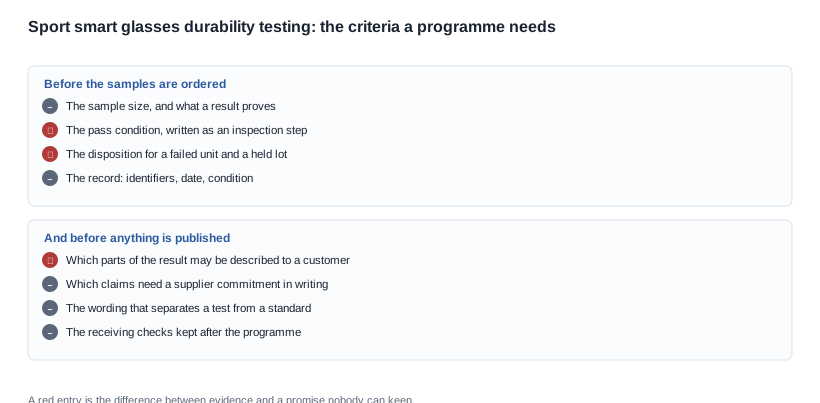
The difference between a durability programme and a set of demonstrations is entirely in the criteria, and the criteria are what a buyer has to write before the first unit is ordered. A usable criterion names the sample size, the condition, the pass condition and the disposition, and it names them for each test rather than for the programme as a whole.
Two further points complete the criteria, and both of them decide whether a programme can be repeated. The first is the control of the test itself: the same units should be used across the sequence where the sequence is meant to be cumulative, and where it is not, the units should be split, because a drop test that damages a unit and a charge test on the same unit are two results rather than one. The second is the identity of the units themselves, and it matters more than it sounds: a programme whose results cannot be tied to the units that were tested produces a document that can be quoted but not audited, and a document that can be quoted but not audited is the worst of both worlds. A buyer who has recorded the unit identifiers has a result; a buyer who has recorded a date and a room has an anecdote.
The sample size is the first decision and it is a commercial one. A test that a supplier's own quality team has run on a large sample is evidence at the programme's level; a test the buyer runs on three units is evidence about three units. Both are worth having, and a buyer should be clear about which one a result is before the result is quoted internally, because a result that is presented with a stronger claim than the sample supports is a claim that will eventually be tested against the customer.
The pass condition is the second, and it is where most of the value of the programme sits. A criterion like "no visible damage" is not usable, because two people will read it differently. A criterion like "the frame retains its shape, the lens shows no chip, the charging interface still completes a charge within the published ceiling, and the published feature notes remain in place" is usable, because a receiving inspector can apply it without asking a question. The third element, the disposition, is what makes the criterion enforceable: what happens to a unit that fails, whether it is quarantined, returned for analysis or scrapped, and whether the lot is held.
It is worth adding one observation about how a programme of this kind interacts with the rest of a quality system, because a buyer who treats it as a standalone project ends up with two sets of records that do not talk to each other. The incoming inspection tells a buyer what arrived; the programme tells a buyer what the product does under load. The value is created where they meet, which is in the defect analysis: a unit that fails in the field and a unit that failed the same check in the programme are the same failure, and a programme that can be linked to the returns record turns a series of complaints into a design input. What to ask a supplier, therefore, is not only whether they will run the tests but whether their analysis can be tied to the units the buyer has returned, and how a recurring pattern gets reported back. The commercial argument for that is straightforward, and it belongs in the same conversation as the sample order.
The fourth element, and the one most often left out, is the record itself. A result that is not written down, with the unit identifiers and the date, cannot be produced when a customer asks, cannot be used to argue a supplier's position on a batch, and cannot be re-examined if the question changes. A programme that produces a record is an asset that a channel can point at; a programme that produces only a pass or a fail is a cost.

Separating the programme from what a listing may say
There is a line between an internal acceptance programme and a customer-facing protection statement, and the line is not a matter of wording. A customer-facing statement is a claim about a product, and a claim has to be supported by something published or by something the supplier has committed to in writing and that the buyer can reproduce. A test result from an internal programme is neither, unless the supplier has agreed that the result is the basis of a published statement, and has said so in a document that says which test, on which units, under which conditions, with what result.
That is why the earlier observation about the absence of a published ingress marking matters more than it first appears. The absence means a channel has no marking to publish, and a durability programme does not create one by itself. A channel that has run a thorough programme is entitled to say in its own copy that it has tested the product under stated conditions, and is not entitled to convert that into a protection standard that the product has not been assigned.
The same discipline applies to the softer claims. A buyer who has tested the product and found that the temple survived a thousand flexes has a fact about a thousand flexes, and a buyer who has tested it and found that the lens scratched has a fact that has to be handled rather than hidden, because it will be discovered in the field and the handling of it is what a customer remembers.
The commercial reason to keep the two apart is that the reverse of a protection claim is an implied protection claim. A listing that says "tested for durability" without saying against what invites the reader to assume a standard, and the reader who assumes a standard and then receives a product that does not meet it is a complaint that the channel cannot answer. The disciplined form is specific: what was tested, on how many units, under which conditions, with what result, and what was concluded.
The general way of thinking about this, which applies to any category and to this one in particular, is that the published rows are the only product claims a channel can make without a document. For these three, what our catalogue prints is the cell arrangement, the rated endurance, the charge ceiling, the charging method, the radio version and the feature notes, and it prints no protection marking at all. A copy writer working from the published rows alone will produce a listing that says very little and cannot be wrong. A copy writer working from impressions will produce a listing that says a great deal and will be challenged.
From the programme to the receiving inspection
The full programme above is a sample-order activity, and it is not what happens on every consignment. What happens on every consignment is a reduced inspection, and the right way to design it is to take the programme and keep the checks that detect the failures the programme found, and drop the checks that found nothing. A buyer who does that ends up with a receiving procedure that is proportionate, and a quality record that grows more useful each time it is used.
Three checks almost always survive the reduction. The charge test does, because a unit that arrives not charging is a unit that cannot be sold and the cell is the component most likely to have drifted. The charging interface check does, because it is a physical interface that has been through transit and that is easy to inspect at goods-in. The marking and contents check does, because it is the only point at which a consignment can be confirmed against the order before it is opened up in the channel.
Two more survive if the programme has been run. The drop and closure check does, because it is the failure that produces the most returns and the most visible damage. The temple and remote check does, if the channel has found a wear pattern, because wear accumulates across a consignment in a way a single unit does not show.
A buyer running this programme should also settle the commercial terms of it in advance, because a programme that is commissioned without an agreement about who pays for the units, the laboratory time and the repeat testing is a programme that gets stopped halfway. The questions to ask a supplier are specific: whether the supplier runs the programme in its own facility and what the charge is, whether a report is produced for a specific serial range, whether a failure analysis is provided on a returned unit, and whether the result can be used in the buyer's own documentation with the supplier's agreement. These are the criteria against which a supplier's programme should be compared, and they are worth more than the number of tests a supplier offers to run.
The rule for the receiving inspection is that it has to be something a receiving team will actually perform, on the units that arrive, in the time they have, and that its records have to be filed per lot. A procedure that depends on a specialist being present will be skipped on a busy day, and a procedure whose records are not kept cannot be used to argue anything later. The programme and the receiving inspection are two halves of one quality system, and the half that gets skipped is the half that decides whether the other half was worth running.
The wider quality-control material for a range programme, including how a supplier's own consistency records are used, is set out in the quality consistency guidance for platform orders. From our side the offer is bounded: we publish the rows for the three sport products, we publish no ingress marking or durability rating for any of them, and we will not supply a protection figure and we will not manufacture one. Send us the deployment, the environment, the volume and the failure history you have from any current product, and we will show you which components the published rows point at for a durability programme, which acceptance criteria have to be written before the samples are ordered, and which of the ten tests can safely be reduced to a receiving check afterwards.


