

Quality consistency is a claim every factory makes and no factory evidences unless the request is written in the right form. The reason this is hard to answer in this category is not reluctance, it is a documentation gap with a specific shape. The product record for this catalogue covers twenty-eight models, and for every one of them the record states that no product photographs, no video and no detection reports have been supplied. The catalogue pages publish specification rows: pixel tiers, cell capacities, charge limits, endurance figures, charge methods, charging case capacities, and in two cases an ingress marking. What none of them publishes is a measurement against which a second unit can be compared. So consistency cannot be read out of the documentation, and the useful question for a buyer is which method closes which row, and how many units that method actually needs.
Where consistency can be checked, and what evidence it needs
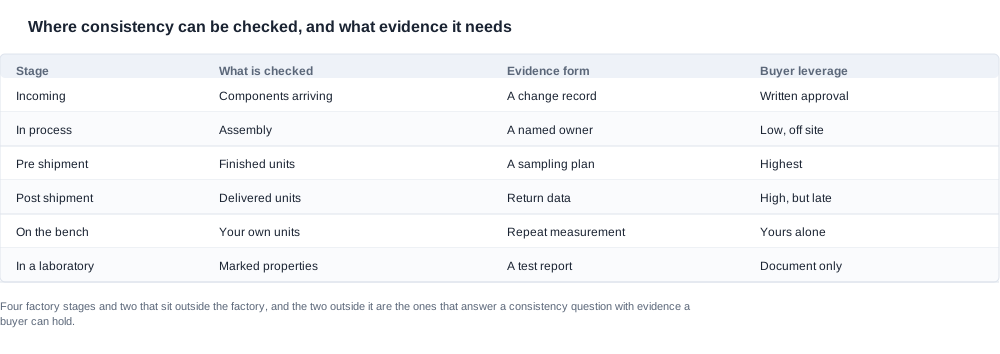
The table below separates the four stages inside a factory from the two that sit outside it, because the outside two are the ones that produce evidence a buyer can hold.
| Stage | What is checked | Evidence form | Buyer leverage |
|---|---|---|---|
| Incoming | Components arriving | A change record | Written approval |
| In process | Assembly | A named owner | Low, off site |
| Pre shipment | Finished units | A sampling plan | Highest |
| Post shipment | Delivered units | Return data | High, but late |
| On the bench | Your own units | Repeat measurement | Yours alone |
| In a laboratory | Marked properties | A test report | Document only |
Two things in that table deserve to be read carefully, because they are where programmes misjudge their own position.
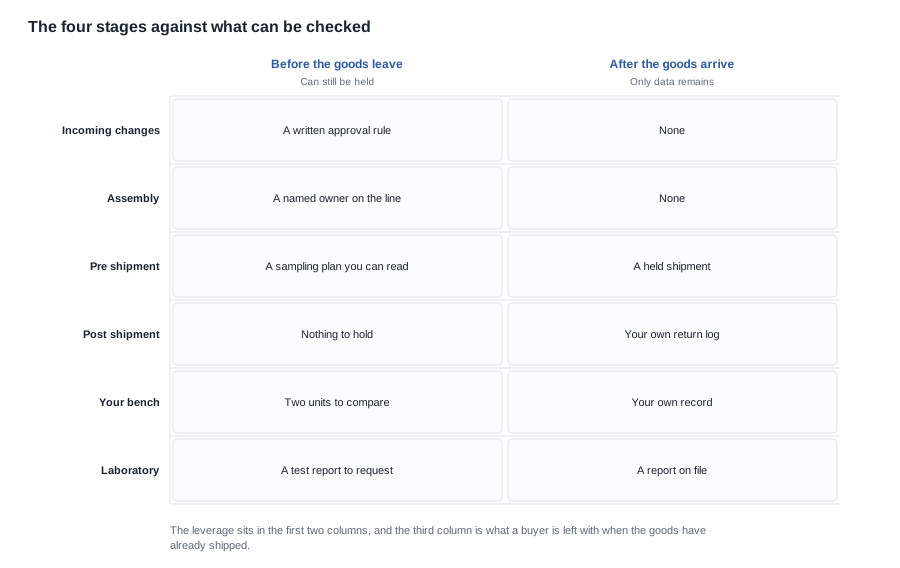
The first is that the leverage is not distributed evenly across the four factory stages. At incoming inspection the buyer's control is indirect but real, because a requirement that a component change needs written approval can be written into the purchase order rather than requested politely. At assembly the control is close to nothing unless someone is on site, and the best available substitute is a rule that a named engineer owns the line and that any deviation from the approved sample is a recorded event. At pre-shipment inspection the control is at its strongest, because the goods exist and the shipment can be held. And at post-shipment measurement the control is real but arrives too late to protect the order that is already in the channel, which is why the stages before it matter more than programmes usually credit.
The second is that two rows sit outside the factory entirely, and they are the two that answer a consistency question with evidence. A bench check, repeated across units, produces a comparison that no internal inspection record can substitute for. A laboratory check produces a document. The rest of the quality conversation happens in a factory's own building, on a factory's own terms, which is not a reason to distrust it, and it is a reason to be clear about which rows you can verify yourself and which ones you are accepting on the strength of a document.

The method an OEM ready platforms consistency question needs
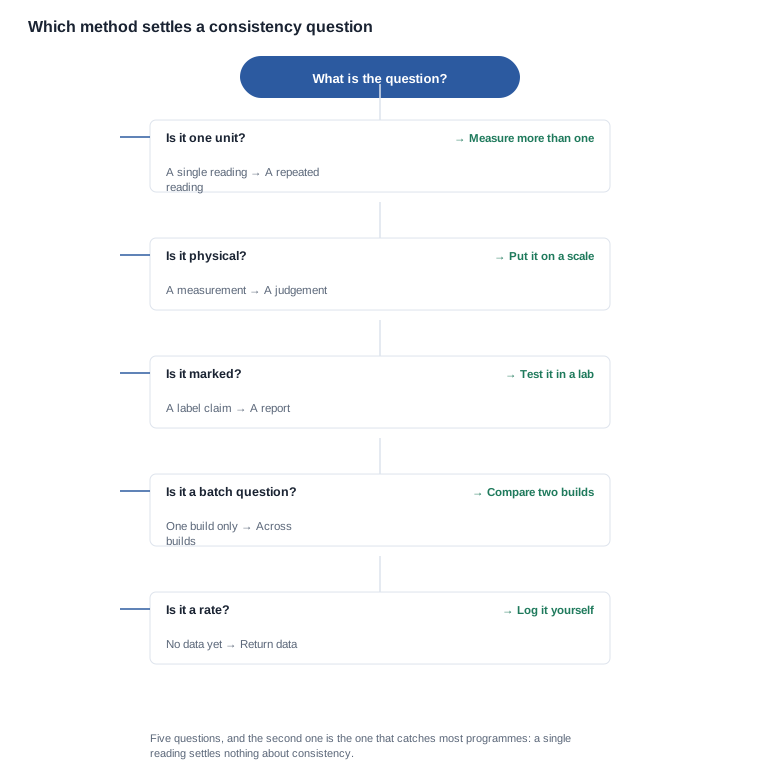
The single most common failure in a quality programme is treating a measurement as if it were a consistency check. One unit on a scale gives you a number. Two units on a scale give you a difference, and the difference is the first real data a buyer has. Three units give you something closer to a spread. The rule is short: consistency questions are answered by repetition, and a single reading answers a different question entirely.
This matters here because the catalogue publishes very little that can be compared. The pixel tier is published and is a range of two values across the camera models, so it is a specification and not a consistency question. What is not published for any model is the sensor, the lens, the field of view, the capture format, the frame rate and the storage arrangement, and every one of those is a row where the only available evidence is a measurement on a unit. The same holds for the frame dimensions, for the charging input, and for the runtime under any set of conditions other than the one the catalogue happened to use.
There is one reference value in the whole catalogue, and it is worth treating carefully rather than casually. A single camera model publishes a weight of one hundred and fifty-eight grams, printed on the same image caption as a foldable charging case, and the catalogue does not state whether that figure describes the glasses or the case. So the situation a buyer faces is not a complete absence of a reference but something more awkward: one reference whose scope is unstated, which means a unit weighed on your own scale cannot be said to match or fail to match it without first establishing what was weighed. That question is a short written request, and it is worth making before the units arrive rather than after, because it determines whether the measurement is usable at all.
Two other rows are outside the reach of a bench check, and both are on the sport models. An ingress marking appears on two models, and the product record states that it is a catalogue annotation with no third-party test report number behind it, and that an ingress level needs a test report before it can be asserted publicly. So consistency of that property cannot be established from documentation and cannot be established by a bench check either; it can only be established by a laboratory, and the honest position for a buyer is that this row is a document question from the start rather than a measurement question that failed.
There is a third category worth separating out, and it is the one that most often gets mistaken for a quality problem when it is actually a documentation problem. Some rows on these models are not unpublished because they are hard to measure, and they are not unpublished because the factory will not share them. They are unpublished because the underlying property has not been characterised at all. The product record says so in several places, and the pattern is consistent. On the photochromic model, the record states that the lens response speed, the uniformity of the change and the light transmission of the lens are the core measures for that category, and that the catalogue provides no lens performance parameter of any kind, which means there is no basis for a differentiation claim and equally no basis for a consistency comparison. On the audio models, the record states that acoustic performance has no third-party measurement behind it, so the two categories whose whole proposition rests on a physical behaviour are the two where the behaviour is unmeasured. And on the models whose published specification rows are identical to one another, the identity is not a coincidence to be explained by a quality difference, it is simply what the documentation says, and a programme that reads a quality problem into it will spend a long time looking for a cause that the record does not contain.
This distinction changes what a buyer should ask for. For a row that is unpublished because the property was never characterised, a request for a measurement is the right request, and a factory that cannot supply one is telling you something real. For a row that is unpublished because it is commercially sensitive, the request may be answerable and the answer may be useful. But for a row that is unpublished because the category is not ready, no request will produce a comparable answer, and a programme that keeps asking is buying time rather than information. The practical test is whether the property is one a person could state a method for, and if the answer is that nobody in the business has a method for it, then the honest position is that the category is early, and the right response is to treat it as a category decision rather than a quality decision.
One more property of consistency is worth stating because it is what separates it from conformity. Conformity is a binary property of a unit: it either matches the specification or it does not, and it is decided on a single unit against a stated reference. Consistency is a property of a population: it describes how much the units vary from one another, and it can only be observed across units. That is why a conformity check and a consistency check need different evidence even when they look at the same physical property, and why a single passed unit tells you nothing about whether the next hundred will pass. It is also why a programme that runs its first inspection on a sample of one has performed a conformity check and recorded nothing about consistency, no matter how many other tests it ran alongside. The practical consequence is that the number of units a pre-shipment check examines is itself a quality decision, and it is the one decision a buyer can make unilaterally by writing it into the order.

What to demand, in the form that gets answered
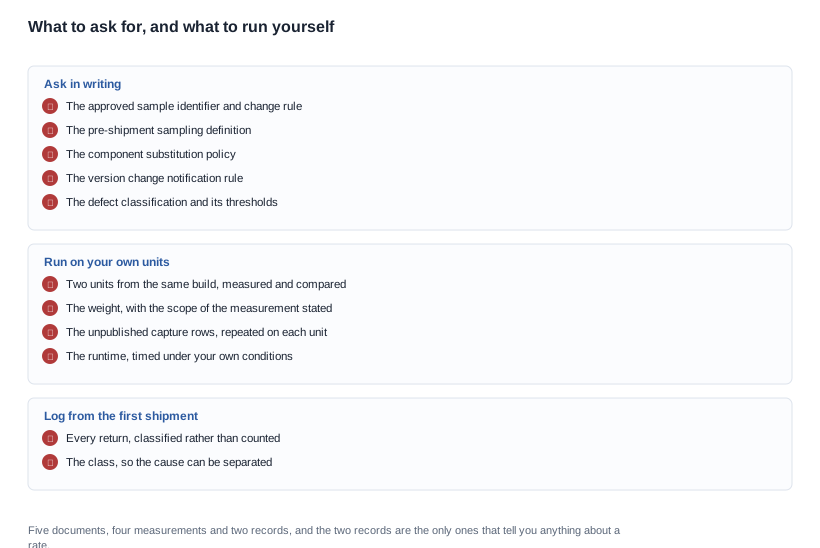
Five requests, each written so that the answer is a document rather than an assurance.
An approved sample, and a rule for changing it. Not a statement that units will be kept to standard, but an identification of the approved unit, a rule that a change to components, firmware or process requires a fresh approval sample, and a record that the previous version stays on file. Without that rule, a factory can improve the product out from under the artwork, and the packaging still says the old thing.
A definition of the pre-shipment check. Not a percentage, a definition. What defect classes exist, what the acceptance number is, who inspects, whether that inspection is internal or third party, and what happens on a fail. If the answer is that every unit is checked, then the useful follow-up is what the check consists of and what it records, because a check that records nothing cannot be audited later.
A component substitution policy. Cells, modules, firmware and materials all change the product, and the question to settle is whether a substitution requires written approval and where that requirement is recorded. It belongs in the order rather than in a conversation, because a conversation is not a control.
A version change notification rule. This is the row that costs private-label programmes the most, because a version change is invisible in the box and visible to the customer, and the record gives no version data for any model in the range. Ask how versions are recorded, how the buyer is notified, and whether a version change re-opens the sample approval.
A defect classification. Returns arrive as anecdotes unless there is a classification with agreed thresholds, and the classification is what makes a return rate interpretable. A scratch on a temple, a cell that will not hold charge and an intermittent connection fault are three different problems with three different causes, and a single return number mixes them into a figure that cannot be acted on.
The fifth request has a subtlety that is worth spelling out, because it is the request most often made badly. A classification is only useful if the thresholds are agreed rather than proposed, and the agreement has to happen before the first shipment rather than after the first argument. The defect classes that matter for this category are not the ones a generic list would contain. They are the ones that follow from what these models actually publish: a runtime that falls short of the figure on the page, a charging behaviour that differs from the stated method, a frame weight that varies between units, a case that does not contain what the configuration says it contains, a lens or a fitting that does not sit correctly, an ingress marking that turns out not to hold, and a unit that will not pair. A generic list of cosmetic and functional defects will capture the easy ones and miss the two that are hardest for a channel to handle, which is the unit that behaves differently from the one that was approved, and the unit whose charge does not last a working day.
There is a related point about who sets the acceptance number, and it is worth being direct about it. A number written by the factory is a number the factory passes. A number written by the buyer, even an imperfect one, is a number that means something to the buyer's own channel, because the consequences of a fail are the buyer's consequences: a shipment held, a channel announcement postponed, a return rate that moves. The formulation that works is a defect class, a threshold and a stated consequence, agreed in advance, and it is worth having that conversation before the first production order rather than during the first dispute about a shipment. Nothing about this requires the factory to have a sophisticated quality system. It requires the two parties to have written down what they are each looking at.

What a buyer can verify without the factory
Five things, and each of them produces evidence a buyer holds rather than evidence a buyer is told about.
- Order two units and compare them, rather than comparing one unit against a specification. The difference between two units of the same build is the first real consistency data available, and it costs one extra unit and a measuring sheet.
- Weigh your own units, and state the scope of the measurement. Whether or not the catalogue figure can be matched, your own weight figure is a reference you own, and it is the one that matters for shipping and for comfort claims.
- Test the rows the catalogue does not publish, and repeat each measurement on every unit you have. The capture format and frame rate read from a recorded file, the runtime timed under your own conditions, and the charging input measured from a supply you control. Repetition across units turns three separate observations into a spread, and the spread is the answer to the consistency question.
- Run the pre-shipment check for the first order yourself, then decide from that experience whether to keep doing it. A first order is the cheapest place to learn what a check costs and what it catches, and the alternative is learning it on the second order.
- Classify your own returns from the first shipment, and put the classification in front of the supplier. This is the only route to a defect rate that means anything, because it is the only route to data you control, and it is the point at which a rate becomes possible at all.
There are four red flags to watch for in a quality conversation, and they are cheap to spot. The first is a consistency claim backed by a single unit. The second is a reference value whose scope is unstated, which is exactly the situation with the one weight figure in this catalogue, and a number that cannot be scoped cannot be compared to. The third is a rate offered without a classification behind it, because a rate without a classification cannot be attributed and therefore cannot be reduced. The fourth is a marked property presented as a settled one, which in this category applies to the ingress marking on two models where the record states there is no test report number behind the catalogue annotation. Before you commit to a quality programme, check for those four, because each of them describes a conversation that has been had with a factory and that has produced a comfortable answer rather than an auditable one.
How to read a quality programme against the record
A quality programme is only as good as the record behind it, and this one is narrow on purpose. We will not quote a defect rate, an incoming-inspection record, a sampling plan or a quality-control report that the product record does not contain, and we will not describe a control system as though it were documented when the documentation for it is not on the record. We will not present the one published weight in the catalogue as a benchmark for your units until its scope is confirmed, because the catalogue does not say what it measures. We will not treat an ingress marking as a verified property, because the record states that the marking is a catalogue annotation with no test report number behind it. And we will not describe a single measured unit as evidence of consistency, because consistency is a property of a population and one unit is not a population.
What the record does support is a division of labour that makes a quality programme efficient. The catalogue settles the specification rows, and it settles them well enough to build a shortlist against. A bench check, repeated across units, settles the physical and captured rows, and it is the only route to most of them. A laboratory settles the marked properties, and the request for that report belongs at the start rather than at the end. And the buyer's own return log, classified rather than counted, is the only source of a rate, and it begins with the first shipment rather than after it.
A brand that separates those four sources, and asks for the five documents in the form set out above, ends up with a quality file it can hand to a customer or an auditor. The sampling discipline that precedes all of it is set out in OEM ready platforms sample before bulk, the certification question that comes before quality is in certification checks, and the model-selection question that precedes both is in OEM ready platforms which models are ready. The sample evaluation page covers the evaluation format itself, and the quality consistency page covers how the post-shipment records are kept.
Send the market, the quantity and the failure modes you most want to avoid, and we will tell you which of the five verification steps you can run on your own and which ones depend on documents you should ask for.


