

The segment is small and the export footprint is not. Three products sit in the sport line of the catalogue, and between them they carry three different cell configurations, two charging methods, a camera function on two of them and a multi-transducer audio arrangement on all three. Each of those differences changes what has to travel with the consignment and who has to be satisfied before the consignment leaves, which is why the useful question is not what has to be exported but which of the three is going where, under whose obligation, and on whose evidence.
The published record supplies the facts that shape that decision and very little else. One product has a pair of 70 mAh cells, a rated endurance of about eight hours, a charge ceiling of two hours and magnetic charging. One more uses a single 115 mAh cell, is rated at about seven hours, and reaches a charge in roughly an hour over a Type-C port. The third has a 100 mAh cell, a rated endurance of about eight hours, the same roughly one-hour charge over the same port, and the same radio generation. The feature lines add a remote shutter to two of them and a surround or stereo audio arrangement to all three. Nowhere in the range is there a row that states a conformity status for a model, and the certificates reproduced as images in the front matter of the catalogue protect the appearance of the products and one mechanism, which is a different kind of record from one that evidences that anything meets a market requirement.
That is the starting position. What follows works through it: the questions a destination market asks of a product, who makes each determination, the evidence a buyer has to hold, the three ways in which this segment's footprint differs between its products, and the sequence in which the work has to be done so that the paperwork and the carton end up describing the same object.
Sport smart glasses export considerations: what changes between destination markets
A destination market is best thought of as a set of questions it asks of a product, because the questions are the same everywhere and only the answers move. Five of them are live for this segment, and none of them is answered by the catalogue.
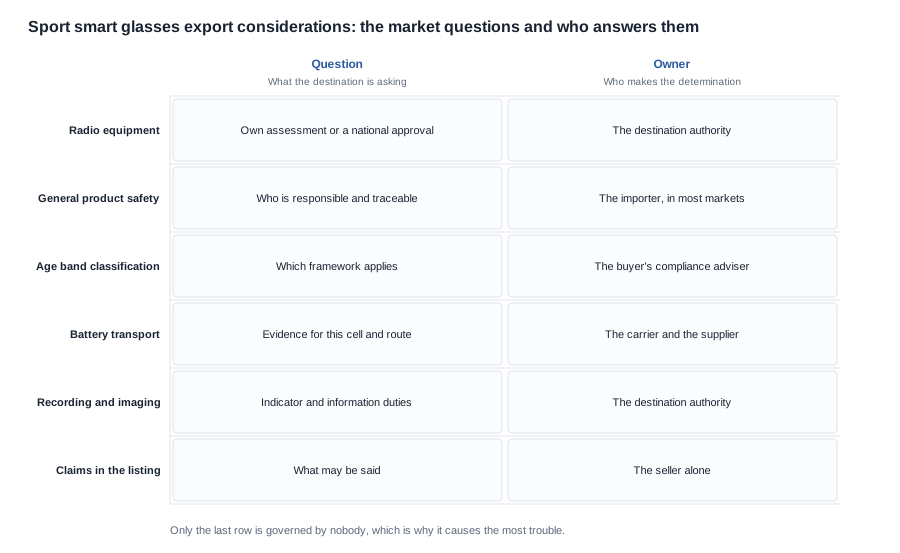
The radio question. All three products carry a radio, and the radio is what pulls the product into the equipment regime that most markets watch most closely. That regime is the Radio Equipment Directive (EU) 2014/53/EU inside the European Union. The question a buyer answers per destination is whether that destination accepts a manufacturer's own assessment of the radio or insists on a separate national approval before the product may be sold. Some destinations do and some do not, and the answer carries a lead time and a cost that belong in the market plan rather than in the product plan. The standards a radio test report will likely reference — the EN 300 328 series for short-range wideband transmission and the EN 301 489 series for electromagnetic compatibility — describe the method that was applied. They are methods rather than permissions, and a reference to one should never be read as a document that allows sale.
The product safety question. A product placed on a consumer market carries general safety obligations, and in the European Union those sit under the General Product Safety Regulation (EU) 2023/988, which places duties on the party responsible for the product, requires the product to be traceable, and requires safety information to travel with it. Which party that is in a given destination is a question the buyer has to answer, and in most destinations the answer is the party importing rather than the factory.
The classification question. Some destinations apply extra rules depending on what the product is and who it is meant for. The frameworks a compliance adviser works from once the product has been placed in an age band are EN 71 in the European Union and ASTM F963 in the United States, together with the consumer product safety rules each jurisdiction administers. The commercially decisive point is that this is a determination the buyer obtains rather than a set of requirements that arrives automatically with a product intended for adults. A product sold through a general consumer channel and a product sold into a childcare or school procurement attract different answers, and the difference follows from the buyer's own classification of the product and the age band it is placed in.
The battery question. This is the one that differs most between the three products, and it has to be settled before the first consignment is packed rather than in the week it ships. Each cell configuration needs its own transport evidence, and these three do not share one. The evidence for a single 115 mAh cell is not the evidence for a pair of 70 mAh cells, and the answer changes again with the mode and the route.
The recording and imaging question. All three products carry microphones as part of the audio arrangement, and two of them add a remote shutter. In a number of destinations a device that can capture sound, or a device that can capture images, attracts obligations of its own: a visible or audible indicator, information supplied alongside the product, or a restriction on how it may be offered. This is a real export variable in this segment and it is invisible to a buyer who has only read the electrical rows.

Who makes the determination in each market
Export work is mostly a question of locating the decision-maker, and there are four of them, and in a given destination they are not the same party.
The manufacturer builds the technical file — the test reports, the applied standards and their editions, the design description, and the signed declaration that ties those documents to a product designation — and holds the cell documentation. What the manufacturer cannot do is determine what a destination requires. A buyer who asks a factory for a market approval receives a declaration that answers a different question.
The destination's authority determines what the product may be sold with, and its determination is the measure against which the importer's obligations are judged. Whether that determination arrives as a national approval, a registration, or an acceptance of the manufacturer's own assessment is a destination-level fact, and it has to be established for each one rather than inferred from a neighbouring market.
The importer is, in most destinations, the party that places the product on that market, and therefore the party the authority deals with. This is the part that surprises businesses selling through distributors: the party that signs a distribution agreement is frequently not the party the authority writes to. Where a destination requires a representative to be identified for it, somebody has to be appointed, and the appointment is a commercial decision with a cost, a term and a name attached to it.
The buyer's own compliance adviser makes the classification decision — the age band, whether any of the stricter frameworks apply, and therefore which requirements have to be met. It is a determination the catalogue cannot make and the factory cannot make on the buyer's behalf, because it depends on the channel, the buyer and the destination.
The sequence of those four is the sequence of the work, and it is not the sequence most people work in. Buyers typically start with the factory, request the file, and treat the destination determination as something that happens afterwards. Working the other way round is more efficient, because both the classification and the destination change what is worth asking the factory for. A buyer who has already established that the general consumer framework applies and that the product sits in an adult age band does not need a children's product file, and asking for one is not caution — it is misleading, because it invites a supplier to supply the wrong evidence.
There is one further determination that belongs to nobody in the supply chain and therefore to nobody at all: the seller's own decision about what the product is called in that destination, what the listing says, and which claims are made. Nothing regulates it, and it is the decision that most often creates a problem in a market where everything else has been done correctly.

The evidence a buyer has to hold for each destination
What follows is the working evidence set for a destination. It is written per destination, because a file held once for the whole range is a file that will be wrong for at least one market.
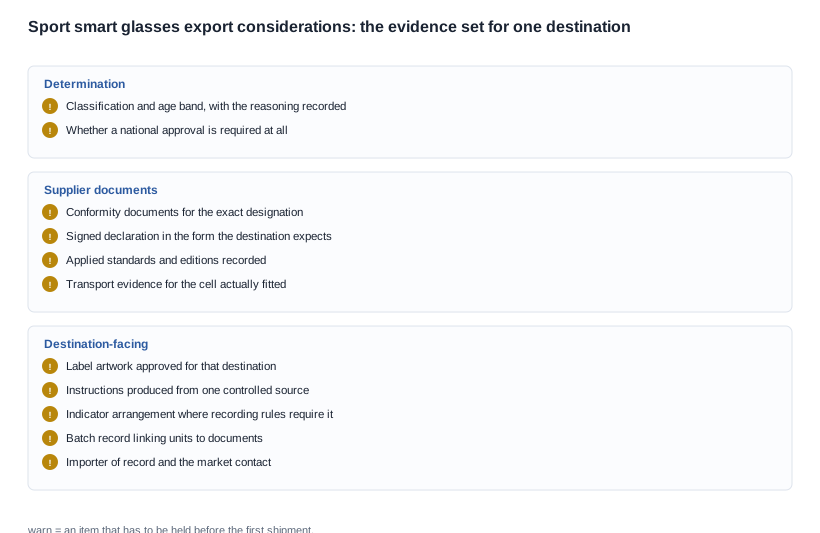
- The classification and age-band determination for that destination, with the reasoning recorded rather than only the conclusion, because it is the document that justifies which requirements were applied and which were not.
- The supplier's conformity documents for the exact designation being shipped, with the applied standards and their editions recorded, and with the designation string matching the unit and the carton.
- The signed declaration that ties those documents to the product, in the form the destination expects.
- The destination's own determination, where one is issued, or the record of how the destination's acceptance of a manufacturer's declaration was established.
- The transport evidence for the specific cell configuration in that product, tied to the cell actually fitted and to the mode and route the consignment will use.
- The label artwork as approved for that destination, showing the marks, the warnings, the identifying information and any indicator arrangement the recording or imaging rules require.
- The instructions and warnings in the destination's language, produced from a single controlled source so that every destination describes the same product.
- The batch or serial record that links a shipped unit to its documents, because traceability is what turns a file into something that can be produced in a recall.
- The commercial record for that destination: the importer of record, the terms, the responsibility split and the contact who can answer a market question during the life of the product.
Nine items per destination, and the cost of the set is why the sequencing matters. The criteria for what to request are straightforward: a document that is issued against a designation, dated and versioned, beats a summary that is issued against a product range, and a document held once beats a document assembled three times. The red flags to watch for in a supplier's reply are a file that names no designation, a standard without its edition, and a market determination presented as a general practice that happens to have applied elsewhere. Three destinations and three products make nine combinations, and a good part of them share the same documents. Establishing which combinations share which, and asking for the shared ones once, is the difference between a documentation programme and a documentation project.
Two of the nine are worth expanding, because they are the ones usually treated as somebody else's problem, and because they are where the total cost of a market entry is usually found. The seventh — the instructions in the destination's language — is a translation with a legal character, and it is only cheap if it comes from a controlled source. A destination that receives a translation made from a retail page rather than from a controlled source ends up with an instruction set that does not match the documentation, and that mismatch is precisely what an authority asks about. The eighth — the batch record — decides whether a recall can actually be executed, and it is the item most often assumed rather than kept.

Where the three products differ in their export footprint
The most useful thing a buyer can do before planning a market entry is to stop treating the sport line as one product. The three differ in ways that each generate a separate document, and a buyer who has planned for one footprint will discover the others one at a time.
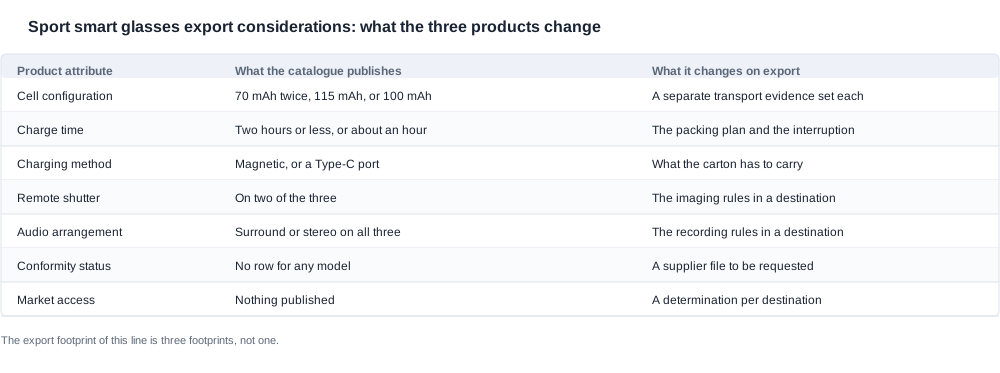
The cell configuration differs in all three. One product carries a pair of 70 mAh cells, another a single 115 mAh cell, the third a single 100 mAh cell. The transport evidence is produced per cell, and the cell also drives the charge time, which is published as a ceiling of two hours for the product that charges over a magnetic contact and as about an hour for both of the products that charge over a Type-C port. A buyer who has planned the freight and the carton on the assumption that all three charge alike will find a materially different packing plan for the one that does not.
The charging method differs in one of them. Two charge over a Type-C port, so the carton carries a standard cable that the customer probably already owns, and which a retailer can source from anywhere. The third charges over a magnetic contact, so the carton carries a proprietary lead that the buyer has to source, stock, count and replace, and which is a stocked line rather than a free inclusion. That difference appears nowhere in the export documents and appears everywhere else.
A remote shutter appears on two of them. A camera function is a materially different proposition from an audio function in a number of destinations, and it changes the classification work, the labelling work and the information supplied with the product. It is also the difference a buyer is most likely to discover late, because the feature line reads as a convenience rather than as a change in the product's regulatory character.
A multi-transducer audio arrangement appears on all three. Two describe a surround-sound arrangement and one describes a stereo surround arrangement in the catalogue's own words. All three therefore carry microphones, and the recording-device question applies to all three even where the camera question applies to only two.
The consequence is a simple planning rule: the export footprint of this line is three footprints, and the destination plan has to be built as a matrix rather than a list. The matrix is not large, which is the good news. The bad news is that a buyer who plans it as a list will ship the wrong carton to at least one destination, and a buyer who plans it as a single footprint will hold the wrong document set for at least two.

Sequencing the destinations before the order is placed
The order of the work decides whether the paperwork and the carton describe the same product, and it is not the order in which the documents arrive.
- Classify the product and the age band for each destination before anything is ordered. This is the determination that decides which frameworks apply, and it is the one that most often changes what has to be bought.
- Establish, per destination, whether its own approval is required or a manufacturer's assessment is accepted. This sets the lead time, and a destination with its own approval cannot be added to a launch plan late.
- Ask the factory for the document set in one consolidated request, organised by designation. A request organised by document produces documents; a request organised by product produces a set that can be mapped to a destination.
- Resolve the transport evidence per cell configuration and per route, and settle the packing that follows from it. The presentation condition for a cell travelling with equipment is a function of the mode and the route rather than of the product, and it is cheaper to establish before the artwork is finalised.
- Decide the carton per product and per destination. The two products that charge over a Type-C port and the one that charges over a magnetic contact do not carry the same contents, and the differences are small enough to be missed and expensive enough to matter.
- Produce the destination-language instructions from one controlled source, and keep a version record against it.
- Confirm the claims that will be made in each destination, and rule out the ones that are not supported. No protection claim may be made for any of these three, because none of them carries a protection rating; no claim about the camera function may be made beyond what the supplier's documents support; and no claim about the audio may be made beyond what is documented.
- Only then place the order, and open the batch record with the very first production run rather than piecing it together afterwards.
The last point is what distinguishes a programme that is ready to ship from one that is ready to be inspected, and it is the point at which a buyer who has done steps one to seven still has a problem. The documents have to describe the product that is actually in the container, and the only way to guarantee that is to fix the designation, the carton and the artwork before the production run rather than after it.
Our own position on this is that for the three products in this segment the documentation stops at the electrical rows and the feature notes, with no market-access row for any of them, so we will not describe any of the three as approved, cleared or certified anywhere, because that evidence is not ours to publish. What we will do is set out the questions each destination asks, who answers each of them, the evidence set a buyer has to hold, the three ways in which this segment's footprint differs between the products, and the order in which the work has to be done. A technical file and a signed declaration are supplier documents; the destination requirements are determinations that have to be made one market at a time, and the route a product takes afterwards is a service question, which the note on after-sales support sets out separately.
If you are planning entry into a set of markets for this line, the three things we need from you are the destinations, the channels you will sell through, and the three configurations you intend to ship; in return we will set out the per-market question set, the classification points that have to be decided before the order, and the document list mapped to designations and to cell configurations. The questions to ask your own compliance adviser are the same ones, and it is worth agreeing them in writing before the order rather than after the first consignment is held.


