
Cycling is the hardest environment in this category and the one where published specification helps least. Every model in the audio range publishes a battery, a charge time, a charging interface and a radio version. None publishes a wind figure, a microphone position, a frame weight or an ingress rating. This page is written for the buyer who has to build a cycling channel anyway: it sets out the staged ride test that replaces the missing rows, the published rows that still do real work once the test has narrowed the field, and the claims that cannot be made on the way to market.
Bluetooth audio glasses for cycling: the wind test replaces the missing row
No open-ear design eliminates wind noise at a microphone, and the reason is physical rather than a matter of engineering effort: the noise is generated where the air moves across the microphone aperture, and an open ear channel has no seal to exclude it. What differs between two frames is where the microphone sits and whether the frame's own shape shelters it. Neither is published for any of the eight audio models in this range.
That leaves a buyer with a choice of two bad options. You can write a claim about wind performance that no measurement supports and carry the consequences when a customer rides. Or you can run a test that produces a documented result and let that result, rather than the claim, carry the product. The rest of this page is the second option.
The four things riding adds to a requirements list
Wind at the microphone. This is the environment's defining variable and it is the one that scales badly with speed.
Frame movement. A frame that shifts on a head turn changes both what the rider hears and what the far end hears. Movement is a mechanical property of the product, and the only published proxy for it is the temple configuration — a slim temple or a detachable temple, which two models in this range publish and six do not.
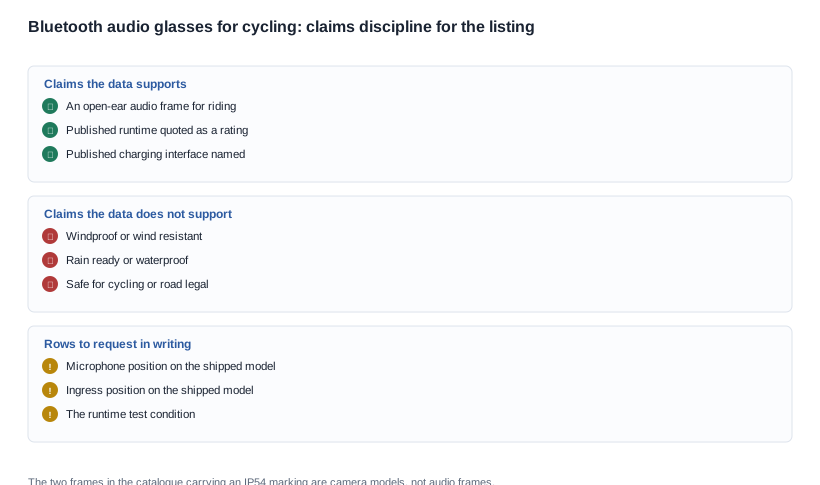
Water exposure. Rain, sweat and road spray are all part of the use case. No audio frame in this range publishes an ingress rating at all. Two models elsewhere in our catalogue carry an IP54 marking — the V06 and the S7, both camera models — and that marking describes protection against water spray rather than immersion, with no test basis given. Carrying that marking across to an audio frame is the easiest and most expensive mistake in this category.
Battery over a long ride. The published rated use figures run from about six hours to about eight hours with no stated test condition, and a long ride is a defined workload worth measuring rather than assuming.
What a cycling channel has to settle before it lists
A brand owner building a cycling channel needs to know which models can be listed at all, knowing that the customer will ride with the product within a week of delivery. The published rows will not decide it, and the listing will be judged on the road rather than on the sheet.
A procurement manager shortlisting for a cycling channel has to separate real differences between the quoted models from catalogue wording, and has to avoid carrying a published row across from a model that does not have it.
A channel buyer placing an order for a fleet customer needs a defensible statement about the product's behaviour in wind, because the customer will not accept a general claim and the supplier cannot make one either.
What a cycling channel costs when the wrong model lands
The commercial shape of a cycling failure is different from a generic audio failure, and the buyer should understand it before the shortlist is scored rather than after the first return.
The failure is discovered in public. A customer who rides the product on the first delivery finds out within minutes whether the audio survives the speed they ride at. That is not a support ticket that arrives next week; it is a photograph and a message, usually with a complaint attached, and in a cycling channel those two arrive together. A channel whose returns are public also has a public competitor, which means the failure rate is a commercial figure rather than an internal one.
The failure is seasonal. A product that fails in wind will not fail in a showroom, in a distributor's warehouse or during a static demo. That means the failure mode will not show up in any pre-shipment inspection the buyer performs in an indoor facility, and it will show up in the field at a rate that is hard to predict because it depends on the weather and the customer's riding speed.
The remedy is a return, not a fix. There is no firmware update and no accessory that fixes wind noise at the microphone. The remedy is a different model, which means the buyer's stock has to be reordered, the listing has to be rewritten, and the second launch costs more than the first. This is why the test has to happen before the order.
The claim exposure is the worst of it. A listing that promises a wind performance that no measurement supports turns an ordinary return into a claim, and in a category where the customer is riding the product in front of other people, that claim is a reputational one as well as a legal one. The commercial argument for running the ride test is therefore not only the return rate. It is the cost of the argument you avoid by not making the claim.
What published data can still decide before anyone rides
The published rows are not useless in a cycling channel. They are simply useful for a narrower set of decisions than buyers usually give them credit for, and using them correctly saves the sample budget.
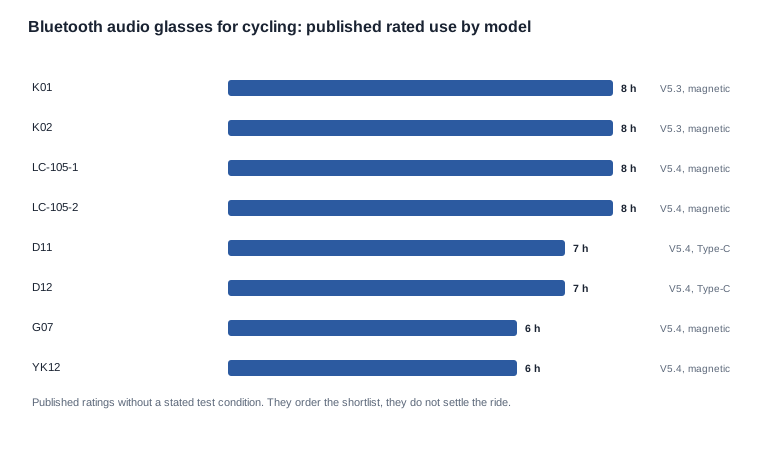
The rated use figure orders the shortlist. The LC-105-1 and the K02, and the LC-105-2 and the K01 publish roughly eight hours; the D11 and the D12 publish roughly seven; the G07 and the YK12 publish roughly six. A long ride is closer to the top of that range than the bottom, so a six-hour model needs a charging plan attached to it and an eight-hour model does not.
The charging interface decides the accessory chain. Six of the eight audio models charge magnetically, and the D11 and the D12 charge over a Type-C port. A rider carrying one cable for everything is a rider whose charging chain is a Type-C model; a rider with a frame bag is better served by a magnetic model and its dock.
The cell configuration sets the margin. The K01 and the K02 publish two 90 mAh cells; the LC-105 pair, the G07 and the YK12 publish two 55 mAh cells; the D11 and the D12 publish a single 100 mAh cell. Two cells of a given size and one cell of twice that size are not interchangeable from a charging-plan point of view, because the recharge behaviour of the pair differs from the single cell.
The radio version is the pairing decision. The K01 and the K02 publish Bluetooth V5.3, and the rest publish V5.4. That is a compatibility question for the rider's phone, not an audio question, and it should be quoted as such.
None of those four decisions answers the wind question. They decide what goes into the sample pool.
The published rows and the row that is missing, side by side
The gap between the two lists below is the entire subject of a cycling channel, and putting them next to each other is more useful than either list on its own.
| Row | Published for the audio range | What it settles for a riding channel | The caveat or the criterion to write |
|---|---|---|---|
| Bluetooth version | Yes, per model | Which rider devices can pair | A compatibility row, never an acoustic row |
| Cell configuration | Yes, per model | The margin on a long ride | Two cells and one cell recharge differently |
| Charge time | Yes, two hours or less | Turnaround at the office or the café | A ceiling, not a measured result |
| Rated use | Yes, about 6 h to 8 h | Whether a ride fits inside one charge | No test condition is published |
| Charging interface | Yes, per model | Which accessory chain a rider carries | Six magnetic, two over Type-C |
| Ingress marking | Not published for any audio model | Whether the frame can be ridden in rain | Nothing to claim without a report |
| Microphone position | Not published | How much wind reaches the microphone | Ask for the position on your model |
| Wind performance | Not published | Whether the audio survives the speed | A ride test at your riders' speed |
| Frame weight | Not published | How the frame sits at speed | Weigh a sample unit |
| Temple configuration | Two models only | How the frame behaves in movement | Movement test per configuration |
How the published rows should appear in the listing
There is a discipline here that costs nothing and removes a whole class of complaint. Every published figure in a cycling listing should appear with the word that makes it true. A rated use figure is published as a rating, so it is quoted as a rating. A charge time is published as a ceiling, so it is quoted as a ceiling and not as a promise. A charging interface is published per model, so the listing names the interface rather than describing it in general terms. And where a row is not published for a model, the listing is silent on it rather than vague about it.
This sounds pedantic, and in a category where the specification is four rows deep it is not pedantic at all. It is the difference between a listing that a customer's own compliance team can check and a listing that generates a question. A buyer who publishes "rated use of about eight hours" and "charging over a Type-C port" for a specific model can be checked against the catalogue line by line. A buyer who publishes "up to eight hours of battery" cannot, and has also made an assertion the catalogue does not support.
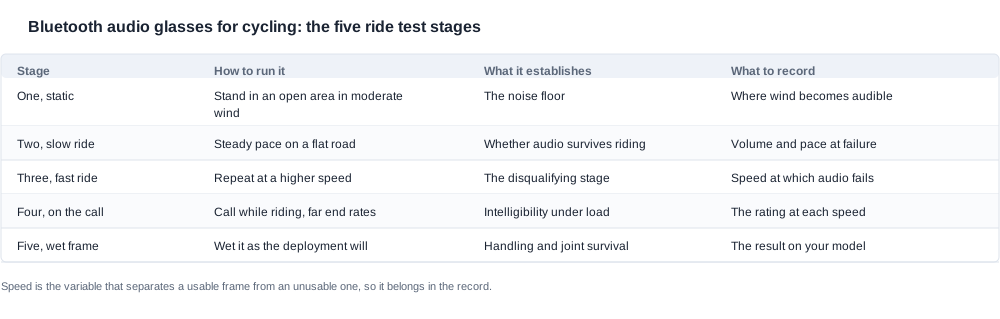
Five ride stages and the record each one has to produce
The ride test below is written so that a buyer can hand it to a supplier, a rider or an internal tester and get the same result. Every stage has a completion standard, because a result that is judged against criteria invented afterwards is a negotiation rather than a test.
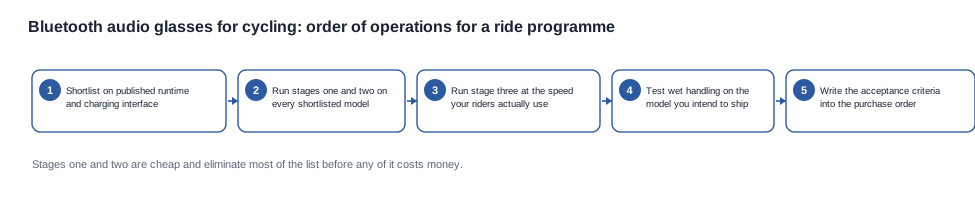
Stage one, the static noise floor. Stand in an open area in moderate wind and play audio. This establishes the floor: nothing on the ride will be better than this, so it converts "the wind is loud" into a reference point. Record the point at which wind becomes audible, described rather than quantified, because the audio hardware in the tester's own device sets the threshold and a number would be false precision.
Stage two, the slow ride. Ride at a steady pace on a flat road and play audio at the volume the rider would actually use. If the audio is unusable here, no specification on any sheet will rescue the product, and the buyer has saved the rest of the test budget by stopping. Record the volume and the pace at which it stops working.
Stage three, the fast ride. Repeat at a higher speed. This is the disqualifying stage, because the noise at the microphone rises far faster with speed than intuition suggests, so the gap between the static floor and a fast ride is much wider than a stationary test implies. Record the speed at which the audio stops working, and the speed at which a call becomes unusable. The speed is the part that makes the record reproducible by another rider.
Stage four, the call stage. Make a call while riding and have the far end rate intelligibility at each speed. This is the hardest measurement in the category and the one that matters most if the channel sells calls as a feature. A rating is needed rather than a yes-or-no answer, because a binary result cannot distinguish two models.
Stage five, the wet frame. Wet the frame the way the deployment will, then check a wipe and a wet joint. With a slim temple this is as much a mechanical question as an electrical one. Record the result on the specific model intended for shipment, because the ingress position is the row most likely to be misread.
Running the ride test on a supplier sample rather than your own
The supplier's sample is cheaper and the buyer's own sample is the only version that survives a dispute. The difference is not the riding, it is the chain of custody. A unit the supplier selects and hands over may have been configured, conditioned or chosen for its behaviour; the buyer's agreement is usually too loose to catch that, and the test then measures an exception rather than the product. A unit the buyer purchases on the same commercial terms as the production order travels the same route as the goods and answers to the same inspection, so the result and the lot are the same population.
Two further points make the difference between a result and a record. The protocol should be written down before the samples arrive, with the acceptance thresholds fixed in advance, because a criterion invented after the ride is a negotiation and the buyer starts it from the weaker position. And the record should be complete enough to be reproduced: stage, speed, volume, weather description and the far end's rating. A result that another rider cannot reproduce is an anecdote, and an anecdote is not evidence in a procurement dispute.
The commercial terms a riding channel should fix
The sample programme. A ride test needs at least one unit per model under test, and riders rather than a laboratory. Ask for the sample cost, the shipping terms and the timeline separately from the production quotation, so that the production price is not anchored to a sample-sized quantity, and so that the sample order does not quietly become the first part of the production order.
The acceptance criteria as contractual text. The stage results, with their speeds and conditions, belong in the purchase agreement. A lot that fails a stated criterion is a lot that can be refused; a lot that underperforms against an unwritten expectation has been accepted, whatever the buyer hoped for.
The return terms for a channel that tests in public. The return window, the quantity band that triggers a different process, and who carries the freight on a return all need to be agreed, because a cycling failure generates returns in clusters rather than singly. A warranty period with a stated response time matters here for the same reason it matters in the call channel: the end customer is waiting on it.
Payment nodes against inspection. Because the decisive rows are visible only in a ride test, a payment node released after the ride stages pass moves the risk to the right side of the contract.
What should not be negotiated. The compliance cost and the compliance lead time follow the testing body and the laboratory queue, and pressing on either produces a longer schedule rather than a shorter one. The per-configuration re-validation cost compounds with each configuration change, which is the reason to freeze the model list and the accessory list before the artwork is approved. And no amount of negotiation produces an acoustic specification; that has to be measured, or it has to be requested in writing and received.
Six ways a cycling channel ships the wrong claim
A wind claim was made from a datasheet. Symptom: the customer rides, the product is unusable, and the claim becomes the buyer's problem. Root cause: a listing asserted wind performance that no measurement supports. Prevention: describe the product as wind-affected unless a measurement exists, and put the ride result in the copy instead of a category adjective.
An ingress marking was carried across from another model. Symptom: a product sold as rain-ready that has no ingress position of its own. Root cause: a marking published on two camera models in the same catalogue was read as a family-wide fact. Prevention: check which model a marking belongs to, and treat an unmarked audio model as unmarked.
Only the static test was run. Symptom: the product passes at the sample and fails at speed. Root cause: the test was done in still air. Prevention: stages two and three run before the shortlist is scored, not after.
The frame was never tested in motion. Symptom: the frame shifts on a head turn and the audio level changes with it. Root cause: only a stationary fit check was done. Prevention: the movement check belongs inside the ride test, and the temple configuration is the variable to vary while running it.
The call row was assumed from the listening row. Symptom: a customer expects usable calls while riding and gets none. Root cause: a surround sound line on one model was read as a transmission row. Prevention: run the call stage, and keep the listening argument and the transmission argument apart in the copy.
The ride result was never recorded. Symptom: a second batch or a second model is compared against nothing, and the argument becomes about opinion. Root cause: the result was verbal. Prevention: record the stage, the speed, the volume and the far end's rating for every model tested, in a form another rider can reproduce.
The claims a riding listing can survive and the ones it cannot
We will not describe any model in this range as windproof, wind resistant, rain ready or safe for cycling, and we will not carry an ingress marking across from a camera model to give an audio frame an outdoor claim. We will not quote a frame weight, a microphone position or a wind figure that we have not been given, and we will not present a ride result as a published specification.
What we will do is tell you which published rows are relevant to a riding channel, be clear that the decisive test is a ride rather than a datasheet, and give you the acceptance criteria in writing so that the result is agreed between the parties rather than argued between the parties. A listing that says "wind-affected, tested to this speed on this route" is a listing that survives a customer's first week. A listing that says "windproof" is a listing that does not.
There is a commercial reason for that narrowness as well as an honesty one. In this category the customer is the only party who will ever test the product under the condition that matters, and a claim that the customer can disprove on the first ride is not a marketing asset. It is a cost centre: it generates the return, it generates the claim, and it consumes the margin on every unit that ships into that channel.
Six things to settle before a cycling order
- The ridden speed profile of your actual customers, written down, because it sets the stages.
- The published rated use figure and the charging interface for each shortlisted model.
- The acceptance criteria for each ride stage, written before the samples arrive.
- The ingress position for the model you intend to ship, which for every audio model in this range is that none is published.
- The results of stages two to four, recorded with speed, volume and the far end's rating.
- The claims the listing will make, checked against the ride record rather than against the category language.
Send the riding distance, the weather exposure and the models you are shortlisting, and we will tell you what is documented for each. The Bluetooth audio glasses collection page is the range reference, which model to pick covers choosing a platform from the published rows, and Bluetooth audio glasses for calls covers the other demanding environment.
Related reading
- The other demanding environment for calls — Bluetooth audio glasses for calls
- Choosing a platform from the published rows — which model to pick
- The charge-time rows behind a riding channel — Bluetooth audio glasses charging options
Send the riding distance, the weather exposure and the models you are shortlisting and we will tell you what is documented.


