

A hiking day is the least forgiving deployment in this whole category, and it is unforgiving in a way that is easy to describe and easy to get wrong. The device is carried from a car or a trailhead and then used for hours. There is no socket, no vehicle and no charging opportunity between the start and the end. The product is put on once and stays on. And the person using it is walking on uneven ground, where the difference between a device that stays where it is put and one that does not is the difference between a product that is used and a product that is taken off.
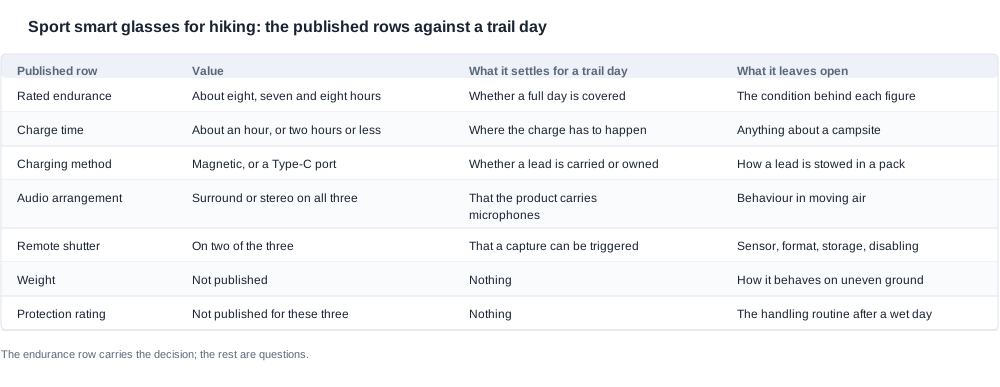
The sport line holds three products, and what the documentation gives for them is electrical: a pair of 70 mAh cells reaching a charge in two hours or less over a magnetic contact on one; a single 115 mAh cell charged in about an hour over a Type-C port on another; a single 100 mAh cell charged in about an hour over the same port on the third on the third. The feature lines describe a surround or stereo audio arrangement on all three and a remote shutter on two. No weight, no geometry, no camera specification and no protection rating are published for any of them.
For a hiking channel that is enough to sort the products and not enough to describe them, which is why this article is organised around the day rather than around the products. It sets out what a trail day asks of a device, why the endurance row does more work here than anywhere else in the range, which questions a trail raises that a desk test never reaches, what carrying and packing add to the specification, and the order in which the questions should go to a supplier.
Sport smart glasses for hiking: the day, and what it asks of a device
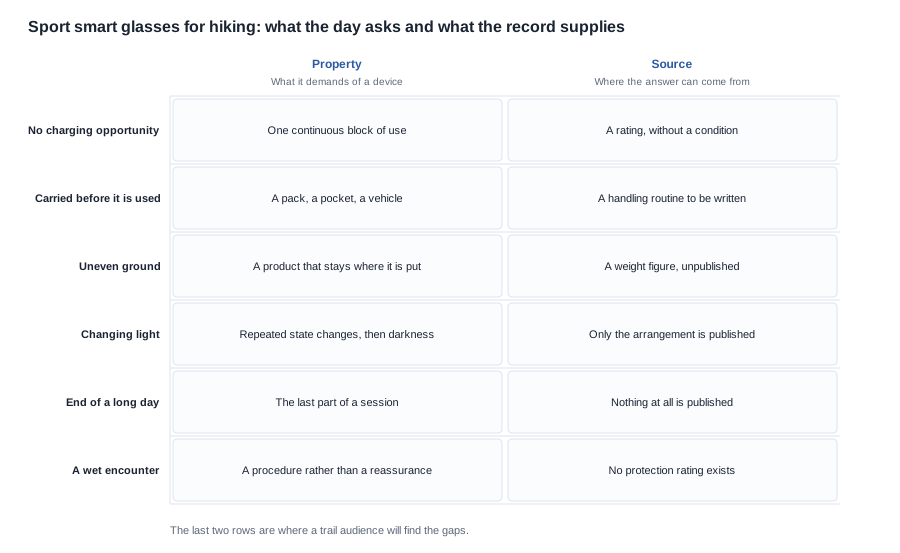
Four properties of a hiking day decide which published rows matter, and each one is a question a buyer should be able to answer before the range is chosen.
There is no charging opportunity. A day on the trail is one continuous block of use with no socket in it. Whatever the published endurance figure is, it has to cover the whole block or the product has to be carried partly unused. This single property is what makes the endurance row decisive here, and it is also why the published rating's missing condition matters: a rating measured under one set of assumptions and a day on a trail are not the same thing unless somebody has said what the assumptions were.
The device is carried before it is used. A hiker does not put a product on at the trailhead; they take it out of a pack, put it on, and put it away again at the end. The conditions it is carried in between are therefore part of the deployment: a pocket, a pack, a vehicle, a rucksack strap. None of these three carries a protection rating, so the handling regime in a pack is a decision somebody has to make and write down.
The ground is uneven. Whether a product stays in place on a moving head is a function of its weight and its geometry, and neither is published. This is the second decisive property, and it is the one that a product page for this segment cannot honestly answer.
The light changes. A trail crosses shadow and sun, and a day can end after dark. Two consequences follow. The first is that a product with a driven tint is being asked to change state repeatedly during the day, and the catalogue publishes nothing about how fast it changes or how it behaves during a change. The second is that the product's own state indicators have to be readable in poor light, which is a question about the documentation and the product rather than about the audio.
There is one more property that the catalogue says nothing about and that a hiking channel will be asked about constantly: what happens when the product is used at the end of a long day, when the cell is nearly spent and the person is tired. The published endurance figures are ratings, and a rating is not a description of the last twenty per cent of a session.

Why the endurance row decides more here than in any other use
The published endurances for the three run to about eight hours, about seven hours and about eight hours, and for a day on the trail that difference is worth more than every other published field combined, because there is no second opportunity to charge.
A hike commonly runs four to eight hours of movement, and the parts of it where the product is in use vary. A buyer who works the coverage calculation early will find the criteria for the shortlist before the quotations rather than after them, and that ordering is what keeps the comparison honest. A buyer who has decided on a trail audience therefore has to answer a question that the catalogue does not: at what point in the day does the product run out, and what does the person do then? If the answer is that the product is used for the first few hours and then switched off, the endurance row needs to cover a long morning rather than a whole day, and the decision about which of the three products to carry is a decision about the morning.
Two things have to be requested to make that decision sound. The first is the reference condition behind each published rating, because a rating without a condition is a planning number and a day on a trail is not a plan — it is a sequence of hours, some of them in shade, some of them at rest, some of them moving. The second is the behaviour at the end of the rated use: what state the product is in, whether it recovers when switched on again, and how long a recovery takes. The second of those is a question a hiker will effectively answer for the buyer if it is not answered in advance, because they will try it at the bottom of a valley rather than at a desk.
The charge time is the related field, and in a hiking deployment it is almost irrelevant. A product charged at the car before the walk starts does not need a fast charger; a product charged overnight at a campsite does, and there is no socket at a campsite. Whether the roughly one-hour charge times or the two-hour ceiling matter to a hiking channel depends entirely on where the charging happens, and that is a channel decision rather than a product one, so it belongs in the question set rather than in the specification.
The charging method matters for the same reason and for one more. A magnetic lead has to be carried or retrieved, and a Type-C cable is a thing a hiker is more likely to already have. Neither of those is a performance question, and neither should be argued from the published record.
The interesting commercial consequence is that a hiking channel and a cycling channel may end up stocking different products from the same three, not because the products are different in the way a buyer expects but because the day is different in the way that matters. A cyclist charges at the end of a ride and a hiker charges at the start of a walk, and a product that suits one habit does not automatically suit the other. The criteria for the shortlist therefore have to be written per audience, and the questions that matter follow from the criteria rather than from a generic list of product features. It is a simple observation and it is the one that most often decides which product a channel ends up listing.
The useful way to frame all of this for a buyer is as a coverage calculation. Take the published rating, subtract the hours of the day during which the product will genuinely be in use, and look at the remainder. If the remainder is comfortable, the endurance row is a non-issue for that channel and the decision moves to weight, geometry and the audio. If the remainder is thin or negative, the product is the wrong one for that day length, and no amount of marketing changes it.

The questions a trail day raises that a desk test never does
The published rows describe a device in a laboratory. A trail is a different environment, and the questions it raises are the ones that a buyer has to put in writing.
Weight, and what it does on an uneven surface. Not published for any of the three, and it is the first thing a hiker notices and the first thing a channel will be asked. The supplier's own view on how the product behaves when the ground is uneven, and on whether the frame or the temple is the part that moves, is a question worth asking explicitly because the answer determines the instructions.
Whether the product stays on the head. The same as above from the other side: is the retention a matter of the product's geometry, and does the geometry survive a day of being put on and taken off?
Whether the audio arrangement is usable on a trail. Moving air is a real acoustic condition and a manufacturer will usually have a view on it. What the catalogue publishes is the arrangement — a surround-sound description on two of the three, a stereo surround description on the third — and nothing at all about how it behaves outdoors, in wind, or with one ear covered by a strap.
What the camera function does on a trail. Two of the three carry a remote shutter and the catalogue publishes no sensor, no field of view, no format, no frame rate and no storage arrangement. A trail is a poor environment for a camera and a good one for the questions: how a capture is triggered while the product is on the head, whether the result is usable while moving, and what happens to the file afterwards. A buyer should be careful here, because the temptation to describe the capability in adjectival terms in a listing is exactly the thing that cannot be substantiated.
What the product looks like in low light. Whether the state indicators are legible in poor light is a documentation question, and it is a question that a hiker will answer in a photograph rather than in a complaint.
How the product is wiped during and after the day. No protection rating is published for these three, so the routine has to come from the supplier rather than from a general assumption about what a sealed product can take. What the supplier is able to state about substances for the surfaces, about the acoustic openings, and about the charging contacts is a legitimate question, and it is one that a hiking channel has to answer because the customer will do it anyway.

Carrying, packing and the questions about handling
A product on a trail spends a good part of its life in a pack, and the pack is an environment that a product page never mentions and that a buyer has to think about anyway.
The first question is the one the catalogue leaves entirely open, which is the weight, and the second is the geometry, and the two together determine whether a product is comfortable to carry for a day or is a nuisance. There is no published figure for either, and a buyer who has not asked will find out from returns.
The third question concerns the charging accessory in a pack, and it is a practical one rather than a technical one. A lead has to be retrievable without emptying the pack, and it has to be stowed in a way that does not damage the contacts. Where the charging method is a magnetic contact, the lead is a specific part that the buyer has to stock and that has to be included in the instructions, because the alternative for a customer who has left it at home is a product that cannot be charged. Where the method is a Type-C port, the customer can substitute a cable they already own, which removes a whole category of support conversation. That is a packaging and instructions decision rather than a performance one, and it is discussed at length in the packaging note for this line.
The fourth is the state of the product when it is put away. If it is switched off and then switched on again an hour later, does it come back in the same state? If it has been in a pack at a different temperature, does it come back differently? These are the questions a hiker answers by trying, and the answers belong in the instructions and in the supplier's documentation.
Between the four questions and the fifth there is a fifth-and-a-half that a buyer should not skip, and it is the one that decides whether the channel can sell into a wet-weather audience at all. It is whether the supplier will state, in writing, that the product is not covered by any protection rating. The catalogue publishes no such rating for these three, which is a fact rather than a weakness, but it is a fact that has to be communicated rather than left to be discovered. A channel that has asked the question has an answer it can use in its own documentation, and a channel that has not asked it will find out from a customer.
The fifth is what happens if the product gets wet. No protection rating is published for any of these three, so the answer cannot be a reassurance. What it can be is a procedure: what the supplier says about the product after it has been exposed, whether it should be dried before it is charged, and what the customer should not do. A channel that sells into a wet-weather audience needs that procedure, and it needs it in writing.
A hiking question set, in the order it should be sent
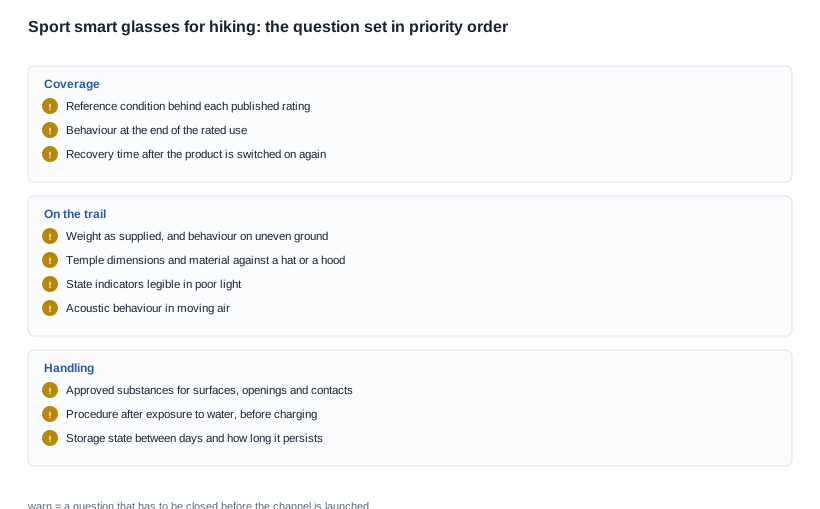
The list below is what a buyer sends to a supplier. The slow answers are asked for first and the ones a sample can settle are asked for last, because a pilot that has to wait for a document is a pilot that stops.
- The reference condition behind the rated endurance published for each product, and whether the three results were taken on a common basis.
- What the product does at the end of its rated use, including whether it recovers and how long the recovery takes.
- The weight of each product in the configuration it would ship in, and the supplier's view on how it behaves on uneven ground.
- The temple dimensions, the frame material and the scope for adjustment, and how the product interacts with a hat or a hood.
- The state indicators, and whether they are legible in poor light.
- What the supplier permits to be used on the surfaces, the sound openings and the charging contacts, given that the products carry no protection rating.
- The acoustic arrangement outdoors, and what the supplier can say about moving air.
- What the two products carrying a shutter actually do when it is used — the sensor, the optical coverage, whether the result is a still or a clip, the format, where the file goes, and whether the function can be switched off.
- What the product does after it has been exposed to water, and whether it should be dried before charging.
- The state in which the product should be stored between days, and how long that state persists.
Ten questions, and the test for the answers is the one that applies everywhere in this range: numbers that arrive with the condition they were taken under, descriptions that arrive with the method they were taken with, and papers that arrive with a date on them. They are also the test a buyer's own compliance and technical teams will apply to whatever comes back, so agreeing them in advance is what makes a supplier's reply usable rather than merely received: numbers that carry the condition they were taken under, descriptions that carry the method, and papers that carry a date. The red flags are a runtime promise with no condition behind it, a reassurance about weather that the record does not support, and a weight figure quoted for a configuration that is not the one being ordered.
Our own position is that where the three products in this segment are concerned the documentation stops with the electrical rows and the feature notes, with no weight, no geometry, no camera specification and no protection rating for any of them, so we will not describe any of them as ready for a trail, or as able to withstand one, and we will not quote an endurance figure as though it were a measured duration. What we can do is work out which published row carries the weight of the decision for a given length of day, and which questions have to go to the supplier to close the rest.
If you are building the question set for a trail audience, give us the length of day you expect to serve, the channels, and the priority order you need, the proportion of that day during which the product would be in use, and whether the channel is buying for the retail shelf or for a guided operation, and we will return the question list in priority order with the ones a sample can answer separated from the ones that need a document.


