

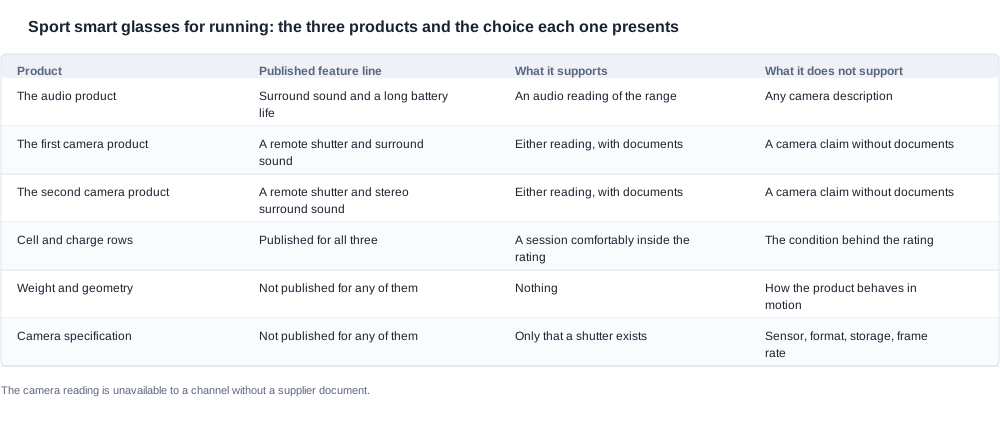
Running splits this category more cleanly than any other use, and the split is written into the catalogue. Of the three products in the sport line, one carries a surround-sound arrangement and a long battery life and nothing else, while the other two add a remote shutter to a surround or stereo audio arrangement. A running channel therefore has an immediate question to answer, and it is not a technical one: is the product being bought as an audio product or as a camera product? Everything about the shortlist, the listing and the question set follows from that answer.
This article works through the choice as a worked scenario. It is a hypothetical case — a running channel working out what to list — and it is not a description of a client project. The scenario is used because the decision sequence is more instructive than a comparison table: a running buyer has to make the audio-or-camera call before the electrical rows mean anything, and the sequence shows where that call bites. The criteria that follow from it are what to ask, in what order, and what a supplier has to put in writing before a listing can be published.
The scenario runs on the published record. The catalogue gives three sport products and, for each, the electrical rows and one or two feature lines. What it does not give is a weight, a geometry, a camera specification, a protection rating or a price, and every part of the scenario below is shaped by those absences.
Sport smart glasses for running: an audio product or a camera product
The two readings of the same category produce different products, different listings and different questions, and the difference starts with what the customer is buying.
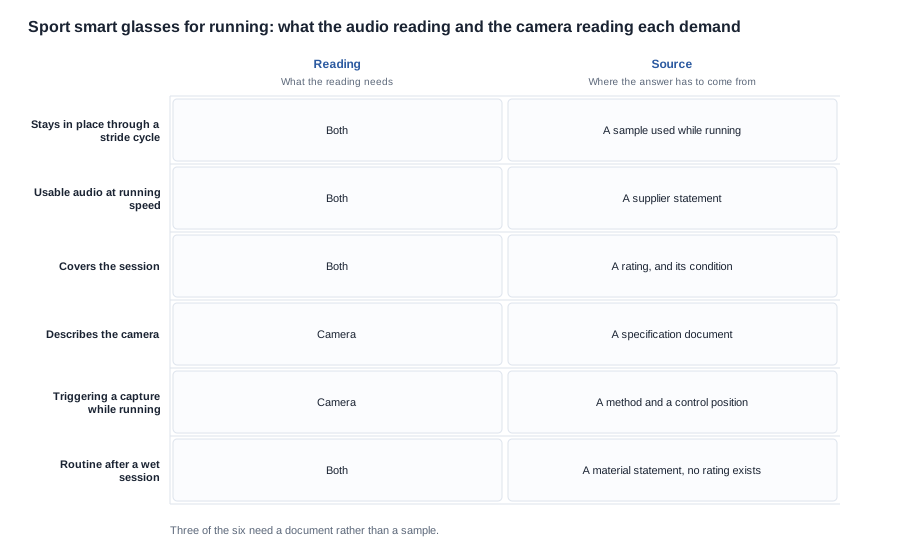
Read as audio. The product is a way of having audio and prompts available during a run, with the product on the head for the duration and nothing else expected of it. The criteria that matter are that it stays in place through a stride cycle, that the audio is usable at running speed, that the endurance comfortably covers the session, and that it is not a nuisance to carry for the remaining part of the day. Almost all of those are outside the published record, which makes the audio reading a sampling exercise with a fairly short question list.
Read as camera. The product is a camera that happens to be carried on the head, with audio as the secondary function. The criteria that matter are the camera specification, how a capture is triggered while running, whether the result is usable at running speed, and what happens to the file. The catalogue publishes none of the camera detail for either of the two products that carry a shutter, and that is the decisive fact about this reading: it is not a question of preference between two products, it is a question of whether a product can be described at all.
There is a fourth consideration that belongs in the reading itself rather than after it, and it is the one that decides how much of the published record is useful. A run is short, which means the endurance row is not the deciding field, and it means the whole weight of the decision falls on the fields the record says least about. That is worth stating plainly at the start of a channel conversation, because a buyer who assumes the published rows will decide the choice will spend the first round of a quotation on the wrong questions, and will then discover at the sample stage that the range it is carrying cannot be described.
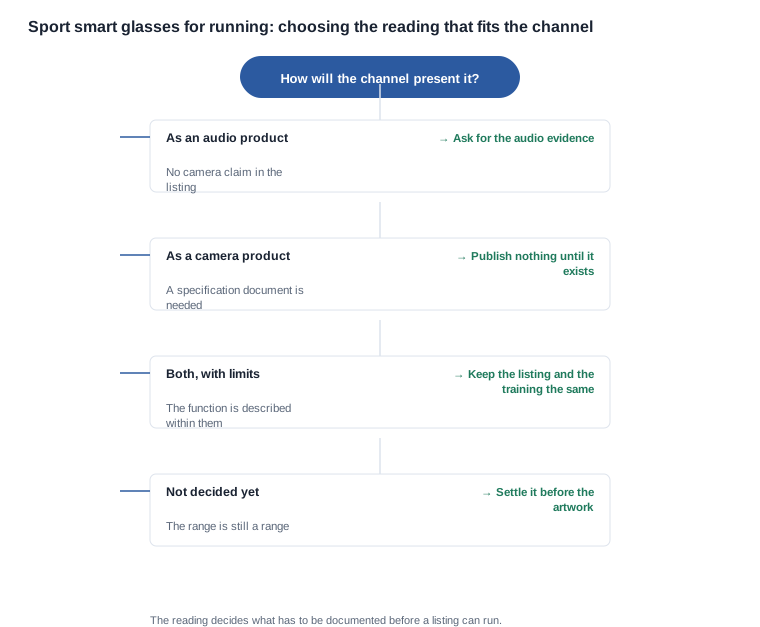
The third reading exists and is worth naming, because it is where a lot of channels end up. The product is bought as an audio product by most customers and is occasionally used as a camera by some of them, and the channel has to decide how to present that. Presenting it as a camera product invites a specification claim the record cannot support; presenting it as an audio product is defensible, and the camera function becomes a secondary line whose documentation comes from the supplier. That is a defensible commercial position and it is a decision the channel has to make explicitly rather than by default.

The scenario, and the four facts that decide it
The scenario is a running channel with a retail and an online channel, a product range of three published models to choose from, no published specification beyond the electrical rows and the feature entries, and a buyer who has to commit to a range before the season opens. Four facts about that channel decide the outcome, and none of them is in the catalogue.
Fact one: the session length. A run is typically far shorter than the published rated endurances, so the endurance row is comfortable for all three and does not discriminate. That fact removes the field that usually decides a purchase in this category, and it forces the decision onto the fields that are documented least.
Fact two: the product has to stay exactly where it is. A run repeats a stride cycle hundreds of times an hour, and the tolerance for movement in this use is much tighter than for a walk or a ride. Weight and geometry are the two fields that decide it, and neither is published for any of the three. Whatever the channel chooses, the choice has to be made from a sample, and the sample has to be used while running rather than standing.
Fact three: the channel cannot describe a camera. If the channel intends to present the camera function, the sensor, the field of view, the capture format, the frame rate and the storage arrangement all have to come from a supplier document, and the catalogue has none of them. The question for the buyer is therefore binary and comes early: is a supplier document available, and is it good enough to build a listing on.
Fact four: there is no protection rating. None of the three products in this segment carries one, so a running channel selling into a summer season cannot make any statement about resistance to sweat or water, and the routine in the field has to be written from a supplier statement rather than assumed. This is a limit on what may be said, not a defect in the product, and it is the same limit the other uses in this segment carry.
With those four facts in place, the shortlist is no longer a comparison of the three products on the published rows, and the negotiation changes shape as well. A buyer who arrives with a comparison to settle has a price conversation. A buyer who arrives with a list of documents to obtain has a scope conversation, and the second one usually produces a better outcome, because it is the one a supplier can act on. It is a comparison of the three products on what has to be sampled, asked and documented, and the sequence below is the one that follows.
Step by step through the decision
Step one: settle the audio-or-camera reading. This is a commercial decision before it is a technical one, and it is taken by the channel rather than by the customer. The criterion to apply is whether a supplier document exists that can support a camera description at the level the channel intends to publish. Without it, the camera reading is not available, and the range is presented as audio with the camera function carried as a secondary line.
Step two: remove the products that the reading excludes. If the reading is audio, the two products that carry a shutter are not excluded, but they carry a function the channel is not describing, and that has to be handled: the listing must not invite a comparison the channel cannot support, and the instruction insert has to describe the function in a way that matches the listing. If the reading is camera, then the product without a shutter is excluded on the reading itself, and the remaining decision is which of the two camera products to carry, which is a camera-specification question rather than an audio one.
Step three: take the samples, and use them the way the product will be used. The weight and the geometry come from measurement, and the movement tolerance comes from use. A sample that is measured on a desk and then used on a run gives two different sets of information, and the second is the one that decides the shortlist. This is also the point at which the supplier's willingness to support a small sample order becomes visible, and it is worth reading that willingness as part of the evidence.
Step four: ask the questions that the samples cannot answer. The endurance reference condition, the state at the end of a session, the acoustic behaviour at speed, the camera specification if the reading includes it, the approved substances for the surfaces and the acoustic openings, given that no protection rating exists, and the state in which the product should be stored between uses. These are supplier documents, and the ones with the longest lead time go first.
Step five: cost the two channels separately. The retail unit and the online unit do not have the same accessory requirement, the same packaging requirement or the same documentation requirement, and a running channel that treats them as one line usually discovers the difference at the point where the artwork is locked.
Step six: write the range decision down before the season. The profile, the reading, the shortlist and the reasons. A running channel that changes its mind in the middle of a season will find that the documentation has to change with it, and the documentation is the slowest part of the whole programme.


What a channel says about the camera when it does not describe it
Deciding not to describe the camera function is a normal commercial choice, and it is a choice that has to be executed rather than merely taken. A channel that has chosen an audio reading and then leaves the camera function visible on the shelf has not made the choice; it has deferred it to the customer, and the customer will ask about it, and the answer will come from whoever is nearest.
There are three things a channel can do, and they are not equally good. The first is to say nothing and let the product speak for itself, which is what happens by default and which is the option that creates the most work later. The second is to describe the camera function accurately and completely, which requires a supplier document and a specification the channel is willing to stand behind. The third is to describe the capability in terms of what is documented — that a remote shutter is present, that a capture is triggered from a control, and that the resulting file is handled in a particular way — and to say plainly that the image specification is supplied on request rather than in the listing.
The third option is the one most channels should be able to reach quickly, because it is built out of information the catalogue already provides. It is also the option that requires discipline in the writing, because a description of a shutter that drifts back towards adjectives is a description that has quietly become a claim. The discipline is simple and checkable: the words used about the camera have to be words the supplier used or words that can be traced to a document, and where a document is missing, the listing says that the document is available rather than describing what is in it.
The commercial reason to do this deliberately is worth stating, because it is the difference between a range that survives its first season and one that does not. A camera function described beyond what the documentation supports produces two outcomes, and both are expensive. Either a customer orders expecting a camera specification and receives something else, which becomes a return and a review; or a competitor compares the two listings and points at the difference, which turns a marketing decision into a credibility problem. A channel that has described the function within its documented limits has neither exposure, and it has the additional benefit of a document it can send when the question is asked, which is what converts an enquiry into an order.
The other side of the same decision is the internal one. A channel that chooses not to describe the camera still has to decide what its own people say when a customer asks, and the answer has to be the same as the answer in the listing. That means the supplier document has to be in the business even if the listing does not quote it, and it means the training material has to carry the same limit. The cost of obtaining the document is lower than the cost of the mismatch, and the criteria for deciding are the same ones that apply to every other part of the range: what to ask, in what form, and what to do with the answer if it does not arrive.

What the running channel has to ask the supplier
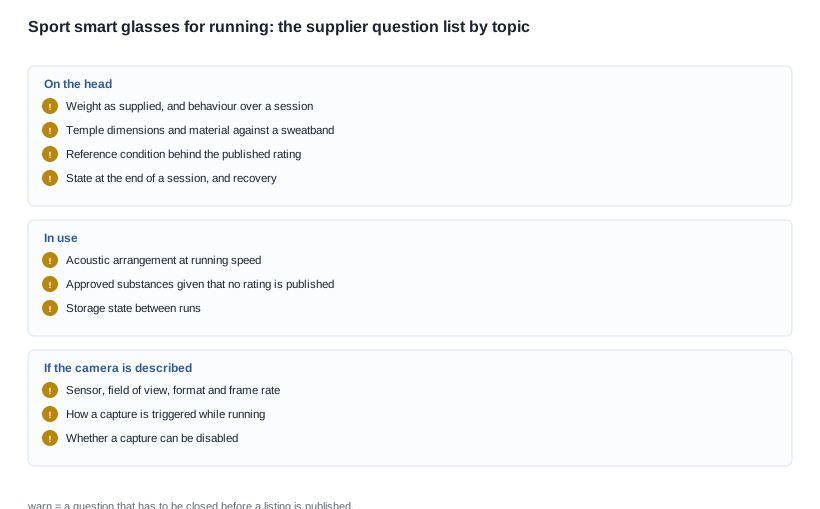
The list is short because the session is short, and it is ordered so that the questions with the longest lead time come first.
- The weight of each product as it is supplied, and whether the supplier has a view on how it behaves over a session with repeated movement.
- The temple measurements, the frame material and the scope for adjustment, together with how the product sits over a sweatband or a hat.
- The reference condition behind each published rated endurance, and what state the product is in at the end of a session.
- The substances approved for the surfaces, for the sound openings and for the charging contacts, given that none of them carries a protection rating.
- The state a product should be left in between one run and the next, and whether it returns to that state on its own.
- The acoustic arrangement at running speed, and what the supplier can state about noise pickup.
- For the products that carry a shutter: the sensor, the field of view, the capture format, the frame rate and the storage arrangement, together with how a capture is triggered while running.
- Whether a capture can be disabled, and what the product indicates while a capture is in progress.
- The charge time measured from a stated starting state, and where the charging is intended to happen.
- The warranty route and what it covers, since a product carried in a pocket and used in a wet environment has a defined set of failure questions that the channel will be asked.
Nine or ten questions, and the criteria for reading the answers are the ones that matter in this category: figures that carry their condition, descriptions that carry their method, documents that carry their date. The red flags to look for are a runtime promise with no condition, a camera description with no specification behind it, and a statement about substances that is a reassurance rather than a material statement.
The limits of what this scenario can tell you
A worked scenario is useful because it shows the sequence, and it is limited because the scenario is invented. Three limitations are worth stating so that nobody reads more into it than it supports.
First, the scenario assumes a channel with three published products to choose from and nothing beyond the electrical rows and the feature entries, which is the position our catalogue is in. A buyer working with a supplier who publishes more has a shorter step two and a shorter step four, and the commercial difference between the two positions is worth putting on the table before an order is placed.
Second, the scenario does not decide the shortlist, and it is not intended to. The product that wins a running channel will be decided by samples and by supplier documents, and the sequence says only what has to be true before that decision is made.
Third, the scenario says nothing about the market. It is a working scenario for a channel, and the questions it raises about a running audience — the session length, the movement tolerance, the absence of a protection rating, the gap between an audio description and a camera description — are questions a channel asks itself. They are not a market analysis, and they should not be presented as one.
Our own position on this is that the documentation for the three products in this segment reaches the electrical rows and the feature entries, and stops there, so we will not put a weight, a temple measurement, an image specification or a protection rating on the page for any of them, and we will not quote a rated endurance as a measured duration. What we can do is set out the decision sequence a running channel has to work through, the questions that have to be asked at each step, and the criteria that make the answers usable. The comparison against the wider range is the right place to see where these three sit against the rest of the catalogue.
If you are working through this decision for a running channel, give us the session length your customers actually run, whether you intend to describe the camera function, and the three product options you are weighing, and we will return the shortlist criteria, the question list in priority order, and the points where a supplier document is required before a listing can be written.


