

The conclusion on this subject is short and it is the reason this page exists. We publish no market size, no growth rate, no market share, no competitor comparison and no pricing data for this category, and we will not write any of them here, because the catalogue holds none of them and the alternative is a number that nobody can check. What we can do is three things that are more useful to a buyer than a trend line would be: set out the structural observations the published record genuinely supports, list the claims this category collects and explain why each of them is unsafe to repeat, and describe what a buyer can put in their place.
There is a commercial reason to be rigorous about this rather than merely cautious, and it is worth putting early. A page that repeats a claim nobody can check is not neutral; it is a liability that the buyer inherits the moment it is quoted onward, because a claim that appears in a buyer's own material is the buyer's claim. The claims a buyer repeats are the ones that come back to them in a dispute, and the cost of a dispute is not the disputed sum.
The structural observation that matters most is a small one. The catalogue contains twenty-eight products, and three of them are in the sport segment. That segment is not a market, it is three products, and the two of them that carry a remote shutter are not distinguished from the third by anything the record publishes about that camera. Any page that describes this category as a growing market is describing a market that does not exist in our own documentation.
The second observation is that the segment sits inside a wider range of twenty-eight products, and the three products are structurally close to each other: the same radio generation across all three, a charge ceiling of two hours on one and roughly one hour on the other two, and cell configurations that range from a pair of 70 mAh cells to a single 115 mAh cell. A buyer reading the segment is reading three variations on one idea, which is a different commercial situation from reading a segment with several distinct products in it.
The third observation is that the two products with a shutter carry a feature line and nothing else about that function. There is no image sensor specification, no optical coverage figure, no recording format, no frame rate and no arrangement for holding the result published for either of them. A market narrative that says the segment is moving towards capturing and sharing is describing a capability that the record does not document and that a channel cannot yet describe either.
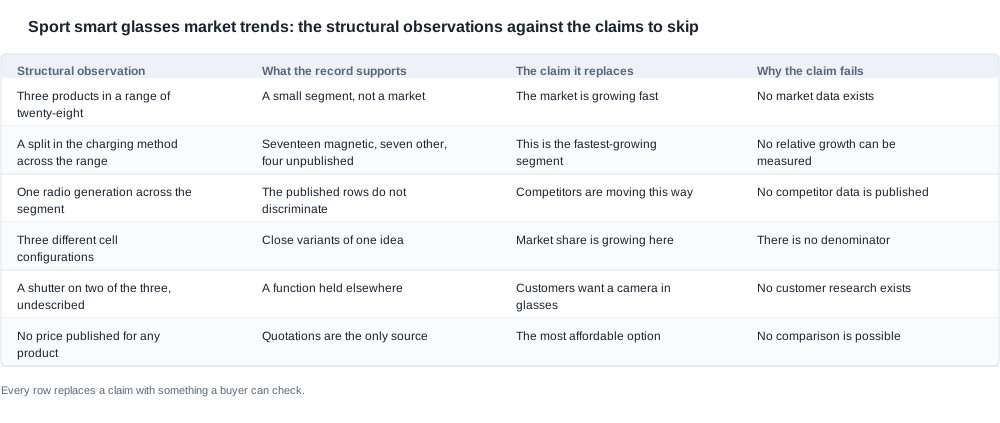
Sport smart glasses market trends: the structural observations we can support
Four observations come out of the published record, and they are worth more to a buyer than an unsupported trend because they can be checked.
The segment is three products inside a range of twenty-eight. The range divides into audio products, sport products and camera products, with a few specialist entries, and the sport group is the smallest of the three. The practical consequence is that a buyer choosing this segment is choosing between three configurations of one idea rather than between a set of differentiated products, and the shortlist criteria have to be written accordingly.
The charging method splits the whole range, and the segment is in the majority group. Across the catalogue, seventeen entries charge over a magnetic contact, seven use a different connector, and four publish no charging-method row at all. The sport segment contains both a magnetic-charged product and two products on the standard connector, so a buyer in this segment is making an accessory and packaging decision per product rather than one decision for the segment.
The radio generation is uniform across the segment, and the cell class is not. All three products publish the same radio version, and they publish three different cell configurations with rated endurances that sit within an hour of one another. Where the published rows are uniform, the published rows do not discriminate, and the decision has to move to the fields the record leaves open.
Two of the three carry a function the record does not describe. A remote shutter appears on two of them, and the audio arrangement appears on all three. In a range where a feature line is often the whole of the differentiation, a feature line without any supporting specification is a signal to a buyer that the specification is held elsewhere — and a signal to a channel that the function cannot yet be described.
These four observations are what a buyer can take into a negotiation. They are also, in a sense, the whole of the market information available from this catalogue, and the honest thing to do with them is to use them as structure rather than to inflate them into a trend.
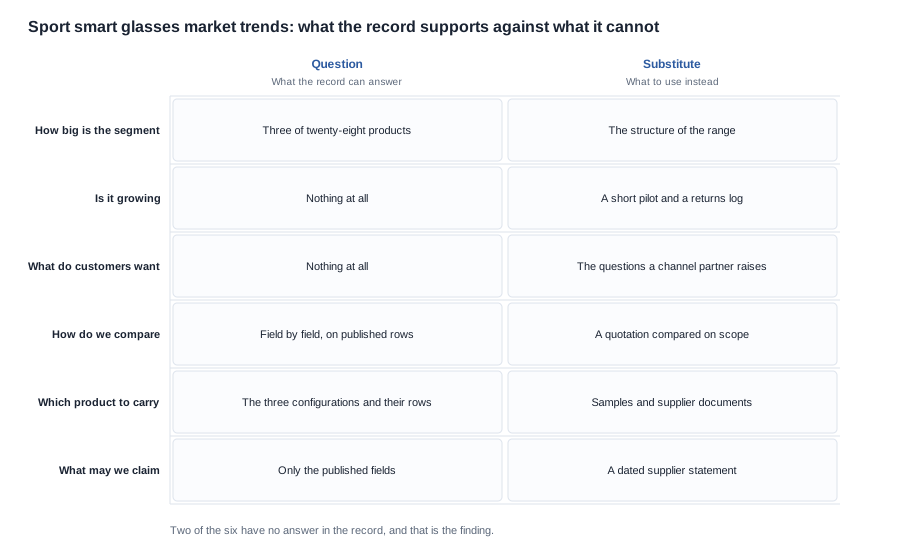

The claims this category collects, and why each of them is unsafe
The claims below are not unusual. They are the ones that appear in the category's own sales material and in the listings of businesses who have not been careful, and each of them fails for a reason that is specific rather than general.
"The market is growing fast." We have no market data of any kind, and neither does a buyer who reads this claim anywhere. The sentence carries no information that can be acted on, and it is usually the first sign that the rest of a listing is also unsupported.
"This is the fastest-growing segment." A statement about relative growth needs a measurement of this segment and of the others. Nothing of the kind is available, and the segment is in any case three products inside a range of twenty-eight, which makes a segment-level growth claim implausible on its face.
"Market share is growing in the sport category." A share claim needs a denominator that a buyer can reconstruct, and there is no published denominator for this category anywhere in our documentation.
"Competitors are moving towards X, so we are moving too." The naming of competitors, their configurations and their prices is not something we publish, and a buyer who receives such a comparison cannot verify it. Worse, the comparison is usually between a competitor's published claim and our own product, which is an argument about the honesty of the other seller rather than a reason to buy from us.
"Customers want a camera in their glasses." There is no customer research in this record, and the published feature lines do not establish a demand pattern — they establish what two of our products do. What customers want is a question a buyer answers with their own channel, not with a sentence in a supplier's brochure.
"Our glasses are waterproof / sweatproof / impact resistant." No protection rating is published for any of the three products in this segment. The rating exists elsewhere in our range for two other products, and transferring it is a straightforward misrepresentation.
"Eight hours of battery in real use." The published figure is a rating without a stated test condition. Turning it into a real-use promise is not a rounding error; it is the difference between a number the manufacturer stands behind and one it does not.
"Studio-quality sound." No acoustic descriptor is published for any of the three beyond the arrangement itself, and an arrangement description is not a quality claim.
"The most affordable option in the category." No price is published for any product in the range, so the comparison has no basis at all — and a claim of this kind is the one most likely to be repeated by a distributor who has been told it by a supplier.
The common feature of all eight is that each substitutes an assertion for an observation, and each of them costs a buyer more than it saves. A buyer who repeats one of them in a channel document becomes responsible for it, and the mechanism by which that responsibility arrives is always the same: somebody quotes the sentence back, in a channel document, in a tender response, or in a conversation with a partner who has noticed that the claim cannot be substantiated. At that point the buyer is defending a statement that was never theirs to make.
There is a second reason the substitution is worth refusing even when it sounds harmless. These claims are not neutral filler. They change what a buyer is compared against. A listing that says the market is growing fast is being compared against a listing that says nothing of the kind, and the first listing is more likely to be chosen for reasons that have nothing to do with the product. A buyer who refuses the claim and documents the refusal instead is buying a comparison that can actually be settled, and the documentation is what makes the comparison survive a second season.
The third reason is the one that matters most for this category in particular. The claims on the list above are the ones that get attached to the feature lines. A feature line saying that a remote shutter exists is a record; a claim that customers want one is a story; and a story attached to a record is what turns a specification into a promise. Every segment in this range has the same characteristic, and the sport segment has it more sharply than most, because two of its three products carry a function that the record does not describe and that the specification therefore cannot yet support.

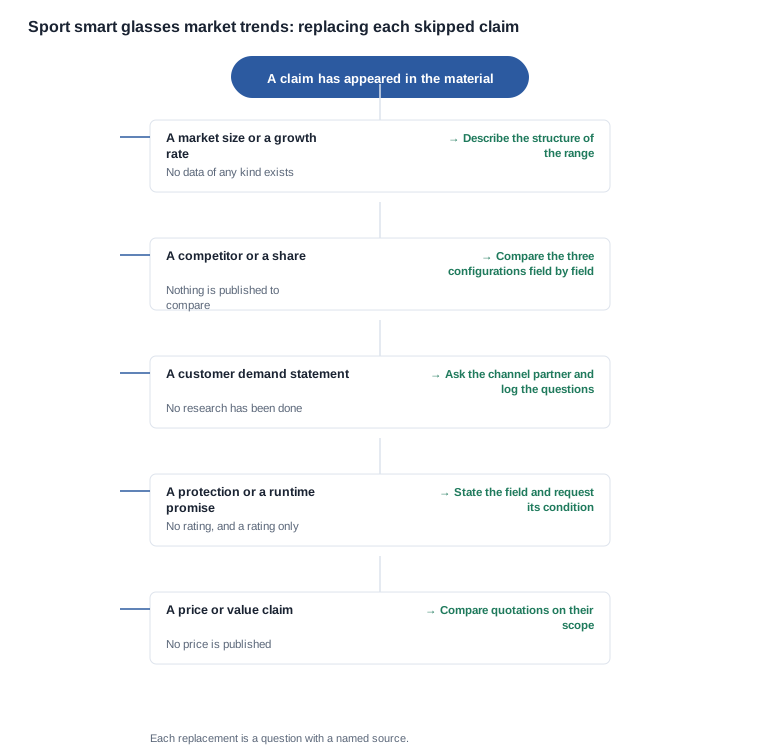
What replaces a market claim in a buying conversation
The replacement for a trend is a structural observation, and the replacement for a demand claim is a question with a named source. Neither is as quotable, and both are worth more.
For "the market is growing", substitute the structure of the range. How many products are in the segment, how they divide, which charging method they use, and which fields the record publishes for each. A buyer can reconstruct that from the catalogue in five minutes, and a distributor can be told it in a sentence.
For "customers want a camera", substitute the documentation that the segment actually requires. If a buyer is going to describe the function, the description comes from a supplier document, and the absence of one is a fact about the market that is more useful than a demand claim: it tells the buyer which channels can be served today and which have to wait.
For "competitors are doing X", substitute the comparison a buyer can actually make. Three products in the segment, compared field by field on what is published, with the differences expressed as differences rather than as advantages. The buyer learns which product covers the session and which covers the day, and the choice is made on the deployment rather than on a competitor's marketing.
For "our price is competitive", substitute the quotation contents. A quotation that lists the accessories, the packaging, the documentation scope, the terms and the delivery arrangement can be compared with another quotation on the same basis. A unit price cannot, because the scope behind it is not stated.
For "the category is moving towards longer battery life", substitute the published field and its condition. The endurances are published for the three products, and the question of what they were measured under is a question to the supplier. That is a real point of differentiation, and it is one the buyer can act on, because it is a document to request rather than a narrative to repeat.


How a buyer builds their own market view
None of this means a buyer has to enter the category without a market view. It means the view has to come from sources a buyer can actually reach, and there are four of them that work better than anything in a brochure.
The sell-through data from a short pilot. A small run into a single channel, with a fixed number of weeks and a pre-agreed question set, produces more usable information than any market estimate, and it produces it in a form the buyer owns. The criteria for the pilot are worth writing down in advance, and there are five of them, because a pilot without fixed criteria becomes a demonstration rather than a test.
- Which product and which configuration goes into the pilot, stated as a designation rather than as a description.
- What the packaging is, because the carton is part of what the customer sees and part of what the freight costs.
- What the documentation scope is, since a channel that receives a different scope from a distributor will price the two differently.
- What the acceptance criteria are for the units that come back, so that the returns can be categorised against something written down.
- How long it runs and what is measured at the end, with the categories fixed in advance so that the result is not shaped by what happened to be interesting.
The questions the channel actually raises. Every unanswered question a distributor brings up is a piece of information about what the market needs, and a buyer who logs them for a season has a demand picture that is specific and defensible. The questions in this batch's other pages are a reasonable starting structure for that log, because they were built from what the record does not contain. A log is cheap to keep and it answers the question a market report would answer, at the scale and the scope a single business actually operates at.
The returns. Sorted by reason, a return rate is the nearest thing to a demand signal a buyer can pick up cheaply, and the reasons worth sorting on are the ones the record leaves open — a sizing problem, a runtime expectation, a documentation gap, an accessory that was missing. The categories matter more than the rate, because a rate on its own does not tell a buyer which of the open questions the customers are actually running into.
The partner conversations. A channel partner knows what their own customers ask, and a buyer who asks a partner for the top five questions of the last season is buying real information at the cost of a conversation. The criteria for the pilot are worth deciding in advance: which product, at which configuration, in which packaging, with which documentation, and against which acceptance criteria.
The questions the channel actually asks. Every unanswered question a distributor raises is a piece of information about what the market needs, and a buyer who logs them for a season has a demand picture that is specific and defensible. The questions in this batch's other pages are a reasonable starting structure for that log, because they were built from what the record does not contain.
The returns. A return rate, sorted by reason, is the nearest thing to a demand signal a buyer can pick up cheaply, and the reasons worth sorting on are the ones the record leaves open — a sizing problem, a runtime expectation, a documentation gap, an accessory that was missing. The categories matter more than the rate, because a rate on its own does not tell a buyer which of the open questions the customers are actually running into.
The partner conversations. A channel partner knows what their own customers ask, and a buyer who asks a partner for the top five questions of the last season is buying real information at the cost of a conversation.
What none of these four gives is a number that can be put on a slide. It is worth being honest with a finance colleague about that, because the request for a slide is usually where the first unsupported claim enters a business. The substitute is a document rather than a figure: a pilot record with its acceptance criteria, a returns log with its categories, a partner question list with the date it was taken. Those three artefacts answer the same commercial question as a market report, at the scale the business actually operates at, and they are the sort of evidence that survives an audit rather than the sort that has to be re-argued every quarter.
What none of these four gives is a number that can be put on a slide. That is a real limitation, and it is a limitation of the market rather than of the buyer: a segment made of three products in a range of twenty-eight, with no published price, no published specification beyond five electrical fields and no published demand data, is a segment where the available intelligence is local and specific. The advantage of working that way is that the intelligence is actionable, and the cost of it is that it has to be collected deliberately.
Our own position on this is the one we have kept across this range, and it is worth stating as a single sentence that a buyer can quote internally without having to soften it or add a footnote to it: we publish what the catalogue publishes, we do not publish what it does not, and where a buyer needs a market view we will tell them what the published record supports and what has to be collected from their own channel instead. The comparison against the wider range sets out how the products in this segment sit against the others in the catalogue, and it is the closest thing to a market map that the documentation supports.
If you are building a market view for this segment, give us the channel you sell through, the length of pilot you can run, and the categories of return you would log, and we will return the structural observations the record supports, the set of claims that have to be excluded from your own material, and the question list to use with a partner so that the answers come back in a form you can act on.


