

A price comparison without a price list is not a contradiction; it is a change of subject. The comparison a buyer can actually run in this category is not between two numbers, because no number is published for any product in the range. It is between two sets of scope, and the numbers only become comparable once the scope has been made identical. Get that order wrong and a buyer can spend a month comparing two products that are not the same product.
The reason the scope matters so much in this segment is that the published specification already tells a buyer where the cost differences live, and a buyer who knows where they live can ask about them in the first round instead of the third. The sport line holds three products: two cells of 70 mAh on one of them, a single 115 mAh cell on another and a single 100 mAh cell on the third; a two-hour ceiling on one and a roughly one-hour charge on the other two; and the same radio generation throughout. Two of the three carry a remote shutter. Those differences are not cost figures, but they are cost drivers, and a quotation that does not address them is a quotation that has left the most expensive part of the comparison unsaid.
This article therefore covers what makes two quotations comparable, the scope lines a quotation has to carry, the three published differences that move the cost, how to normalise two quotations onto one scope, and the questions to ask before any total is compared.
Sport smart glasses price comparison: what makes two quotations comparable
Two quotations are comparable when a reader can tell, for every line of cost in both, what is included. That is a narrower requirement than it sounds, and most quotations in this category do not meet it, because the most expensive items are not the ones that get listed.
The comparison breaks down in three places, and they are worth naming separately.
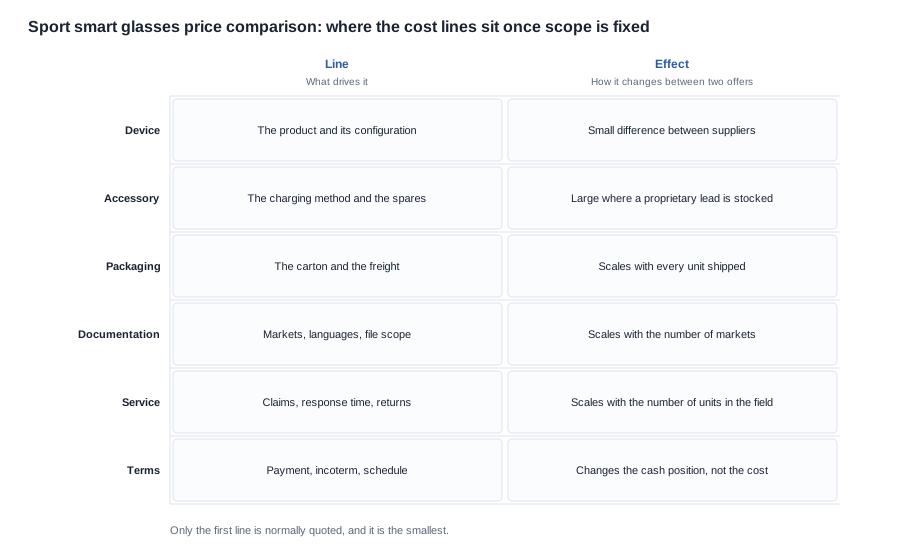
The device line. This is the one everybody looks at, and it is the one that is usually quoted on a configuration that is not the one the buyer intends to order. A quotation for a bare product, for a product with a case, for a product with a per-market documentation package and for a product with a support commitment are four different objects, and the difference between them is frequently larger than the difference between two suppliers. The first rule of the comparison is therefore to establish the configuration before reading a single figure, and to write it down in the request so that both suppliers are answering the same question.
The accessory and packaging lines. These are where the charging method does its work. A product that charges over a Type-C port arrives with a cable the customer probably owns, and the cable in the carton is close to a free line. A product that charges over a magnetic contact arrives with a specific lead that the importer has to source, stock, count and replace, and the carton has to be built to hold it. Two quotations that are identical on the device line can be a long way apart once the accessory and the carton are priced properly, and the gap grows with volume.
The scope lines. Documentation, translations, per-market artwork, the conformity file, the cell documentation, the spare-parts position and the aftersales route. These are per-market or per-programme costs, they are the ones a supplier is most likely to exclude from a headline quotation, and they are the ones that a buyer discovers in the second year of selling.
A fourth and final comparability trap is worth naming, because it is the one that produces the most confident and most wrong answer: comparing a quotation that includes a documented product against one that includes an undocumented one. A supplier who has prepared a conformity file, a per-market artwork set and a translated instruction set can quote a higher number and still be the cheaper offer, because the other supplier's lower number is a number that a buyer will have to raise later in order to sell anything. The comparison has to be made on what each offer puts in front of a customer, and the two offers are rarely the same size.
The commercial consequence is that a comparison run on the device line alone does not produce a wrong answer; it produces an answer to a question nobody asked. The device line is the line that is quoted, the line that is published by nobody, and the line on which the differences between two suppliers in this category are frequently smallest. Building the comparison on the device line therefore maximises the chance of a decision that is decided by a small number on a line that carries only part of the cost, which is a poor way to make a decision of any size.
The second thing worth saying about comparability is that it is a property of the pair of quotations and not of either one. A quotation can be perfectly adequate on its own and still be uncomparable with the one it is being set against, because the other one excludes something this one includes. That is why the reference configuration has to be written before the quotations are read rather than after, because a configuration reconstructed from a quotation is always a configuration that makes that quotation look complete.
The commercial consequence is that a comparison run on the device line alone does not produce a wrong answer — it produces an answer to a question nobody asked. The total cost of a product in this category is the device plus the accessory plus the packaging plus the scope, and the ratio between those four is not published anywhere, so a buyer has to ask for it, and then has to keep asking at every re-order, because the ratio moves as the volume moves and as the scope does.

The scope lines a quotation has to carry
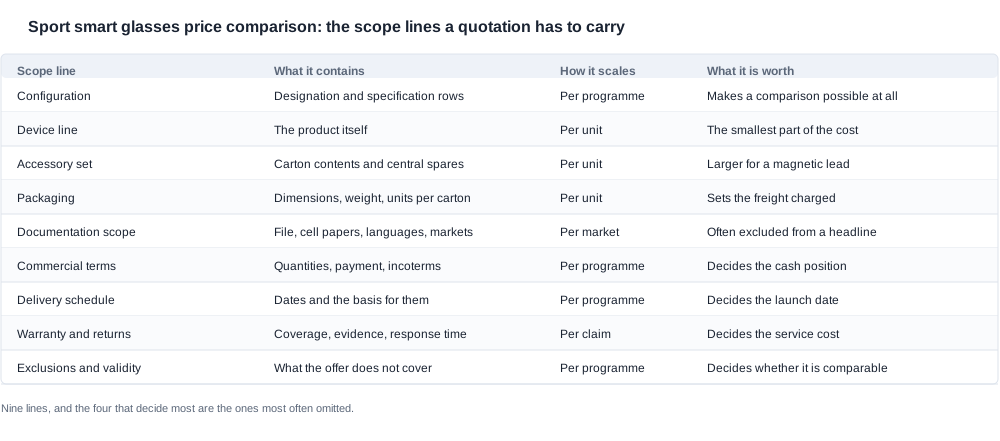
A quotation that is going to be compared needs nine lines, and the list is short because the number of things that can differ between two offers of the same category is small once it is written down.
- The configuration, described as a designation and as the specification rows it is built on, so that both quotations are demonstrably about the same object.
- The device line, with the cell configuration, the charge arrangement and the radio named, and with the published ceiling used as a ceiling rather than restated as a duration.
- The accessory set, as a numbered list with part numbers and quantities, separating what is in the carton from what is held as spares.
- The packaging, with the shipped external dimensions, the packed weight and the units per outer carton, because the freight is calculated on them.
- The documentation scope, naming what is included: the conformity file, the cell documentation, the instruction sets, the number of languages and the number of markets.
- The commercial terms, with the minimum order quantity, the sample quantity, the payment terms and the incoterms stated in the document rather than in a conversation.
- The delivery schedule, tied to the configuration and to the payment terms, with the basis for the schedule stated.
- The warranty and the aftersales route, including what is covered, the evidence a customer has to supply, the response time and who pays the freight.
- The validity period and the exclusions, so that a comparison is between two live offers rather than between two documents of different ages.
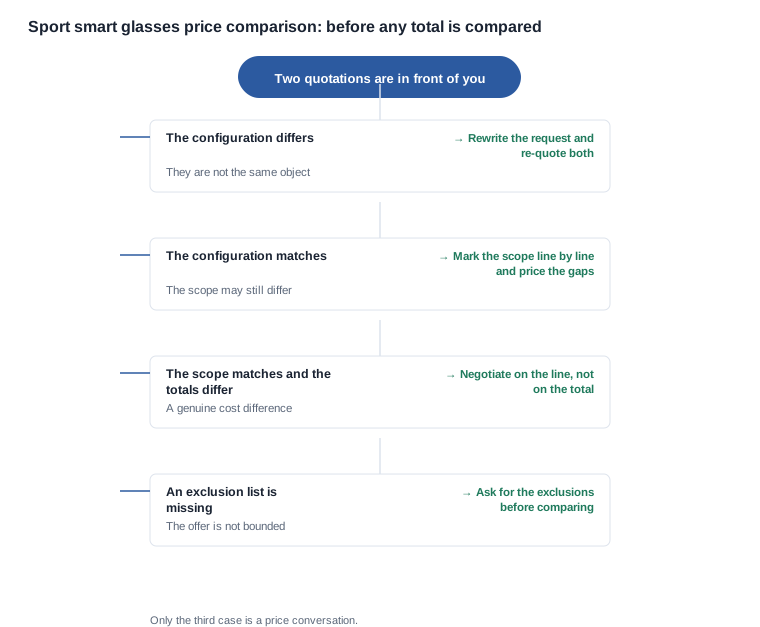
The last line is the one most often left out and the one that decides whether a comparison can be relied on. A quotation without an exclusion list will be read as a commitment to anything the reader can imagine, and the supplier who left it out either did not think about it or is relying on the buyer not to. A quotation that states what it excludes — this market, this quantity, this date, this configuration — is a document a buyer can put next to another one and compare.

The three published differences that move the cost
The published rows earn their place in a price comparison for a reason that is easy to miss: they identify where the cost sits, even though they say nothing about what the cost is. A buyer who has the rows knows in advance which questions to put to a quotation, and a buyer who does not has to ask the same questions of everybody and compare the shape of the answers instead of the numbers.
The published rows are useful in a price comparison for a reason that is easy to miss: they identify where the cost is, even though they say nothing about what the cost is.
The charging method is the largest single driver, and it works in two directions. The magnetic-charged product needs a lead that is a stocked line rather than a free inclusion, and that lead has to be inside the carton, which changes the carton dimensions, which changes the freight per unit. The two products on a Type-C port carry a cable that costs a supplier very little and a buyer nothing, because the customer owns one. A comparison that prices the device alone and treats the cable as a rounding error reverses the relationship between the two products on this point, and the reversal gets larger with every unit shipped.
The charge time changes the cost of interruption, which is an operational cost rather than a purchase cost. A product that reaches a charge in roughly an hour is a product that can be recharged inside a break, and a product with a two-hour ceiling is one that cannot. Whether that is worth anything depends on the deployment, and where it is worth something, it is worth something in service cost and in lost use rather than in the quotation. A buyer who cannot see the deployment cannot price this difference, which is why the comparison has to carry a stated use case rather than an assumed one, agreed before the quotations arrive.
The cell configuration changes the documentation and the packing. A pair of 70 mAh cells and a single 115 mAh or 100 mAh cell are different products from a transport point of view, and the transport evidence, the presentation condition and the packing arrangements all follow from them. The two products with a single larger cell also have the shorter charge time, so the two differences happen to run together, and a buyer comparing on one of them without noticing the other is likely to draw the wrong conclusion about which is the simpler product to run.
The fourth difference — the remote shutter on two of the three — is a cost in documentation rather than in hardware, and it is the one most often excluded from a quotation. If the function is to be described, a document has to be obtained and the configuration has to carry a camera specification that the catalogue does not publish. If it is not to be described, the listing has to be written so that it does not invite a comparison the channel cannot support. Either way there is a decision, and the decision belongs in the quotation as a scope line.


Normalising two quotations onto one scope
The normalisation step is arithmetic with a document attached, and it is the step that turns a comparison into a decision. The sequence is short.
- Write the reference configuration — the designation, the specification rows, the accessory set, the packaging, the markets, the documentation scope and the terms — and use it as the definition of the object being compared.
- Take each quotation and mark what it includes against that definition, line by line, and record what is missing rather than what is present. A missing line is the interesting one, because it is the one that will be paid for later.
- Price the missing lines, using the supplier's own quotation where one exists and a written estimate where one does not. An estimate has to be marked as an estimate, because the alternative is a total that is not comparable.
- Adjust for the differences that are not scope. Where one quotation includes a case and the other does not, or one carries a document scope the other does not, the difference is real and belongs in the comparison as a labelled item rather than being averaged away.
- Normalise the freight and the payment terms, so that a comparison is not being decided by a delivery term or a payment window that the business would have to take anyway.
- Compare the normalised totals, and then read them against the criteria that were set before the quotations arrived. The second step is the one that prevents a price comparison from deciding a selection question.
- Record what was changed to normalise each quotation. A normalised total without the normalisation record is an assertion, and the record is what lets a colleague check the conclusion six months later.
There is one more step in the normalisation that is easy to skip and expensive to omit, and it is the one that produces the record: the list of what was changed. A normalised total on its own is a number that cannot be explained to a colleague, because the colleague cannot see which adjustments were made to reach it. A normalised total with its adjustment list attached can be checked, and it can be re-run when the volumes change, which they will. The adjustments themselves are few and worth naming in advance, because a buyer who names them before the quotations arrive is not adjusting the quotations to reach a preferred answer — the buyer is stating a basis and then holding to it.
The reason step six matters is that the published rows cannot do the work of the criteria. A comparison of two totals tells a buyer which quotation is lower; it does not tell the buyer which product fits the deployment, whether the accessory chain has been priced, or whether the documentation scope is what the channel needs. Those are decisions, and they are made against the criteria rather than against the number.
The questions to ask before any total is compared
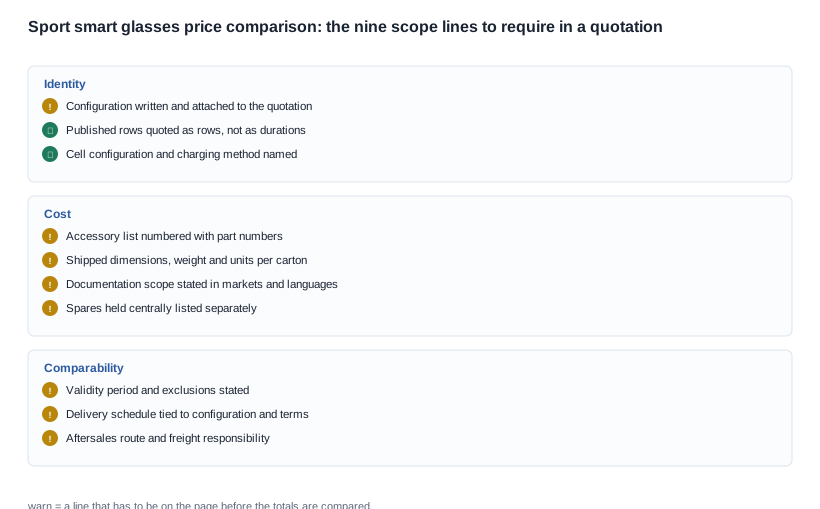
The list below is what a buyer should have in hand before the first comparison is drawn, and it is deliberately a request rather than an analysis.
- A quotation against a written reference configuration, with the configuration attached to it and not described in a covering note.
- The accessory list with part numbers, separating the carton contents from the spares held centrally, and a stated loss rate for the proprietary lead.
- The shipped carton dimensions and the packed weight, and the units per outer carton, so that the freight can be priced on the real thing.
- The documentation scope, stated as what is included and how many markets and languages it covers, and whether the conformity file and the cell documentation are in it.
- The validity period, the exclusions and the basis of the delivery schedule, so that the comparison is between two live offers.
- The aftersales route and the response time, and who pays the freight on a returned unit.
- The treatment of the camera function, whether it is described or not, and what document stands behind it if it is.
- The commercial terms, minimum order quantity, sample quantity, payment terms and incoterm, in the document.
- What is not included, stated by the supplier, which is usually the most valuable line on the page and the one that closes the comparison properly.
Nine questions, and each one is a question about a document rather than about a product, which is the point: a product can be excellent and a quotation can still be unusable, and the two failures are independent of one another. A buyer who asks the questions and does not act on the answers has still lost the comparison, because the gap between the two quotations has simply been moved from the purchase order to the warehouse.
The criteria for judging the answers are the same ones that apply everywhere in this category: a figure with its condition, a description with a method, a document with a date, and a scope that says what it excludes. The red flags are a total with no configuration attached, a freight figure calculated on an average carton, a documentation scope described as "as required", and an exclusion list that is absent.
Our own position on price is that no price is published for any product in the range, and neither is a price tier or a minimum order quantity, so we will not put a figure here that a buyer cannot check against a quotation, and we will not quote a band. What we can do is set out the nine scope lines a quotation has to carry, the three published differences that move the cost in this segment, the normalisation sequence, and the questions to ask before a total is compared. The charge and endurance differences that drive the accessory cost are set out in the note on battery behaviour during activity.
If you are holding two quotations for this segment, send them with the configuration you intend to order, the volume, the destinations and the packaging you have in mind, and we will return a line-by-line comparison that separates what is a scope difference from what is a real cost difference, and that marks the lines where the comparison is still open because a document has not yet been supplied.


