

Colour is the narrowest customisation axis in this range, and the published evidence behind it is thinner than most buyers expect when they first raise the subject. Standard oem color options, as the catalogue actually publishes them, consist of a colour list on one camera model and a colour list on another; the remaining 26 entries carry no colour row at all. That single sentence is the whole of the published position, and everything useful a sourcing team does with it depends on reading it to the letter rather than in the spirit.
The distinction that follows it matters more than the count itself. A missing row is a statement about documentation, not about what a factory is capable of producing. A programme that reads the absence as a prohibition gives up an option that may well exist; a programme that reads the absence as capability promises something nobody has verified. Both errors surface late — at the pre-production sample rather than at the enquiry — and both land on the schedule rather than on the preference.
So the useful work is not deciding which colours to like. It is establishing which rows in the catalogue can carry a colour decision at all, what a colour option actually changes once it has been agreed, and in what order the conversation has to run if the buyer is going to end up with answers that can be placed into an order.
How narrow the published colour position actually is
The published set is short enough to state in one breath, and stating it exactly is the first piece of due diligence on any colour programme.
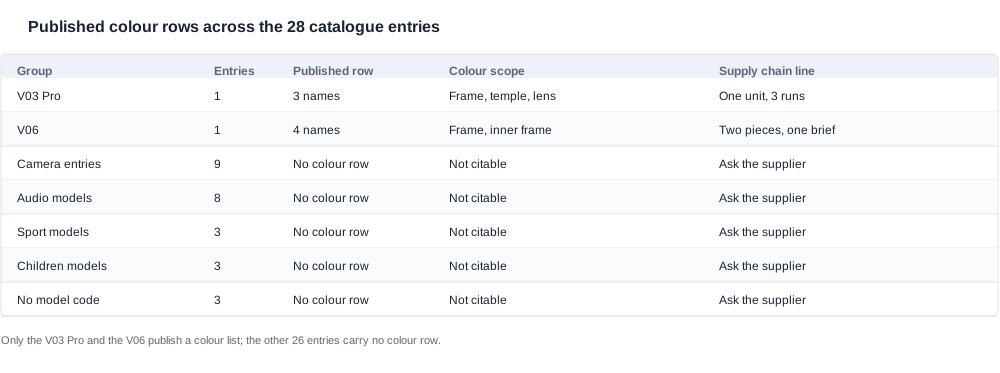
Two models publish a colour list
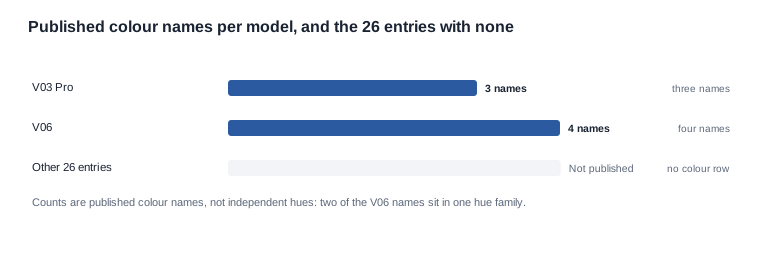
The V03 Pro publishes three colour names: orange, off-white and black. Its catalogue page carries three structural rows alongside them — flexible temples, photochromic lenses and a Type-C charging port — which matters because that page describes one product configuration rather than a family of them.
The V06 publishes four: orange, white ice blue, black and black ice blue. Its page carries an ergonomic-design row, a long-runtime row, a removable inner frame row and an IP54 ingress marking.
Both of them sit inside the eleven-entry camera group, whose published resolution classes split eight entries at 8 MP and three at 13 MP, and both of them are the entries whose pages carry a colour row. One detail inside the V06 list is worth carrying into a negotiation rather than quoting as a raw number: those four names are not four independent hues. White ice blue and black ice blue belong to a single hue family at two tones, so a reference request, a batch discussion or a tolerance discussion covering that family has to cover both names. A buyer who reads the count as four separate colour decisions will end up asking for four separate processes where one may serve.
What the other 26 entries do and do not say
For the rest of the range the catalogue publishes no colour row. That covers the nine remaining camera entries, the eight audio models, the three sport models — the YKC02, the D17 and the ZH12 — the three children models, and the three entries listed without a model code of any kind: the AR glasses, the electrically colour-changing glasses and the bone-conduction glasses. Nine, eight, three, three and three make twenty-six, which accounts for every entry in the range that carries no colour row.
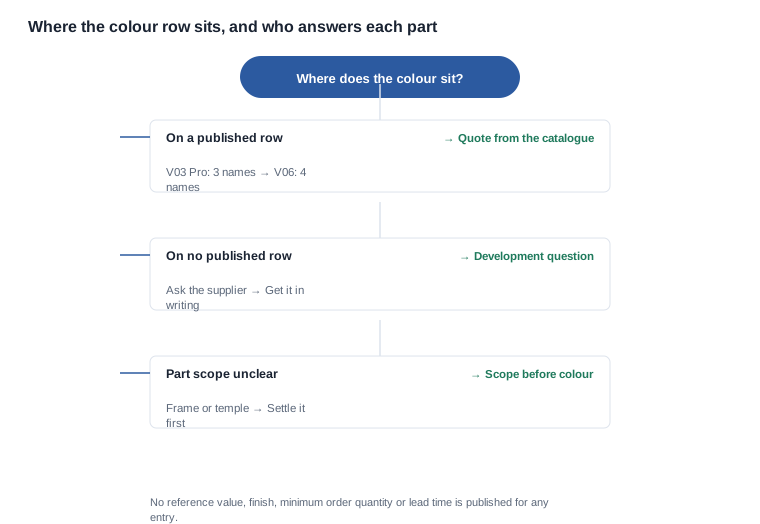
The citable form of that fact matters, and the form is not interchangeable with a stronger claim. The catalogue publishes no colour row for these 26 entries. It does not say that these 26 entries have no colours, and it does not say the factory cannot produce them in another colour; it says the catalogue does not carry the row. Every colour statement about those 26 entries is therefore a question, and the answer has to arrive in writing from the supplier before it becomes part of a specification, a sample request or a quotation. A sourcing team that turns an unanswered question into a catalogue row in a spreadsheet has manufactured a fact, and that manufactured fact is the one that gets quoted to a customer later.
Why a narrow published position is still useful
Two consequences follow, and both of them are useful to a buyer rather than merely disappointing.
The first is that the published list behaves as a shortlist requiring no development conversation. A buyer working with the V03 Pro or the V06 can name a colour today without opening a tooling question, because that colour already sits inside the published configuration the supplier runs. The colour axis, where it is published, is the cheapest line of variation available — not because colour is simple, but because nothing about it has to be invented.
The second is that the gap itself is legible. What the catalogue does not publish is as informative to a buyer as what it does. There is no colour reference value anywhere in the range, no surface finish description, no minimum quantity attached to a colourway, and no lead time attached to a colourway — for the two models that publish colour names and for the twenty-six that do not. A published colour name is the beginning of a conversation, never the whole of a specification.
There is a third consequence that catches experienced buyers out, and it is about the depth of the published record rather than its breadth. The S7 publishes a removable inner frame and an IP54 marking in much the same way the V06 does, yet it carries no colour row. The V06 and the S7 are close enough on published structure that it is tempting to treat them as a pair, and colour is exactly the row where that assumption fails. Colour is tracked per individual product page in this catalogue, not per family, so a buyer cannot infer one entry's colour row from a sibling's.

What a colour option changes in the supply chain
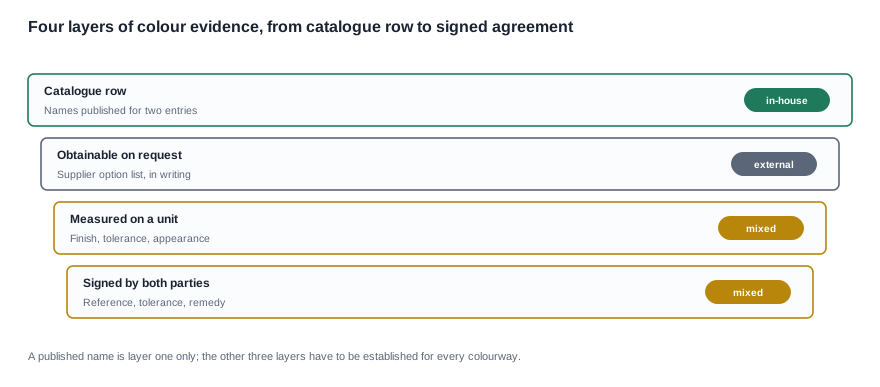
Once colour is on the table it reaches at least four separate things, and colour programmes get expensive because teams usually discover them in the wrong order — usually after the model, the parts and the packaging have already been committed.
Which part carries the colour
Colour lands on a component, not on a product, and this catalogue publishes component structure only in a few places. A removable inner frame is published for the V06 and the S7, and a detachable temple is published for the G07. Where a piece comes off, a colour decision can land on two surfaces rather than one, and whether that second surface matches the first or contrasts with it is a design decision. It has to be made before the supply-chain question — which piece adds a setup — can even be asked properly.
The charging case makes the same point in the opposite direction, and the catalogue's own treatment of that row is the reason. Five camera entries publish a case capacity: the L1 Pro and the CY05, and the CY03 — each at 1400 mAh, the L2 Utral at 900 or 1400 mAh, and the MT6 at 1200 mAh in its folding case. Two more publish the existence of a case without publishing its capacity: the KY06 and the MT5. Four publish no charging-case row at all — the V03 and the V03 Pro, and the V06 and the S7 — and for those four the presence of a case in the deliverable is an unpublished item rather than a published absence.
Set those three states beside the colour rows and the scope of a colour decision becomes concrete rather than abstract. For the V03 Pro, with three published colour names and no charging-case row of any kind, the colour applies to the glasses and to nothing else unless the supplier confirms that a case is part of the deliverable. For the V06, with four published names and the same gap in its case row, whether a case travels with the product is an open question, and until it is answered the colour brief cannot say whether a second coloured surface exists at all.
The reference, the process and the tolerance
Three items are missing from every colour row in the catalogue, and a colour programme needs all three before it can be closed.
The first is a reference value. No colour reference appears anywhere in the range, so the target has to be supplied by the buyer — and supplying a name is not the same act as supplying a specification. A named colour without a reference is a description of intent; a colour tied to a reference value is something a factory can reproduce.
The second is the process. The catalogue publishes no surface finish and no process name, which leaves the achievable range, the behaviour under abrasion and what becomes visible at the edges of a thin coating entirely unstated. A buyer who specifies only a target has quietly delegated those decisions to whoever happens to be nearest the line on the day, and that delegation is the single most common root cause of a first-article rejection in cosmetic work.
The third is the tolerance, and a tolerance that does not state how it is judged is a preference rather than a criterion. What it needs is a viewing condition, a comparison method, a number of units to be examined, and a stated consequence when a unit falls outside the band. Frames are where thin coatings show, because a coating thins exactly where the part turns, so the edge behaviour is not an academic detail — it is the place most likely to generate a defect claim or a concession request.
The setup, the documentation set and the stock line
Each colourway is a separate setup on the production line. Configuration, not model, is the unit of setup, so a model with three published colours represents three runs of a build the supplier already knows how to make, while a colour outside the published list is a development item that has to be planned, costed and scheduled like one. This is where the distinction between a configuration and a development becomes financial rather than semantic, and it is why the answer to the question "can you do it in our colour" matters more than the answer to "what colours do you offer".
The same multiplication applies downstream of the line. Every colourway carries its own label, its own artwork, its own barcode and its own stock line, so the inventory a buyer holds grows with the colour count even when the product count does not move at all. A brand that plans three colourways across one model has planned three labels, three artwork sets and three stock lines, and a procurement checklist that counts products rather than colourways understates the work by a factor of three.
Documentation is the third multiplier, and it is where the published record is thinnest of all. The catalogue carries a company-level export certification page whose content is images rather than text, and its text contains no reference to CE, FCC or RoHS anywhere. There is no per-model certification row against which a colour treatment could be checked. The only frameworks a buyer can write into a specification are the Radio Equipment Directive (EU) 2014/53/EU and the EMC Directive 2014/32/EU, and whether a particular surface treatment or material change interacts with the technical file behind them is a question for the supplier, answered in writing rather than assumed.
The rows that colour does not move
There is a practical method hiding in the catalogue, and it is worth stating because it makes a colour programme tractable. Every entry in the range publishes a battery capacity, a charge time and a rated runtime. These rows are common to all 28 entries, which means they can be used to narrow the model before colour enters the conversation at all.
Two properties of those rows are worth noting, because they are a lesson about how published rows should be read. Every entry publishes a charge time, and for 26 of them the published figure is a ceiling of two hours or less rather than an exact figure, while the D17 and the ZH12 are the only two entries published at about an hour. And a published value on a camera page can arrive under different labels — a charge duration label on some pages, a use-duration label on others and a runtime label on the rest — so a buyer checking a figure has to check which label the page actually uses before moving the number into a comparison.
The point generalises directly to colour. A row that publishes a ceiling is less precise than a row that publishes an exact value, and a row that publishes a name is less precise than either. The correct buying response to an imprecise row is to narrow the range with the rows that are precise and treat the rest as questions. A buyer who uses the published rows to settle the model, and then treats colour as the last axis to be negotiated with the supplier, ends up with one focused conversation instead of a single open-ended one.

The rows a colour decision can be built on
A colour decision can only be built on rows that exist, and a buyer who has not checked which rows exist is negotiating against a document nobody has written. The table below sets out what this catalogue publishes about colour and about the rows that surround it, and what each published row actually decides for a colour programme.
| Catalogue row | What is published | Which entries carry it | What it decides for colour |
|---|---|---|---|
| Colour names | 3 names | V03 Pro | The citable colour set |
| Colour names | 4 names | V06 | The citable colour set |
| Colour names | No row | The other 26 entries | Nothing citable; a question for the supplier |
| Resolution class | 8 MP and 13 MP | 11 camera entries | Which pages carry a colour row |
| Charging case | 1400, 900/1400, 1200 folding | L1 Pro and CY03, CY05 and MT6, and L2 Utral | Whether a case is a second surface |
| Charging case | Case shown, no capacity published | KY06, MT5 | Whether a case is a second surface |
| Charging case | No row published | V06 and V03, and S7 and V03 Pro | Whether a case is in scope at all |
| Removable part | Removable inner frame | V06, S7 | A colour can land on two pieces |
| Removable part | Detachable temple | G07 | The temple is its own decision |
| Ingress marking | IP54 | V06, S7 | A surface treatment meets a water claim |
| Colour reference value | No row | All 28 entries | Nothing to specify against |
| Surface finish | No row | All 28 entries | Nothing to specify against |
| Minimum order quantity | No row | All 28 entries | Nothing to plan against |
| Lead time | No row | All 28 entries | Nothing to schedule against |
Read down the right-hand column and a pattern emerges that is worth stating before any negotiation starts. Every row a colour programme needs in order to be closed — reference value, surface finish, minimum order quantity, lead time — is absent, for every entry in the range, including the two that publish colour names. What the catalogue does publish is the shape of the decision: which model, which part, whether a case is in scope, whether a component comes off, and whether a published water-resistance marking has to survive the treatment.
Three conclusions follow, and they are the ones a buyer most often reaches by accident rather than by design.
- A published colour is a configuration, not a development. Inside the published list there is no new tooling question to ask, and a programme built there moves at the speed of a standard build.
- A published name is not a specification. It names a colour. It does not name a reference value, a process, a finish or a tolerance band, and it cannot be placed on a purchase order on its own.
- The absent rows are the ones that cost money and time. A programme that proceeds on names alone discovers the reference value, the minimum order quantity and the lead time at exactly the point where they are most expensive to change.
What the table does not let you do
It is worth being explicit about the limits of the table above, because a dense catalogue can look more complete than it is.
It does not let you quote a colour for any of the 26 entries without a row. It does not let you put a reference value, a finish or a tolerance on the two published lists, because none is published. It does not let you infer that a case exists, or that it does not, for the four camera entries whose pages carry no case row. And it does not let you carry a figure from one model's page to a sibling model, because the published depth differs from page to page and the colour row in particular tracks the individual entry rather than the family. The table is a map of what can be cited, not a substitute for the supplier's written answer on everything the map leaves blank.

The order to settle a colour programme in
The sequence below is ordered by how expensive a late change becomes, which is the only ordering that keeps a colour programme cheap. Each step produces a written artefact that the next step consumes, and each step is a point at which a procurement decision can be recorded against a name and a date rather than against a memory of a meeting.
- Name the model. The colour evidence in this catalogue is attached to models rather than to a range, and only the V03 Pro and the V06 carry a published colour row. A programme that starts with a colour and looks for a model afterwards asks the same question twice and pays for the second ask.
- Name the part. Frame, temple, inner frame or case. For the V03 Pro no charging-case row is published at all, so whether a case travels with the product has to be answered before the colour brief is drafted; for the V06 the same question is open, and the answer determines whether a second coloured surface exists.
- Classify the brief as configuration or development. The V03 Pro's three names and the V06's four are configurations the supplier already runs. Any other target is a development conversation with its own planning, its own reference value and its own minimum order quantity, and the classification should be agreed before a quotation is requested rather than discovered inside one.
- Ask for the reference value and the process together. The catalogue publishes neither. A brief carrying a target and the process it maps to is a specification that can be judged against a unit; a brief carrying only a target is a preference that will be judged by whoever is nearest the sample, which is not a procurement process.
- Ask for the minimum order quantity and the lead time per colourway, separately. Neither appears anywhere in the catalogue, and they are the two figures that decide whether a four-colour programme is viable at a given base volume or whether it quietly consumes the whole stock budget in one colourway.
- Write the acceptance condition. Viewing condition, comparison method, number of units examined and the stated consequence of a mismatch. This is the clause that stops a colour dispute from turning into an argument about the lighting in a meeting room.
- Ask what the colour does to the technical file. No per-model certification row exists in the catalogue, so the answer cannot be read from it; whether a surface treatment changes the material behind the file is for the supplier to confirm in writing, and the certificate scope for the finished unit has to follow the treatment rather than the base product.
- Decide the documentation set per colourway. Model list, label, carton artwork, barcode and manual artwork all carry the colourway identity, and each is a per-colourway item rather than a per-model item, so a bulk order across three colourways needs three documentation sets.
- Record the approval with a revision and a date, and retain the physical reference unit in the agreed finish. A screen image is not a reference, because a screen image and a moulded or coated surface are not the same object, and a contract that refers to an image is a contract that refers to something the factory never produced.
Questions that need a written answer
Behind those nine steps sits a set of questions for the supplier, narrow enough to be answered and specific enough to be checked. A procurement team that puts these in writing, rather than in a call, gets answers that can be attached to the order:
- Which parts on this model can take a colour, and which parts are fixed for the production run?
- What reference value does each published colour correspond to, and what surface finish is applied?
- Is a colour outside the published list a new tool, a new material or a batch variation, and what does that do to the schedule?
- What is the minimum order quantity per colourway, and how does it differ from the order minimum for the model itself?
- What is the lead time for a colourway, and how does it differ from the lead time for the standard configuration?
- Under what viewing condition and by what comparison method is a colour unit accepted?
- What happens to a unit that falls outside the band — rework, replacement, or a concession?
- Does the chosen treatment change anything in the technical file, and does that change the documentation set?
- Is the colourway quoted and scheduled as its own line, or absorbed into the model's production run?
A worked example of the sequence
To make the method concrete, take a hypothetical case rather than a client project. A brand wants a light-coloured sports camera, and it wants that colour available in two markets on a single purchase order.
The first step settles the model, and here the catalogue does the work: among the eleven camera entries, the V06 is the one that publishes a colour row and carries the sport-side structural rows at the same time. The brand now has two of the four published names in front of it without asking anyone. The second step settles the part, and the V06 publishes no charging-case row at all, so the question of whether a second coloured surface exists is genuinely open and has to be put to the supplier. The third step classifies the brief: the two chosen names are configurations, so the programme is not a development, and the remaining two names are the fallback the buyer already knows about.
The seventh step is where a less careful programme goes wrong. Because the V06 publishes an IP54 marking, the brand has a surface treatment to reconcile with a water-resistance claim, and because no per-model certification row exists anywhere in the catalogue, there is no published document to reconcile it against. The question therefore goes to the supplier in writing, and the answer enters the documentation set as an attachment rather than as an assumption.
What the hypothetical case demonstrates is that the catalogue narrows the problem rather than solving it. It removes most of the search space in one step, and it makes the remaining questions specific enough that a supplier can answer them and a buyer can audit the answers.
Written into that sequence, our position is narrow on purpose: the catalogue publishes a colour list for two models and no colour row for the other 26, and we do not turn an unpublished row into an available option in a quotation. We will tell you which rows are citable for a given model, which are questions for the supplier, and where a colour programme becomes a development item, and we will say so before a sample is ordered rather than after it has been approved.
The standard oem color options
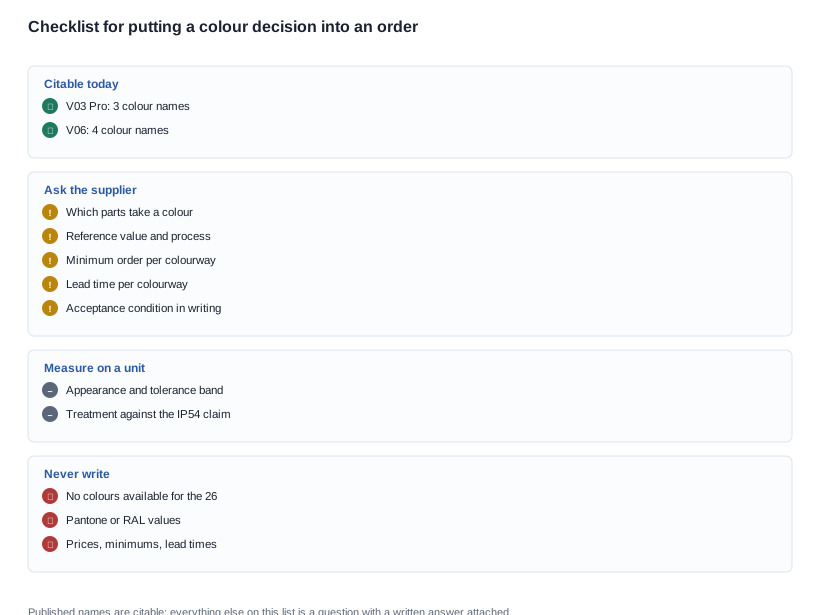
Stated in the form that can be quoted without a caveat attached: the catalogue publishes a colour list for two models — three colour names for the V03 Pro, four colour names for the V06 — and it publishes no colour row for the remaining 26 entries in the range.
That is a narrow axis, and for a buyer planning a launch it is a usable one, because it converts an open-ended question into a bounded one. The question is no longer "what colours are possible" but "which of the two published lists does this programme sit in, and what is the second step if it sits in neither". A programme inside one of those lists is a configuration exercise with a known scope of parts and a known documentation shape. A programme outside them is a development item with its own planning, its own reference value to be established and its own minimum order quantity to be agreed in writing before a quotation is meaningful.
The discipline that keeps this honest is a single sentence, and it is worth keeping on the file because it is the sentence most often lost in the move from a catalogue to a spreadsheet to a customer email: the catalogue publishes no colour row for these 26 entries. Not that these 26 entries have no colours, and not that a colour cannot be developed for them. Everything beyond the two published lists is a question with a written answer attached to it, which is a perfectly workable position for a procurement team — but only if the question is actually asked, and only if the answer is recorded before the colour reaches a purchase order.
The verification side follows the same logic. A colour claim inside a specification is verifiable only against a stated reference, a stated process and a stated acceptance condition, and none of the three is published for any entry in the range. The standard oem color options a buyer can rely on today are therefore a model reference and a list of names — a shortlist that removes the search — and everything else in a colour programme has to be established, in writing, before it becomes a commitment to a customer.
Related reading
- Customisation options across the range
- Frame colour options
- Temple colour options
- Colour matching across a product
- Standard OEM brand guidelines
Send the model and the colour you are working with, and we will tell you whether it sits on a published row or has to be established with the supplier first.


