

The standard OEM engagement is usually described as a sequence of activities: enquiry, quotation, sample, order, shipment. That description is accurate and useless, because it describes what happens without describing what has to be true at each point for the next point to be possible.
A better way to describe it is as a chain of transfers. Three parties are involved — the brand, the factory and the buyer of the finished product — and the engagement works by moving four things between them: an intent, an answer, an approved file, and a physical unit. Each transfer has a sender, a receiver, and a failure mode that appears later and is attributed to something else.
Standard oem how it works is therefore a question about the quality of the transfers rather than about the sequence of steps. The test of a transfer is simple and unforgiving: the receiving party can act on what arrived without asking the sending party a follow-up question. Everything else — the document names, the stage labels, the meetings — is scaffolding around that test.
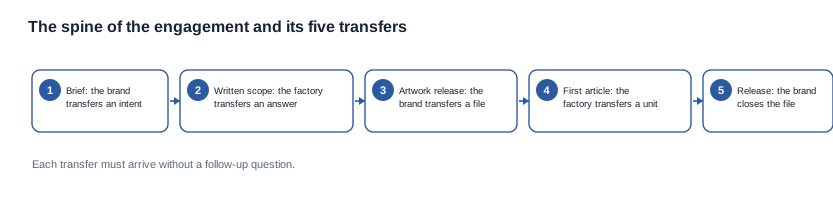
How a standard engagement moves from brief to release
The spine of a standard engagement has five positions. A brief at the front, a written scope, an approved artwork file, a first article, and a release. Everything that happens in between is one of two things: work that belongs to one of the five positions, or work that belongs to none of them and therefore tends to be lost.
Release is the position buyers most often misunderstand. It does not mean the goods have shipped. It means the finished unit has been accepted against written criteria, the file has been closed, and the accepted unit is now the reference against which any later batch will be judged. A programme that ships without passing through release has not accepted anything, and the first complaint will be the first conversation about what was expected.
The three parties, and what each one is actually doing
The brand decides what the product should be. The factory decides how the product is made and answers what can be done. The buyer of the finished product reads the object and the packaging and treats both as a promise. These are three different activities, and the failure mode in most programmes is that one party's output is handed to the next as though it were the next party's input without conversion.
The brand's output is an intent, and an intent is not a specification. The factory's output is an answer, and an answer is not an agreement until it is written and accepted. The buyer's output is a perception, and a perception is not a defect claim unless there were criteria to measure it against. A programme that understands this will spend its effort at the four boundaries, which is where the cost of a failure is set.

The handover points and what each one transfers
There are five handovers in a standard engagement, and each of them fails in a characteristic way. The table below sets out what crosses each boundary, what has to travel with it, and what a failure appears as three weeks later.
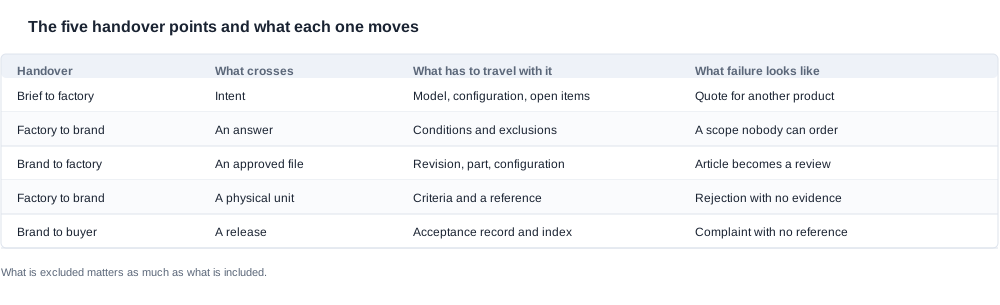
| Handover | What crosses | What has to travel with it | What failure appears as later |
|---|---|---|---|
| Brief to factory | Intent | Model, configuration, parts, criteria | A quotation against a different product |
| Factory to brand | An answer | Configuration, conditions, what is excluded | A scope nobody can order against |
| Brand to factory | An approved file | Revision, part, configuration | A first article that is a review |
| Factory to brand | A physical unit | Criteria, reference unit, record | A rejection nobody can evidence |
| Brand to buyer | A release | Acceptance record, file index | A complaint with no reference |
How to evaluate a handover before it happens
The quality of a transfer can be checked while it is still being prepared, and the check takes less time than the failure it prevents. Six questions, asked at each boundary, cover most of what goes wrong.
- Can the receiving party act on this without a follow-up question? If the answer is no, the transfer is not ready, whatever else is true about it.
- Does it identify the product it applies to? A document that names a family rather than a model and a configuration can be filed against the wrong unit.
- Does it state what it excludes? An exclusion is a decision, and its absence is what a buyer later discovers as a surprise.
- Is there a named owner on the receiving side? A transfer into a team is a transfer into nobody's list.
- Does it carry a version, a date and a reference? Three fields, and they are what make the next transfer possible.
- Is there a written rule for what happens if it is wrong? A transfer without an error route gets corrected by whoever is nearest, usually the buyer.
The trade-off here is the usual one. A thorough check at each boundary costs a conversation, and skipping it costs a programme. What to ask, and when to ask it, is the decision that determines which cost is paid. The pattern worth avoiding is not a slow handover; it is a fast handover that transfers an answer the receiver could not have got anywhere else, followed by a slow one that transfers a question the receiver should have been able to answer.
The brief transfer: intent, and what has to accompany it
The brief is the first transfer and it is the one most often made badly. What crosses is intent — what the brand wants the product to be. What has to travel with it is the identification that makes the intent actionable: a model and a configuration, the parts in scope, the markets, the criteria the unit will be judged against, and the list of things the brand has not decided.
That last element is the one that gets left out, and leaving it out is what makes a first handover fail. A brief that presents every question as answered transfers a set of answers the factory has not verified, and the factory will fill the gaps in the direction that suits its current production run. A brief that presents the open questions transfers a work plan instead, and the two sides can then plan against the same gaps.
The answer transfer: what was excluded matters as much as what was included
The factory's written scope is the second transfer, and buyers read it in the wrong direction. They read it for what it includes. The part that changes programmes is what it excludes, because an exclusion is a decision rather than an absence.
A scope that names the parts, the configurations and the conditions it covers, and that states the items it does not cover, is a document a buyer can build a programme on. A scope that covers everything in general terms is a brochure in contract form, and the excluded items will reappear as surprises.
The artwork transfer: a file is not an approval
The third transfer is the approved artwork file, and it fails in a specific way. What crosses is a file, and what has to travel with it is the revision, the part it applies to, and the configuration it was drawn for. A file sent without those three travels as an image, and the factory will read it as an illustration of an idea rather than as a specification.
This is where the "which part" question earns its place. A product with a removable element has at least two surfaces a treatment can land on, and the published structure of this range includes a removable inner frame, a detachable temple and removable parts on several models. An artwork release that names one surface has left the other one unowned.
The unit transfer: criteria, not impressions
The fourth transfer is the physical unit, and it is the one that decides whether the programme can accept or reject a batch. What crosses is a sample. What has to travel with it are the criteria the unit was measured against and a reference.
Without written criteria, a sample transfers an impression, and an impression cannot be used later to reject a production batch that differs from it. The reason to write the criteria before the unit arrives is not ceremony. It is that the criteria are the evidence, and a judgement made without them is an opinion that evaporates the moment the buyer's attention moves to the next programme.
The release transfer: the file, not the goods
The last transfer is the release, and it is internal to the buyer's own organisation more than to the factory. What crosses is a closed file — an acceptance record, an index of the documents in force, and the reference unit. A programme that ships without it has converted its own decisions into memory, and memory is the least durable input in the whole chain.
Where the published specification ends and the agreement begins
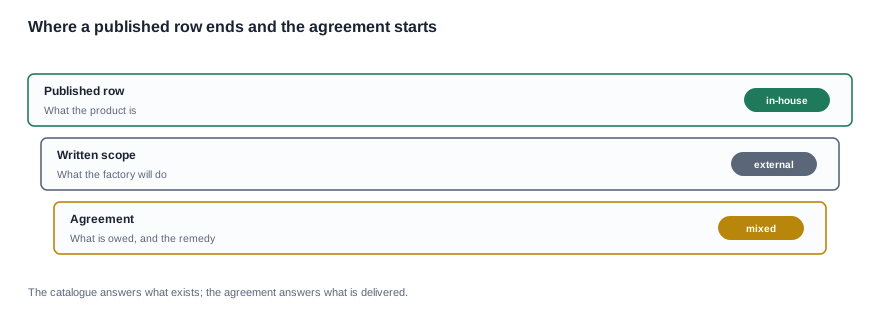
The catalogue is a specification of a product. An agreement is a commitment about a delivery. They meet at a boundary, and the boundary is drawn by a simple test: a published row states a fact about what the product is, and it says nothing about what will be delivered, in what quantity, by when, or against what criteria.
The published side is substantial. Every entry in the range publishes a charge time, a rated runtime and a cell capacity, and the camera entries publish a resolution class. Two camera entries publish colour names. Two camera models publish a removable inner frame, another publishes a detachable temple, and a remote-control feature row appears on the D17 and on the ZH12. Two entries carry an ingress marking, with no third-party report number attached to it. One entry publishes a weight, and that weight describes the glasses body rather than a bare frame.
The agreement side starts exactly where those facts stop being sufficient. A charge time published as a ceiling of two hours or less tells a buyer nothing about the start state or the end criterion, so the agreement has to fix the conditions the figure is judged under. A colour name tells a buyer nothing about a reference value, so the agreement has to fix the target. A resolution class tells a buyer nothing about the sensor, the field of view or the frame rate, so the agreement has to decide which of those it is willing to claim.
| Layer | What it settles | What it does not settle |
|---|---|---|
| Published row | What the product is | What will be delivered, and against what |
| Written scope | What the factory will do for this configuration | The criteria, or the commercial terms |
| Agreement | Criteria, quantity, schedule, remedy | Anything the catalogue has not published |
The practical consequence is that a programme cannot be run from the catalogue alone, and a buyer who tries will find the catalogue answering the wrong question. The catalogue answers what exists. The agreement answers what is owed. The two are both necessary, and neither substitutes for the other.

What changes when the requirement is not a catalogue row
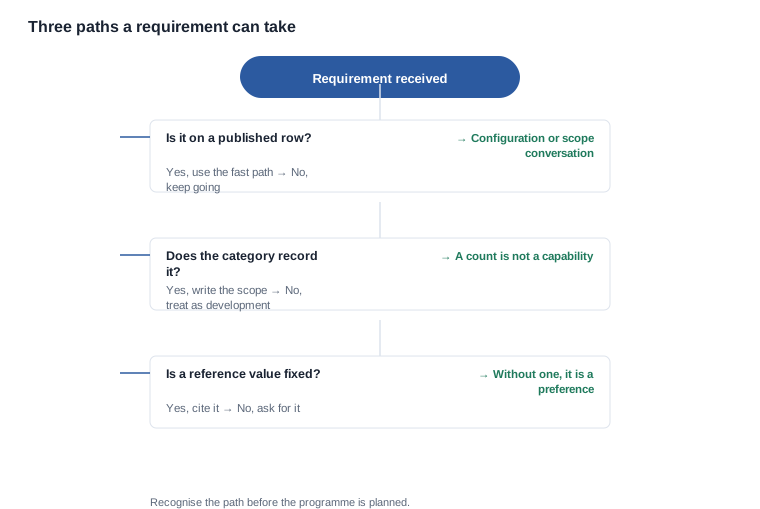
Not every requirement sits on a published row, and the three situations a buyer can be in differ more than they look. The difference is in the work each one creates, and in how early the conversation has to start.
The requirement is a published row
This is the fast path, and it exists only where a row actually covers the requirement. A colourway on the V03 Pro or on the V06 is a published configuration. The work is ordinary: confirm the configuration, agree the reference and the criteria, release the artwork, accept the article, close the file. The fast path is genuinely fast, and it is the only path where a programme can be planned from published material alone.
The requirement is absent, and the category carries recorded customisation
This is the middle path, and it is the most common one. The requirement does not appear on any published row, and The internal planning record notes, for each category, how many customisation axes it holds — the camera group seven, the audio group five, the sport group five and the children's group two, with a smaller number or an unclassified position for the three entries that carry no model code.
The work this creates is a scope conversation, and the key discipline is that the recorded count is not a capability list and the recorded set is not published. What has to happen is a written answer against the named model, the named configuration and the named part, stating what the treatment changes, what it adds to the setup, and what it does to the schedule and the price. A buyer who treats the recorded count as an offer will discover the difference at the quotation, and a buyer who treats it as a capability list will discover it in the marketing.
The requirement is absent, and the record is silent
The third path is the one that has to be planned for rather than absorbed. The requirement is absent from the catalogue and the internal record discloses nothing for the relevant category, which is the position for the bone-conduction entry, with the AR entry unclassified and the children's category carrying the shallowest recorded set of all.
What this creates is a development conversation, and a development has its own planning, its own reference values, its own tooling position and its own order minimum. The correct buyer behaviour is to establish in writing that the record is empty before anything is committed, and to treat the first answer as the start of a scoping exercise rather than as a quotation.
The signs that a programme has drifted into the third path without noticing are recognisable. The requirement is being described in capability terms rather than in part-and-surface terms. Nobody can name a reference value. The documentation set has no acceptance condition in it. And the schedule has been quoted without any of the variables that would move it.
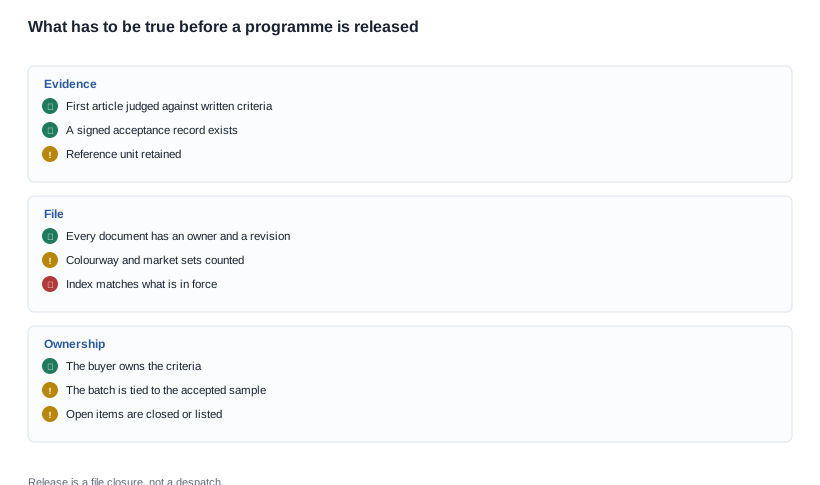
The release check at the end is the one that closes the engagement, and it is worth treating as a gate rather than as a formality. A programme is releasable when the first article has been judged against written criteria and signed off, when the accepted unit has been retained as the reference, when every document in the file carries an owner and a revision, when the colourway and market sets have been counted rather than assumed, when the index matches what is actually in force, and when the open items are either closed or listed with a date against each. A programme that fails any one of those can still ship. It just cannot be defended afterwards.

How we stand on how the engagement runs
The engagement runs on written transfers and the written part is not bureaucracy around the work. We answer a brief against a named model and a named configuration, on paper, stating what is included and what is excluded. We release artwork against a revision and a part. We judge a first article against criteria that were agreed before the unit existed. And we close the file with an acceptance record and a batch record that identifies the units against the approved sample.
A price, an order minimum and a delivery date are all withheld until the scope is on paper, and an unpublished row is never presented as an available option. Where a requirement is not on a published row, we will say so, and we will say what would have to be settled before it could be quoted — which is a slower answer than a list of possibilities and the only one that survives contact with a first article.
A buyer assessing whether an engagement model will work for them should look at one question: who owns the acceptance criteria. In our reading of the standard engagement, that should be the buyer, written before the sample, and signed after it. An engagement where the supplier owns the criteria is an engagement where the buyer owns the dispute.
Standard oem how it works, stage by stage
In the compressed shape it would carry in a handover note: a standard engagement is a chain of five transfers — brief, written scope, approved artwork, first article, release — and the test of each one is that the receiving party can act on what arrived without asking a follow-up question.
The published specification covers what the product is: cell, charge time, runtime, resolution class on the camera entries, colour names on two camera entries, removable parts on several models, an ingress marking on two entries and a single published weight. The agreement covers what is owed: the configuration, the reference values, the criteria, the quantity, the schedule and the remedy. A programme cannot be run from the catalogue alone, because the catalogue answers what exists and the agreement answers what is delivered.
When a requirement is not on a published row, the work changes in a way that has to be recognised early. Where the category carries recorded customisation, the programme needs a written scope against a named model, a named configuration and a named part. Where the record is silent, the programme is in a development and needs to be treated as one. The criteria for telling the two apart are simple: a scope conversation produces an answer against a named configuration, and a development produces a plan.
For the same chain seen through the documents it produces, see how a programme file is assembled. For the same chain worked through as a single programme, see a first programme followed from requirement to shipment.
Send the requirement you are working from, and we will tell you whether it sits on a published row, what the written scope would have to settle, and which of the two paths it takes.


