

V03 Pro smart glasses buyer review work differs from the rest of the camera range in exactly one step: the photochromic lens has to be looked at under several light conditions. Everything else follows the same pattern the whole range follows, because the same set of fields is published and the same set is not — and knowing which is which before the cartons are opened is the difference between a review and a search.
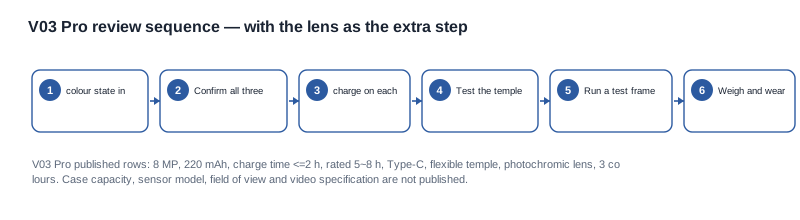
The V03 Pro is the model in the camera group that combines a photochromic lens, a flexible temple, a published Type-C interface and three published colour options — orange, off-white and black. It shares the 8 MP camera tier and the 220 mAh cell with the V03, prints a five-to-eight-hour rated runtime and a charge ceiling of two hours or less, and — like the V03 — publishes no charging-case row at all. This article is written for the buyer who is about to accept or reject a shipment, and for the supplier conversation that has to happen before the acceptance rule is written.
There is a reason to do that conversation first. It is not bureaucracy: a review without a written threshold produces a conversation, and a conversation about a shipment of this size is expensive to have twice. A review run without an agreed rule produces a set of observations, and observations do not survive a disagreement: the supplier will accept the findings that suit them and contest the rest, and a buyer with no written threshold ends up negotiating against whoever is more patient. A review run against an agreed rule produces a result, and a result is something a credit note, a rework request or an acceptance certificate can be built on. The cost of writing the rule is an afternoon; the cost of not having one is usually the entire value of the disputed units.
The second reason is that this model publishes more rows than most models in the camera group at the same tier, which sounds like an advantage and is in fact a trap. More published rows mean more things a listing can quote, and therefore more things a customer can hold you to. A model with two published rows invites two claims; a model with six invites six, and the six arrive whether or not the product has been tested against all of them.
V03 pro smart glasses buyer review checklist: the six steps and what each settles
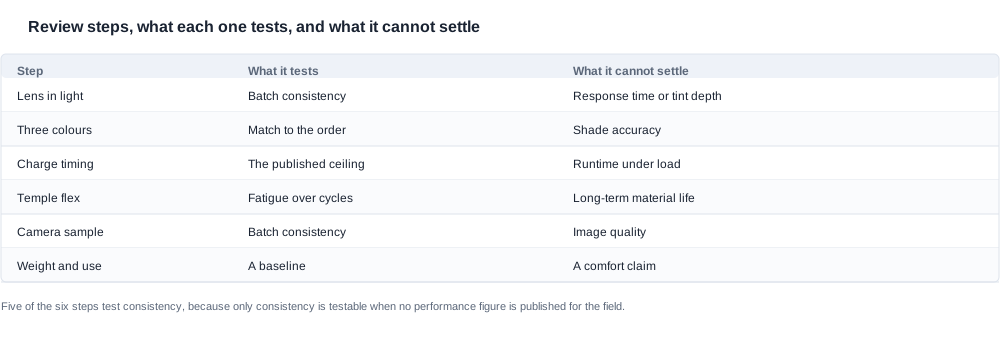
The six steps below are ordered so that the cheapest checks happen first and so that no carton has to be opened twice.
- Check the lens colour state in several light conditions. No photochromic performance figure is published for this model — not response time, not tint depth, not transmission — so there is no specification to test against. What you can do is establish a batch baseline: expose several units to the same conditions and compare them. Units that behave visibly differently from one another are a quality signal you can act on even without a specification, and a batch that agrees with itself is the strongest evidence available.
- Confirm all three published colours match the order. Orange, off-white and black are the published options. Check the actual units against the purchase order rather than against the sample, because a sample and a production batch are different things and colour is exactly where the difference hides. Draw units across cartons for this check rather than taking the first carton, since a colour deviation introduced mid-run will not appear at the front of the production line. If a private label is involved, check the finish against the approved proof at the same time; a colourway that matches the order but not the artwork proof is still a problem for the brand.
- Time a full charge to the published ceiling. Type-C is stated for this model and two hours or less is the published figure. Write the start state of charge into the record, because "about two hours" from a partly charged unit is not the same measurement as two hours from empty and the difference will be argued about later. Hold the adapter, the ambient temperature and the cable constant across every unit in the sample, and record all three. A charge review without a stated protocol is a set of opinions about a charger, and Type-C in particular rewards a poor cable with a slower result that has nothing to do with the product.
- Test the temple flex. A flexible temple is published for this model and it is a mechanical claim. Cycle it repeatedly and record the first point of visible change, not the point at which it breaks. A flex point that fatigues is a warranty exposure two years into a channel's life, and it is far cheaper to find during a review. Run the same cycle count on every unit in the sample rather than stopping at the first sign of change on one, because the useful number is the spread: a batch where one unit fatigues at forty cycles and the rest hold to two hundred is a process question, and a batch where all of them hold to the same count is a reassuring one.
- Run a test frame and compare across units. No sensor model, field of view or video specification is published for this model, so again you cannot test against a specification. Batch consistency is the useful question, and the reasoning behind it is in AI camera glasses imaging. Capture the same scene from the same position on every unit in the sample, under the same light, and compare the results side by side rather than one at a time. Side-by-side is the only comparison that exposes the differences a sequential test hides, because the eye adapts to each image individually and accepts a weak frame as normal when it has just seen a good one.
- Establish a weight baseline and use one unit for a full session. No frame weight is published, so the number you produce becomes your own reference rather than a catalogue figure. Long-session behaviour is what drives returns, and it is the one thing a bench review cannot substitute for. Weigh the frame on its own and state the method — with or without packaging, with or without a populated lens, and on how many units — because the difference between a weighed frame and a weighed retail box is routinely larger than the number a buyer expects to find published. Then run one unit through a full working session and note where it was removed and why.
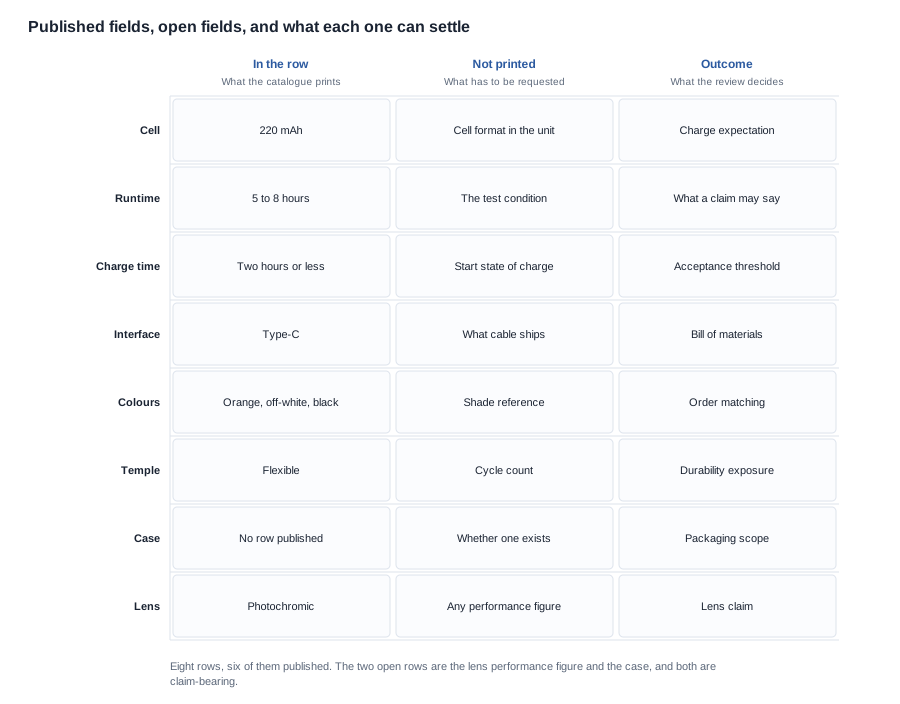
Five of those six steps test consistency rather than correctness, and that is not a weakness in the checklist — it is a direct consequence of what the published row contains. Six of the eight rows in the matrix above are printed: cell, runtime, charge ceiling, interface, colours and temple. The two that are not printed are the lens performance figure and the case, and those are the two that carry a claim.
The lens, which is the step the camera range does not otherwise have
The lens is the reason this model reviews differently. It is the only camera model in the published table carrying a photochromic lens configuration, which makes it the model where lens behaviour becomes commercially relevant — and also the model where a buyer is most likely to over-read what a review can tell them.
Three practical points. First, photochromic behaviour is tied to ambient light and to temperature, so a comparison is only valid when both are held roughly constant; a unit tested at midday on a warm bench and a unit tested on an overcast morning are not comparable, and neither is a unit tested indoors next to a window. Second, there is no published figure to test against, so the review can establish that a batch agrees with itself and cannot establish that any unit in the batch is correct. Third, because there is no figure, a lens claim cannot be written into a listing on the strength of a review — the review produces internal evidence, not a specification.
A protocol worth adopting: put three units on one bench, in the same position, and photograph them at three points in a single day — indoor light, indirect daylight, and direct sun. Photograph rather than judge, because a photograph can be put side by side months later when a question arrives, and a memory cannot. Keep the three sets with the review record. That costs ten minutes per unit and it converts the lens from a subjective observation into a reference a warranty conversation can actually use.
The same protocol, run across a second shipment, is what turns a one-off review into a supplier conversation. Two batches with visibly different lens behaviour is a process signal rather than a unit signal, and process signals are cheaper to fix before the programme grows than after.
What makes this workable rather than frustrating is that batch consistency is genuinely the higher-value question in most programmes. A single unit with a slow lens is a service case; a batch where every unit behaves differently is a supplier conversation that should happen before the balance of the order ships. The lens rows that are not published are set out in photochromic lens technology.
What this review cannot settle
Four gaps sit outside what any amount of bench work will close on this model.
The frame weight. Not published, so a comfort claim cannot be built on a number and the baseline a review produces is yours alone. That is still worth having, because it is the only figure you will have when the next purchase order asks for it.
The ingress rating. The V03 Pro row carries no IP marking, and no rating above the marking is published for this model either. A channel selling an outdoor proposition cannot attach a protection claim to this model on the strength of the catalogue, whatever the model's neighbours print.
The charging case. Neither the V03 Pro nor the V03 publishes a case row, and the Type-C port is what distinguishes the V03 Pro from the magnetic-charging V03. That difference is commercially important beyond the port itself: it decides whether a cable is in the box, whether a dock is needed, and whether a customer who bought a magnetic model can charge this one. None of that is answered by the published rows.
The certification position. No certificate numbers, laboratory names or report dates are published for this model. The distinction worth drawing is between a marking and a document: a marking is a statement printed on a product, and a document is something a third party issued and can be checked. Only the second one satisfies an importer's compliance obligation, and only the second one can be put in a technical file that survives an audit. The compliance obligations sit with the importer, and the way to satisfy them is a written request for the document plus a check that the document names the configuration actually shipped. The full method is in certification checklist.
None of those four gaps is unusual, and a buyer who has worked in this category will recognise the pattern: the published row describes the product, and the gaps describe everything a listing needs. Working through them in advance is the difference between a programme that can answer a technical buyer's questionnaire in an afternoon and one that cannot.
There is a fifth gap that only appears once a private label is involved. Nothing in the published row describes what ships in the box beyond the product itself, so the packing list, the accessory contents and the box artwork are all open scope. That matters most on this model because the Type-C port implies a cable and the V03's magnetic charging does not, so a channel carrying both models needs two accessory assumptions rather than one. Ask for the packing list per configuration in writing, and check it against what actually arrives in the carton at review.
There is also a measurement caveat that applies to every step above. The five-to-eight-hour rating carries no stated test condition — no workload, no volume, no ambient temperature — so a runtime measured on your bench is a number about your protocol, not a refutation of the published band. Record the protocol with the result.
Recording per unit rather than per batch

The single most consequential habit in an incoming review is writing findings down per unit rather than per batch. A batch summary answers the question you asked on the day; a per-unit record answers the question a customer asks six months later, which is usually a warranty question, and it can only answer it if the units are still identifiable.
Per-unit recording is also what makes a follow-up order comparable to the first one. A buyer who inspected the first shipment per unit and the second one only as a batch cannot tell whether a difference between them is a product change or an inspection change, and that ambiguity is expensive precisely when it matters, which is when something has gone wrong. Keeping the same record format across shipments costs nothing at the time and pays for itself the first time a question is asked about the difference between two batches.
Three fields do most of the work. The carton the unit came from, so a later problem can be traced to a point in the run rather than to a shipment. The measurement method, so two people measuring the same thing get comparable numbers — a charge time without a stated start state is not comparable with another charge time. And the defect category, agreed before the first order rather than invented during the review, because the categories in your returns terms have to describe the failures the product actually produces.
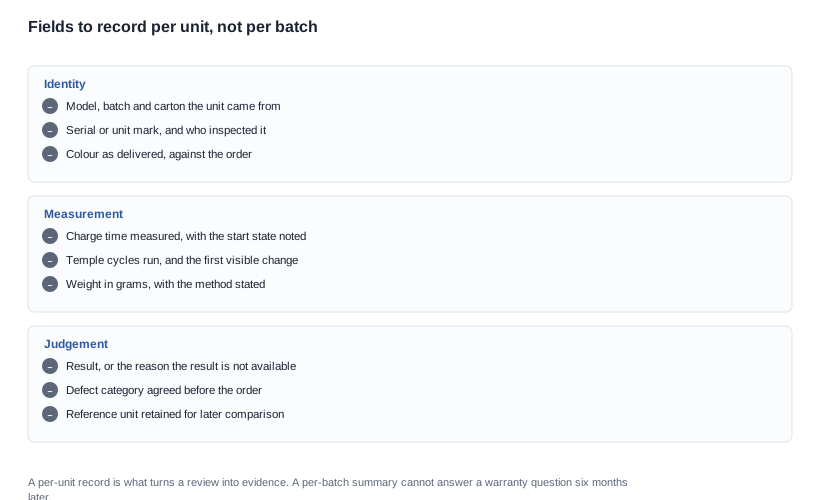
Retain a small number of accepted units as a reference batch. They are the only evidence that will exist when a question arrives about whether a later shipment is the same product, and they cannot be recreated after the fact. Mark them, date them, store them away from the working stock, and record where they are. A reference batch stored in the same box as the live inventory is a reference batch that will be sold.
Two further habits repay the effort on a model with this many published rows. The first is to keep the review record in a form that a colleague can read without asking you — a fixed set of columns, filled the same way every time, rather than free text. The second is to send the supplier the result, including the findings that passed. A supplier who only ever hears about problems starts answering defensively, and a supplier who receives a clean review record will answer the next question faster. This is the same discipline the wider range uses, and it sits alongside the private-label work in OEM ready platforms.
Before the sample is opened, write the acceptance rule
An acceptance rule agreed in advance is what makes a review binding rather than advisory. It is also the document that settles who pays when the shipment fails, which is a question best answered before the cartons are opened rather than after the disagreement has started. It should state the sample size per colour and per carton, the measurements, the pass threshold, the fail threshold, what happens between the two, and the consequence of each. On this model the sample has to be drawn across colourways rather than from a single carton of one colour, because the questions being asked are about the production run and not about one colourway's consistency. For this model the thresholds are easier to write than they look: the charge ceiling is published at two hours or less, the colours are published as three named options, the temple is published as flexible, and the interface is published as Type-C. Everything else on the list is a consistency threshold, which means you set the tolerance rather than read it off a row.
Two thresholds deserve particular attention on this model. The lens tolerance should be expressed as agreement between units rather than as an absolute tint value, because there is no absolute value to work from. The charge threshold should be the published ceiling of two hours or less, measured from empty, because that is the only charge figure in the row and a ceiling is what a supplier can be held to. Using an average instead of a ceiling is the most common way a charge review ends in an argument rather than a result.
The colour threshold is easier than it looks: three named options, so the only question is whether the delivered unit matches the order. Shade accuracy within a colourway is a separate question and it is not published for this model, so record the observation rather than converting it into a rejection.
Set the tolerance before you measure, not after. A reviewer who sees a spread of lens behaviour and then decides how much spread is acceptable has built a criterion around the answer, and that criterion will not survive a disagreement with the supplier.
The V03 Pro supports a listing built on interface, colours, temple design and the published power rows, and does not support one built on lens performance or image quality. The lens step is the most valuable item on this list precisely because the published data will not tell you whether the lens is performing — only whether your units agree with each other.
Tell us your channel and your target market and we will tell you which rows we can evidence for this model and which remain open. The model sits on our AI camera glasses range page, and the surrounding buying sequence is in the AI camera glasses buying guide.


