
An AI camera glasses buying guide built on published rows is the only kind of guide that survives contact with a supplier. This range has eleven camera models, and between them they publish a resolution class, a cell capacity, a rated runtime, a charge time, a charging interface in some cases, a charging case in most cases, and two ingress ratings. That is enough to narrow eleven models to three or four. It is not enough to make an image quality claim, a durability claim or a compliance claim about any of them, and this guide is organised so that you stop reading specification rows and start asking for the six rows nobody publishes.
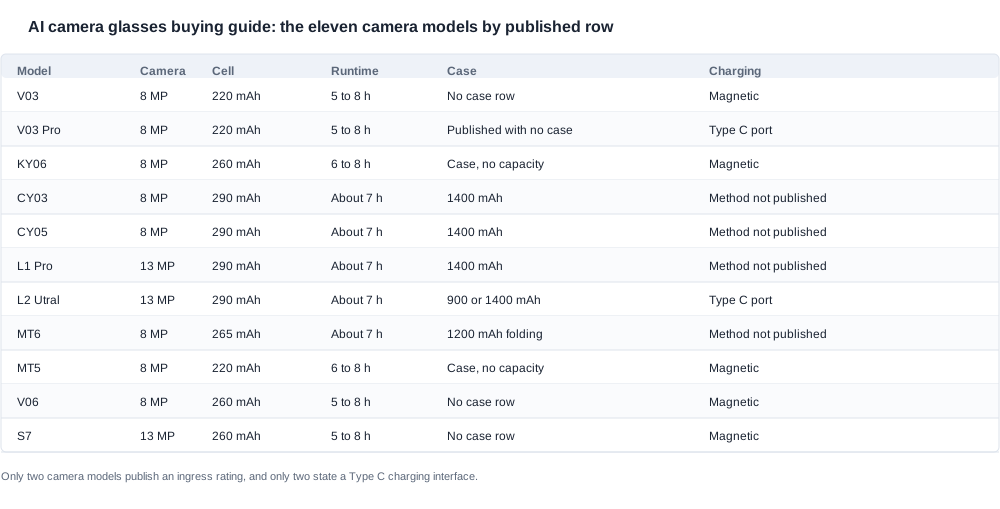
AI camera glasses buying guide: the eleven models grouped by the rows they publish
Grouping the range by what it publishes produces a structure that is not the same as grouping it by what it costs or by how good it is, and that difference is the point of the exercise. The groups follow the catalogue's own rows, so a buyer can rebuild them from the source document without asking anyone a question.
By camera resolution. Eight models publish 8 MP: the V03 and the KY06, the V06 and the MT6, and the MT5 and the CY03, and the CY05 and the V03 Pro. Three publish 13 MP: the L2 Utral and the S7, and the L1 Pro. The three-model group is a real tier with a real boundary; the eight-model group is not a tier at all, because eight models sharing a resolution class tells you that resolution is not what separates them in this range.
By cell capacity. 220 mAh for the MT5 and the V03 Pro, and the V03. 260 mAh for the KY06 and the S7, and the V06. 265 mAh for the MT6 alone. 290 mAh for the CY05, the CY03 and the L2 Utral, and the L1 Pro. The spread from smallest to largest is roughly a factor of one and a third, which is not a wide spread for a range, and it is the reason capacity is a poor primary sort.
By endurance shape. Five models publish a point figure of about seven hours — the L1 Pro and the CY05, and the CY03 and the MT6, and the L2 Utral. Four publish a range of five to eight hours — the V03 and the S7, and the V06 and the V03 Pro. Two publish a range of six to eight hours — the KY06 and the MT5. All eleven publish an endurance figure, so there is no camera model in this range where the runtime row is missing; the problem is that the three shapes are not on a common basis, which is handled in the battery comparison.
By charging interface. Five publish magnetic charging: the V06 and the KY06, and the V03 and the S7, and the MT5. Two publish a Type-C port: the V03 Pro and the L2 Utral. Four publish no interface row at all: the MT6 and the CY03, and the CY05 and the L1 Pro — and all four of those do publish a charging case capacity, so the silence is about the port, not about the accessory.
By charging case. Five publish a case capacity: the L1 Pro and the CY05, and the CY03 — each at 1400 mAh, the L2 Utral at either 900 mAh or 1400 mAh, and the MT6 at 1200 mAh in a folding case. Two publish a case with no capacity: the KY06 and the MT5. Three publish no case row at all: the S7 and the V06, and the V03. One has no charging-case row: the V03 Pro. The difference between a missing row and an explicit statement is worth a paragraph of its own, because a buyer who reads the three silences as "no case" will conclude that the V03 Pro is the only case-less model in the range and will build a packaging programme on that reading.
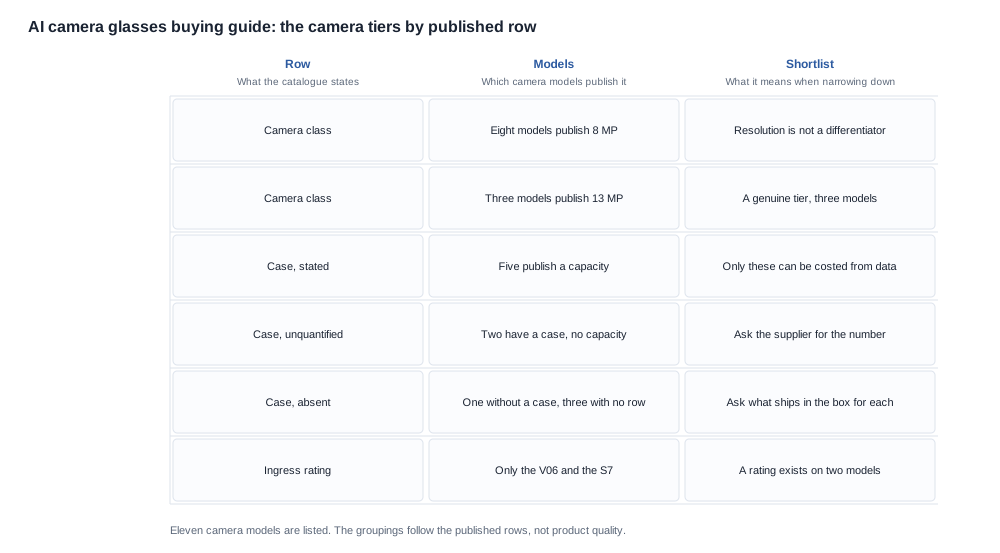
By ingress marking. Exactly two camera models publish one: the V06 and the S7, both at IP54. Both of those also publish an ergonomic design and a removable inner frame, which means the durability-marked group is also the group with a published structural feature, and the remaining nine models have neither a rating nor a structural feature row. The IP rating supplier verification note covers how a rating is checked in a market, because a published marking is a claim that a buyer will have to be able to defend.
The grouping that actually does the work. Resolution, capacity, runtime and ingress are all useful filters, but the filter that reduces a range to a workable shortlist fastest is the case row, because it is a physical object with a stated capacity, a stated form and a stated place in the box. It also determines what the parcel weighs, which is a landed-cost input rather than a product attribute, and it determines whether the packaging programme has one architecture or two.
The four questions that narrow the range before you look at any specification sheet
Four questions, asked in this order, reduce eleven models to a shortlist of two or three without a single conversation with a supplier. The order matters, because each question removes a different kind of model and the cheapest eliminations come first.
Question one: is image resolution load-bearing in your proposition? If it is, the shortlist sits in the 13 MP group — the L2 Utral and the L1 Pro, and the S7 — and you have three models rather than eleven. If it is not, an 8 MP model is defensible on the published rows and the resolution row stops doing any work in your shortlist. Notice where those three sit: two of them carry a 290 mAh cell and a 1400 mAh case, and the third, the S7, carries 260 mAh, a five-to-eight-hour range, magnetic charging and one of the two published ingress ratings. The tier is a tier in resolution and nothing else, and a buyer who assumes the resolution tier is also the endurance tier is reading a pattern the catalogue does not contain.
Question two: does your parcel need a quantified case? If the answer is yes, the shortlist is the five models that publish a capacity — the MT6 and the L2 Utral, the CY03 and the L1 Pro, and the CY05. If the answer is no, the KY06 and the MT5 are not excluded, because a case exists for them even though its capacity is not published. The three models with no case row, the V03 and the S7, and the V06, and the one has no charging-case row, the V03 Pro, both require a question to a supplier before they can be planned into a packaging programme.
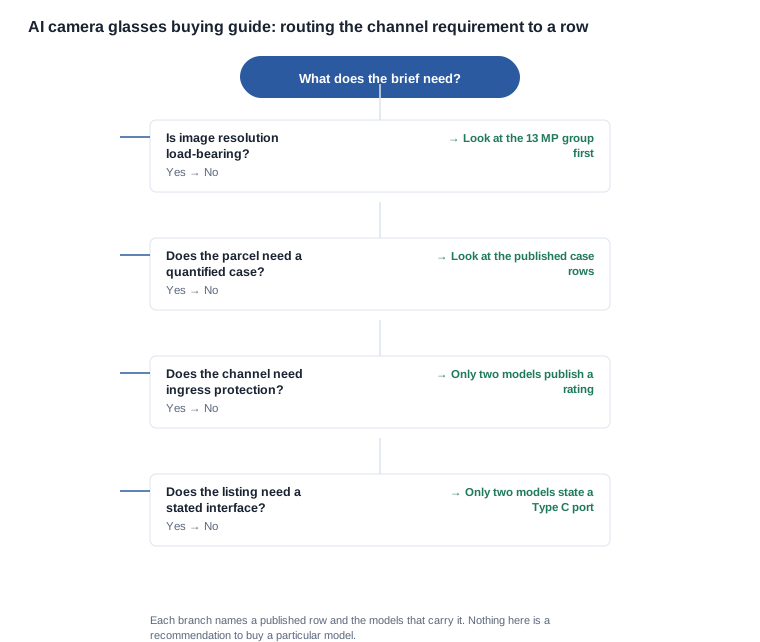
Question three: does the channel require a stated ingress rating? If yes, the shortlist is the V06 and the S7, and there is no third option in this range. If no, nine models remain and the question simply stops mattering. This is the clearest example in the catalogue of a requirement that narrows a range to a hard ceiling rather than a preference, and it is worth knowing before the brief reaches a buyer who has already been told that the range has options.
Question four: does the listing need a stated charging interface? If yes, the shortlist is the seven models that publish one — five magnetic and two Type-C. The four that publish nothing cannot be listed with an interface claim today, even though in every likelihood the hardware has one; the distinction between a published row and a supplier statement is the distinction between something you can list and something you can list once it appears in a document you have signed.
The order of the four, and why it is this order. Resolution first, because it is the only question that removes seven models in one step. The case second, because it is the one that determines the landed cost and therefore the commercial viability of the whole programme. Ingress third, because it is a hard ceiling of two models when it applies and it is cheap to establish early. The interface fourth, because it is the one where a supplier answer is likely to arrive and it changes the packaging rather than the product.
What this sequence does not do. It does not produce a recommendation, and it cannot, because the four questions route to rows rather than to verdicts. A shortlist that arrives from this sequence is a shortlist with a known shape — one resolution class, one case position, one interface position, and two or three models inside it — and it still requires the supplier to answer the questions that the catalogue does not. The which model to pick article covers the range-level decision that sits above this one, and the resolution options analysis covers what a resolution class can and cannot be asked to carry.
The nine rows no camera model publishes and what each one blocks
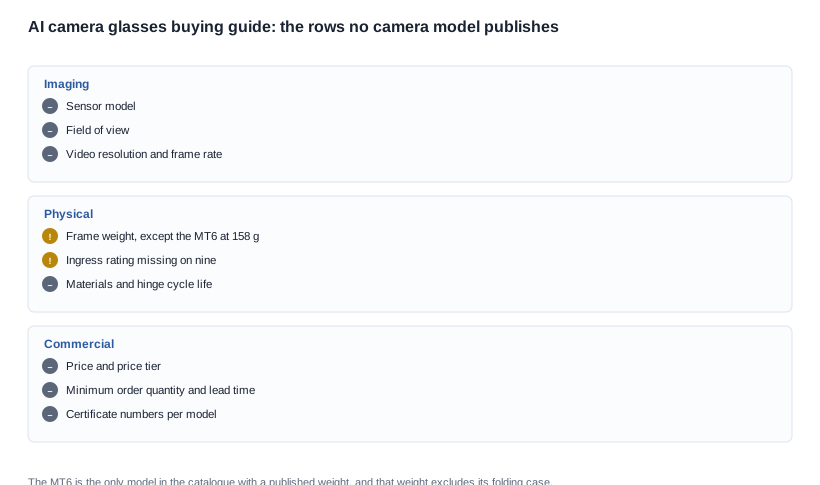
Nine rows are missing across the whole camera group, and each of them blocks a specific thing a buyer would otherwise want to do. Listing them as gaps is more useful than filling them with values typical of the industry, because a camera specification invented once tends to be copied for years and it is very hard to retract from a live product page.
The sensor model. Without it, a resolution class cannot be converted into an image expectation, because megapixels count pixels and say nothing about the size of the light-gathering element behind them. This is the row that decides whether 13 MP is a useful tier to pay for or a shelf argument. The AI camera glasses imaging note covers why resolution and image quality are separate questions.
The field of view. Without it, nobody can judge whether the product suits first-person video at all. A narrow field and a wide field are different products for a content channel, and no amount of megapixel information substitutes for it.
Video resolution and frame rate. Without them, a buyer does not know whether the camera records video at all, let alone at what quality or how smoothly. This is the most commonly overlooked gap in the category and the one that most often invalidates a proposition after the first sample.
The frame weight, with one published exception. The MT6 is the only model in the catalogue with a published weight: 158 grams for the glasses body, including the cell and the camera, and excluding the folding charging case. The case weight is not published. No other camera model publishes a weight, so this is a single data point in a group of eleven and it cannot be generalised. Weight is also the variable most consistently correlated with returns in this category, which makes the missing row commercially expensive rather than merely incomplete.
The ingress rating, with two published exceptions. The V06 and the S7 publish IP54. The other nine camera models publish no ingress position at all, which means no durability claim and no dust or water exposure guidance can be written for them. Note carefully the direction of that statement: it is not that the other nine models lack a rating in the hardware, it is that the catalogue does not publish one.
Per-model certification numbers. No camera model publishes a certificate number, an issuing body, a validity period or a model schedule. The catalogue carries a company-level export certification page whose content is images rather than text — ten patent certificates, eight appearance-design patents and two utility-model patents — and the catalogue text contains no reference to CE, FCC or RoHS anywhere. A patent certificate is not a conformity position, and a company-level page does not tell you which model numbers your file will cover. This is a document to request from a testing body in the destination market, and the certification checklist covers how to ask for it in a form that can be checked.
Materials and hinge cycle life. Not published for any camera model, so a buyer cannot state how many cycles a temple is rated for, whether the hinge is a serviceable part, or what a replacement frame costs.
Price and price tier. Not published for any camera model, so a channel cannot build a price ladder from our own material, and a distributor cannot tell a buyer what a configuration is meant to sit at.
Minimum order quantity and lead time. Also absent, so a first order cannot be planned from a published figure. These three close the list: the summary chart groups them under physical and commercial rows, and a buyer working from the chart is working from nine gaps, not six.
Two more rows that are not in the nine but belong in the same list. The Bluetooth version is not published for any camera model, so a buyer cannot state the radio generation for any of them. And the charging interface is not published for four of the eleven, as set out above. The charging case options analysis covers what follows from a case position, and the customization options article covers the rows a brand programme adds on top.
What the AI feature entries do not tell a buyer
Every model in this catalogue carries the AI designation in its name, and the range carries AI feature entries across its pages. Neither of those facts tells a buyer anything they can put on a product page, and it is worth being precise about why, because the name is the most visible thing a buyer will see and the least useful.
A name is not a specification. The catalogue names these products as AI photo glasses. What it does not publish, for any camera model, is a description of what the assistant does: whether processing happens on the device or on a server, whether a subscription is attached, whether any function works with the network unavailable, where data is stored and how long it is retained, and what happens to a recording when a request is made. None of that is a specification, and none of it can be inferred from a product name.
Why this matters more in this category than in an audio category. A camera glasses product in a channel is a device that captures what a person sees, and the questions a procurement lead at a retail or distribution customer will ask about that capture — where the footage goes, how long it is kept, whether the device can be used with the radio off, whether a recording can be triggered by accident — are all in this unpublished set. They are also the questions that a channel's own legal function will ask before the product can be listed. The AI features in smart glasses note sets out the four questions that determine whether an assistant claim can be built on at all.
The three questions worth putting in the enquiry, and what each one unlocks. Where is the processing performed, on the device or remotely? Does any function work with no network connection, and if so which? What is the retention and deletion policy for captured media, and can a customer or an enterprise account set it? The answers decide whether a voice or assistant feature can appear on a listing at all, whether the product can be sold into a locked-down market, and whether the channel's data questions can be answered with a document rather than a reassurance. They are not answers we publish, because our documentation does not contain them, and they are not answers a buyer should accept in a conversation either.
The practical boundary for a listing. A buyer may state that the product is an AI photo glasses model, because that is the designation in the catalogue. A buyer may not state that it performs any particular AI function, because no published row supports any particular function, and a listing that names a function the documentation does not carry is a claim that will have to be defended to a returns desk, a channel compliance team and eventually a regulator in the destination market.
How to turn the published rows into a shortlist a supplier can answer
The output of this guide is not a list of models. It is a specification request and a shortlist with the open rows marked, and both of those are more useful to a supplier than a vague enquiry about the camera range.
The shortlist sheet, and what goes in each column. The model designation exactly as published. The camera resolution class. The frame cell capacity and the rated runtime, as published values, with a range kept visually distinct from a point figure. The charge time of two hours or less, stated as a ceiling, with the note that the catalogue publishes no starting state and no termination criterion. The charging interface, with the four unpublished ones flagged as an open question rather than left blank. The charging case position, in one of the four published states — a stated capacity, a case with no capacity, no case row, or published without one. The ingress marking, where published. And the weight, only for the MT6, with the body-only qualifier attached.
The open rows that travel with the shortlist. Six per model, drawn from the section above: sensor model, field of view, video resolution and frame rate, frame weight with the cell fitted, ingress position where it is not published, and the per-model certification scope. Add two more for the models where they bite: the charging interface for the L1 Pro, the CY03 and the CY05, and the MT6, and the charging case capacity for the KY06 and the MT5.
Why a marked-open shortlist gets better answers than a blank one. A supplier reading a request that says "field of view: open" knows exactly what is being asked and can answer it in a sentence. A supplier reading a request with a blank cell does not know whether the buyer forgot, does not care, or is testing the supplier, and the default answer is a paragraph of marketing copy. The marked-open request also protects the buyer: a model that a supplier will not answer for is a model whose listing claims are unbacked, and a buyer who wants to resell it needs to know that early, before the artwork is finished.
What to do with a model that cannot be answered. If the sensor and the field of view are not available for a model, that model cannot be listed with any image performance claim, and the listing has to be built on the resolution class and the physical specification instead. That is a legitimate product page, but it is a different page, and it is a page where the comparison against a competitor with published sensor data is one you will lose. Buyers who accept that early design their proposition around it, and buyers who discover it at the artwork stage pay for the reprint.
How to get the answers into a file rather than a conversation. Every answer should arrive in writing, attached to a model designation, and recorded in a specification file that says which rows are published, which are supplier-supplied and which remain open. That file is the input to the sample approval, the artwork, the conformity file and the pre-shipment inspection, and it is the only artefact in the whole programme that prevents four different people from holding four different beliefs about what the product is. The AI camera glasses quality checks cover the incoming inspection that works from the same file, and the bulk ordering sequence covers where the file sits in the order.
Our position, stated once. This category can be narrowed to a shortlist with the published rows, and the shortlist cannot be finalised until the open rows are answered. We will give you the rows we have, name the ones we do not, and refuse to fill the gaps with values typical of the industry, because a camera specification invented once tends to be copied for years and it is very hard to retract from a live product page. We will not quote a price, a minimum order quantity, a lead time or a certification status in any article, because our documentation does not contain them, and we will not turn a published-row guide into a recommendation that the documentation cannot carry.
What we can tell you today, in one paragraph. We can tell you the resolution class, the cell capacity, the rated runtime, the charge time and the case position for all eleven camera models, and we can tell you which models publish a charging interface, which publish an ingress rating, and which publish a weight. We cannot tell you the sensor, the field of view, the video specification, the weight of ten of the eleven models, the ingress position of nine of the eleven, the Bluetooth version of any of them, or the certification scope of any of them. Rather than guess at those, we mark them open and tell you who has to close them.
The next step. Tell us your channel, the markets and whether image quality or the case story drives the brief, and we will narrow this to two or three models, list what remains open on each, and put the open rows into a form you can send to a supplier as a specification request.
Related reading
- The full camera range — AI camera glasses
- Why resolution is not image quality — AI camera glasses imaging
- The endurance rows and how to read them — AI camera glasses battery comparison
- Questions to ask before trusting an AI feature row — AI features in smart glasses
Pass the target market, the quantity and the required configuration to us, and we will come back with what is available and what is not.


