
V03 Pro smart glasses certification status reduces to one fact and one gap. Our catalogue publishes no CE, FCC or RoHS text and no per-model certification row anywhere in the range. What is not published for this model is any certificate number, issuing body, validity date or model-coverage list. This model has one complication the other camera models do not: a photochromic lens, which raises a testing question of its own and sits awkwardly beside the electronics paperwork.
The gap is not a defect and it is not unusual in this category. It is simply the normal shape of a product-row catalogue, and a buyer who knows to ask for it early treats it as a task; a buyer who discovers it at the retailer review treats it as a problem. This article is written for importers, brand owners and distributors who are assembling a compliance file, and it sets out the order in which that file gets built.
Three things are worth establishing before the rest of this article makes sense. The first is that the compliance obligation in most markets sits with the importer, not with the factory, which means the document set you need is yours to assemble and yours to hold — the supplier can supply it, but nobody else will do it for you. The second is that a document you have not seen is not a document you have, and that a verbal assurance that the paperwork exists is worth exactly as much as an unsigned note. The third is that the cheapest moment to obtain any of this is before the first purchase order, because after the order is placed the same question carries a different negotiating position.
None of that makes the V03 Pro unusual. It makes the file buildable, which is the useful thing to know about it.
V03 pro smart glasses certification status: what is printed and what is not
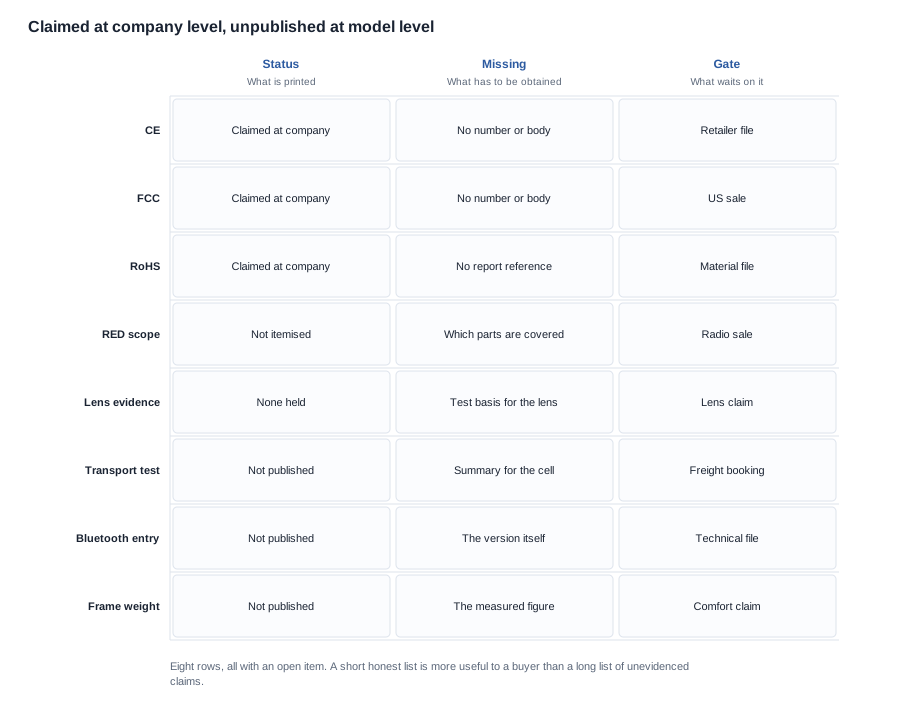
The published rows for this model describe the product and nothing else: an 8 MP camera tier, a 220 mAh cell, a charge ceiling of two hours or less, a rated five-to-eight-hour runtime, a Type-C interface, a flexible temple, a photochromic lens, and three colour options — orange, off-white and black.
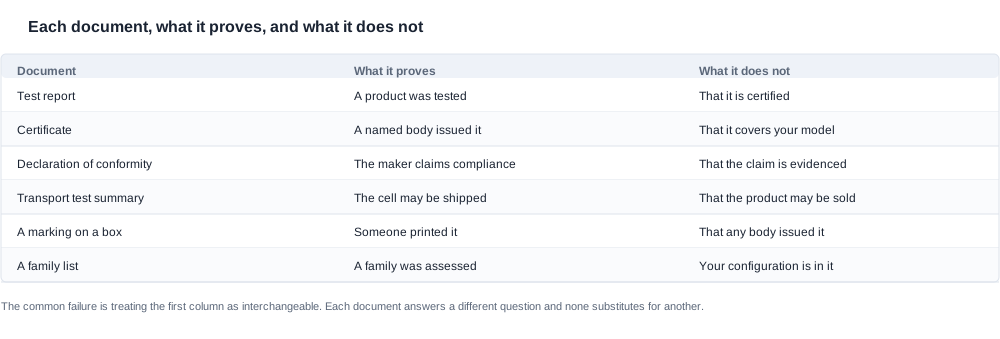
Not one of those rows is a compliance document. They tell you what the product is, not whether it can lawfully be sold in your market. That distinction is the whole of this article: a compliant product and a documented product are different things, and only the second one closes a retailer's file, survives a customs query, or answers an auditor who asks for evidence rather than for assurance.
Two further gaps belong in the same list. The Bluetooth entry for this model is published as not published, so a technical file that needs the radio version has an open item. And no frame weight is published, which is not a compliance matter at all but stops being one the moment a listing or a technical questionnaire asks for it.
There is a fourth position a buyer should be aware of because it is easy to misread. Where a range publishes a family-level claim, it is tempting to read that claim as covering every model in the family. It does not, and the reason is structural rather than evasive: a family-level claim tells you that a company has, at some point, held documents for products of this type. It does not tell you which configuration was assessed, which cell was in it, which port it used, or whether the lens was present. This model publishes a Type-C port and a 220 mAh cell, both of which differ from at least one of its neighbours, and the lens is a distinguishing feature rather than a shared one. A family claim is a starting point for a request, not a substitute for the request.
The practical consequence is a sentence worth having ready: I have read that these approvals are held for the range, and I need the documents that cover the V03 Pro as configured. That sentence costs nothing and it distinguishes a buyer who is doing due diligence from one who is asking a question they already know the answer to.

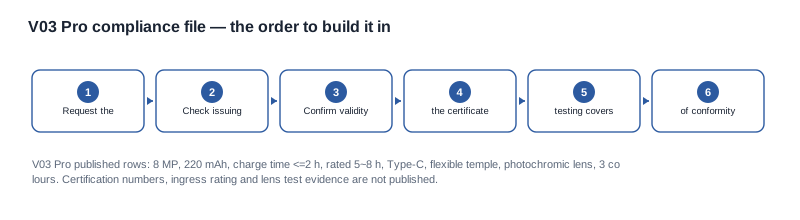
The six steps that build the file, in order

The order below matters, because each step is cheap to do while it is early and expensive to do while it is late.
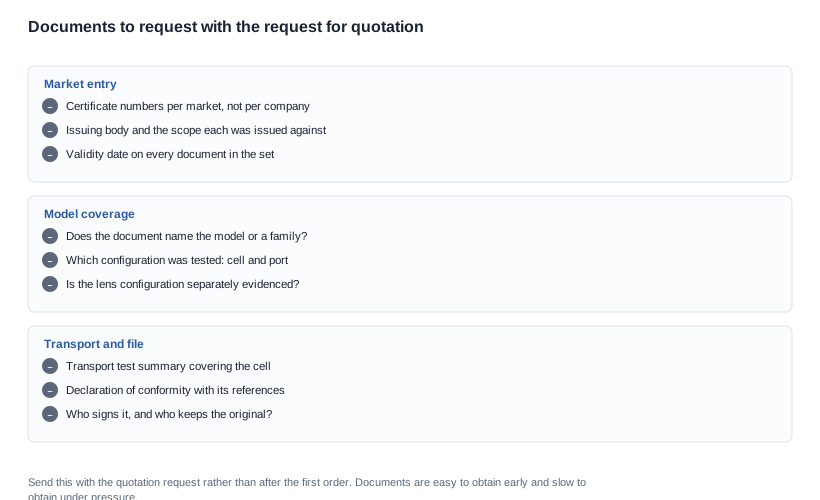
- Request the certificate numbers. A number is the fastest disqualifier in the whole process: with it you can verify almost everything else, and without it nothing downstream is checkable. Ask for numbers per market rather than a single company-level claim, and ask for them in a format that can be filed — a scan of the document itself rather than a sentence describing it. A number typed into an email is a claim; a number on a document you can file is evidence.
- Check the issuing body and the scope it was issued against. A test report is not a certificate, and a certificate issued by one body is not interchangeable with a certificate issued by another. The check that matters here is scope: a document covering the radio alone does not cover electrical safety, and one covering safety does not cover the radio. This model is a camera with a wireless link, so it needs both, and a supplier who offers a single document for both should be asked which standard it was issued against. A certificate covering the radio alone does not cover electrical safety, and one covering safety does not cover the radio — and a camera model with a wireless link needs both.
- Confirm the validity dates. Certificates expire and are sometimes suspended or withdrawn, and a document that is current today may not be current for the whole life of the programme. Check the date against your expected launch window rather than against today, because a certificate with four months left is a different commercial fact from one with four years left. A number without a current date is not an answer, and a document in the file with a lapsed date is worse than an absent document because it invites the assumption that the rest are equally stale.
- Match the model designation. This is where most claims collapse, and it is worth doing character by character rather than by eye. A document reading V03 Pro, one reading V03, and one reading V03 Pro with a suffix such as a batch or region identifier are three different things, and the last is often the one you need and the one nobody mentions. Ask for the designation exactly as it appears on the unit rather than as it appears on the supplier's invoice, because those are frequently not the same string. The document must name the V03 Pro, not a family and not a phrase like "our smart glasses range". A mismatch produces friction at customs, friction with the retailer, and an awkward conversation after a quality claim.
- Confirm the lens has its own evidence, if your market needs any. A photochromic lens near the eye is a separate subject from the electronics, and it is the one subject on this model where a family-level document is least likely to be sufficient. Ask whether the lens has been tested in this configuration or one resembling it, and on what basis. We hold no lens test data for this model, and we will not estimate one. The lens position in general is set out in photochromic lens technology.
- Assemble the declaration of conformity. In the European market this is the document that ties the product to the standards claimed. A CE marking printed on a box is not a declaration, and a listing that implies otherwise is a claim the file cannot support. Check that the declaration references the documents that are actually in the file rather than a set that was assembled two revisions ago, and confirm who signs it and who holds the original.
Two more practical points belong to this step. First, the declaration is the importer's document as much as the supplier's, and in some markets it has to carry the importer's own details — which means it cannot be produced as a generic PDF before the importing entity is settled. That is a reason to start the process before the entity is final, not after. Second, keep the file in a form that can be produced in minutes: a single folder with the documents named by what they are rather than by the date they arrived, and a one-page index listing each document, its number, its scope and its validity date. A file that takes an afternoon to assemble is a file that does not get assembled during a retailer's onboarding call.
The retailer-specific items described at the end of this section belong in the same folder, because a retailer will ask for them in the same conversation.
Before working through the steps, it is worth separating two activities that buyers routinely merge. Verification asks whether a document is genuine, current and correctly scoped — that is a due diligence exercise, and it is the one that protects you. Filing asks whether the right set exists for a given market — that is an administrative exercise, and it is the one that protects the sale. Doing the first well and the second badly still leaves you exposed, because a perfectly genuine set of documents assembled for the wrong market satisfies nobody. For this model the second activity is the harder one, because a family-level claim makes it look as though the work is already done.
How to evaluate a supplier's answer at each step follows a simple rule: the further a document is from the thing being sold, the more it should be checked. A document naming a family, a date in the past, or a scope that excludes the radio all look identical on a specification sheet and behave very differently when someone asks.
The transport question, which is decided before the booking
A 220 mAh lithium cell raises a second file that has nothing to do with market access. Transport test evidence for a lithium cell is required in most shipping configurations, and it is not published for this model. If you are moving units by air or sea, that has to be established before the booking is made rather than at the carrier's desk, because the carrier's desk is where the delay happens.
The practical sequence is short, and it is worth doing in a single correspondence rather than across several. Ask for the transport test summary covering the cell that will actually ship, confirm it names the cell configuration rather than a generic cell, and confirm the packing arrangement the evidence assumes matches the carton you will use. A summary that names a different cell format is a common and easily-missed failure, particularly on a model where the cell is shared with a neighbouring product. The wider transport compliance context is in battery transport.
Three further transport questions are worth settling at the same time. Whether the units ship with cells installed or fitted on arrival changes the paperwork, because a product shipped with a cell installed is usually treated differently from one shipped with the cell packed alongside. Whether the retail packaging differs from the transport packaging matters for the same reason, and a private-label programme usually changes the retail packaging while leaving the transport packaging alone. And whether any state-of-charge restriction applies to the chosen mode is a question for the forwarder rather than the supplier, but it is a question that has to be asked before the booking rather than at the loading dock.
A fourth question, and the one most often skipped, is whether the documents name the supplier, the factory or a trading company. In this category the three are frequently different entities, and a document issued to a trading company tells you nothing about the factory's own position. A buyer building a long-term programme wants to know which of them actually holds the approvals, because that determines who can answer the question when the programme needs a change and who cannot.
None of these are unusual, and none of them are expensive to resolve early. What is expensive is a consignment that is held at the port, because the demurrage, the storage and the customer relationship cost together are multiples of the documentation cost involved in preventing it.
It is worth noting why this is listed alongside the certification question rather than in a separate article. Both files are assembled from the same supplier, in the same correspondence, at the same point in the programme, and a buyer who requests them separately pays for the delay twice.

What a complete file still does not settle
There is a fifth gap in this model that is worth separating out, because it is the one most likely to be overlooked by a buyer who is working from a checklist rather than from the product. This model publishes a photochromic lens as a distinguishing feature, and a lens that sits near the eye is a different regulatory subject from the electronics beside it. We hold no lens test data for this model and we will not estimate any. A buyer who needs a lens claim for a market that treats it separately has to obtain it, and the request is better made early because lens testing is slower than the paperwork around it.
Even a complete, current, correctly scoped compliance file establishes that the product may be sold. It does not establish that the product meets your requirement, and the two are routinely confused by buyers who assume that a file which closes a retailer's audit also closes a specification question.
For this model, five items remain open regardless of the compliance position. No sensor model is published, no field of view is published, and no video specification is published, so a camera claim in a listing has no documented basis. No frame weight is published, so a comfort claim has none. And the five-to-eight-hour runtime carries no stated test condition — no workload, no volume, no ambient temperature — so a runtime measured on your own bench is a number about your protocol rather than a refutation of the published band. The reasoning behind the imaging gaps is in AI camera glasses imaging, and the runtime measurement point is covered in smart glasses battery life.
There is a fourth category that sits between the two: what the retailer asks for beyond compliance. Product liability requirements, packaging labelling, language of instructions and importer-record obligations are all part of a retailer's onboarding in most markets, and none of them is answered by a certificate. Those are market questions rather than product questions, which is why the same file will be sufficient for one destination and insufficient for another even when the product is identical.
It is worth naming one asymmetry that catches buyers out. Compliance work is a fixed cost per market, and it is paid once per entity. The specification gaps above are a per-listing cost, and every new listing repeats them. A channel that launches forty variants of a model inherits the compliance file once and the specification problem forty times, which means the specification gaps are the ones that actually grow as a business does. Closing them is not a compliance task; it is a product-documentation task, and it is the one that determines how quickly the programme can scale without every new listing needing a new negotiation with the factory.
The order that follows from that is straightforward: build the compliance file once, per market, and treat it as a stable asset. Close the specification gaps model by model, because they are what recur. A buyer who splits the two workstreams finds the first one takes a fortnight and the second one takes a conversation that has to happen again for every new claim. Product liability requirements, packaging labelling, language of instructions and importer-record obligations are all part of a retailer's onboarding in most markets, and none of them is answered by a certificate. Those are market questions rather than product questions, which is why the same file will be sufficient for one destination and insufficient for another even when the product is identical.
Where our documentation stops on the V03 Pro certification status
There is one further habit worth naming, and it is the one that separates buyers who handle this smoothly from those who do not. Write down, at the moment each document arrives, which question it answers and which questions remain open. A file is not a stack of papers; it is a set of answers against a set of questions, and the mapping is what a retailer, an auditor or a new colleague will ask for. Keeping that mapping as the file is built costs five minutes per document and saves a full afternoon every time somebody needs the answer again.
We would rather give you a short, accurate list of the documents we hold than a long list of claims we cannot substantiate. For the V03 Pro that list is currently short, and we will tell you so rather than dress it up.
We will not convert a claimed certification into an evidenced one in a listing. We will not supply a certificate number, an issuing body or a validity date that we cannot verify, and we will not extend a company-level claim to a model-level document that has not been shown to us. Ask us for the certification evidence and we will say which items we can produce; where a number, a body and a validity date are not among them, that is a decision for you to make with full information.
The document set to request is set out in certification checklist, and where this model sits in the camera range is on our AI camera glasses page. Tell us the target market, the volume and the required configuration, and we will come back with what is available and what is not.


