

These two camera models sit at opposite ends of the published power range, and the interesting thing about them is that the bigger battery does not carry the longer published runtime. One of them carries two hundred and twenty milliampere-hours and publishes an endurance band of five to eight hours. The other carries two hundred and ninety milliampere-hours and publishes a single endurance figure of about seven hours. A buyer who reads those two lines side by side concludes either that the smaller cell is somehow more efficient or that the larger figure is a mistake, and neither conclusion survives a second look.
The reason it survives neither is that the two products are not doing the same work. They are different camera products, with different published resolution classes, and the load behind each endurance figure is unpublished. That is the whole of the analytical content, and it is the reason the two rows cannot be compared on their face.
The other half of the comparison is the charging arrangement, and here the two models are closer than the power figures suggest. They share the connector family and the ceiling on the charge interval, and they differ in what comes in the box: one of them is published as having no charging case at all, while the other publishes two case capacities on its page and the only pair of variant names in the camera range. A comparison of the battery and charging rows therefore has three genuinely different outcomes rather than one, and they point in three different directions.
Nothing in this comparison describes what either product does with the energy it carries, and no figure here has been supplied from anywhere but the catalogue. Where the record falls silent, this article names the party who is able to close it.
V03 Pro smart glasses vs L2 Utral battery and charging: two ends of the range
What the table sets out, and what it does not
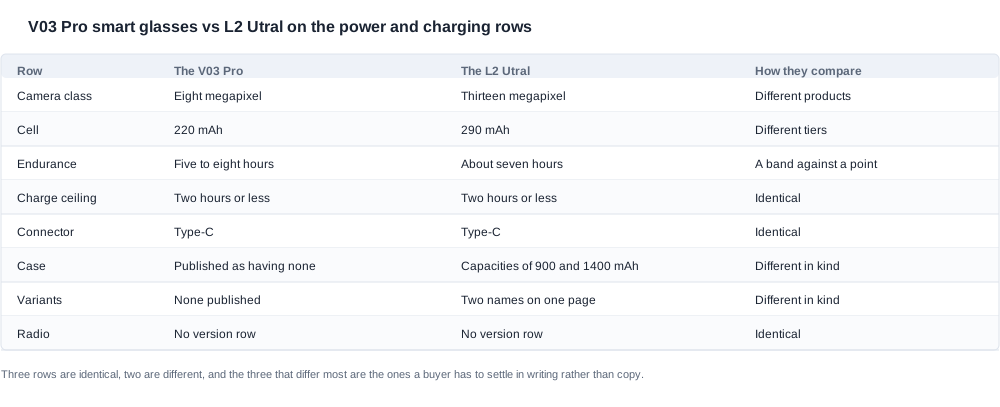
Three rows are identical between the two designations: the ceiling on the charge interval, the connector family, and the radio position, in the sense that neither publishes one. The camera class differs, the cell differs, the endurance figure differs in form as well as in value, the case position differs in kind, and the variant naming differs in kind.
What the table does not do is turn those differences into a comparison, and the reason is worth stating before the substance rather than after it. The endurance row on one side is a band and on the other side it is a point. Five to eight hours is two published outcomes; about seven hours is one. A band and a point are not the same kind of measurement, and a sheet that puts them in a single column is presenting a comparison that has not been made.
The three questions a buyer can answer from the table alone
Before anything is asked of anybody, three things are already settled by the two pages, and a buyer who has them does not need to spend the programme's time on them.
That the two products are not substitutes for one another. They publish different resolution classes, different cell tiers and different endurance forms, and they are therefore two different products at two different points in a range. A channel that was treating them as a pair of colour or specification options for the same product has mis-read the pages, and that mis-reading is worth catching before a range is planned rather than after.
That one charging routine covers both. The connector is the same family and the ceiling on the charge interval is the same bound, so a channel stocking both does not have to design two charging instructions, two demonstrations or two spare programmes for the cable.
That the accessory question is the real one. One of the two has a settled case position, and the other has two published capacities and two names on the page. Everything that remains open in this comparison is open because of what the packaging and the configuration have to contain, not because of what the battery does.
Those three are the reason a buyer can shorten the list of questions to four, and it is worth noticing that none of the three is a question at all.
The labels, again, and this time on two different products
This is the second article in the family to have to make the same point, and on this pair of products the point is sharper rather than softer, because the two endurance figures happen to be numerically close. A reader who sees five to eight hours in one column and about seven hours in the next will treat the second as the midpoint of the first, and it is not, because the two figures were produced under conditions nobody has published.
The catalogue labels the two rows differently as well. The endurance row on the V03 Pro's page is labelled as usage duration, and the row on the L2 Utral's page is labelled as endurance. The cell rows are labelled differently too, one as a capacity row and the other as a battery capacity row. None of this is a defect. It does mean that a specification sheet built from the two pages needs each figure to be written with its quantity attached, and that the rule about writing the quantity into the field name rather than only into the value is worth applying to the pair rather than to the individual.

The 220 and 290 milliampere-hour cells, and the endurance bands around them
Why the smaller cell with the wider band is not the anomaly
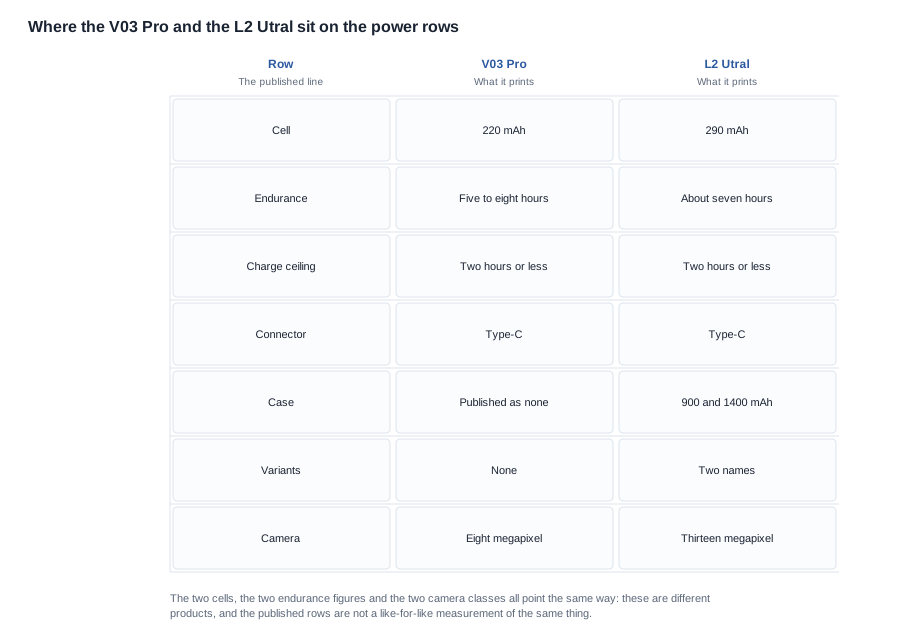
The natural reading of the two power rows is that the two hundred and ninety milliampere-hour model is the one with the endurance advantage, because a bigger cell is a bigger reservoir. The published figures do not support that reading, and there are three explanations available, none of which the catalogue helps a buyer to choose between.
The loads differ, because the products differ. The two models publish different resolution classes, and a higher resolution class is a different amount of work. A bigger cell carrying a heavier load can land on a similar runtime to a smaller cell carrying a lighter one, and nothing about the endurance row contradicts that. This is the most likely explanation and it is also the one that makes the endurance rows the least useful as a comparison.
The measurement conditions differ. A band and a point are almost certainly different products of different test arrangements, and if the arrangements are not published then the two numbers are two measurements rather than one measurement taken twice.
The band is a spread and the point is a single outcome. Five to eight hours may describe a spread of units, and about seven hours may describe one unit, or one condition. In that case the apparent agreement is an artefact of a spread being quoted at its centre.
The practical consequence is the same in all three cases, and it is a rule rather than a conclusion: the two endurance rows cannot be compared until the conditions behind both of them are on file. A buyer who wants to compare these two products on runtime has to measure them, at the same duty cycle, on the same kind of day, and that is the only route to a comparison that survives a review.
The cell tiers, and why they are not a price argument
The two cells are different tiers, and a channel reading a range will see that as a positioning decision rather than a specification one. That is a legitimate instinct and it is also a place where a buyer can go wrong, because the tier does not tell a buyer what the endurance will be, what the unit will weigh, or what the camera will do.
What the tier does tell a buyer is that the two products are aimed at different points in a range, and the published resolution classes agree with that. A channel building a tier structure has two products that sit on different rungs, and a channel building a single proposition has two products that do not both belong. Neither conclusion needs a price, and neither should be inferred from a number of milliampere-hours on its own.
What has to be measured, and how the two can be compared at all
The comparison is possible, and it needs three things. The same duty cycle for both, because a difference in what the unit is doing while it runs is the most likely explanation for a difference in the figures. A sample from each, sized for a spread rather than for a single unit. And a record that states the setting, because a day count without a setting is the thing that cannot be compared.
With those three in place, a channel can say something useful: which of the two lasts longer under the same conditions, and by how much. Without them, the two published endurance figures support a description of each product and not a comparison between them.

Two different interfaces, and a case that only one of them has

The connector on both models is a Type C lead, so the interface family is shared and a channel stocking both runs one kind of cable rather than two. That is worth stating plainly, because it is the row most people expect to differ and it does not.
What differs is the arrangement around the connector, and the differences are large enough to decide an order on their own.
The charging case. One of these two models is published as having no charging case at all, which is a settled product statement that a packaging specification can be written from. The other publishes two case capacities on its page, and those two numbers are unusual: this is the only camera page in the range that carries a pair of case capacities, and they are different from each other rather than a single figure repeated.
Two published capacities raise a question rather than settle one, and the question is the difference between an option and a set. A case capacity of nine hundred milliampere-hours and one of fourteen hundred could mean two configurations of the same case, two different cases, or a smaller and a larger version of an accessory. A channel that has to write a packing list cannot begin until that is answered, and a channel that has to write a listing cannot promise a use-time benefit until the capacity is known.
The variant names. The same page carries two names for the product, which no other camera page in the range does. That is a configuration question, and a configuration question is an order-line question. A channel needs to know whether the two names are orderable configurations with different contents, or a product and a variant of it, or an internal distinction that a customer never sees. Until that is answered, the number of SKUs in the range is unknown, and every number that depends on it is unknown too.
The consequence for a range. A channel that carries the model whose case position is published can draw up its carton specification and its transit record on the day it starts. A channel that carries the model with two published case capacities has an open question about its own configuration, plus a second open question about which capacity is in which configuration. The first is a one-question problem and the second is a two-question problem, and that difference lands on the artwork schedule and the documentation scope.
The consequence for a listing. Neither of the two capacities can be turned into a use-time promise without knowing which configuration carries it and what it restores. A listing that says "comes with a case for two days" is a claim that depends on a question nobody has answered.

Which difference decides an order, and which one does not
The three that do not decide anything on their own
The connector. Shared, so it is not a differentiator and it costs nothing to carry both.
The charge ceiling. Identical on both, so it settles that one charging routine and one instruction will serve a range containing both.
The cell capacity on its own. It marks two tiers, and tiers are a range decision rather than a specification argument. A buyer who treats a larger cell as a better product will find the endurance rows contradicting the conclusion, because the loads differ.
The three that do decide something
The accessory position and the case capacities. This is the one that decides the packaging specification, the transit record, the accessory programme and the number of questions in the file. It is also the one that can be closed with two written answers.
The variant naming. This decides how many configurations exist, how many minimums apply, how much artwork is needed and what a channel can list. It is a configuration question with a documentation cost, and it is answered by one written answer.
The conditions behind the two endurance figures. This decides whether the two products can be compared on runtime at all, and whether a channel can publish a figure for either of them. It is answered by a measurement, and the measurement is the one item in this comparison that a buyer cannot delegate.
The four lines that belong on the order
A comparison is only worth writing if it ends in something that can be ordered. For this pair, four lines have to appear on the order, and the order of the lines is the order in which they have to be settled.
- The designation and the configuration, together. Not the designation on one line and the configuration on another, because that is how a unit arrives with something the order did not name.
- The accessory position, per designation. For one of the two it is a statement that can be written down today; for the other it is an answer that has to be requested, and the line stays on the order as an open item with a date until it is closed.
- Which case capacity, if either, is in the configuration. Two published capacities on a page are two numbers that a packing list has to choose between, and a channel that has not chosen has not described its own product.
- The endurance criterion, in the quantity it measures. Not a number of hours with no setting attached, and not a comparison between the two products that has not been measured.
Those four lines are what a buyer actually needs, and every one of them comes from a row in the table rather than from an opinion about which model is better.
The order in which to close them
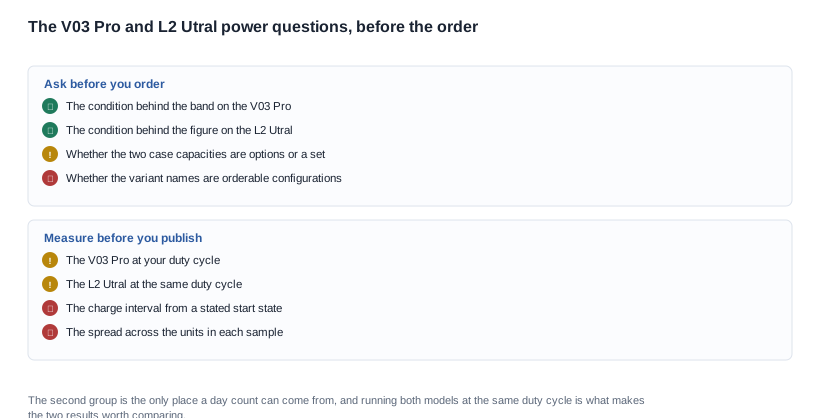
Ask the two configuration questions first, because they gate the artwork and the documentation and they cost nothing but a message. Measure the two endurance figures next, at the same duty cycle, because that is the only way the comparison becomes real. Settle the commercial terms against a configuration that has already been written down, so that the quotation and the goods are describing the same thing.
The order matters because the two configuration questions are free and the measurement is not, and because a measurement carried out against a configuration that later changes has to be carried out again.
What a buyer can state, and what a buyer has to hold
There is a short list of sentences that can be written today for these two products, and a short list of things that have to be held back until the four lines above are settled.
Can be stated. The resolution class of each model, in its own words. The cell tier of each model, as a tier. The ceiling on the charge interval, in the ceiling form the catalogue uses. The connector family, as a shared item. And the endurance of each, as the published figure with its label, where the label says which quantity it is.
Has to be held back. Any sentence that puts the two endurance figures next to each other as though they were measured the same way. Any use-time benefit derived from a case capacity. Any assumption about how many configurations exist behind the variant names. Any suggestion that a larger cell means a longer run, and any suggestion that the two products can be swapped.
The second list is short enough to be printed inside a channel, and it is the part that keeps a comparison from turning into a claim. In a category where the published rows are this thin, the discipline of what not to say is worth more than a clever reading of what is there.
What each of these two products publishes, on its own
What our catalogue prints for these two products is what each of them publishes, and we will not merge them into a single family description, because they differ in exactly the places where a buyer has to write something down. We will not convert a band and a point into a comparison, and we will not read a tier as a verdict, and we will not treat an unstated configuration as though the catalogue had stated it.
What we will do is take the two designations, the markets in order and the duty cycle your customers actually use, and mark the rows above against those three answers: which are already settled, which are one written request away, and which one has to be measured before any of it can be published.
Give us the two designations, the sequence of markets and the configuration you intend to ship, and we will hand back the four questions with an owner against each one and the order they have to be closed in.
The endurance row behind both of these designations is worked through in the endurance piece for this model.


