

The published endurance for the V03 is a band, and the catalogue labels it in a way that does not mean what it appears to mean on the page. Read carefully, three separate figures are in play: a cell capacity of 220 milliampere-hours, a row carrying a charging-duration label whose value reads five to eight hours and which in fact describes running time, and a separate row giving the charge time as two hours or less. Two of those three get confused with each other in opposite directions, and the confusion is the reason a buyer can end up holding a specification that promises an eight-hour runtime and a two-hour recharge at the same time.
That is the whole of the difficulty on this page, and it is worth setting out before anything else, because the reading protocol comes later and the reading has to be right before the protocol is any use.
There are two questions underneath the label problem, and this article takes them in order. The first is what a five-to-eight-hour band on a 220 milliampere-hour cell actually means to a channel that intends to publish a runtime figure. The second is what has to be put in writing before that band can become a day plan, since the catalogue publishes the band and does not publish the conditions that produced either of its ends.
Nothing here is a statement about how the product performs in the field, and nothing here invents a figure. Where the catalogue stops, this article says where it stops and names the party who can close the gap. The camera entry in this range publishes a resolution class, a cell, an endurance band and a charge ceiling, and that is genuinely all it publishes.
V03 smart glasses battery life: reading one endurance band off a small cell
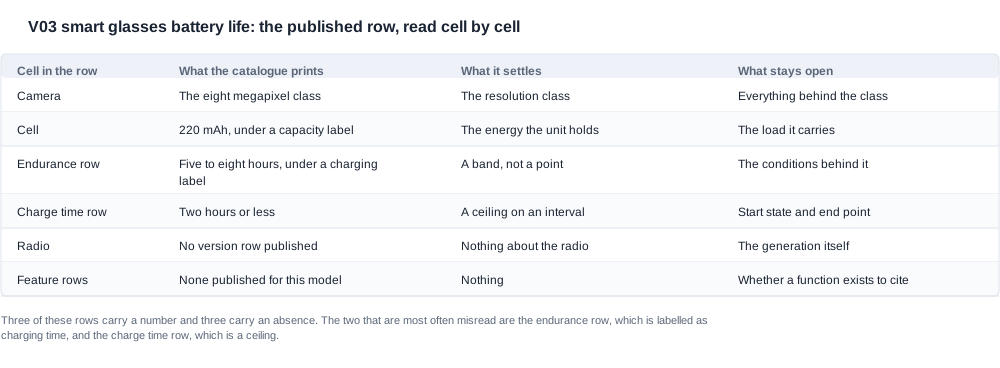
The table below is the whole published record for this model, arranged in the order a buyer meets it. Read it in that order and the model is fully described; skip a line and you have a description with a hole in it.
The camera entry
The camera is published at the eight megapixel resolution class, and that class is the only thing published about it. There is no sensor model behind the figure, no field of view, no frame rate, no storage capacity and no file format, which means the row supports the statement "eight megapixel" and supports nothing else at all.
For a buyer, this is a more comfortable position than it first appears. A published class is a class that the supplier has stood behind, and a channel can print it. What the channel cannot print is the pair of sentences that usually follow it in marketing copy, the ones that describe what the camera is good at, because nothing in the record supports them.
The cell, and the tier it sits in
The cell is published at 220 milliampere-hours, under a capacity label. The camera models in this range publish more than one cell tier, and this model sits in the lower of them. That fact is worth knowing for two reasons and it is worth not over-reading for a third.
The first reason is arithmetic: a smaller cell has less energy to give, so the endurance figure attached to it has to do more work. The second reason is commercial: a model at the lower tier of a published range is a model a channel can usually place in a price position, and the cell figure is one of the few published numbers that helps it do that. The third is the over-reading, and it is this: a cell capacity does not predict a runtime, because the load is not published for any model in the range. A camera product with a camera, a sensor and, where fitted, a radio, spends its energy in a pattern that nobody has documented.
The endurance band, and why it is two numbers
The endurance row reads five to eight hours, and the important thing about it is that it is a range rather than a figure. A single number is one outcome produced under one condition. A range is two outcomes, and there are three ways a catalogue can arrive at a range: a spread across units, a spread across operating conditions, or a spread across measurement runs on nominally identical units.
The catalogue does not say which of the three applies, and that unanswered question is the most consequential line in the row. The three readings lead to three different buying decisions, and none of them can be selected by inference. If the band describes a spread across units, a channel's useful number is the lower end and its useful sample is a large one. If it describes a spread across conditions, the useful number depends entirely on the condition the channel will ship in, which makes the band a question rather than a specification. If it describes measurement variance, the band carries very little information and a measurement programme is needed before anything is promised.
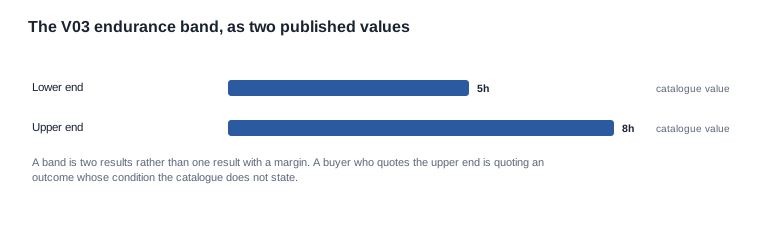
The chart above shows the band as the catalogue publishes it, which is two values and not a bar with a margin. A buyer who quotes the upper end is quoting an outcome whose condition nobody has stated, and the difference between the two ends is three hours of a working day that a customer will notice.

The 220 milliampere-hour figure, and what the catalogue does not add to it
A cell capacity is a denominator, and the temptation in a specification sheet is to treat it as a result. It is worth being explicit about the arithmetic that a buyer must not do, because in this range the arithmetic is easy to do and the conclusion is wrong.
Do not divide the capacity by the band to get a load. That calculation produces a number with a unit that looks like watts and means nothing, because the band is a range of outcomes rather than a single energy quantity, and because the catalogue publishes no charge or discharge behaviour for the cell at all.
Do not assume the two ends of the band describe the same units. If the band runs across a performance spread rather than a condition spread, then the unit that produces the upper end and the unit that produces the lower end are two different products as far as a channel's support policy is concerned, and only the lower one is the one the specification has to cover.
Do not treat the capacity as a measure of the product's class. The models in this range publish more than one cell tier, and the tier a model occupies says nothing about the tier of its camera, its sensor or its software. It is an energy figure and it is useful as one.
What the catalogue does not add to the figure
Seven things are absent from this model's record, and each of them is absent for a reason that is ordinary rather than a gap in anyone's work. The catalogue publishes a specification summary rather than a full technical file, and a buyer who expects a full file in a product page is expecting the wrong document.
- The load the unit runs at. No duty cycle, no recording profile, no pairing state, no idle state. Without it, the band cannot be attached to any particular use.
- The measurement condition behind either end. Not the temperature, not the sample size, not the number of units, not whether the ends came from different units.
- The charge and discharge behaviour. No charge curve, no rest behaviour, no indication of what a charge interval restores or how it is spread.
- The ageing behaviour of the cell. No cycle count, no calendar expectation, and nothing about what the band looks like after a year of use. A channel that wants to describe a second year of ownership has no published basis for it.
- The starting state for the charge interval. The row gives a ceiling, and the ceiling is a statement about an interval whose beginning is not defined.
- The radio generation. No version row is published for this model, so where a radio is present in the unit, its generation has to be established in writing rather than read off a page.
- The physical facts. No frame weight, no frame geometry, no adjustment range, no lens material. Those belong to a sample, and a channel that quotes any of them without measuring is quoting something nobody has checked.
The pattern worth taking from that list is that every absent item is absent in the same way. The catalogue has published a summary of the product, and a summary is a legitimate thing to publish. What it does not do, and cannot do in a catalogue page, is carry the conditions that make a figure usable in a procurement file. Those conditions are what a request to the supplier and a sample on a desk are for.

The label that says charging time and means running time
The single most expensive line on this model's page is a label.
On the V03's catalogue page the endurance row is labelled as charging duration, and it reads five to eight hours. The charge time itself is on a different row, and that row reads two hours or less. A specification sheet that is transcribed by hand, translated, or pulled into a product information system will turn the first row into a recharge time, and a five-to-eight-hour recharge is both obviously wrong and a credibility problem the moment a customer tries it.
It is not an isolated slip. The range uses three different labels for the same quantity on different pages. Some camera pages label the row as charging duration, some label it as usage duration, and some label it as endurance. All three mean running time. A buyer who has seen one of the three styles in a previous quotation, or who has had a colleague transcribe from a different page, has a live route to the same mistake.

The reading protocol in the image is six steps and it takes a minute per row. Identify the label before the value, because the label is what tells you which quantity you are looking at. Treat the value as running time. Then find the separate charge-time row and keep its ceiling wording exactly as published, because a ceiling and a duration are different assertions. Treat a range as two results rather than one. Write the boundary next to the figure, inside the same sentence, so that it travels with the number. And do not let any figure reach a listing without the condition attached to it.
How this ends up in a buyer's own specification
The fix is a house rule rather than a research project, and the rule is that the two quantities never share a line.
- Rated running time: five to eight hours — catalogue value for this model, with the condition to be established.
- Charge time: two hours or less — catalogue ceiling, with the starting state to be established.
Written that way, the two cannot be confused, and the gap between them is visible to anyone who later asks. Written as a single pair of numbers in a table with the headings "battery" and "charging", they will be confused, and the confusion will not surface until a customer tries to recharge a unit that is supposed to take eight hours.
The same discipline applies to the other end of the record. The charge ceiling of two hours or less is a bound on an interval, and it is not a promise that a unit is usable again in two hours, because the catalogue does not define what a charge restores. A buyer who wants to say "ready to use in two hours" needs a supplier statement, and the wording of that statement matters as much as the number.

Fitting the band into a working day without turning it into a promise
A band is useful. It is a range that a channel can plan against, and a planning range is worth more than a single figure precisely because it is honest about the spread. The mistake is to let a planning range become a published claim, and the way to avoid it is to decide in advance which of the two a given piece of copy is.
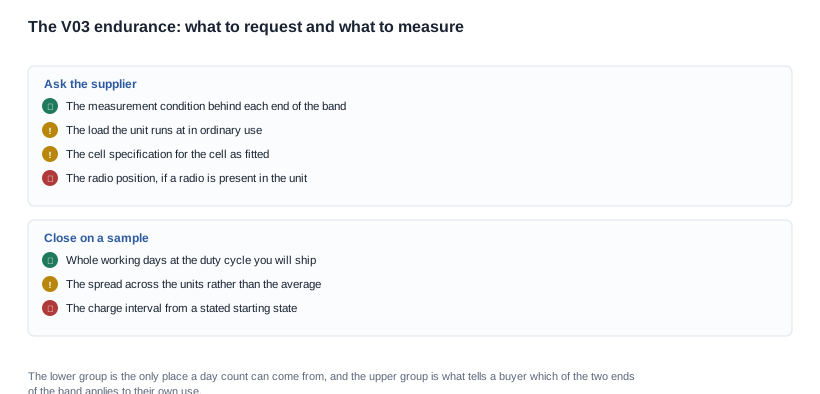
What a channel can publish, and what it cannot
The published band can be printed, provided the model and the wording travel with it. A listing line that says the catalogued running time is five to eight hours, for this model, is a statement about the catalogue, and it is defensible in a review.
What cannot be printed is any version that converts the band into a duration or a day count. "Up to eight hours" is a duration claim built on the wrong end of the range. "Eight hours of use" is worse. "Two full days of use" is invented entirely, because nothing in the record supports a figure of that kind. And a comparison that sets this band against another model's band is not a comparison until somebody establishes that the two were produced under comparable conditions, which the catalogue does not do for any of them.
The measurement that turns a band into a plan
Four things have to be settled before a band can be planned against, and only one of them is a number a buyer chooses.
The duty cycle. What the unit will actually be doing in a customer's day. This is a decision, not a discovery, and it has to be made before anything is measured rather than after a result arrives.
The sample. One unit produces an anecdote and several products at one moment. A measurement that will be defended needs units taken from the batch that is being ordered, and the sample size decided in advance.
The recording. Start and end of use for each day, the number of days the unit completed its work, and the days it did not. The count of whole days is the figure a support policy can use, and it is the only figure that is not a translation of the band.
The criterion. The acceptance condition, written as a number of days at a stated duty cycle, agreed before the test and carried into the purchase order. A criterion that lives in an email is an intention.
The two questions that start the work
Everything above collapses into two questions to put in writing, and sending them on the first day costs nothing and saves a round of exchanges.
What produced each end of the band, and is the spread across units, across conditions or across runs? This is the question that decides whether the band is a planning range, a measurement to repeat, or a number that has to be measured before it can be used at all. A supplier who answers it precisely is telling a buyer that the figure is repeatable. A supplier who answers it vaguely is telling a buyer not to quote either end.
What does the unit run on in ordinary use, and at what setting would our customers be running it? This is the question that turns a band into a test plan, because it supplies the duty cycle that the second measurement has to hold constant.
The criteria for judging the answers are short: a figure with a unit and a method, a condition that can be repeated by somebody else, and a sample size. Any answer that fails those three is an assurance rather than a measurement, and an assurance cannot be written into a purchase order.
Two trade-offs follow from them and both are worth deciding early. A band measured across a wider range of conditions is more useful to a channel that plans for variety and less convenient to put on a product page, because the copy has to carry the condition with it. And a wider sample produces a band that is more defensible and a longer measurement programme, so the sample size is a cost decision as much as a statistical one. The questions to ask before you order are cheap; the cost of not asking them is a specifier on a carton that nobody in the channel can defend.
The commercial consequences of getting this wrong
The three places a runtime figure ends up are the listing, the support policy and the acceptance criterion, and each fails in its own way.
A listing that overstates the band creates a complaint on the first customer who runs out early, and the complaint is not a complaint about the product so much as about the copy. A support policy built on the upper end of the band over-forecasts the number of units a customer will need and under-forecasts the returns queue, because a unit that runs out before the expected end of the day is the event that generates the contact. An acceptance criterion that does not exist means the first lot is judged against an expectation rather than against a standard, and that is an argument the channel will lose or win on the basis of who happened to sample first.
None of the three is expensive to avoid, and the cost of avoiding them is the four questions in the checklist above.
Our own position on this model
We publish the rows the catalogue prints for the V03, in the order the catalogue prints them, and we do not extend them. That means the eight megapixel class, the 220 milliampere-hour cell, the five-to-eight-hour band, the two-hours-or-less charge ceiling, and the absence of a radio row and of any feature rows are all available to a buyer, and the conditions behind every one of them are not.
We will not choose which end of the band a channel should quote, because that is a commercial decision and the condition behind the choice is the supplier's to state. We will not convert a ceiling into a duration. And we will not supply a figure for anything the record does not carry, because a figure that reaches a carton becomes a claim the channel has made on the supplier's behalf.
What we will do is take a duty cycle, a market list and a sample size and mark the band against them, so that a buyer can see which of the four questions in the checklist is already answered, which one needs a document, and which one needs a unit on a desk. Give us the profile your customers will actually use, the destinations in your sequence, and how many units you can put on a desk, and we will tell you which end of the published band your programme is running against and what it will take to find out for yourself.
The interface on this model, and the accessory question that follows from a row the catalogue does not print, are set out in the charging piece for this model.


