

These two designations publish almost the same specification, and that is the source of most of the confusion around them. The camera class is the same, the cell is the same, the endurance band is the same figure, and the charge ceiling is the same bound. Four rows match line for line. A buyer who reads only the matching rows will conclude that the two are interchangeable, and they are not, because the four rows that do not match decide everything a channel actually has to write down: the charging interface, the accessory position, the configuration on offer and the presence of any published function at all.
There is a second trap, and it is the more expensive one. The same endurance figure appears on both pages under two different labels, and a specification sheet assembled from the two pages can carry the endurance as a charge time without anybody noticing, because the number is identical on both sides and the label travels with it in a spreadsheet field name rather than in the sentence.
So this comparison has two jobs. It has to set out the four matching rows and the four that do not, precisely, so that a buyer knows which specification can be shared and which has to be written twice. And it has to separate the two kinds of difference, because "no accessory line printed" and "published as having no accessory" are not variations on the same fact: one is an open question and the other is a closed one, and they produce different work.
Nothing in this comparison describes how either product performs. It is a comparison of published rows and of what has to be settled in writing before a buyer can put an order down.
V03 Pro smart glasses vs V03 spec comparison: two rows that almost match
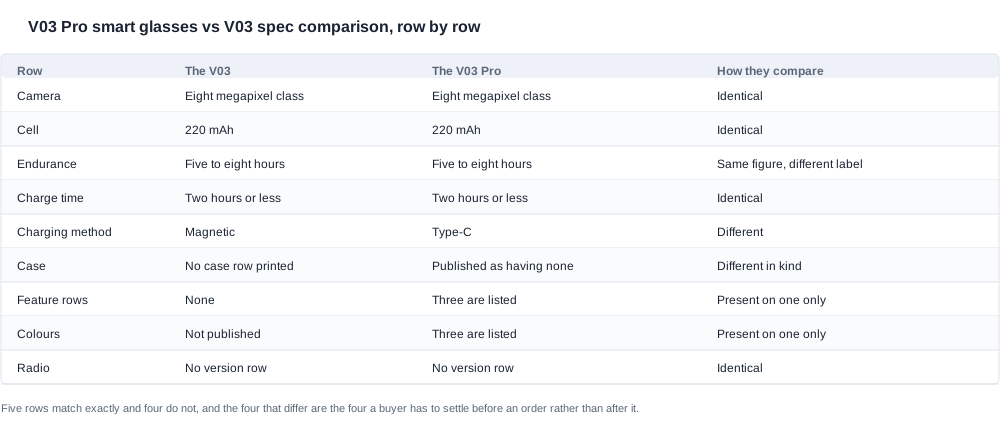
The five rows that match, and what that saves
The resolution class matches, at the eight megapixel level on both. The cell matches, at two hundred and twenty milliampere-hours on both. The endurance band matches, at five to eight hours on both. The ceiling on the charge interval matches, at two hours or less on both. And neither designation publishes a radio version, so that row is empty on both sides and matches in the way that two absences match.
Those five rows can be verified once and used for both designations, and that is a real saving. It means a single measurement programme covers the camera class, a single weighing covers the cell figure, a single set of endurance samples covers the band, and a single specification sheet describes the electrical side of both products.
The saving has one condition. It holds only if the condition behind the band is the same for both. Nothing in the published record says that it is, because the record publishes the figure and not the condition, and a manufacturer who measures two designations on the same bench with the same protocol will produce the same band for both while two manufacturers would not. So the saving is real in the common case of one source, and it has to be confirmed rather than assumed.
The label difference sits inside this group and it has to be handled separately, which is the next section.
The label that differs while the number does not
The endurance row on one page is labelled as charging duration, and the row on the other page is labelled as usage duration. Both carry five to eight hours. Both mean running time, because that is the quantity the figure measures, but only one of the labels says so.
Why this matters more than it looks. A figure that is the same on both sides of a comparison invites a shortcut: once it has been checked and found identical, it gets copied once and travels to every document that quotes it. At that point the label is no longer in the same sentence as the number, and a reviewer reading a specification sheet sees a number under a heading that may not be the right heading. A charge time of five to eight hours is absurd enough to be noticed; a runtime of five to eight hours sitting under a charge column is not.
The rule that prevents it. Write the quantity into the name of the field rather than only into the value, so that a value that travels on its own cannot be mistaken for a different quantity. A field called rated running time and a field called charge ceiling cannot be confused with each other, and a spreadsheet that loses its column headings still cannot lose the meaning of the number.
The check. Every document that quotes either figure should be read once with the label attached. It is a five-minute pass over a file, and it is the difference between a specification that survives a review and one that does not.

The charge interface, and the one place they differ
The charging interface is where the two designations part company, and it is the row with the widest commercial reach, because it reaches the customer in the box, at the counter and in the support call. One of the two models charges by magnetic contact and the other by a Type C lead, and a channel stocking both is running two routines rather than one.
That is a real cost and it is worth pricing rather than assuming. A channel with both products carries two sets of spare items, two customer instructions, two ways of demonstrating the product and two answers to the same question. A channel with one of them has a simpler operation and a narrower range. Neither is automatically the better choice, and the decision belongs to the range strategy rather than to the specification sheet, which is exactly why the comparison has to hand the buyer a clear row rather than a verdict.
The row is also the one that decides the shape of the sample programme, because a magnetic contact and a lead are not the same object to test against, and a buyer who has ordered one of them will find the accessory for the other does not fit.
The four rows that do not match
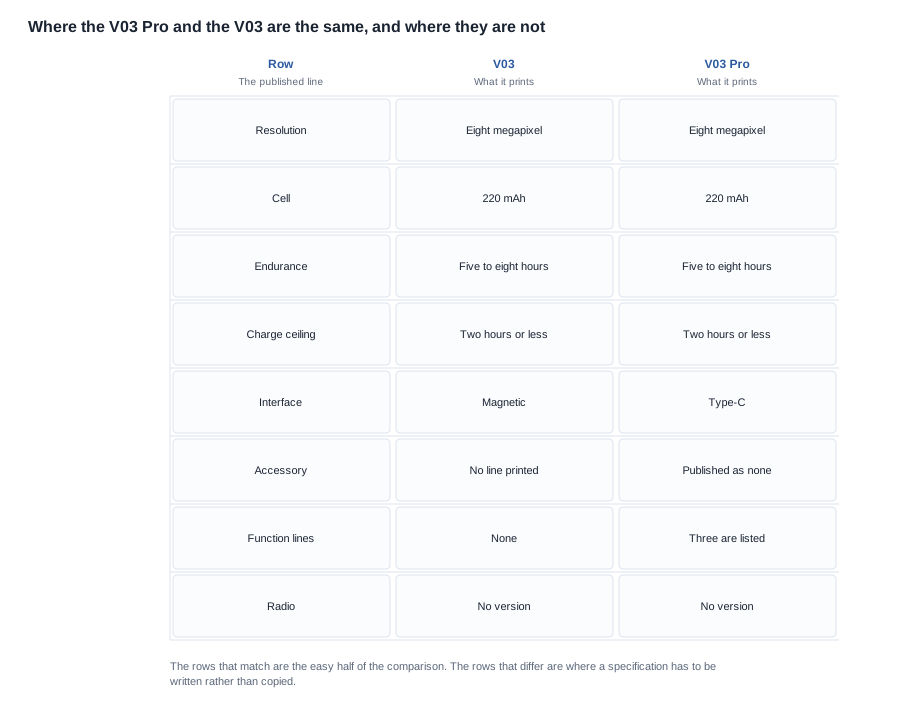
The charging interface is magnetic on one and Type C on the other. That single row decides whether a channel runs one charging routine across the two products or two, whether it stocks one kind of spare or two, and whether a customer can charge a unit at a desk with a cable they already own.
The accessory position is unprinted on one page and printed as absent on the other, and the next section deals with why that difference matters more than it looks.
The function lines are empty on one page and carry three entries on the other, and those entries change what the product can be described as doing.
The colours are not published for one and are listed for the other, which is a configuration question rather than a specification question, and it is one that has to be answered on the order line.

The case row, and the difference between absent and excluded

This is the row that buyers misread most often, and the misreading is understandable because the two statements look like each other on a summary sheet.
On one page, the catalogue prints a charging-case line that states the model is published without one. That is a positive product statement. The packaging specification reflects it, the contents of the carton are settled by it, and the transit record follows from it. A buyer can write the packaging today.
On the second page, no charging-case line appears at all. That is a statement about the documentation rather than about the product, and it leaves the question open. It does not say that no case exists, and it does not say that one does.
What the difference does to the work
The packaging. For the designation whose page says the case is not part of the product, the carton specification is a settled document and the artwork can be produced. For the designation whose page says nothing, the carton contents are not yet known, so the artwork is not yet producible. Two products that look identical on a comparison sheet therefore have two different artwork schedules, and the one that is not settled is the one that will move.
The transit record. What is inside the box drives the declaration. One designation has a known content; the other has a question mark, and the question has to be answered by the supplier before a consignment can be described accurately.
The claims a channel may make. A channel can say that one of these products is published without a charging case, and it cannot say the same about the other, and it cannot say that either of them comes with one. All three sentences are unavailable for one of the two, which is an awkward thing to discover at artwork stage.
The after-sales story. A customer whose unit arrives with something the listing did not mention has a documentation problem, and the desk will meet it whichever way the buyer resolved the question internally.
The instruction is short. Settle the accessory position for the designation whose page is silent, in writing, against that designation, before the artwork is approved, and treat it as an open item with a date until it is closed. It is a single question, and it is the one that decides the schedule for that product.
The function lines, and why the order has to carry the configuration
Three entries are listed on one of the two pages and none on the other, and one of those three has a consequence that reaches into the order rather than into the copy. The product name of the designation that carries them does not contain the name of the colour-changing lens; the lens appears as an entry in the feature line, which is a correct way to publish it and a poor way to order it.
A buyer who writes only the model name onto a purchase order has ordered the product without the lens option, and the goods that arrive will carry a configuration the order does not mention. Nothing is faulty and nothing is damaged, but there is no document that says what was agreed, and the resolution has to be reconstructed from a catalogue page that was never read as an order line.
The same applies to the temple entry and to the three listed colours. Each of them is an item, and an item belongs on an order line, in the specification, and in the artwork release, and the three have to agree with each other. A configuration that is settled in conversation and not written down is a configuration that arrives as a surprise.

What a buyer can order with confidence, and what stays a question
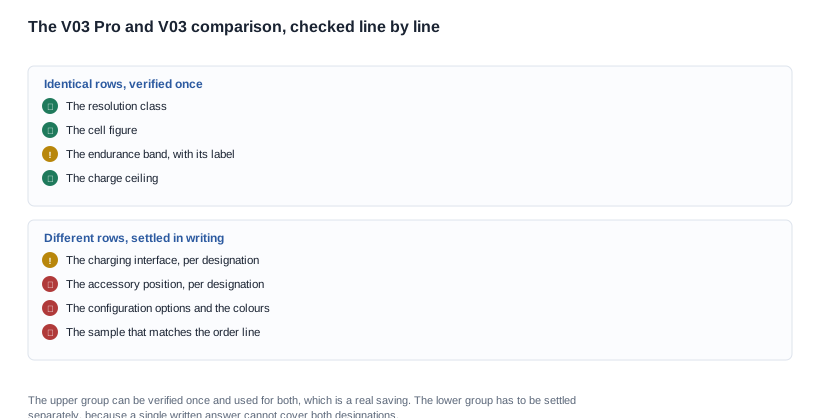
What can be ordered with confidence today
The camera class, the cell figure, the endurance band and the ceiling on the charge interval can all go onto a specification sheet, for both designations at once, provided two conditions are met. The condition behind the band has to be the same for both, and the endurance has to be written as running time on every document that quotes it. Neither of those is a document the buyer can produce, and both are one question each.
The charging interface can also be ordered with confidence, because it is printed for both and it is printed differently. A channel that wants both products knows what it is committing to: one contact-based routine and one lead-based routine, two different spare items, and two different customer instructions.
What stays a question
The accessory position for the designation whose page is silent. It is one written answer and it blocks the packaging, the label and the transit record for that product.
The configuration on offer for the designation that carries the function lines and the colours. The catalogue publishes what exists; it does not publish what a channel may order, and those are different lists.
The conditions behind the band, for either designation, and the question of whether they are the same for both.
The radio generation, for either designation, if a radio is fitted in either of them.
The four questions, in the order to ask them
Four questions close this comparison, and they are ordered by what each one unblocks.
- Is the condition behind the endurance band the same for both designations? If it is, the band can be verified once and quoted for both; if it is not, the two products need their own measurement programmes, and the cheap version of this comparison disappears.
- Which charging object is supplied with each designation, and can a spare be obtained? This decides whether the connector is a comfort or a lock-in, and it decides how many spare items the channel has to hold.
- What is the accessory position for the designation whose page carries no case line at all? One written answer, and it gates the carton artwork, the label and the transit record for that product.
- What configuration, including the lens option and the colour, is available to order? The catalogue publishes what exists; a channel needs to know what it may buy, and the two lists are not the same.
The criteria for judging the replies are the same for all four. A figure with a unit and a method. A condition somebody else could repeat. A date against it. A reply that fails any of those is an assurance, and an assurance cannot be written onto an order line.
How to use this comparison when the decision is a range decision
Most channels are not choosing one of these two products against the other. They are deciding how many camera products to carry and which of these two earns a place. That is a different question, and the comparison is useful in it in three specific ways.
It tells the buyer which specification can be shared. Five of the nine rows are common to both designations, so a range that carries both products needs one camera specification, one cell figure, one endurance measurement programme and one charge ceiling. That is the part of the range that gets cheaper, and it is worth quantifying before the range is planned rather than after it is bought.
It tells the buyer what a second product actually costs. The extra cost is not the second set of shared rows, because those are shared. It is the second interface, the second spare item, the second customer instruction, and the second file, and in the case of the designation whose accessory line is unprinted, the second artwork that cannot be produced until a supplier has answered a question. A buyer who has priced the extra product on the unit price alone will discover the rest of it in the second quarter.
It tells the buyer which of the two is cheaper to launch, if the choice has to be made. One of the two has a case position already on the record, so its carton artwork can go to production straight away. The designation with the unprinted line cannot. That is not a product judgement, it is a schedule fact, and it is often the one that decides the launch order.
The criteria for making that choice are the ones a channel already uses for a range decision: which proposition the two serve differently, which one the channel can describe without a measurement programme, which one carries less documentation work per market, and what the total cost of the second line is against the demand it wins. What this comparison adds is the last two, because they are the two the published rows settle.
The two traps, in the order they catch people
The first trap is the endurance label, and it catches people who have done everything else correctly. The number is the same on both pages, so it gets checked once, and the label goes missing in the second document that quotes it. The second trap is the accessory row, and it catches people who have read the summary rather than the pages: one page says the product has no case and the other says nothing, and a summary sheet that records both as "no case" has turned an open question into a false fact.
Neither trap is expensive to avoid. Both are invisible to the eye, and both are caught by a single rule applied consistently: read the label, not the value, and treat an absent line as a question rather than as an answer.
Our position on the two designations
Our published rows for these two products are what the catalogue prints for each of them, and we do not merge them into a single product family description, because the two differ in exactly the ways that a buyer has to write down. We will not tell a channel that either designation is a better choice, and we will not describe the unprinted accessory line as though it were a statement about the product.
What we will do is take both designations, the markets and the configuration you intend to ship, and mark the nine rows above against them: which can be verified once for both, which have to be settled separately, and which are the questions that still have to be put in writing.
Give us the two designations, the market sequence and the configurations under consideration, and we will mark the matching rows that can be shared, the differing rows that have to be written twice, and the one question that decides when the artwork can start.
The same designation measured against the camera product that publishes the higher resolution class is in the comparison against the higher-class model.


