

The charging story for this model is one published word and one published line that is not there. The charging column on the catalogue page for the V03 reads magnetic, and that is genuinely useful: it tells a buyer that the unit charges by placement rather than by plugging, that a customer can seat it one-handed, and that there is no cable to lose, to trip over or to fail. It is the kind of row that removes a whole category of support and returns problems before a channel ever reaches them.
And then the page prints no charging-case row at all. Not a row saying there is no case, and not a row saying what the case holds. Nothing. For a buyer, that absence is the larger half of the charging question, because it means the accessory that a camera product is most often bought with is neither confirmed nor excluded, and neither of those is a fact a channel can put on a packing list.
This article takes the two halves separately. The first half is what magnetic charging buys a channel and what it still does not tell it. The second half is the absent row, what a buyer should put in writing because of it, and how a range plan is built while the answer is still outstanding.
The boundary on all of this is worth stating at the start: the endurance figure for this model is a separate published row and is dealt with in its own right, and nothing here should be read as a claim about how long the unit runs. What follows is about how it is charged and what a buyer is still missing.
V03 smart glasses charging options: the interface the catalogue does publish
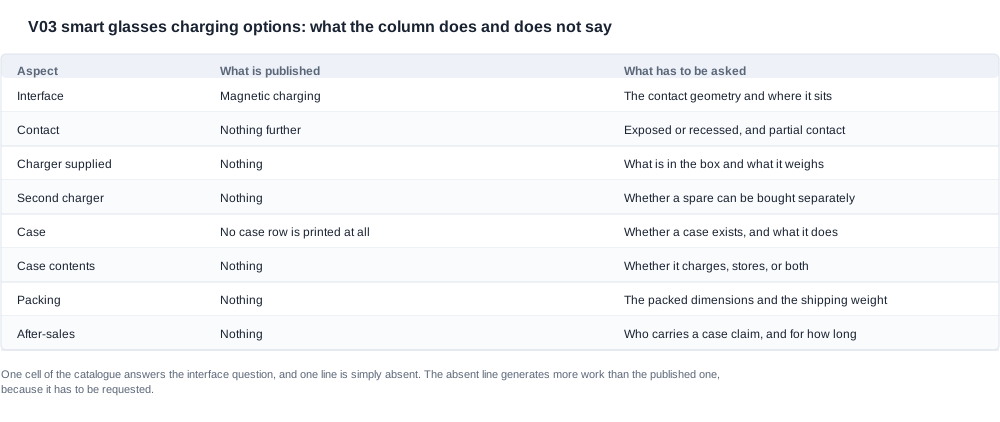
What magnetic charging actually changes
The published word is doing more work than it looks, and it is worth spelling out the specific consequences a channel can rely on, because each one is a cost or a failure mode that disappears.
Placement replaces insertion. There is no connector to align, no port to find in the dark, and no cable to fail at the strain relief. For a product that gets handled in a pocket, on a desk and in a bag, that removes the single most common physical failure in the category.
Tolerance replaces precision. A magnetic contact seats within a tolerance rather than requiring a fixed alignment, which is the difference between a customer charging a unit on the first attempt and a customer asking a shop assistant for help. For a channel with a physical retail presence, that is worth more than any specification on the page.
The charger becomes the thing that is lost. The failure mode does not disappear, it moves. A cable is replaceable from any supplier; a proprietary contact is not, and a customer who loses the charger has a product that cannot be charged. Which is why the second charger question in the checklist below is not a trivial one, and why a channel that stocks a spare needs to know whether a spare exists.
The charging surface becomes a design object. If the unit seats on something, then that something is either the supplied charger or a dock, and the appearance of it in the box is part of the product's presentation. A channel doing private label work has to decide whether that object is printed, and that decision is a cost.
What the interface row leaves open
Seven things, and they are the ordinary questions that follow any published interface.
Where the contact sits and what it looks like. A recessed contact in the hinge, a contact on the temple, a pad on the front of the frame: the three are different objects with different ways of being packaged, demonstrated in a shop and dropped in a bag.
What happens on a partial contact. A contact that has almost seated may charge slowly, may not charge at all, or may report a state to the unit. For a customer that means a unit left on a charger overnight may not have charged, and for a channel that means a support question with a predictable shape.
What is actually supplied. A contact, a cable with a contact at one end, a pad, a lead, or a combination. The catalogue prints the method and not the object, and the difference between a supplied lead and a supplied pad is the difference between a channel that can explain the product and a channel that has to photograph it.
Whether the unit can be charged from a standard source. A proprietary contact implies a proprietary source, and a channel whose customers carry a particular kind of adapter has a question that the page cannot answer.
Whether a second charger can be bought. This is the question that determines whether the charging method is an inconvenience or a lock-in, and it is the one a channel should ask first.
How the charger is presented. Weight, dimensions, materials, finish, and whether it is printed. A charger is a visible object in a customer's hand, and it is the one part of the product that a buyer will judge against a photograph of the whole package.
What the charge indicator does. Whether the unit shows a state, whether the charger shows a state, and what a customer is told to look for. A charging method with no observable state produces a support contact on the first night, and the channel will pay for it.
The interface in a buyer's own specification sheet
The published word is one cell in a much larger document, and the way a buyer writes that cell determines how much work the rest of the programme generates. The useful way to record it keeps the published fact, the open items and the owner in one line each, rather than folding them into a sentence that will be copied and then quoted.
Charging method: magnetic. That is the published row, and it should be recorded exactly as published, without adding a cable, a plug, a port or a lead that the record does not mention.
Charging hardware: not published. The contact arrangement, the supplied object, the indicator behaviour and the spare-parts question are all open, and each one wants a name against it. A specification sheet that lists four open items with four owners produces a schedule; one that says "charger TBC" produces a negotiation later.
Charging accessory: not published. A distinct line from the hardware, because the questions are different and because the two are frequently confused. The hardware is about how the unit is charged; the accessory is about what else a customer may buy.
The reason to keep three lines rather than one is that the three close on different timelines. The hardware answer is a document request and comes back in a week. The accessory answer is a product question and comes back with a design decision attached. And the third line, the one that is not in the catalogue at all, is the one that a channel has to make a commercial decision about, because a range plan cannot wait for it indefinitely.

Magnetic charging on the V03, and the case row that is absent
The charging case question for this model is not answered by the catalogue in either direction, and the distinction matters more than it might appear.
What the page actually does is print no charging-case row for this model. There is a line for the interface, and the case is not on it. The correct reading of that absence is that the case is not published — which is a statement about our documentation, not a statement about the product. A buyer must not turn it into "the V03 has no case", and must equally not tell a customer that a case exists. Neither statement is supported.
Why that reading is the correct one. A catalogue page that wanted to say a product had no case would say so, in the same way it says when a feature row is absent because the feature does not exist. The page is not silent about things it has decided; it is silent about the accessory.
What the absence leaves a buyer with. A camera product is a product people buy with a case, and a channel's range plan for a camera product normally has a place for one. With the row absent, the channel is planning a product line with a hole in it, and the hole is in the part of the proposition that generates the second purchase.
The question the absence generates
One question produces most of the others, and it is the one to put in writing first: does a case exist for this model, and if it does, what does it do?
There are three possible answers and they lead to three different programmes, and the fact that a catalogue page cannot tell a buyer which of the three applies is exactly why the question has to be asked rather than assumed.
If the case is simply a dock that holds the unit and charges it from a fixed source, then it is a packing item. It belongs in the box, it has a presentation cost, and it changes nothing about what a customer can do with the product.
If the case carries its own energy and can charge a unit away from a socket, then it is an accessory with a capacity, and a capacity that is not published cannot be compared with another accessory, cannot be added to a total energy budget, and cannot be described in a listing as a use-time benefit.
If it does both, then it is a stocked line with its own specification, its own artwork, its own packaging, its own warranty and its own claims, and a channel that has not scoped it has a product line arriving in the order by accident.

What a missing row leaves a buyer to request in writing

The request is short, and it belongs in the first message to the supplier rather than in a later round, because the answer changes the shape of the order rather than the wording of a document.
- Does a charging case exist for this model, and what does it do? The three-way answer, in one sentence, against this designation.
- If a case is supplied, is it supplied with the unit, and is it a separate orderable item? The first decides the packaging; the second decides the accessory programme.
- What is the contact arrangement, where is it located, and what happens on a partial contact? With a photograph of the frame, which is worth more than a paragraph.
- What charger is supplied, and can a replacement be bought separately? A spare part question, and the answer is either yes with a price or no.
- What are the packed dimensions and the shipping weight, with and without any case in the carton? Two numbers, and they belong in the freight model before the first shipment rather than after it.
- Who carries a claim on a case, and for how long? A stocked accessory with no claim path becomes the channel's general returns budget by default.
The paperwork that comes with the answer
Two of those answers carry documents of their own, and they arrive with the accessory rather than with the product. A case that carries energy is an item with a cell inside it, which means it has its own transport and handling paperwork and its own conditions for a shipment. A case that is supplied in the carton changes what the carton contains, which changes the packaging specification, which changes what the artwork and the label have to describe. Neither of those is a detail, and both are easier to arrange before the artwork than after it.
The right way to handle both is to ask for them as part of the same request. A buyer who asks about the accessory and the product in two separate exchanges gets two different sets of answers and a schedule that has to be reconciled.

Pricing and stocking an accessory you cannot yet compare
The last section is the commercial one, and it is the part that a range plan is actually built from. The accessory is not published, and the question is what a channel does about that in the weeks before an answer arrives.
Three documents a channel needs before it can cost the accessory
A channel that intends to carry the accessory as a stocked line is going to need three things, and all three are cheaper to assemble before the artwork than after it.
A line sheet for the accessory. The published description, the quantity it adds, the configuration it is available in, and the price basis. A line sheet is what turns the accessory from a sentence in an email into an item that can appear on a price list, and a channel that cannot produce one cannot take an order for it.
The packaging data. The packed dimensions of the carton with the accessory in it, the shipping weight of the accessory on its own, and the way the accessory is presented inside the box. These are the numbers that go into the freight model, and the first two of them also decide whether the carton still fits the shelf the channel has planned for it.
A warranty line. Who carries a claim on the accessory, for how long, and what the remedy is. A stocked accessory without a claim path is a line item that quietly becomes part of the general returns budget, and the cost of that shows up in a figure that nobody reviewed.
The criteria for deciding whether the accessory can be carried at all are worth stating separately, because they are the criteria that decide the money. There has to be a defined role, so that the channel can say what it is for. There has to be enough data to cost it, which means the capacity if it carries any, the packed dimensions, the weight and the warranty line. And there has to be a packaging answer, because a case printed as part of the box is an artwork commitment made before the artwork exists.
The red flags for an accessory programme that is running on assumptions are simple and each of them is cheap to check: a price with no line sheet behind it, a packed dimension that is an estimate, a warranty that is the product's warranty by default, and a carton that has been costed without the accessory in it. Any one of those is a red flag; all four together is an accessory programme that will be re-costed after the first shipment rather than before it.
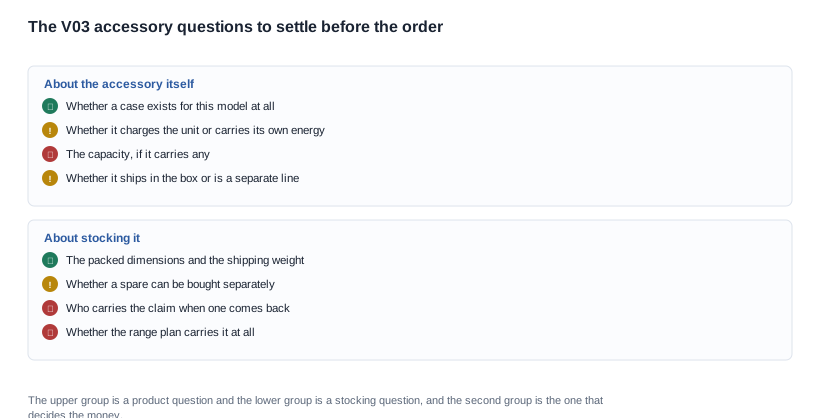
Three things the accessory decides, and none of them is the product
The freight model. A case in the carton changes the packed dimensions and the shipping weight, and those two numbers decide what a unit costs to move. An accessory that is a separate line adds a second SKU, a second pick and a second parcel, and a channel that has not costed that is discovering it when the first invoice arrives.
The retail experience. If the case is the charging surface, then a store that wants to demonstrate the product needs one, and a store that does not have one cannot show the product working at all. That is a merchandising decision, and it has to be taken before the product lands rather than after the first customer asks to try it.
The support desk. A customer with a problem with the accessory contacts a desk that is set up for the product. If the accessory is not in the product record, the desk has no script, no spare and no answer, and the case problem arrives as a product problem.
Whether the accessory belongs in the range plan at all
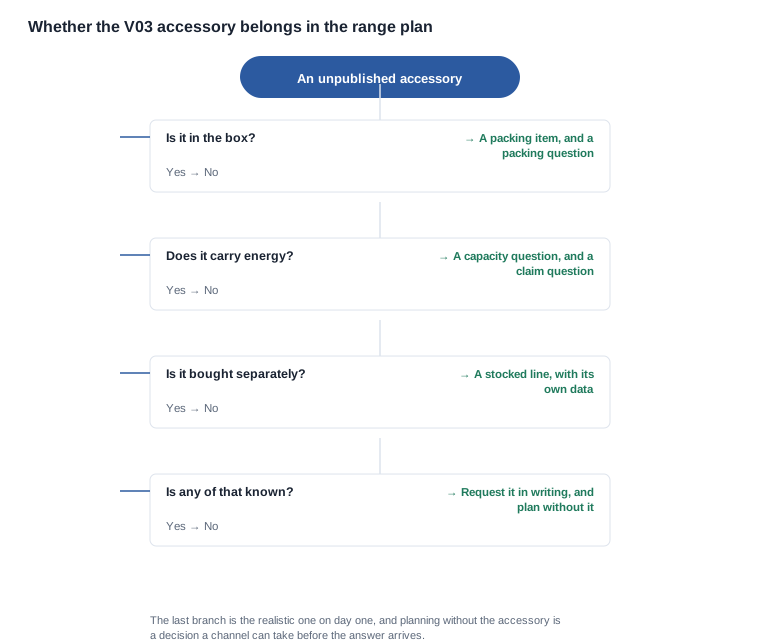
The decision chart reduces the whole question to four branches, and the last one is the realistic one on day one. If none of it is known, the channel can plan without the accessory, and that is a legitimate decision rather than a postponement. A range plan built for the product alone, with the accessory held back until its data exists, keeps the launch date and removes an unknown from the cost model.
The criteria for taking the opposite decision, bringing the accessory into the plan, are equally short. Its role has to be defined, so that a channel can say what it is for. Its data has to be complete enough to be costed, which means the capacity if it carries any, the packed dimensions, the weight and the warranty line. And the packaging has to be settled, because a case that is printed as part of the box is an artwork commitment that has to be made before the artwork is produced.
What a buyer can say today, and what has to wait
A channel can say today that this model charges magnetically, and it can say that the charging accessory is not published and is being confirmed. What it cannot do is mention a case in a listing, in a packing list, in a retail display, in a support article or in a customer email, because each of those is a statement that an accessory exists and the record does not support it.
That is a narrower position than it looks, because the accessory question is not usually the reason a channel buys a camera product. But it is the position the record supports, and it is the one that survives a question from a customer or a reviewer.
Our own position on this model is that we publish the charging method as the catalogue prints it, and we will not extend it into a statement about the contact geometry, the supplied charger, the existence of a case, or the contents of a case. We do not publish a charging-case row for this model, and we will not describe that absence as a product fact, because it is a gap in our documentation rather than a decision about the product.
Give us the range plan you are building, the markets in the order you intend to enter them, and whether the accessory is a line you want to carry or one you would rather confirm first, and we will mark the questions above against those three answers and give you the request in a form that can be sent the same day.
The file side of this family, and the difference between an accessory line that is printed and one that is not, is worked through in the compliance note for this family.


