

A model is best for something, and the useful version of that sentence is not about the product at all. It is about a kind of buyer, a kind of channel and a kind of appetite for work. The V03 is a camera model whose published record gives a buyer three things to plan with — an eight megapixel camera class, a 220 milliampere-hour cell, and a magnetic charging method — and leaves a fourth thing, the accessory position, open. A channel that can work with that arrangement has a candidate; a channel that needs the arrangement to be closed before it sells anything does not.
This article is therefore organised around programmes rather than around features. It sets out the four kinds of business the model suits, the two published facts that make it workable for one of them in particular, the programmes it genuinely does not suit, and the questions to settle before a first order. It closes with a worked case, because the distance between "suitable in principle" and "suitable in practice" is usually a packaging decision and a sample measurement.
One boundary first, because the article title invites a specific kind of reading and this is not it. Nothing here describes what the camera does, how the picture looks, or what a first-person creator would get out of the product. Those are questions a sample answers and the catalogue does not. What follows is about a procurement decision, and the figures it quotes are the published rows and nothing else.
V03 smart glasses best for: the programmes this model fits
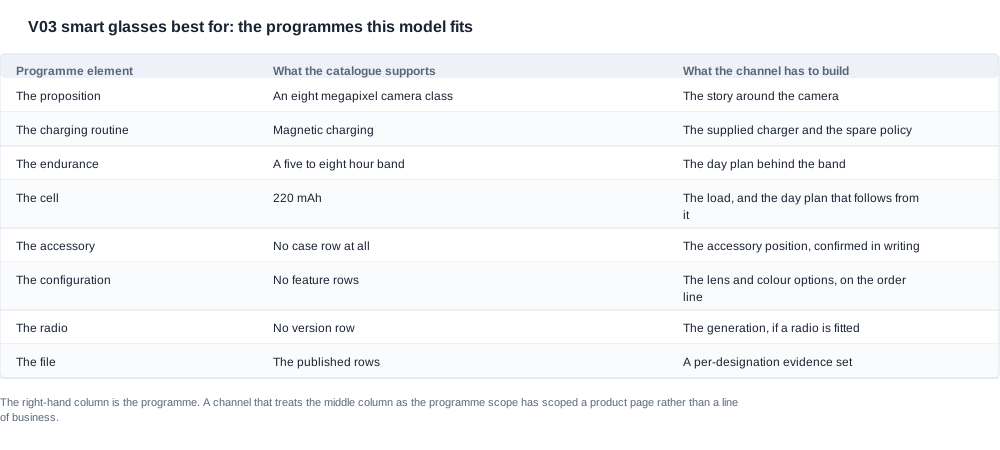
The first programme: a channel whose proposition is the camera
A channel selling a capture-led line, where the camera is the product rather than an attribute of something else, is the natural home for a model in this class. The eight megapixel class is published, the class is shared across the range, and a channel that leads with the camera can print it without asking anybody for anything.
What such a channel has to accept is the rest of the record. Behind the class there is no sensor, nothing published about the angle the lens covers, the rate of capture, the storage or the format, so a description of what the camera does well has to come from the channel's own samples or it does not exist. The right posture for that channel is not caution but authorship: they are the party who will have measured it, and the published class gives them a defensible floor to build on.
The second programme: a range that wants one charging routine
Magnetic charging is the fact that makes this model easy to place in a multi-model range. A channel that stocks several camera products and does not want to teach a customer two charging procedures, keep two kinds of spare, and answer two versions of the same support question, has a reason to look at the models grouped by interface first, and this model sits in the larger group.
The catch is a small one and it is worth naming early, because it is the kind of thing that surfaces at the worst moment. A contact-style interface usually means a proprietary source, and a proprietary source usually means a customer who has lost the charger cannot charge the product at all. A channel that intends to sell spares needs to know whether spares exist, and the record does not say.
The third programme: a buyer who wants a named cell figure
There are channels whose customers ask about the battery before they ask about the camera, and for those a published capacity is a genuinely useful line on a product page: two hundred and twenty milliampere-hours, with the row label stated rather than summarised. This model publishes that figure, and the band beside it is a range rather than a point, which is the honest form for it.
What this channel has to accept is that a capacity does not tell a customer how long the product will run. It tells them how much the product holds. The conversion from one to the other is the measurement programme, and there is no version of the catalogue that makes it unnecessary.
The fourth programme: a private-label channel that will scope its own configuration
A channel doing its own artwork needs a model whose configuration it can name and control, and this model publishes no feature rows, which means the configuration space is defined by the supplier rather than by a published list. For a channel with a configuration process, that is workable and even convenient: the options are set in conversation rather than inherited from a catalogue line, and the order line can carry whatever the channel has decided.
For a channel without that process it is a problem, because a configuration nobody scoped is a configuration nobody ordered.
The buyer who wants magnetic charging and a published cell figure
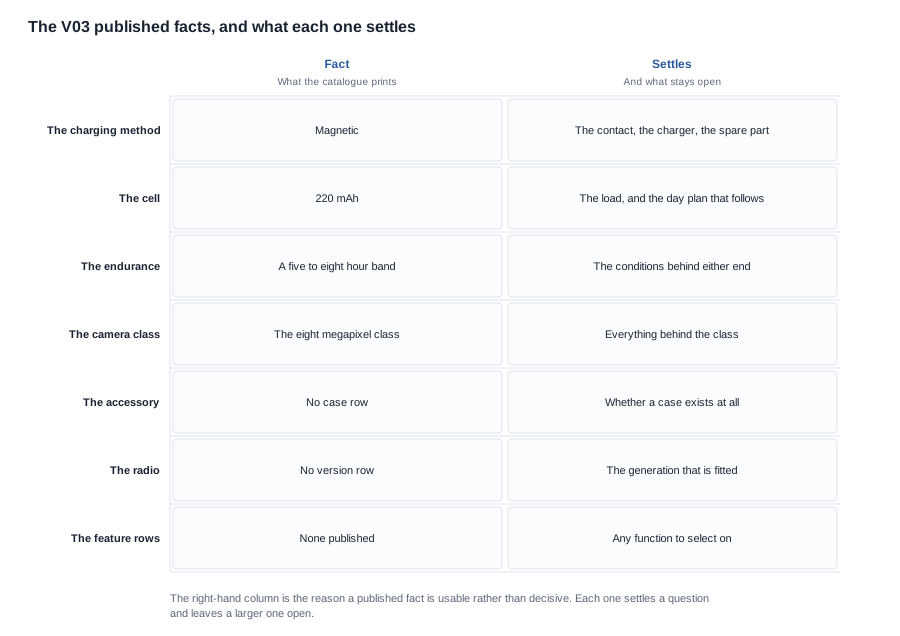
Those two published facts are what make the model workable for a specific kind of buyer, and it is worth being precise about why each of them earns its place.
The magnetic interface is a support-cost fact before it is a convenience fact. A contact that seats without alignment removes a category of help at the counter and a category of returns from a dropped cable. In a channel with a physical presence, that is measurable in the number of conversations a customer does not have to have, and it is one of the few places where a published word removes work rather than creating a question.
The published capacity is a specification-sheet fact before it is a selling point. Two hundred and twenty milliampere-hours, with a label, on a model in a range that publishes several tiers, gives a buyer a number that can be placed in a data feed, compared across a range and defended by pointing at the page. It is also a number that says nothing on its own, which is why it works well alongside the band and badly on its own.
Put together, the two facts support a channel that wants to be precise about what it is selling and is prepared to measure the rest. The model is a good fit for a channel whose buyers are technically literate and whose own staff will write the specification. It is a poor fit for a channel whose buying decision is made on a single number per product and where nobody is going to run a sample programme.
The two questions a buyer should ask before committing to the model
Is the accessory position going to be closed in writing, and when? The catalogue prints no charging-case row for this model, and the difference between an unprinted line and a printed one is the difference between a question with a date and a gap that gets discovered at the packing bench.
Is a spare charger available, and at what lead time? A magnetic interface is a convenience when a spare can be bought and a dependency when it cannot. The answer decides whether the model is a first purchase or a first purchase followed by a consumable.
Neither question is difficult, and both are cheaper to ask at the start of a programme than in the middle of one.
The four capabilities a channel has to already have
A model is a good fit for a programme only if the programme already has the machinery to use it, and the machinery is specific. Four capabilities decide it, and all four have to be present, because each one covers a gap the record leaves open.
A sample programme that can produce a spread rather than an anecdote. The band published for this model is two numbers, and the only way a channel finds out which end applies to it is by measuring more than one unit. A channel that samples one unit and treats the result as typical will publish a figure that its own second shipment contradicts.
A configuration process that writes onto the order. No feature rows are published for this model, so the configuration space is set in conversation. That is only an advantage for a channel that already has somewhere to put the decision. A channel without an order line discipline will end up with units that differ from the units that were approved, and the difference will be discovered by a customer rather than by a goods-in check.
A documentation habit that attaches a condition to a figure. Every published number for this model needs its boundary written next to it, and the boundary is a sentence rather than a field. Channels that feed product data into a system are the ones at risk here, because a value with the wrong field name is indistinguishable from a value with the right one.
A support desk that can identify what a customer is holding. With no feature rows and two designations in the same family, the desk will be asked what a unit is for and which version it is. A desk that cannot answer either will turn a product question into a complaint, and a complaint about a missing function is much harder to resolve than a question about a documented one.
A channel with these four has a model it can launch with. A channel with three of them has a model that will generate work rather than remove it. A channel with two has a product page rather than a line of business, and that is a legitimate thing to want, as long as nobody calls it a range.

The programme it does not fit, and why
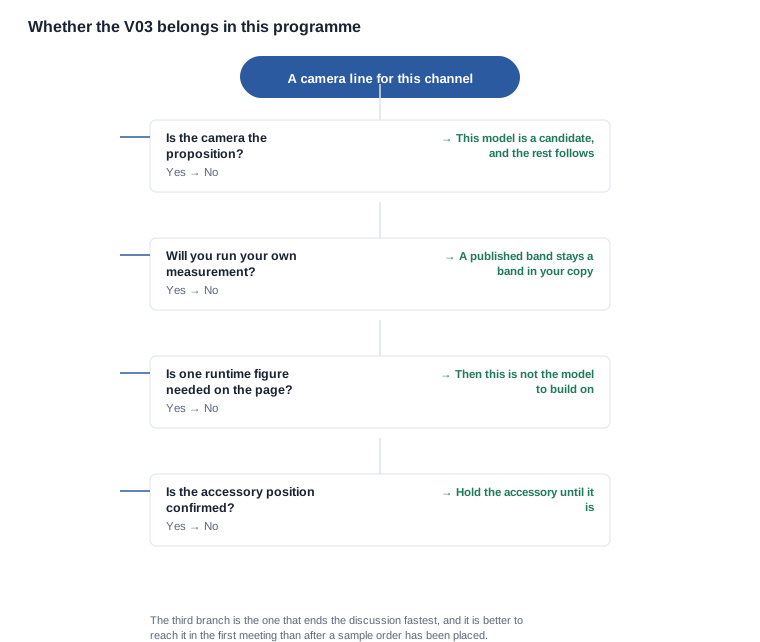
There are four programmes this model does not suit, and each of them fails for a different reason, which is why the failures are not interchangeable and a buyer should identify the one that applies to them.
A channel that needs a single runtime number on the product page. This model publishes a band, and the band has to be explained wherever it appears. A channel whose buying decision is made on one figure per product has a structural problem with it, and the problem is in the format rather than in the product.
A channel that cannot carry an unresolved accessory position. The absence of a case line is a legitimate opening, but it only works if somebody is going to close it. A channel that launches on the assumption that the accessory question will resolve itself will either ship without the answer or discover it at the point of a customer complaint.
A channel whose proposition needs a named function. Nothing is published as a function for this model, so there is nothing to select it for. A channel building a range around capabilities, rather than around a camera class, has to look elsewhere, and that is a legitimate reason to pass on a model.
A channel that needs a published radio generation in its specification. Nothing is printed for it, so a written specification that needs to name the radio cannot take that name from our pages. Where a radio is fitted, the generation has to be established in writing and quoted from a document rather than from a catalogue page.
A worked case: a distributor adding a camera line
The scenario is constructed to show the sequence rather than to describe a customer.
A distributor with an established audio range is approached by a brand that wants a camera line added under the distributor's own label, for one market first, with a second market to follow. The distributor's first question is not about the camera. It is whether the line can be described with a single figure per product, because that is the format their retailer's product pages use.
The answer from the published record is that this model does not fit that format, because the endurance is a band rather than a figure. That single point ends the possibility of launching the model the way the retailer's pages work, and it starts a different conversation: what the page will actually say.
The distributor's second step is to ask for the accessory position and the configuration in writing, against the specific designation. The answer establishes what is in the carton and which options are available, and it produces two lines that go onto the order rather than into a description.
The third step is a sample order, sized for the spread the channel intends to claim rather than for the cheapest possible measurement. The measurement runs at the duty cycle the distributor believes its customers will use, and it records whole days rather than hours.
The first tranche produces two findings. One is that the band holds across the sample, which is a usable result and is not a result a channel gets for free. The other is that the carton contents do not match what the initial artwork described, because the artwork was produced before the accessory position was confirmed, and the carton has to be reprinted.
The distributor's decision at the end of the first tranche is not about the model. It is to hold the artwork until the configuration and the accessory position are on the order line, and to treat the measured profile as a document in the file rather than as a number for the page. The model stays in the range, because what the measurement confirmed was that the model works for the proposition, and what it cost was a schedule, which is a cost a programme can absorb and a verdict cannot.
The trade-offs in the ninety days
Choosing this model is not free, and the honest version of the decision names what the channel gives up as well as what it gains.
What the channel gives up. A single runtime figure for the product page, because the endurance is a band. A settled packaging specification, because the accessory position is not published. A function to select the model for, because no feature rows exist. A named radio generation for a specification, because no version row exists. Those are four things other models in the range can offer, and each of them is something a channel will be asked about by a customer, a retailer or a reviewer.
What the channel gains. One charging routine across the range, because the interface groups with the majority. A published cell figure with a label, which is rare enough in this category to be worth putting on a page. A camera class that a channel can print and defend while it works out what to say about everything behind it. And a model that rewards the channels that measure, which is a durable advantage in a category where almost nobody does.
The trade-off in one line. This model moves work from the supplier's description to the channel's own evidence, and it is only a good trade when the channel was going to do that work anyway for something else. A channel that is buying a product to avoid writing specifications should look elsewhere, and a channel that is building a camera line anyway should look here first.

Questions to settle before the first order
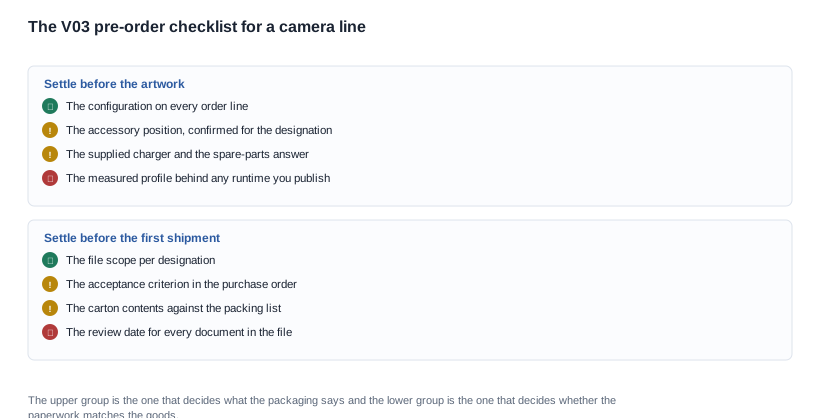
Eight questions, in the order they should be asked, and the first four of them cost nothing but a message.
- What is the configuration for the units we will order, written onto the order line? The lens option, the colour option, the accessory position and any print treatment are items, and a model name is not an item.
- What is actually supplied to charge the unit, and can a spare be obtained? The object and the spare-parts answer together decide whether the interface is a convenience or a dependency.
- Is a charging case part of this designation, and on what date will that be confirmed in writing?
- What is the load the unit runs at, and what condition produced the band?
- How many units will the acceptance sample cover, and what will the criterion be? A criterion written before the test binds; one written afterwards is a discussion.
- What is the file scope for this designation, and which documents are already assembled?
- What will the carton contain, checked against the packing list, and who signs for it?
- What review date will sit against each document in the file?
Each of the eight has an owner and a date, and the first four can be closed inside a week because they cost nothing but a message. The fifth and the sixth need a sample and a supplier reply, the seventh needs a goods-in check, and the eighth is a decision the channel takes for itself. A buyer who asks all eight at once, in a single document, and who marks each one as answered, incomplete or outstanding, has a programme that can be scheduled. A buyer who asks them in sequence has a programme that will be managed by whoever is nearest.
The ninety-day shape of the programme

The sequence in the image is the one that keeps the schedule. The configuration and the accessory position go in writing in the first week, because they decide the artwork. The sample is ordered next, and it is sized for the claim rather than for the cost. The measurement runs at the customer's duty cycle, the criterion is written as whole days, and the artwork waits for the configuration. The last step, reconciling the documentation against the units that actually shipped, is the one that catches the gap that every other step in a camera programme eventually produces.
The position we take on this model, our published rows are what the catalogue prints, and we will not extend them into a suitability verdict that the record cannot carry, because suitability is a property of a programme rather than of a product. What we will do is take the type of channel, the customer it serves and the configuration you intend to ship, mark the published rows against those three, and tell you which of the eight questions above is already answered, which one needs a written reply, and which one needs a unit on a desk.
The sample work behind the criteria used here is itemised in the review list for this model.


