
A sample review is only worth the half day it costs if it produces a criterion, and the two halves of this checklist are arranged to make that likely. The first half is a list of observations that anyone can make with the box open. The second half is a list of measurements that need a stated starting condition and a written result. And the last stage turns both into a document that a purchase order can enforce, which is the only reason to run the review at all.
The order matters more than usual on this model, for one reason. Four figures are published for this model, and past those four the record falls silent: the accessory position, the radio and any function are all unstated. A review that starts by powering the unit and working backwards produces impressions, because every question it raises about the hardware is a question the record cannot answer and the reviewer has to improvise. A review that starts with identity, configuration and carton contents produces a set of facts, and the facts then narrow what the powered-on stage has to establish.
None of the items below is a test method in the laboratory sense, and none of them describes how the product performs in use. They are the observations a buyer can make on a sample, in the order that makes each one meaningful.
V03 smart glasses buyer review checklist: what a sample settles
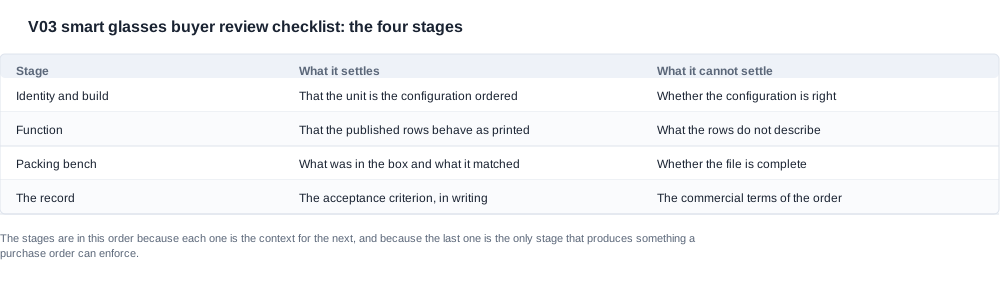
The four stages, and what each one is for
Identity and build establishes that the unit in front of the reviewer is the unit that was ordered. It sounds obvious and it is the stage most often skipped, because the unit looks like the sample in the photograph. The items are the designation, the configuration, the build, the print and the contacts, and every one of them is cheap to look at.
Function establishes that the published rows behave as printed, one row at a time, with a stated starting condition. For this model the rows that matter are the camera class, the recording behaviour, the charge interval and the radio where one is fitted. The endurance band is measured here too, and it is measured at a duty cycle rather than quoted.
The packing bench establishes what was in the box and whether it matched what the paperwork said. For a model whose page prints no charging-case line, this stage is the one that turns the accessory question into a fact, and it is also the stage where a private-label programme discovers whether the artwork describes the goods.
The record turns the first three into a criterion. Without it, a review is a set of notes that the next reviewer will redo differently, and the programme has paid for a sample without buying an acceptance standard.
What a sample cannot settle, and where that leaves the buyer
Three things, and they are the same three for every model in this range, which is why they are worth naming once rather than three times.
A market entry position. A sample is a unit; a market position is a determination made against the finished product for a named market. No quantity of samples produces one.
A commercial term. Prices, order quantities, lead times and warranty periods are in a quotation, not in a box, and a review that starts asking about them has turned into a negotiation.
A comparison with another model. A sample of one model says nothing about a model it was never compared with. A buyer who wants to know how this model compares with a neighbour has to buy a neighbour, and the comparison then has two samples, two records and two sets of conditions to align.
How to brief the person doing the review
A checklist handed over without a brief produces impressions, and impressions are not records. The brief has three parts and it takes a page.
The reference. What the unit is, which configuration was approved, which artwork is the approved version, and which document the reviewer should be checking against. The reviewer compares rather than judges.
The states. Which of the observations matter to the channel and which are simply good practice. A reviewer told that the starting state of the cell matters will record it; a reviewer not told will record the charge time alone and the measurement will be unusable.
The output. The form the record takes, where it is filed, and by when it is needed. A review that lands after the shipment has been booked cannot stop it.
There is a fourth item worth adding, and it is the one that saves the most time: tell the reviewer what the review is not for. If the file is being assembled separately, say so, and the reviewer will not spend the morning trying to reconstruct a conformity position out of a packing list.
Before the unit is powered on

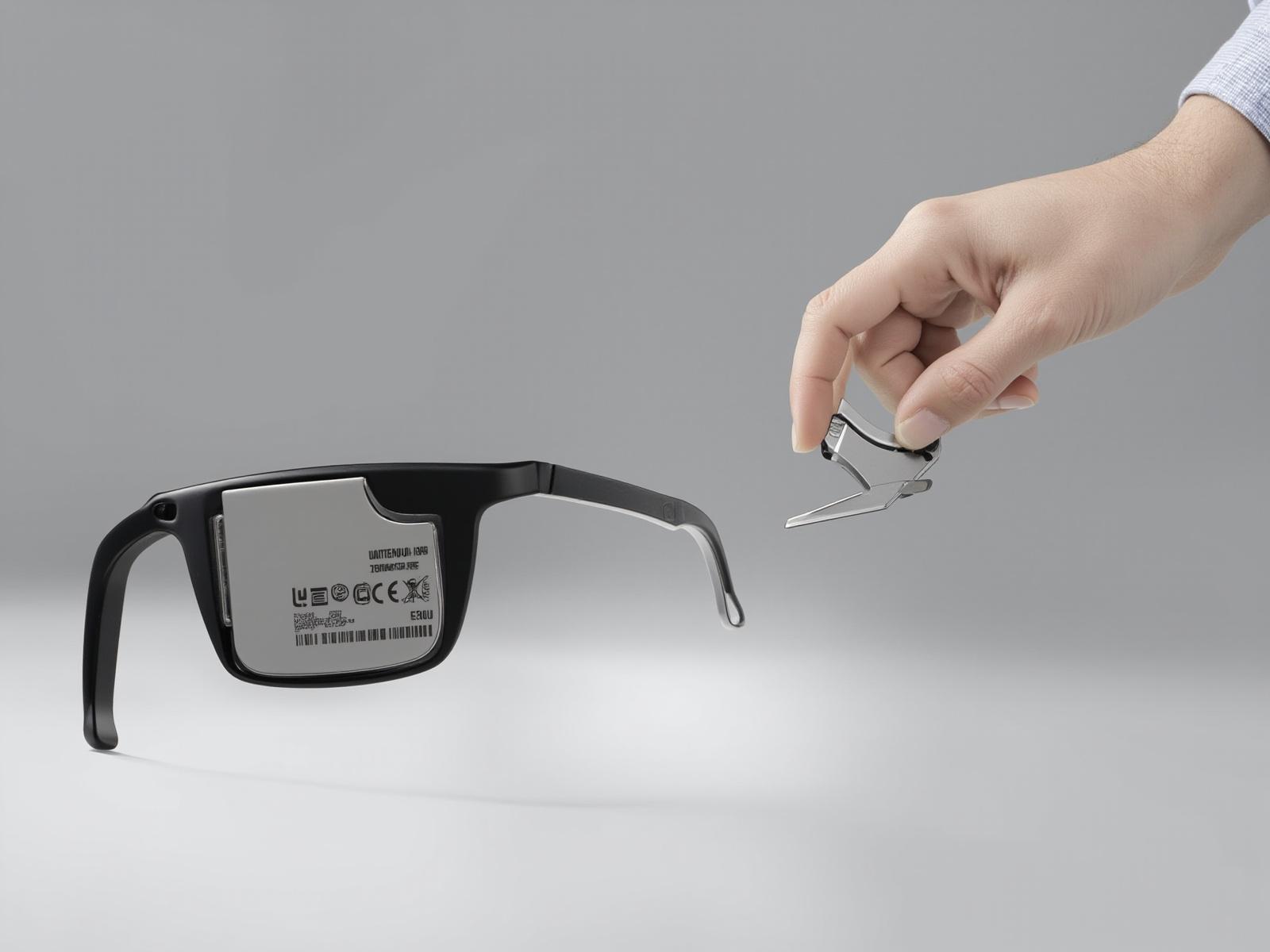
The order in the image is deliberate. The carton is opened and recorded before anything is powered on, because the contents are the only evidence of the accessory position, and once the unit is running the box tends to get tidied away.
Identity
The designation on the unit has to be checked against the order, character for character rather than in substance. Two models in this family differ by a small step in the name, and a reviewer working from a photograph or from memory will not see the difference.
The configuration has to be checked against the approved sample or the approved artwork, whichever is the reference. On this model the configuration is not carried in the product name, which means the check has to be made against a written line somewhere, and if there is no written line then the configuration has not been approved and the review cannot find it.
The printed marking and the finish have to be the approved version rather than the standard one, and for a channel doing private label work this is the item that most often fails. The shell finish, the printed graphics and the colour all have to match, and a unit that is correct in every other respect is still a unit that has to be reworked if the artwork is wrong.
The build
The hinge is opened and closed through its travel, looking for play that was not there at the factory. A camera product is handled constantly, and a hinge that is loose on arrival will be loose in the customer's hand.
The temples and the bridge are checked for alignment, because a frame that is out of true will not sit properly and will not be worn. Where a model publishes a feature line about a flexible temple, the reviewer should be looking at whether that flexibility behaves as the line implies rather than merely whether it moves.
The lens is inspected for chips, for coating marks and for any print on the visible surface, and the review note should say which side and where, because a lens marking found at goods-in and a lens marking found at a customer's desk are two different conversations.
The charging contacts are looked at. A contact that has picked up a fibre in transit does not seat properly, and a unit that does not seat does not charge, and a unit that does not charge becomes a battery complaint rather than a charging complaint.
The carton
Every item is counted against the packing list, including the ones that are not obviously products. The count is what turns the accessory position from an absence into a fact, and the fact is what the packing specification and the label can then be written from.
Anything present that was not ordered is recorded as well. An extra item in the box is usually a substitution that nobody has written down, and a substitution discovered at goods-in is cheap to fix and expensive to discover later.

With the unit running
The camera class
The published row gives the resolution class and nothing behind it. The review can establish that a unit captures at the level that class describes, and it can establish that the captures are the ones the channel intends to ship. What it cannot establish, and should not try to, is anything about the sensor, what the lens takes in, how quickly it captures, what it can hold or the form it takes, because none of those is published and a reviewer's impression of image quality is a preference rather than a result.
Recording and storage
Recording is a function rather than a number, so it is checked as a function: does it start, does it stop, does what was recorded appear where the unit says it did, and does a long recording behave the same as a short one. A channel that intends the product to record unattended needs to know the answer, and the catalogue does not carry it.
The charge interval
This is the measurement that most often produces a number nobody can use, and the reason is always the same: the starting state was not written down. The reviewer records the state of the cell when the unit goes onto the charger, the elapsed time, and the state at the end. Two reviewers who start from different states have made two different measurements, and only one of them is a measurement.
The published charge time for this model is a ceiling rather than a duration, so what the reviewer produces is an observation of one interval, not a confirmation of the published bound. The two have to be kept apart in the record, and the record should say which is which.
The radio, where one is fitted
If a radio is present in the unit, the pairing behaviour has to be checked, along with what the unit reports about itself when it connects, because no version row is published for this model and the generation has to come from a document rather than from a page. What the review can produce is the observed behaviour and the naming strings, which the person responsible for the specification can then use.
The endurance sample
A single unit measured for a day produces an anecdote. The review of a sample that is meant to support a claim needs the units drawn from the batch being ordered, the duty cycle recorded, the start and end of use logged for each day, and the number of days on which the unit completed its work. The number a channel can publish is the number of complete days at a stated setting, and the worst day in the sample governs rather than the average.
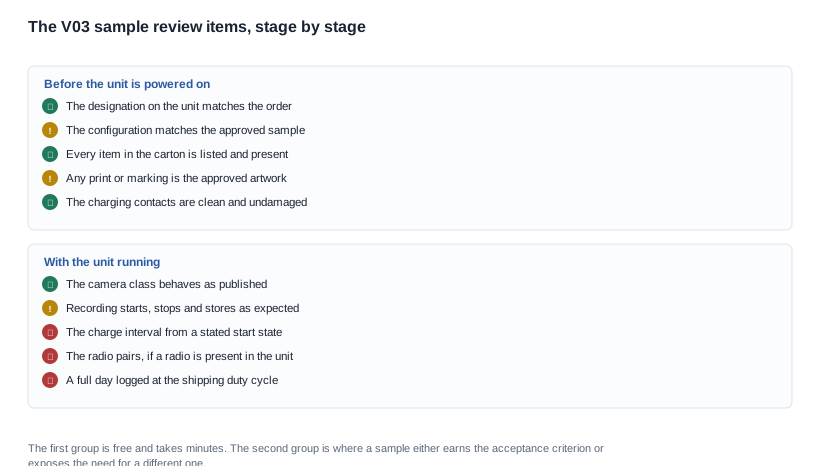
The five running checks, in order
- The camera class. Confirm that the unit captures at the level the published class describes, and record the configuration and the setting the captures were taken in. Nothing beyond the class is under test, because nothing beyond the class is published.
- Recording and storage. Start it, stop it, and confirm that what was recorded is where the unit says it is. Then run it long enough to see whether the behaviour holds, because a product that records well for a minute and badly for an hour is a different product from one that records consistently.
- The charge interval. Record the state of the cell before the unit goes onto the charger, the elapsed time, and the state at the end. This is an observation of one interval, and it is not a confirmation of the published ceiling, which is a bound rather than a duration.
- The radio, where one is fitted. Pair it, reconnect it, and record the naming strings the unit reports. No version is published for this model, so the behaviour and the strings are what the specification can be written from.
- The endurance sample. Log the start and the end of use for each day of a working week, at the duty cycle the channel will ship, and count the days the unit completed its work. The count of complete days is the only figure from this stage that a support policy and a listing can both use.
The order is not arbitrary. The first two checks are quick and they establish whether the unit is functioning at all, which is what makes the fourth and the fifth worth running. Running the endurance log before the unit has been shown to record properly produces a week of data about a unit that was not working, and a week of data is expensive enough that it should not be spent on a fault.

At the packing bench, and the record it produces
The last stage is the one that matters commercially
A review produces observations, and observations do not change what a supplier has to do. What changes it is a criterion, and a criterion has to be written down, attached to the order, and expressed in a way that a lot can be accepted or rejected against.
Six entries, and the format matters more than the length.
- The identity of the units, by designation and by configuration, so that the record describes specific things rather than a shipment in general.
- The observations, stated as observations, with the condition attached wherever a condition was used.
- The measurements, with their units and their starting states, so that somebody else could repeat them.
- The carton contents, against the packing list, with the accessory position recorded as a fact rather than as an absence.
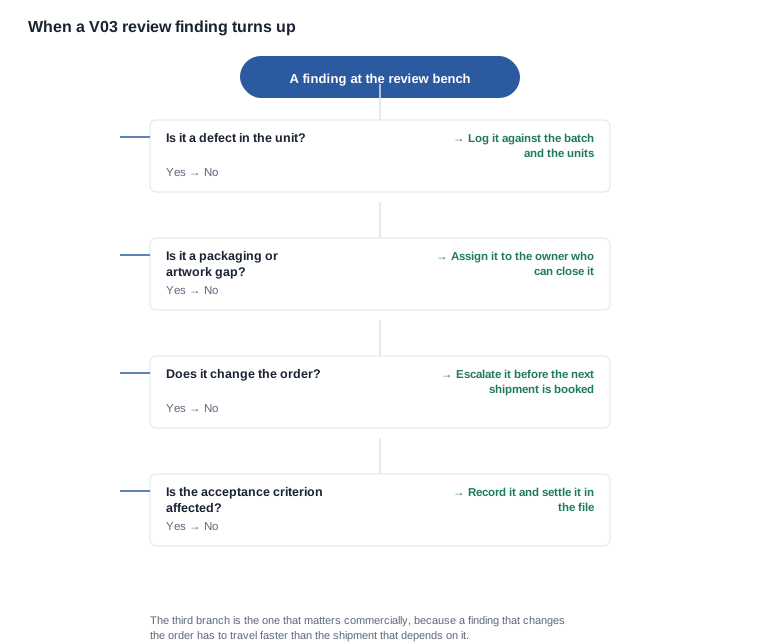
- The findings, each one classified by the routing rule.
- The criterion, as a number that a lot can be accepted or rejected against.
The sixth entry is the one that justifies the other five. A record without a criterion is a set of notes, and a set of notes does not stop a consignment.
Routing a finding
The decision chart in the image is the rule for what happens when something is found, and the fourth branch is the one that closes the loop. A finding that affects the acceptance criterion has to change the criterion or be dismissed explicitly, because a criterion that a finding has already contradicted is not a criterion, it is a memory.
The first branch is the one that protects the channel's data. A defect in the unit is evidence about the batch, and it only stays evidence if it is logged against the batch and the units it came from rather than against the sample in front of the reviewer.
The criterion in one paragraph
For this model, a workable criterion reads something like: units drawn from the ordered batch, checked against the approved configuration, with the camera class behaving as published, the charge interval completing from a stated start state, the carton contents matching the packing list, and the unit completing a stated number of working days at the stated duty cycle. The number of units, the start state and the duty cycle are the buyer's to set, and setting them before the test is what makes the result binding.
Two traps sit inside that paragraph, and both of them are ordinary enough to be worth naming. The first is the unit count: a criterion written against one unit is a statement about that unit, and a buyer who wants a criterion that can reject a lot has to have sampled enough units for the spread to mean something. The second is the duty cycle: a criterion written against a setting the channel does not intend to ship is a criterion that will be met in the laboratory and missed in the field, and it will be missed by exactly the customers who bought the product expecting the behaviour that was measured.
What the review is worth, in commercial terms
A sample costs money twice, once for the units and once for the time of the people who review them, and both costs are recoverable if the review ends in a criterion. The criterion is what lets a channel accept a lot without re-opening the specification, and it is what lets a buyer refuse a lot without starting an argument about the specification.
It is also what turns a returns figure into something actionable. A channel that has no criterion has nothing to compare a return against, so a rising return count is a feeling rather than a finding. A channel with a criterion knows whether the units it received matched the units it approved, and a pattern in the returns can then be read against the record instead of discussed against a feeling.
The commercial value of the review is therefore not in what it finds. It is in the fact that a lot can later be accepted or rejected without anybody having to remember what a sample looked like.
Our position on the review
We publish the rows the catalogue prints for this model, and a review of it can establish that those rows behave as printed. It cannot establish a market entry position, it cannot establish a commercial term, and it cannot establish a comparison with a model that was not sampled, and we will not supply any of those from a product page.
What we will do is tell a buyer which of the observations in this checklist are already answered by the published rows, which need a supplier document, and which need the units on the desk, and in what order to work through them so that the specimen is not opened before the box has been counted.
Give us the configuration you intend to ship, the destinations in the order you have them, and the number of units your sample budget covers, and we will mark the checklist against those three and tell you which stage of it is the critical path for your programme.
The questions a camera buyer's team is actually asked are collected in the question intake for this model.


